
Pack It Right: Sight Word Put in 4 Brilliant Directions
Continue the packing map lesson with sheet 21 and the other first grade words in the $4 collection.
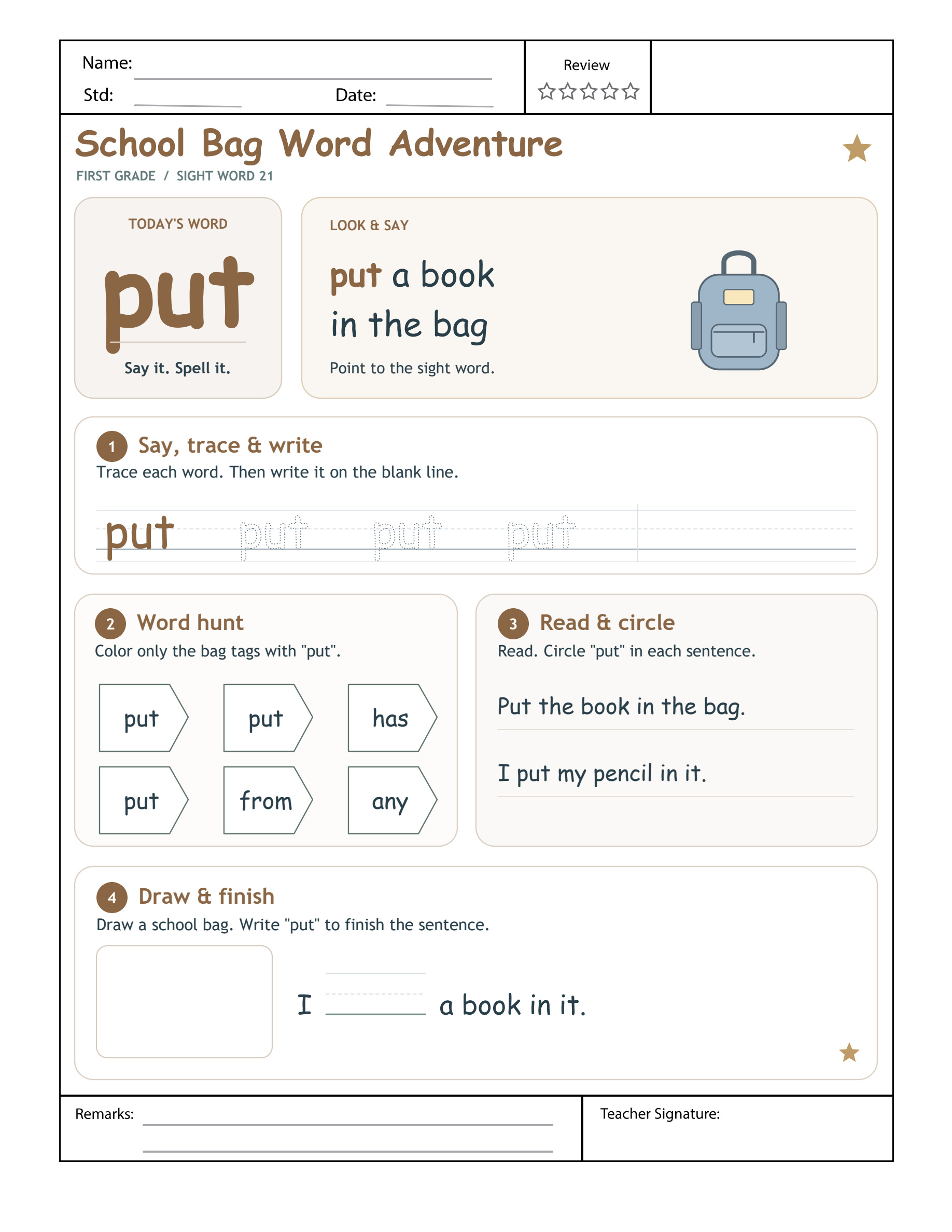
See the opening model and all four put exercises inside the original frame.
The full 21 preview shows the illustration, handwriting guides, coloring hunt, sentence panel and finish line.
Packing map
Send a book to the correct pocket
Jo picks up a library book, hears “put it away,” and spots an open bag and an empty shelf. Which place did the speaker mean? Bring out Sight Word Put after settling that question. Set the picture beside the words and let the listener check the speaker’s message. In the packing map, choose one short spoken exchange before the first pencil turn. Give the child a way to point, move a paper model, or read a caption back to a partner before asking for an explanation.
Look closely at the packing map picture
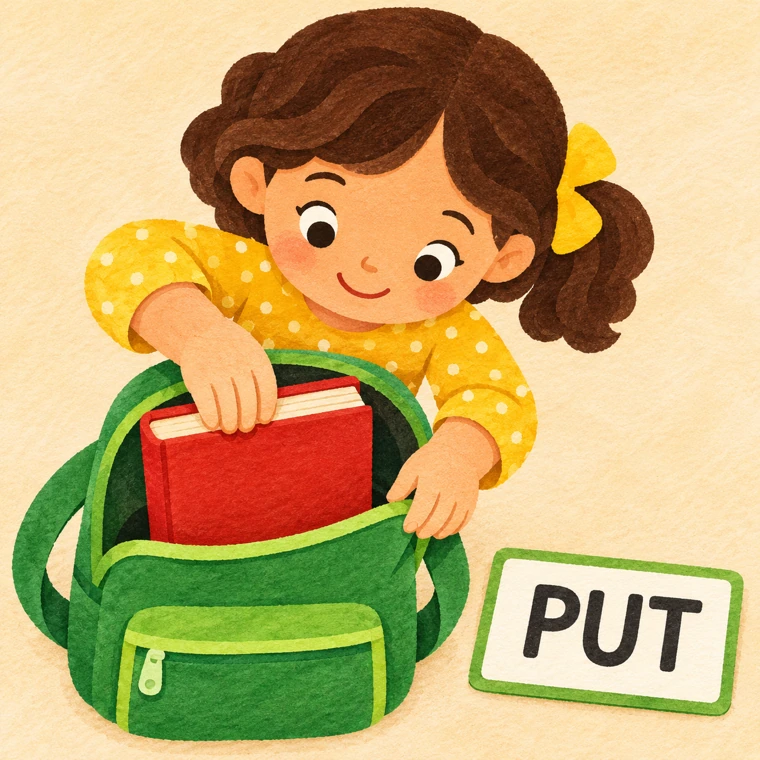
The middle letter in put spells the vowel in foot for many speakers. Compare put and cut aloud and hold u in view while the two vowel sounds change. Keep the last t clear when saying the word slowly. The three exact tags stay in the same p-u-t order even if a child reads the rows from bottom to top.
The packing desk gives four directions · Sight Word Put
- Book in the main pocket
Set a book by a bag. The child asks for the exact destination and moves the book only after hearing the entire line.
- Pencil on a shelf
Swap the object and keep the location phrase visible until a partner has placed the pencil. Explain why on works for the shelf.
- Map under a folder
Read the message without pointing. The helper shows the result and explains which printed words gave the place away.
- One move, two voices
Ask one child to give a direction and another to report it afterward. See whether both can use put.
Leave the place out of a note and make a listener repair it with one phrase. Then leave the object out instead.
A handwriting sample worth keeping · put
In the tracing turn, hear the vowel in foot as a clue. Compare cut and put only after the learner can read the full packing direction.
Find the heavy print of put at the start of the guide. Read it once before putting a pencil down. Use a card under the guide if the other examples draw the eye away from the first copy. Let the learner give one copy all of their attention. Then ask what they would like a later reader to see more easily.
On a fresh slip, ask for one independent put. Compare the direction, height and spacing of that attempt against the model. Bring the slip to a new reader afterward, since a good check is whether someone can read it without help from the writer.

Which part of the instruction is missing?
| Try it | Read or do |
|---|---|
| Book in the main pocket | Set a book by a bag. |
| Pencil on a shelf | Swap the object and keep the location phrase visible until a partner has placed the pencil. |
| Map under a folder | Read the message without pointing. |
| One move, two voices | Ask one child to give a direction and another to report it afterward. |
Set a tote under a table and a folder on top. Give an adult a reading turn naming where one trip item must go. The learner marks the placement with a picture, then reads the whole instruction to check where they moved it. The same exchange can become a very short report about an earlier packing job by changing who is talking. Keep the two papers apart until a partner says which one tells what already happened.
Give the next reader a fresh problem · packing map
Make a short packing list for a visit to the school library. Let a child put one item into a folder and another by a tote. Have a second reader check the final arrangement with two spoken directions. Try putting the same object in two different places across two turns, and let a helper point to the phrase that changes. Finish by asking whether the original sentence speaks to the listener or describes something the speaker did.
Two more turns from the packing map
Make a short packing list for a visit to the school library. Let a child put one item into a folder and another by a tote. Have a second reader check the final arrangement with two spoken directions. Try putting the same object in two different places across two turns, and let a helper point to the phrase that changes. Finish by asking whether the original sentence speaks to the listener or describes something the speaker did.
Pack for an imaginary class trip
Deliver three instructions without pointing
Sketch a cupboard with an upper shelf, a lower shelf and a drawer. Give a child a card for the item and a separate card that names its place. The learner can combine the two cards into a complete instruction with put. When a partner puts the book into the drawer instead of on a shelf, compare the sentences and ask which location phrase would change the result.
Take the board away and leave the cards on the table. Read one direction back to the child and ask them to draw the result from the words. The next time the board is out, let them compare their drawing with the actual placement before making another copy of the word.
A print check before the crayon comes out · put
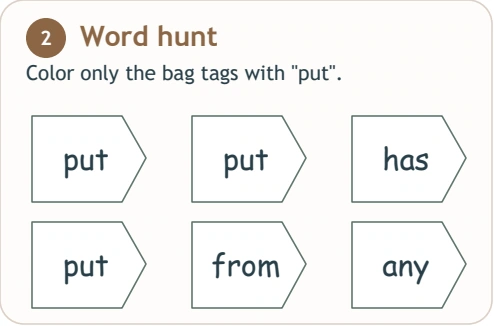
The printable offers these six choices: put, put, has, put, from, any. Have the reader read a candidate under their breath and then compare it with the big spelling. Keep a finger on the spot until the reader can explain the decision. The choices has and any give the group two things to check before committing to a color.
Wait for three matches. If a child colors any good-looking shape without reading the word, give them a separate page for decoration and use a pointing turn here. Ask a new reader to verify one of the chosen put labels afterward. The crayon should leave the word readable.
Pair the printed lines with a listener’s job · put
Put the book in the bag.
I put my pencil in it.
Put tells someone to place an item or reports that they already placed it. Put the book in the bag is a direction. I put my pencil in it can be a report, and it points back to the bag in this imagined scene. Ask a partner to add a position, such as under the chair, and move the same book somewhere else. A reader who knows put still needs the location to carry out the instruction.
Start by having a listener tell which line would help them act out part of the scene. A partner reads the other line and asks a different question about the message. When the words are clear, find the target and circle it. Give the reader one more turn to say the full line with put included.
Take the packing map to a home or classroom table
At home. Set out a bag, a book and a paper pencil. Let a child invent a direction about packing the pencil, then check it on a partner who can see both objects. A second direction can ask where to put the book, which gives the same word a different job in the conversation.
With classmates. Give partners two picture cards with possible destinations. An announcer reads a line from the sheet and the other partner moves the corresponding prop. A third learner records the word that prompted the move. Swap the destinations afterward and use a self-written direction.
For a second visit, give a helper a direction with the location left out. See whether they can tell exactly where the book belongs. Let the child restore a place phrase and watch what changes in the placement. Ask which part of the instruction stayed the same after the fix.
Use the last line as a message to a new reader · put
Draw a school bag. Write "put" to finish the sentence. The printed frame is I ___ a book in it.. Give the illustrator a moment to pick one essential part of the picture. Have a partner say the finished line from start to finish before the child adds the missing spelling in pencil.
Bring the picture to a new reader and give them time to read the line unaided. Ask which marks in the packing map scene support the sentence and which information is supplied by put. Let the illustrator clarify the caption by reading it aloud.
What to listen for during put practice
- Read the whole word. Ask the reader to distinguish put from one nearby label without relying on the outline of its picture.
- Check a sound. Listen to put in the spoken example. Pick one part to read slowly, then practice saying it with the other words at ordinary speed.
- Guide a movement. Help the child steady the worksheet, make a careful copy of put, and look for a specific shape they can identify again later.
- Explain the message. Let a partner explain why the packing map scene makes sense after hearing one printed line. Give the first reader a chance to adjust their interpretation.
- Give the reader a choice. Invite them to return tomorrow with an object, sketch, or message of their own that uses put.
Suggested for first graders around six or seven. A child who can already use put in conversation may want to read a sentence before tracing. Another child may want to point at the packing map picture or try the word with an adult first. End a short visit after one clear read or copy. Let the learner choose what they want to show a family member or classroom partner the next time they see the page.
Print the original sheet 21 for another reading
Download the free worksheet for put. Eligible members can get the clean PDF without site markings. In the printer dialog, check portrait US Letter and look at one copy for the readability of the pale guides.
The $4 collection has this page at position 1 in the combined file. Look for the matching printed number to select a single page for a later visit.
Choose another reading turn if time permits, or listen to the short vowels. To compare a different sound or spelling, blend the short vowel in AT words or read and match the word eat.
Teachers and families can browse the UF Literacy Institute’s word activities and the Reading Rockets guide for frequently used words.
Related Topics
Popular Worksheets
Printable resources families and teachers are downloading now.
 Free
 Free
 Free
 Free