
Supply Desk: Sight Word Take in 4 Clever Choices
Continue the supply menu lesson with sheet 22 and the other first grade words in the $4 collection.
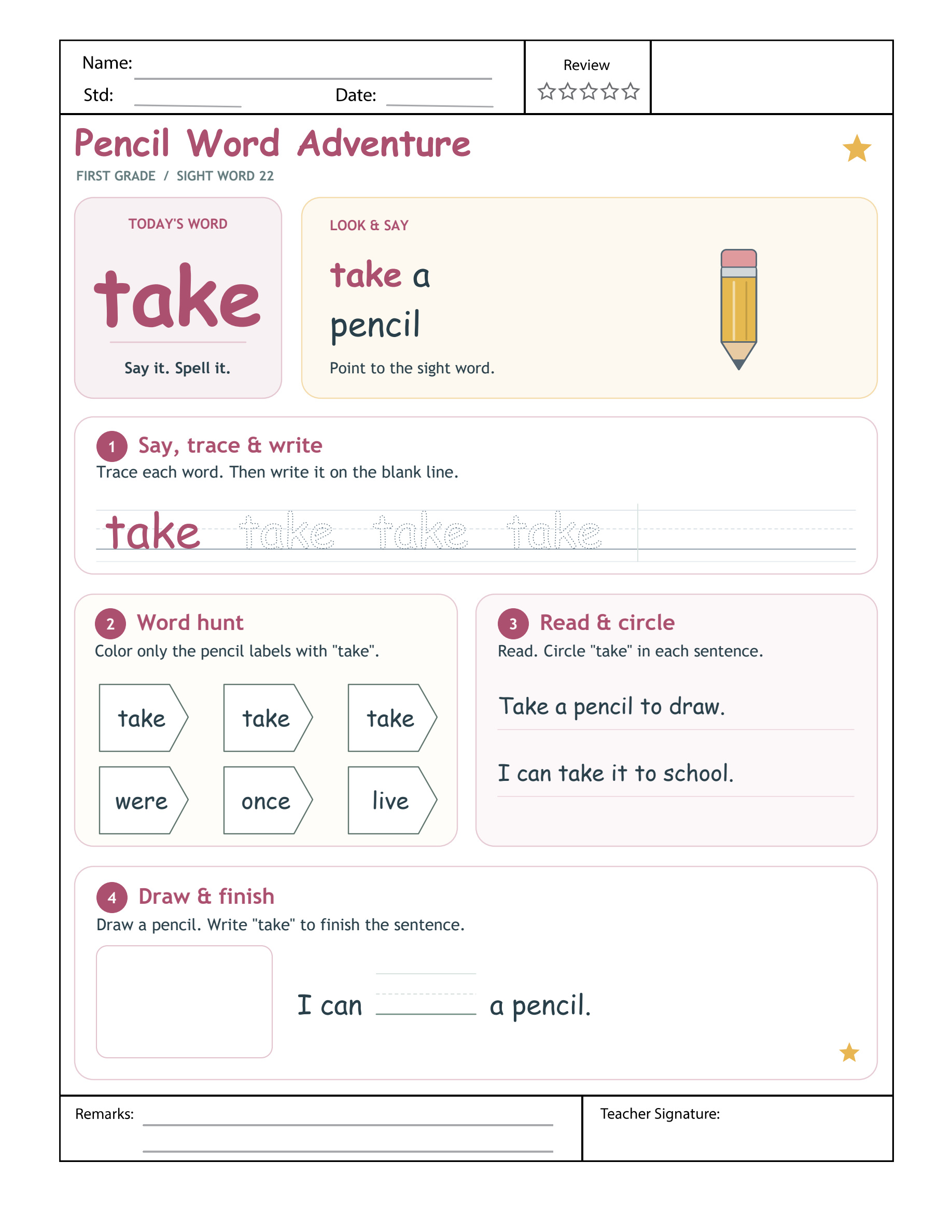
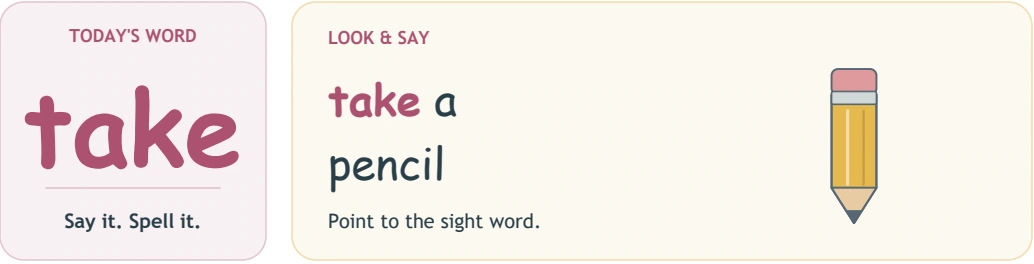
See the opening model and all four take exercises inside the original frame.
The full 22 preview shows the illustration, handwriting guides, coloring hunt, sentence panel and finish line.
Supply menu
A pencil can leave the supply desk for two reasons
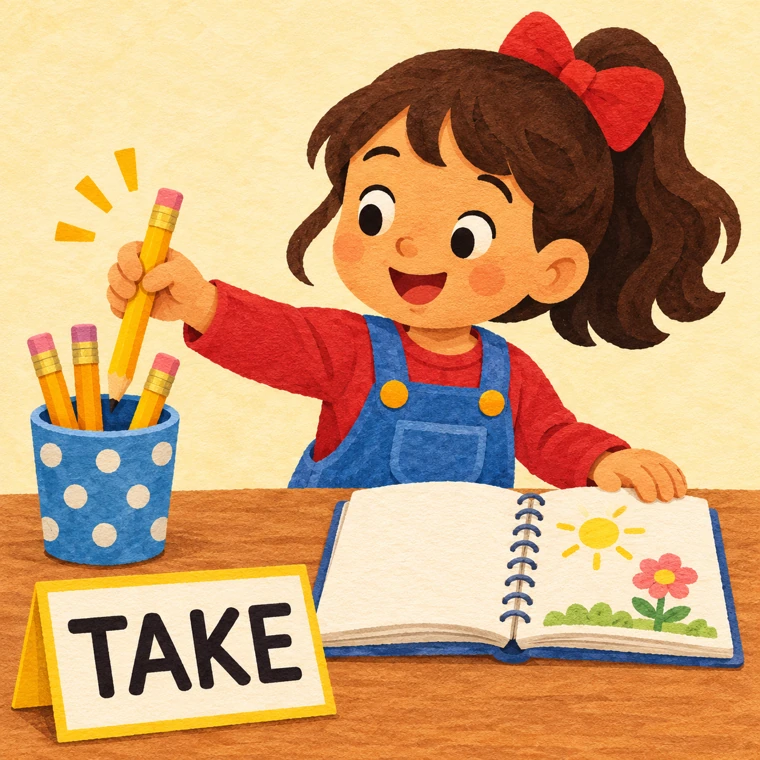
The art shelf holds two blue pencils. One can stay beside the drawing pad. The other needs to reach the table across the room. Selma offers to write the two orders. Start Sight Word Take with the scene still in view. A child can decide what the speaker is saying, then check how that message appears in print. The supply menu gives the reader a reason to say take and an audience to listen. Keep the exercise sheet nearby for a word comparison or a fresh writing turn.
Borrow, carry, ready to draw · Sight Word Take
- Collect a tool
A reader picks up a paper pencil for themselves. Have them explain the purpose of taking it before they start to draw.
- Carry the pencil
Point out a starting desk and a destination. Let the learner read a new note and move a token between the two places.
- Ask before borrowing
Pretend the pencil belongs to a neighbor. Give the reader a chance to ask for it and hear permission first.
- Send someone else
A helper takes the pencil to a named desk. Gather reports on what the helper took and where it went.
Make one instruction with no destination and one that names a desk. Decide which could be followed by a runner who missed the start of the game.
Look closely at the supply menu picture
Check the a and final e together in take. The written e stays even though there is no separate sound for it in this word. Compare tack and take orally before looking at which letters differ. The first row of the six-choice search happens to hold all three matches. Give the learner time to verify the printed words without assuming that each row has to contain a correct answer.
Check the pencil order before filling it
| Try it | Read or do |
|---|---|
| Collect a tool | A reader picks up a paper pencil for themselves. |
| Carry the pencil | Point out a starting desk and a destination. |
| Ask before borrowing | Pretend the pencil belongs to a neighbor. |
| Send someone else | A helper takes the pencil to a named desk. |
Give two partners an identical drawing tool each. One needs to take theirs to an art desk; the other needs to take theirs to the register. Have a messenger report each move without touching the pencil. Switch the destination signs and see who notices that the message has to change. The child can make a tiny route sketch and tell someone else where the pencil began and where it ended.
Pair the printed lines with a listener’s job · take
Take a pencil to draw.
I can take it to school.
Take is used when someone gets an item or carries it somewhere. In the first printed line, a pencil is picked up for drawing. In the second, someone can carry it to school. Make the starting place and destination visible, then ask who is taking which object. Compare a direction to take the pencil with a direction to leave it in the cup.
Start by having a listener tell which line would help them act out part of the scene. A partner reads the other line and asks a different question about the message. When the words are clear, find the target and circle it. Give the reader one more turn to say the full line with take included.
A print check before the crayon comes out · take
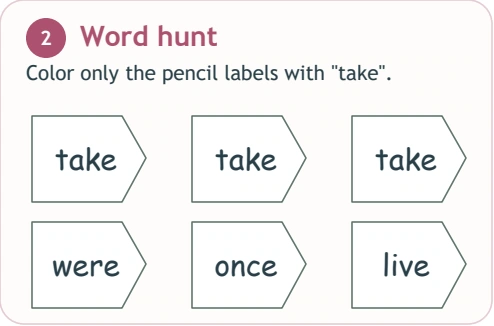
The printable offers these six choices: take, take, take, were, once, live. Have the reader read a candidate under their breath and then compare it with the big spelling. Keep a finger on the spot until the reader can explain the decision. The choices were and live give the group two things to check before committing to a color.
Wait for three matches. If a child colors any good-looking shape without reading the word, give them a separate page for decoration and use a pointing turn here. Ask a new reader to verify one of the chosen take labels afterward. The crayon should leave the word readable.
Two more turns from the supply menu
Set three tools in front of a learner before giving a direction to take one for a particular purpose. Cover the picture of the tool once the words are spoken. The listener can repeat the direction and point to where the item needs to go. If the answer depends on guessing which pencil a speaker meant, label the options by color. Read a new permission sentence with take after the material is on the right desk.
Prepare a pencil for two different destinations
Write a request slip for the pencil desk
Give the supply clerk pencils of two colors. A customer needs one color for a drawing they can describe but cannot yet show. The clerk reads a permit containing take, listens to the purpose, and sets the tool aside. Change the activity from drawing to putting a name on a folder so a child can give a second plausible reason to take a pencil.
Think about the order in which a customer needs the information. Compare a request to take a pencil with permission to take the pencil to another room. A child should know which action finishes at the desk and which includes a second place. The reader can sketch the difference as two short paths.
A handwriting sample worth keeping · take
Keep the vowel letters a and e in view together. Let a child say long a even when the final e adds no separate sound.
Find the heavy print of take at the start of the guide. Read it once before putting a pencil down. Use a card under the guide if the other examples draw the eye away from the first copy. Let the learner give one copy all of their attention. Then ask what they would like a later reader to see more easily.
On a fresh slip, ask for one independent take. Compare the direction, height and spacing of that attempt against the model. Bring the slip to a new reader afterward, since a good check is whether someone can read it without help from the writer.
Use the last line as a message to a new reader · take
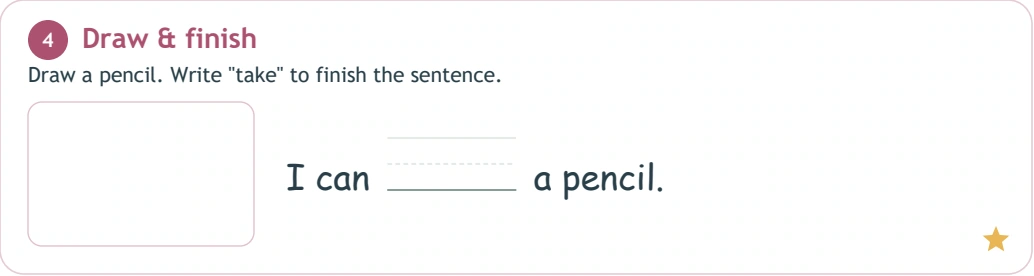
Draw a pencil. Write "take" to finish the sentence. The printed frame is I can ___ a pencil.. Give the illustrator a moment to pick one essential part of the picture. Have a partner say the finished line from start to finish before the child adds the missing spelling in pencil.
Bring the picture to a new reader and give them time to read the line unaided. Ask which marks in the supply menu scene support the sentence and which information is supplied by take. Let the illustrator clarify the caption by reading it aloud.
Take the supply menu to a home or classroom table
At home. Put a pencil cup next to a book. Tell the learner which item they can take to a writing spot. Let them reverse the roles and give a new direction that says where to carry one thing.
With classmates. Use a classroom model with a supply station and a drawing station. A reader passes a direction to a helper, who collects the correct item and moves it to the destination. Have a listener retell who took what before starting the tracing.
Compare that game with a quiet work table where the pencil never moves. Ask the learner which written direction would be out of place there. Then reread the sentence about taking it to school and ask what the pronoun stands for in the story you set up together.
What to listen for during take practice
- Read the whole word. Ask the reader to distinguish take from one nearby label without relying on the outline of its picture.
- Check a sound. Listen to take in the spoken example. Pick one part to read slowly, then practice saying it with the other words at ordinary speed.
- Guide a movement. Help the child steady the worksheet, make a careful copy of take, and look for a specific shape they can identify again later.
- Explain the message. Let a partner explain why the supply menu scene makes sense after hearing one printed line. Give the first reader a chance to adjust their interpretation.
- Give the reader a choice. Invite them to return tomorrow with an object, sketch, or message of their own that uses take.
Suggested for first graders around six or seven. A child who can already use take in conversation may want to read a sentence before tracing. Another child may want to point at the supply menu picture or try the word with an adult first. End a short visit after one clear read or copy. Let the learner choose what they want to show a family member or classroom partner the next time they see the page.
Print the original sheet 22 for another reading
Download the free worksheet for take. Eligible members can get the clean PDF without site markings. In the printer dialog, check portrait US Letter and look at one copy for the readability of the pale guides.
The $4 collection has this page at position 2 in the combined file. Look for the matching printed number to select a single page for a later visit.
Choose another reading turn if time permits, or try a family of words with AP. To compare a different sound or spelling, practice reading leg in a new activity or listen to the short vowels.
Teachers and families can browse the UF Literacy Institute’s word activities and the Reading Rockets guide for frequently used words.
Other details to check on sheet 22
Related Topics
Popular Worksheets
Printable resources families and teachers are downloading now.
 Free
 Free
 Free
 Free