
Frog F Finder: 4 Brilliant Picture-to-Print Missions
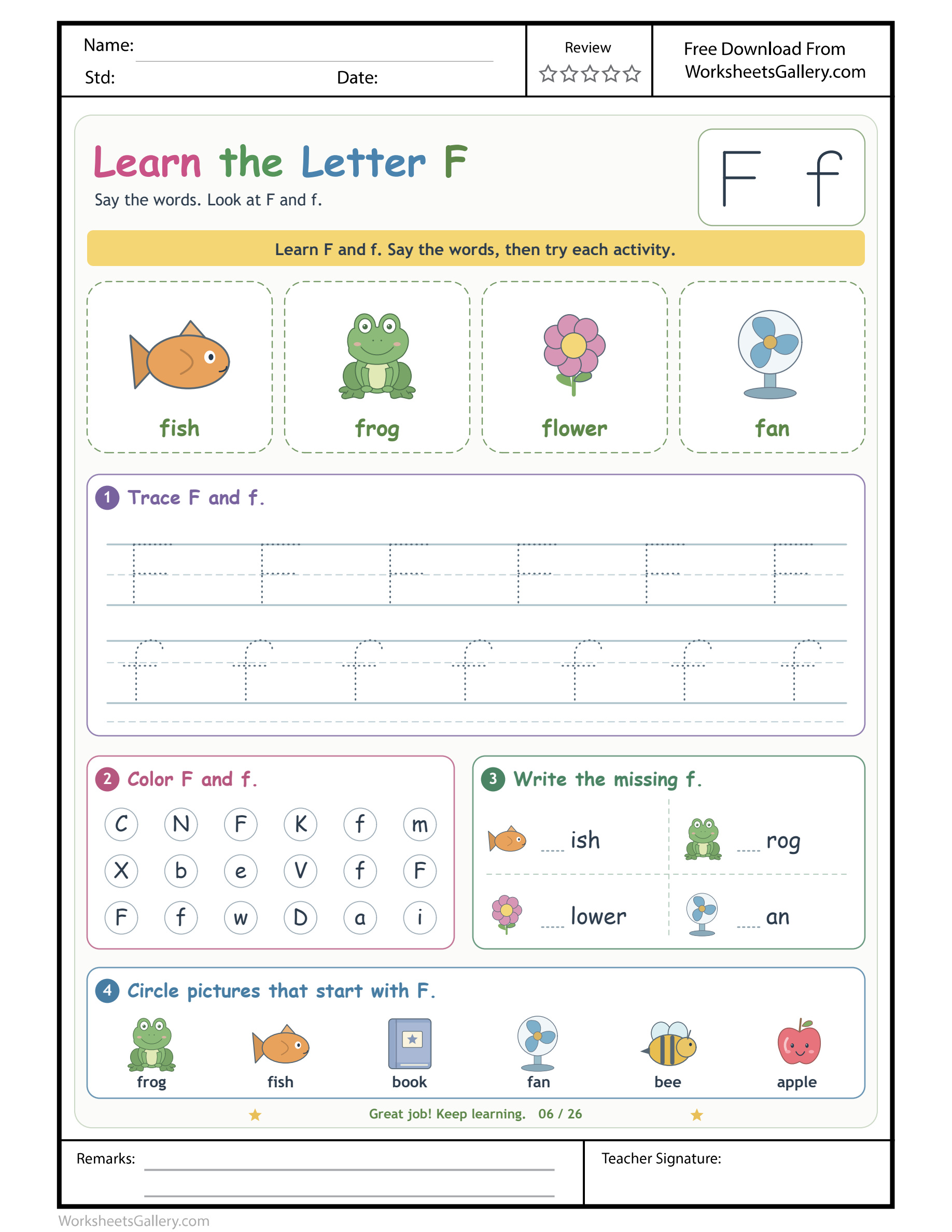
Frog F Finder: Inspect F and f in the letter field before choosing frog, fish and fan from the picture row.
Frogs can jump between lily pads, but a printed f stays in one place long enough for a careful look. Frog F Finder uses fish, frog, flower and fan to connect familiar pictures with two forms of the same letter. Its four numbered activities invite tracing, a case search, missing-letter writing and a final picture decision. Adults can read the labels aloud while children point, compare or make a few marks. The aim is a manageable encounter with Ff, with enough visible references to help a learner explain a choice rather than guess.
Begin beside a frog and a folding fan — Frog F Finder
The four upper Frog F Finder pictures offer different ways into the page. A child might describe a frog's legs, pretend to smell a flower or explain when a fan feels useful. Listen first, then read the printed labels and locate their initial f. The shared written beginning matters more here than knowing a definition for every object.
Say fish and fan naturally, drawing attention to their opening sound without adding an extra syllable. An adult can supply the words frog and flower when the consonant groups feel harder. Recognising the initial letter is a smaller task than independently reading an entire label, and the page does not require those achievements to arrive together.
Farah's pretend pond at home: Frog F Finder
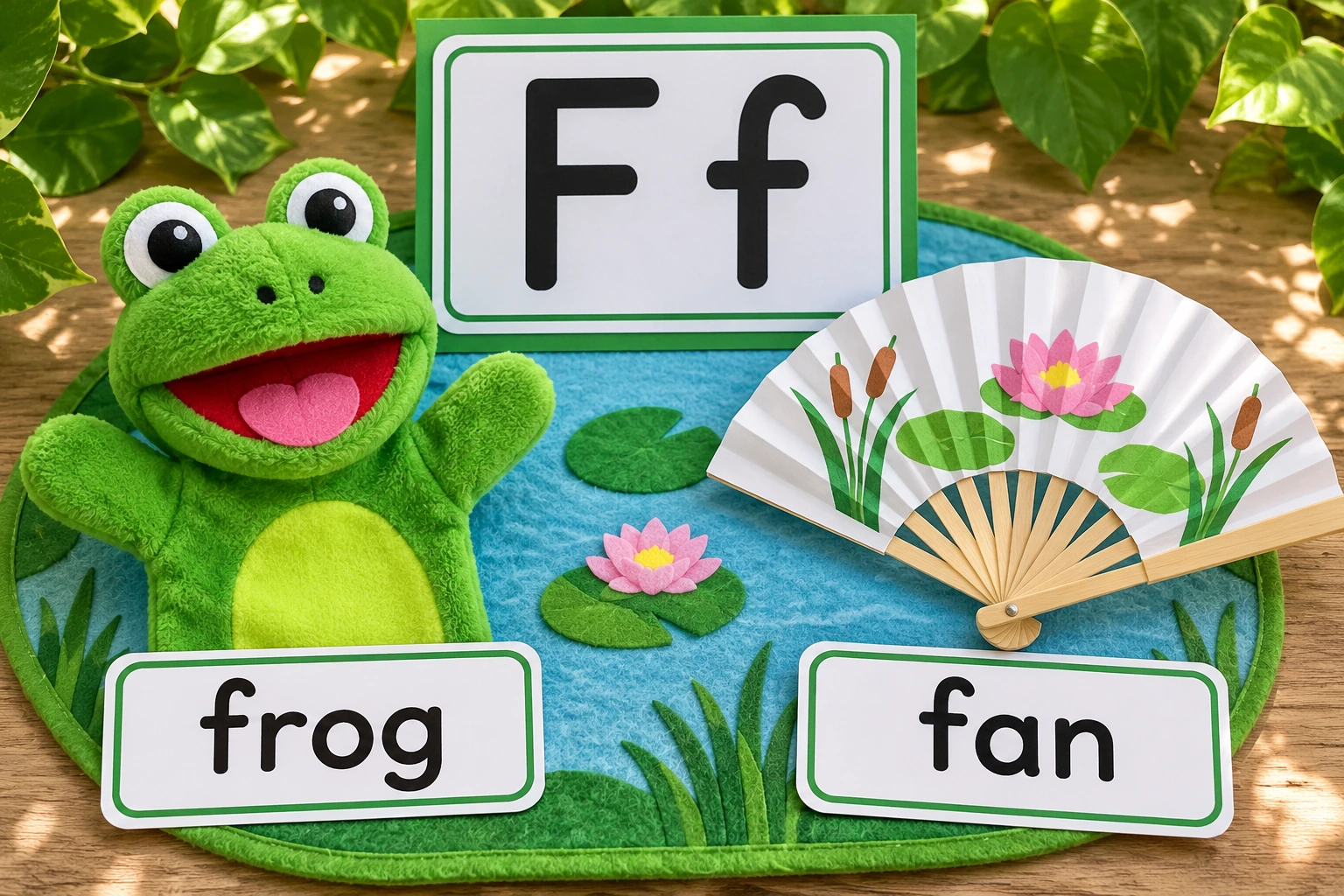
Imagine Farah putting a toy frog on blue fabric. A grown-up brings out Frog F Finder, names the frog label and asks whether the large capital F and small f can both belong to the frog's letter family. Farah points at the different shapes before choosing one printed row to trace.
This is a possible teaching scene, not a report about a real child's progress. The toy supplies a reason to talk; it does not become a prize withheld until all the writing is complete. Farah can finish the visit by finding another f with a finger and letting the frog return to its pond.
Consult the page before offering an answer: Frog F Finder
| Frog F Finder activity | Adult quick check | Source detail |
|---|---|---|
| Trace F/f | 6 F models;7 f models | Frog F Finder guide rows |
| Find Ff cases | 3, 5, 11, 12, 13, 14 | 6 matches in the Ff circle field |
| Complete fish through fan | f | Ff: initial f |
| Picture-name check | frog, fish, fan | 3 choices fit Ff |
Use this Frog F Finder guide privately when checking the four panels. Positions in the circle field run across each row of six, starting at the upper left. Six case matches and three matching picture names belong to different activities. Keeping their instructions separate prevents a child from being told to find an incorrect total below.
Thirteen tracing models, with permission to choose: Frog F Finder
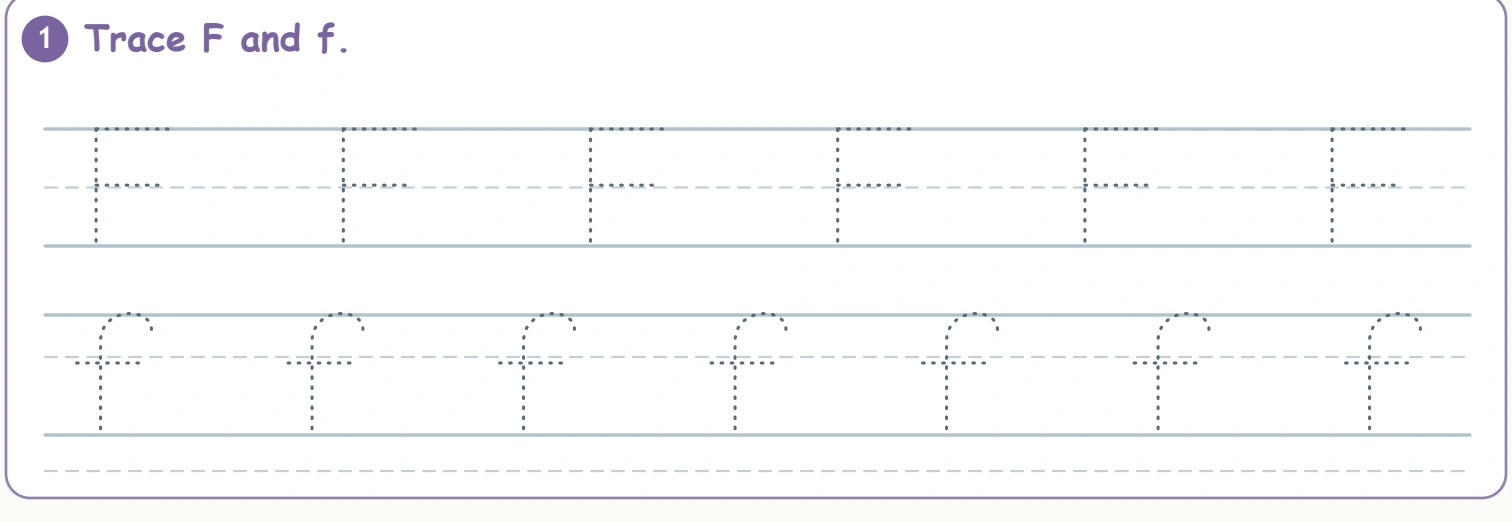
The tracing area supplies six capital F forms and seven lowercase f forms. On Frog F Finder, each row has a visible example to follow; there are no printed numbers telling the learner a compulsory stroke order. Show a broad movement on spare paper if needed, then look back at the actual dotted model.
A short attempt may tell you more than a heavily retraced row. Ask which part of the shape the hand is following. If finger tracing feels easier, start there. Keep paper steady with the other hand and offer a comfortable tool without making a particular grip or perfectly dark outline the price of joining the letter activity.
Look beyond a single familiar line: Frog F Finder
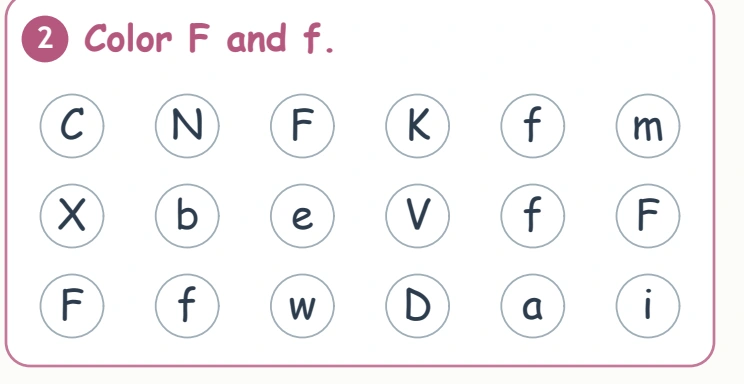
The Frog F Finder recognition field mixes capitals and lowercase forms among eighteen circles. A partial glance can make a distractor seem convincing. Compare a candidate with the complete F or f shown above, including the parts that extend away from its upright. Invite a reason: what visible feature makes this one fit?
Read one row before moving to another if the choice area feels busy. Cover the other rows with a separate sheet temporarily, then uncover them as interest allows. Do not draw additional permanent guides over the original print. A child may mark the six targets in any sensible order, provided both cases are considered.
Six useful kinds of practice inside Ff: Frog F Finder
- Letter identity. Linking a tall F with a smaller f develops the idea that appearance can change while the letter's name stays connected.
- Careful comparison. Inspecting a whole candidate discourages choosing merely because one line resembles the model.
- Beginning awareness. Spoken fish, frog, flower and fan give the written initial a meaningful setting.
- Hand control. Brief tracing and one-character writing offer different amounts of movement without requiring a long copied passage.
- Reference habits. The complete word bank remains available when a missing beginning needs checking.
- Explaining a rule. Selecting a bottom picture provides a reason to say which label begins with f.
These opportunities in Frog F Finder are invitations, not promised outcomes. One learner may name the frog confidently but need help distinguishing the small case; another may find the circles while leaving handwriting for later. Notice the particular decision made rather than attaching a broad ability judgement to the finished sheet.
One small f restores each word: Frog F Finder
The writing fragments in Frog F Finder are ish, rog, lower and an, each with an initial space. Consult fish, frog, flower and fan above to see what belongs before each fragment. The requested addition is one lowercase f, even when a longer word looks more demanding.
The fragment lower can already be an English word in another setting. Here its picture and reference label identify flower as the intended completion. Explain that context openly instead of telling a child the existing letters are meaningless. There is no requirement to copy every remaining character or hide the correct example while the child works.
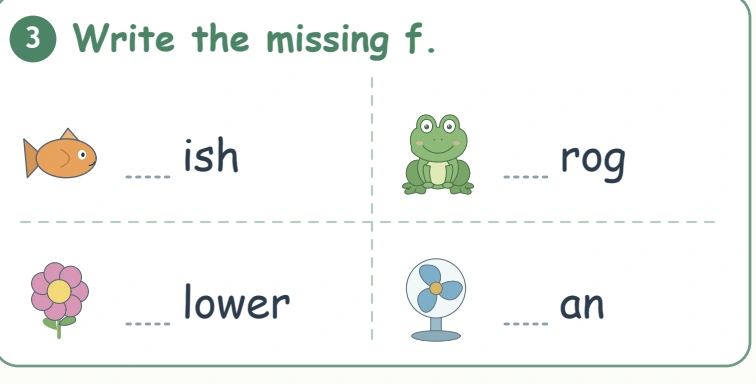
Which pictures actually appear in the last strip?: Frog F Finder
Frog, fish, book, fan, bee and apple are the six lower choices. Frog, fish and fan match Frog F Finder's initial-letter direction. Flower belongs in the top bank but is not a fourth answer in that bottom strip. An adult can name every pictured item before asking the learner to decide.
If a child says toad for the frog, acknowledge the thoughtful animal vocabulary and read the supplied frog label. The print establishes the word being compared on this page. The question is not whether every alternative everyday name for the drawing has the same first letter.

A classroom invitation at the nature table: Frog F Finder
For a hypothetical group session, place a frog figure, a paper flower and a folded fan near Frog F Finder. A teacher reads the labels while children choose one example to discuss. The flower can prompt a spoken first-sound observation even though it does not appear among the final selections.
Give each pupil an independent copy for marking and keep a larger reference available. One child may explain a circle choice orally while another writes a missing f. End by asking what evidence they used. This imagined routine values individual reasoning without presenting a uniform handwriting quantity as the only useful classroom response.
Five pond-side games that change the demand: Frog F Finder
Make a fan's name visible: Frog F Finder
Fold spare paper into a fan and display a completed fan label beside it. Read the label, find its first character and compare it with Frog F Finder's lowercase model. The craft's folds are free exploration, not a new tracing pattern printed on the PDF.
Offer two letter landing pads: Frog F Finder
Write a large F and f on separate cards. A toy frog can land beside either when an adult names the letter. Add a visibly different letter only after both target forms are familiar. Avoid turning the jumps into a speed contest.
Supply a flower's lost beginning: Frog F Finder
Place a large f card next to a lower fragment and a complete flower reference. Let the learner repair the label by moving the card. This duplicates the word decision with a bigger movement, leaving precise pencil work for another time.
Tell a fish-and-fan story: Frog F Finder
Ask what might happen if a paper fish borrowed a fan. An adult can write the child's dictated sentence and point out fish and fan afterwards. Enjoy unusual ideas without grading the story for how many target words it contains.
Build an observation pair: Frog F Finder
Choose one case match and one nonmatch from a separately drawn adult example. Ask the child to describe a difference before returning to the real search field. Evidence can be a pointed feature; a formal letter-shape vocabulary is unnecessary.
Keep challenge separate from discomfort: Frog F Finder
For Farah’s frog play, Frog F Finder offers supported print choices to children roughly three to six, according to their readiness. Readiness varies between picture talk, recognising print and controlling a small tool. Start with the part the child can approach willingly, and offer a larger comparison when a cramped mark conceals an otherwise clear answer.
A stable surface and an easy pause can make the session calmer. Stop if the hand feels tired. Replacing a pencil task with pointing changes the response method while preserving the letter question. Older or younger learners may also find a selected panel useful when it matches their present experience.
Respond to the exact mix-up: Frog F Finder
Common Frog F Finder difficulties include accepting only capital F, writing an uppercase form into a lowercase gap, or circling flower below without checking that it is actually absent there. Return to the relevant part of the page rather than restarting all four activities.
A plausible word still needs a visible picture choice. Ask the child to locate the item they mean. If frustration rises, use a large f card or name the pictures together, then close the sheet. A correction should reveal information the learner can use, not create a long cycle of erasing.
Let the frog introduce another brief visit: Frog F Finder
The toy-pond theme can bring Frog F Finder back into ordinary play. On one day, find a single case pair; on another, restore fan's initial. Repeated encounters can vary in length and activity while keeping the same models accessible. There is no need to finish an identical routine each time.
Specific feedback might be “You checked the complete fan word before choosing f.” Invite the child to say what was helpful and leave room for stories, building and outdoor observations. The worksheet is one small source of print experience within that wider play, rather than a measure of the entire day.
Choose your Ff PDF and print a clear copy: Frog F Finder
Open the free control for the supplied Learn the Letter Ff original. The clean Frog F Finder download is a separate premium variant available with current eligible membership; website-domain text, promotional ads and the worksheet watermark have been removed without changing the frog-and-fan activities.
The linked A–Z library has a $5 purchase price for one merged clean PDF. It is a separate product from the individual member file. After saving Frog F Finder through your permitted option, review the US Letter paper setting and the original guide size. A detail image is helpful for discussion, while the downloaded PDF is intended for printing.
Follow Ff into other kinds of print play: Frog F Finder
Frog F Finder connections: Frog play can move into Ff Letter Tracker; Ff Worksheet is another way to revisit Ff. After the fan's initial is familiar, Kite Alphabet Gaps provides a separate alphabet-order invitation.
For adult-led extensions beyond Frog F Finder, see NAEYC's family play ideas or learning articles from PBS Parents. These external organisations supply their own resources; their links do not add pages to this file or indicate that they endorse the worksheet.
Popular Worksheets
Printable resources families and teachers are downloading now.
 Free
 Free
 Free
 Free