
Kettle K Keeper: 4 Wonderful Kk Practice Adventures
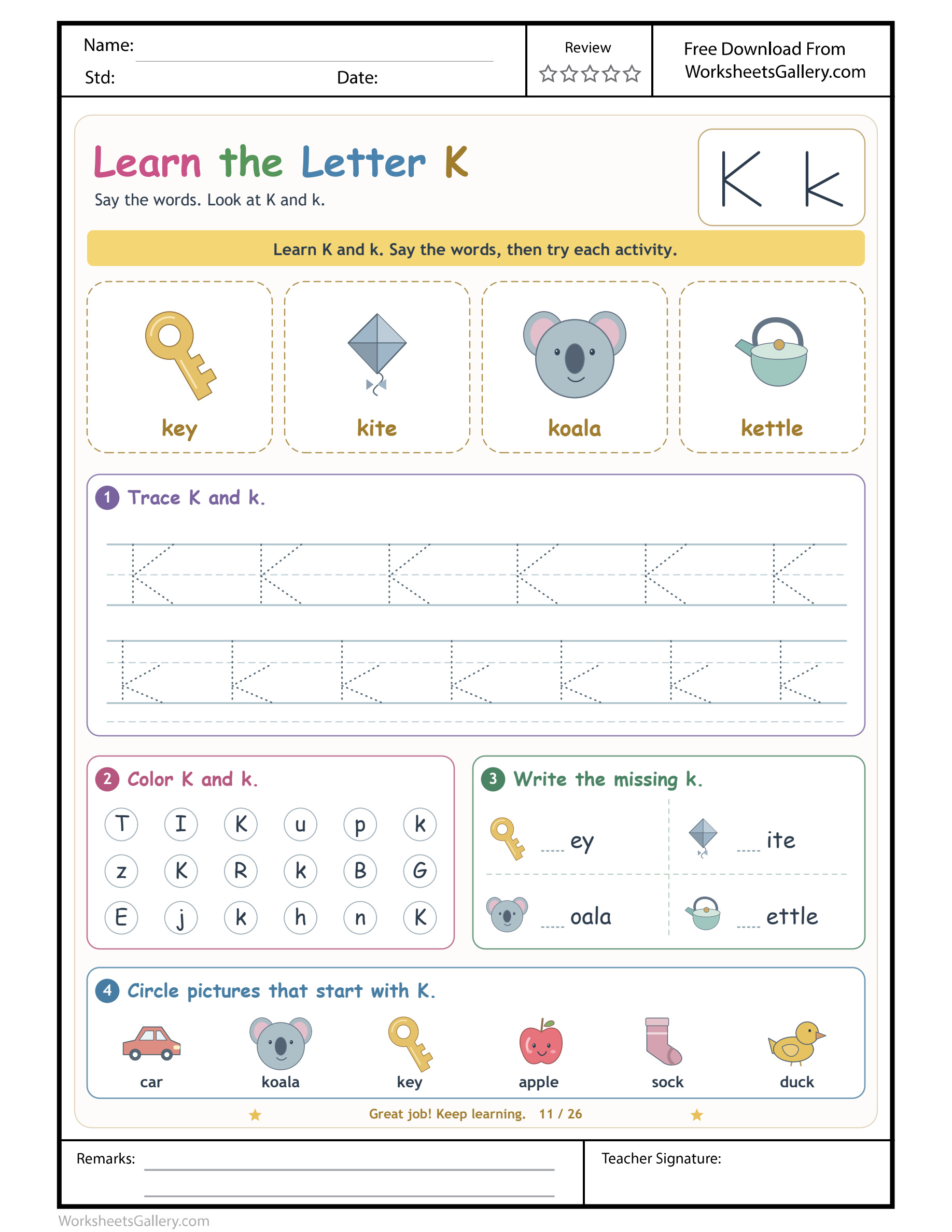
Kettle K Keeper: Compare the slanted branches in K and k while using the key and koala labels for picture checks.
Keys can open a pretend door, and a printed k can open a discussion about how names begin. Kettle K Keeper pairs key, kite, koala and kettle with four different letter tasks on one sheet. Children encounter the two cases, dotted tracing examples, missing lowercase beginnings and a final picture group to inspect. An adult can supply every spoken label while the learner concentrates on a visible detail. Choose a small starting challenge that suits today's interest and hand comfort. There is no requirement to read all four names independently before making a useful observation about Kk.
Start with a kettle's name, not a hot appliance — Kettle K Keeper
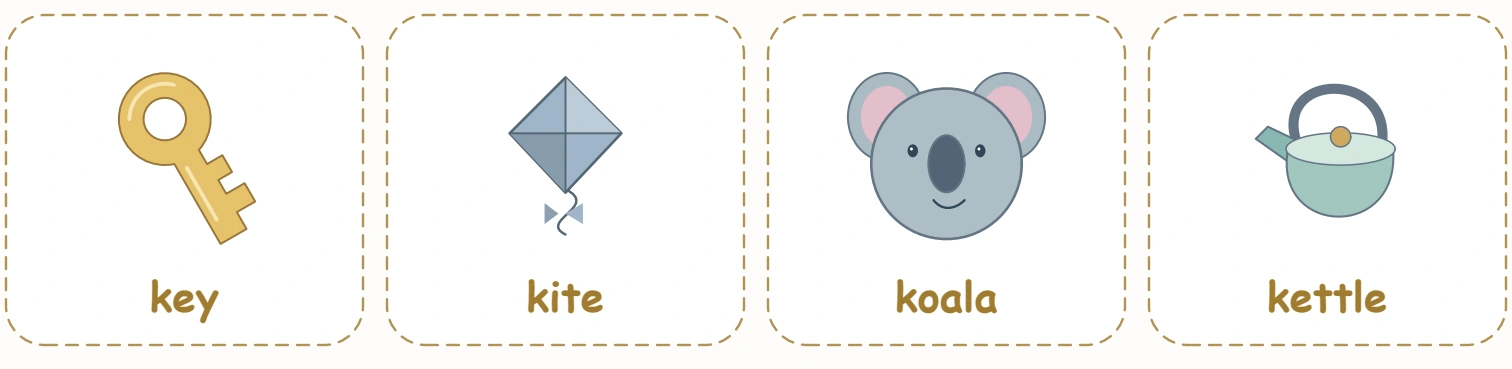
A toy kettle or picture provides enough context for Kettle K Keeper; no real heating activity is needed. Read key, kite, koala and kettle from the upper bank, then inspect their first letters. The mix of familiar objects and an animal can lead into talk about different uses and places.
Koala may be a new word to some learners. Name it clearly before asking which initial fits. A child can compare k in the label without knowing every fact about the animal or sounding out its whole spelling. Keep adult vocabulary support separate from the smaller print decision.
Kavi's imaginary tea shop: Kettle K Keeper
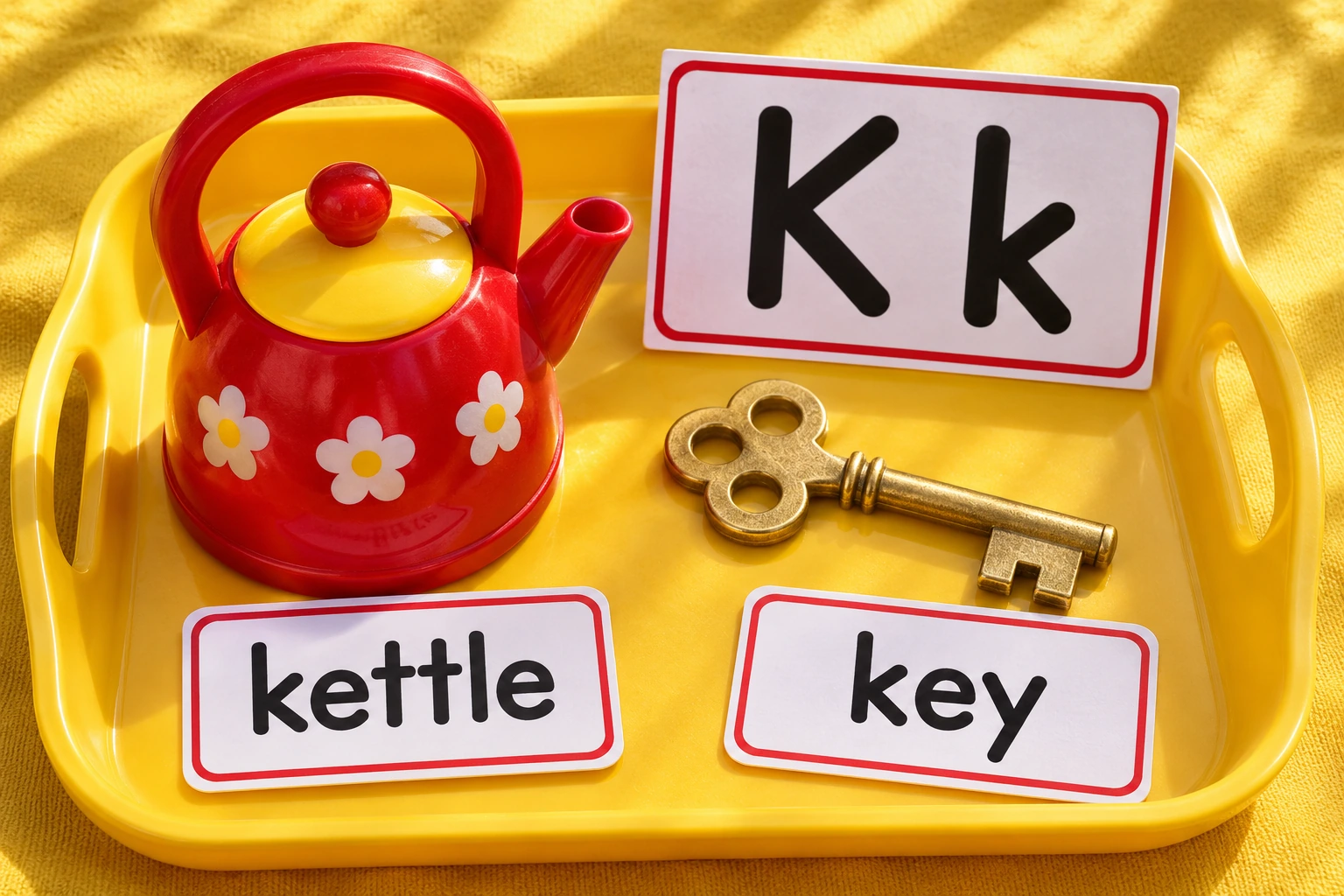
Imagine Kavi arranging a toy kettle and a large key on a home play tray. A grown-up reads their names on Kettle K Keeper. Kavi notices the slanting parts of the capital model, then compares the little k beside it. Together they choose one circle to inspect before returning to the pretend shop.
This suggested scene is fictional, not an account of a child's results. The adult could accept a pointed answer, or write a label dictated by Kavi on another sheet. The print conversation can be brief while the play continues for as long as it remains interesting.
Read the adult checking map: Kettle K Keeper
| Kettle K Keeper activity | Adult quick check | Source detail |
|---|---|---|
| Trace K/k | 6 K models;7 k models | Kettle K Keeper guide rows |
| Find Kk cases | 3, 6, 8, 10, 15, 18 | 6 matches in the Kk circle field |
| Complete key through kettle | k | Kk: initial k |
| Picture-name check | koala, key | 2 choices fit Kk |
The Kettle K Keeper search positions follow rows of six from left to right. Its six Kk answers include three capitals and three lowercase letters. Two pictures match in the final strip. Keep those rules distinct when checking, and consult the actual labels rather than assuming all four upper examples reappear below.
Compare the branches on both cases: Kettle K Keeper
The K and k on Kettle K Keeper share recognisable slanting branches, but differ in size and proportions. Look at the supplied models closely. A candidate that contains one slant is not automatically a match; its complete arrangement needs to resemble the target reference.
Invite an explanation in the child's own terms, such as pointing at where lines meet. Formal names for letter parts are optional. Seeing the same letter in two cases gives an opportunity to discuss identity despite a change in appearance, without pretending that every printed font will be identical.
Choose a manageable tracing sample: Kettle K Keeper
There are six capital guides and seven lowercase guides in Kettle K Keeper. Select one row and compare its model with the larger case example first. A finger can follow the dotted shape before a pencil is offered, with the other hand helping to keep the paper still.
The source has no numbered formation arrows. Demonstrate a larger K or k separately if useful, and describe that as adult guidance. Repeated darkening is unnecessary when the learner is tired. A pause or larger model can reveal more about an understood shape than another cramped attempt.
Search one neighbourhood of circles at a time: Kettle K Keeper
Eighteen choices give Kettle K Keeper a bounded recognition task. Start at a comfortable place and keep both reference cases visible. One row can be considered before another, with temporary covering paper if the field looks crowded. Ask what feature makes a selected letter fit before colouring it.
Do not use the adult total as a pressure to find six quickly. A learner who identifies only the capitals may need the lowercase partner introduced again. A learner who names every distractor slowly can instead compare one candidate directly with the target; the instruction does not require naming all eighteen letters.
Restore four beginnings by consulting the bank: Kettle K Keeper
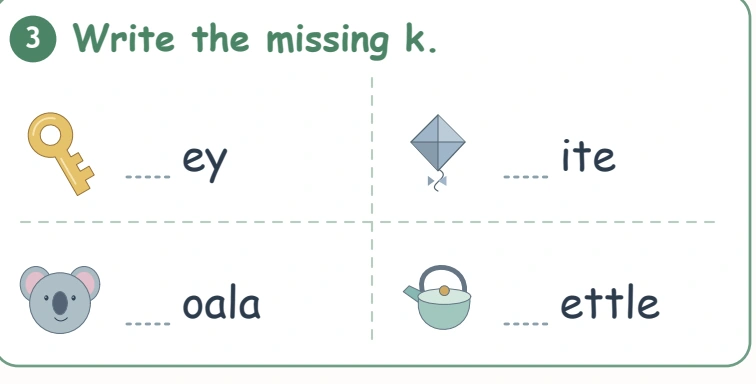
The Kettle K Keeper fragments ey, ite, oala and ettle each need one lowercase k. Look between a fragment, its drawing and the complete reference above. Key remains key after one small addition; kettle does not require a longer answer merely because it has more printed letters.
If capital K is proposed, acknowledge the correct letter name and then show the requested case. The task asks for one missing character rather than an entire rewritten label. A large movable k can make the comparison concrete before a learner decides whether to use the small pencil space.
Koala and key make the lower pair: Kettle K Keeper
Car, koala, key, apple, sock and duck are the final Kettle K Keeper choices. Koala and key satisfy the initial-K instruction. Kettle and kite are genuine top-bank examples, but neither is an extra answer in that bottom strip. Naming the visible choices first prevents a remembered upper word from substituting for a picture that is absent.
An alternative picture name deserves a hearing. A child may call a car a vehicle or a key something that opens a door. Read the supplied label before judging its initial. The page's grouping concerns the chosen written words, not every reasonable description of the drawings.

Five ways to recognise useful work: Kettle K Keeper
- Inspecting a junction. Comparing the slanting branches encourages attention to the whole form.
- Linking cases. Capital K and lowercase k can both join the search group.
- Using pictured vocabulary. A named koala connects unfamiliar language with a visible label.
- Planning a small movement. A brief traced or written character gives the hand a defined job.
- Checking evidence. The full kettle label can guide the missing initial rather than relying on recall.
These opportunities around Kettle K Keeper are possible points for observation, not guaranteed gains. Listen for reasoning and notice comfortable movement. A clear oral answer and a difficult tracing attempt can occur together; adapt the response method without losing sight of the decision the learner understood.
A possible classroom object-label table: Kettle K Keeper
In a hypothetical classroom, a teacher lays out a toy key, a kite picture and completed labels beside Kettle K Keeper. Children hear the names and compare their written beginnings. The adult can introduce koala with a larger picture before inviting a case choice on an individual sheet.
One pupil may point at the slanted branches while another writes k. The teacher can describe those different actions specifically rather than requiring the same finished page from everyone. This imagined activity illustrates a way to organise support and is not presented as a documented classroom outcome.
Four extensions beyond the tea tray: Kettle K Keeper
Give a pretend door its key label: Kettle K Keeper
Place a completed key card beside a toy lock or cardboard door. Read it and find the first character. Returning to Kettle K Keeper then has a clear purpose: locating the same beginning in print rather than guessing from an object alone.
Let a kite carry a sentence: Kettle K Keeper
Invite a story about where a paper kite travels. Write the dictated sentence and read it back. Its language can range freely; there is no need to force every word in the sentence to begin with the target letter.
Make the branches visible at a larger size: Kettle K Keeper
Draw K and k on spare paper and ask where their lines meet. Compare the examples with the source models afterwards. Keep the demonstration complete and avoid adding invented arrows to the PDF's tracing area.
Move a k into place: Kettle K Keeper
Offer an ettle fragment beside a complete kettle reference and a large lowercase k. Sliding the missing letter before the fragment repeats the print decision with a broader hand movement. Small writing can wait until it feels manageable.
Match the invitation to readiness: Kettle K Keeper
Kavi’s key-label game may interest a learner aged about three to six; choose Kettle K Keeper panels according to preschool or kindergarten readiness and available help. Some will prefer naming or pointing before tracing. Others may welcome a short written repair. Use a stable surface, keep references visible and let willingness and hand comfort guide the amount.
Typical mistakes include choosing by a single slant, accepting only the capital or adding uppercase K to a lowercase gap. Return to the feature or instruction that resolves the particular uncertainty. A calm comparison is more useful than a broad demand to redo every panel.
Keep a future visit connected to play: Kettle K Keeper
The kettle theme can bring Kettle K Keeper back to a pretend café another day. A single key label or one search row is enough for a fresh invitation. Mix paper work with books, conversation and building rather than treating a complete repeated sheet as the only kind of regular practice.
Specific encouragement might be “You compared where the branches meet before choosing.” If frustration appears, switch to a larger example or end with a successful spoken observation. Leave the learner a clear detail to recognise next time, not a tally of spaces still waiting.
Choose the printable Kk file: Kettle K Keeper
Kk has two individual editions: the supplied Learn the Letter Kk original under the free control, and a clean Kettle K Keeper premium PDF for members with active qualifying access. The latter preserves the kettle and key activities after removing worksheet ads, domain promotion and website watermark.
The linked library is sold for $5 through its own checkout, combining twenty-six clean pages. That collection purchase is separate from individual membership access. Download Kettle K Keeper using the option available to your account, then inspect a US Letter preview without changing the source proportions. The PDF is the printing resource; the key and koala images are explanatory views.
Other routes into letter conversation: Kettle K Keeper
Kettle K Keeper connections: Kettle play gives a useful context for Kk Letter Scout. Try Kk Worksheet for another Kk encounter. After a key-label comparison, Kite Alphabet Gaps can introduce a broader capital-order question.
Adults extending Kettle K Keeper can consult PBS Parents learning and growing ideas alongside family play articles from NAEYC. These independent resources supply optional reading without endorsing this page or adding files to its download.
Popular Worksheets
Printable resources families and teachers are downloading now.
 Free
 Free
 Free
 Free