
Hh Letter Search: 3 Wonderful House-and-Whale Clues
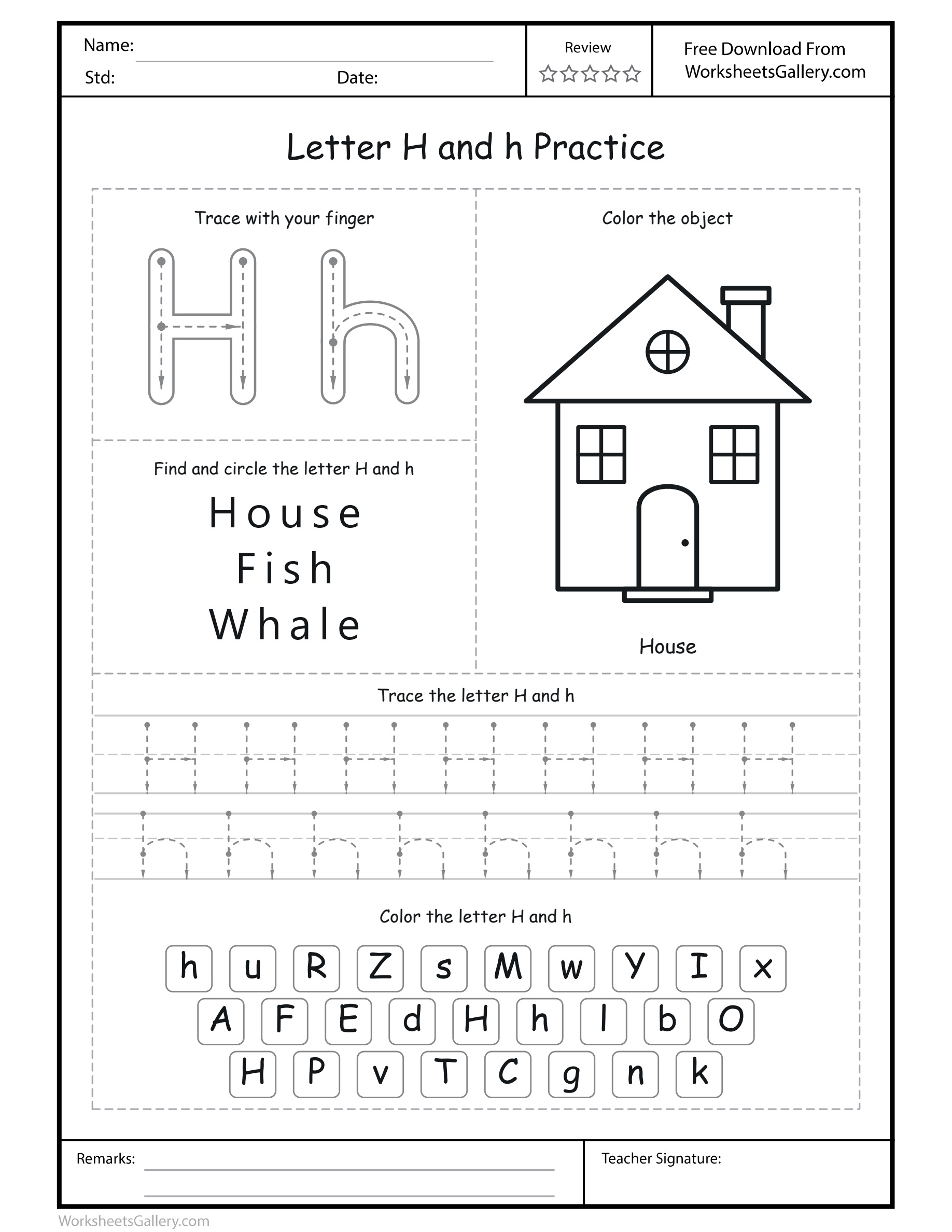
Hh Letter Search belongs to the 26-page collection. Find H/h at the beginning, end and inside words, including h within Whale.
House opens the search, Fish hides a letter at its end, and Whale places one just after W. Hh Letter Search makes those three positions the centre of a preschool letter visit. Children can compare H with h, follow the printed movement cues, colour a house and inspect a field of mixed letters. An adult reads the labels, so a learner can participate before reading the words independently. The interesting question is where the written h appears, with time to point, reconsider and explain each choice in a comfortable way.
A house with three different letter addresses — Hh Letter Search
Begin Hh Letter Search by reading House, Fish and Whale aloud while a finger travels beneath the print. Then name the target letter. Ask the child to find its shape, regardless of whether it begins the word. House offers the capital at position one. Fish ends in lowercase h at position four. Whale contains lowercase h at position two. There are three targets across this word panel.
Keep this visual task separate from a claim about identical sounds. The h in Fish belongs to the spelling sh; Whale begins with wh. A child need not explain those spelling patterns to complete Hh Letter Search. Say, “We can see h here,” rather than stretching an isolated /h/ over every occurrence. A separate spoken first-sound game can use house and hat later, without changing the printed search into a phonics test.
| Printed label | Look here | Adult question |
|---|---|---|
| House | First character, H | Which letter starts this label? |
| Fish | Fourth character, h | What happens when we check the end? |
| Whale | Second character, h | Can your finger stop just after W? |
Give the bridge and arch a closer look: Hh Letter Search
The large models in Hh Letter Search show two members of one letter family with different outlines. Capital H has two uprights joined by a bar. Lowercase h has a taller stem and a smaller arch. Point out the joining places before asking for any pencil movement. A finger can travel over the supplied guides while the other hand rests on the paper.
Use the printed start marks and arrows as the local movement reference. A short cue such as “tall stem, then arch” may help with h, but watch the actual model together. Avoid making a child trace several times because the first attempt was slow. One deliberate journey can reveal more than a page of hurried strokes. Hh Letter Search provides a place to notice the change from straight movement to a rounded return.
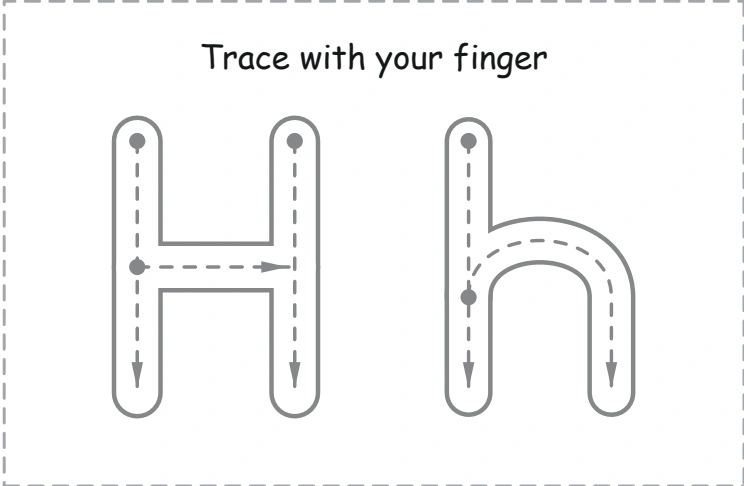
If a learner calls h “a little bridge,” accept that description and add the letter name. If they select n, compare the height of the first stem with the model. Covering unrelated sections of Hh Letter Search can make this comparison easier. The page stays available for a later return when the distinguishing feature feels clearer.
Six useful outcomes to notice: Hh Letter Search
Position awareness: the three labels move attention from a word's opening to its interior and ending. In Hh Letter Search, an end-letter discovery is as useful as a beginning-letter discovery.
Case connection: matching the H of House with the lowercase targets links two visibly different forms. A child can name both without assuming that size alone determines case.
Controlled direction changes: the h arch asks a hand to rise and turn after a tall movement. A comfortable grip and modest pressure matter more than filling every guide immediately.
Visual checking: returning to the model gives a practical way to review an uncertain tile. Hh Letter Search invites comparison instead of guessing from a neighbouring answer.
Descriptive talk: words such as tall, across, inside and last give the child language for what their eyes have noticed. An adult can record a spoken explanation without requiring a written sentence.
Choice within a task: selecting the house colours lets the learner direct part of the visit. That decision can make the more demanding letter search feel like a personally owned project.
A class post office, imagined: Hh Letter Search
Imagine Hana delivering three paper envelopes in a classroom. Her teacher writes House, Fish and Whale on separate cards, reads each, and places them beside Hh Letter Search. Hana first delivers a token to House because its H is prominent. The teacher asks which other address contains the same letter family. Hana inspects Fish from left to right and finds its last character.
The useful moment comes when Whale is still unchecked. Instead of naming the answer, the teacher places the large h model beside that card. Hana compares the tall stem and arch, then parks the token after W. This imagined exchange makes the position change visible. It does not suggest that every preschooler should find all three without support.
Back at Hh Letter Search, Hana chooses whether to circle the printed targets herself or point while the teacher makes the marks. Either response can demonstrate recognition. The teacher notes which kind of help made the search accessible, so the next visit can begin at a sensible level.
Seven tall H guides and eight smaller h guides: Hh Letter Search
There are seven uppercase handwriting guides and eight lowercase guides in Hh Letter Search. Preview the row endings, then try a small selection. A learner who loses track of a starting place may benefit from an adult pointing to the next guide. Keep the unused practice opportunities available rather than rushing through them for a finished appearance.
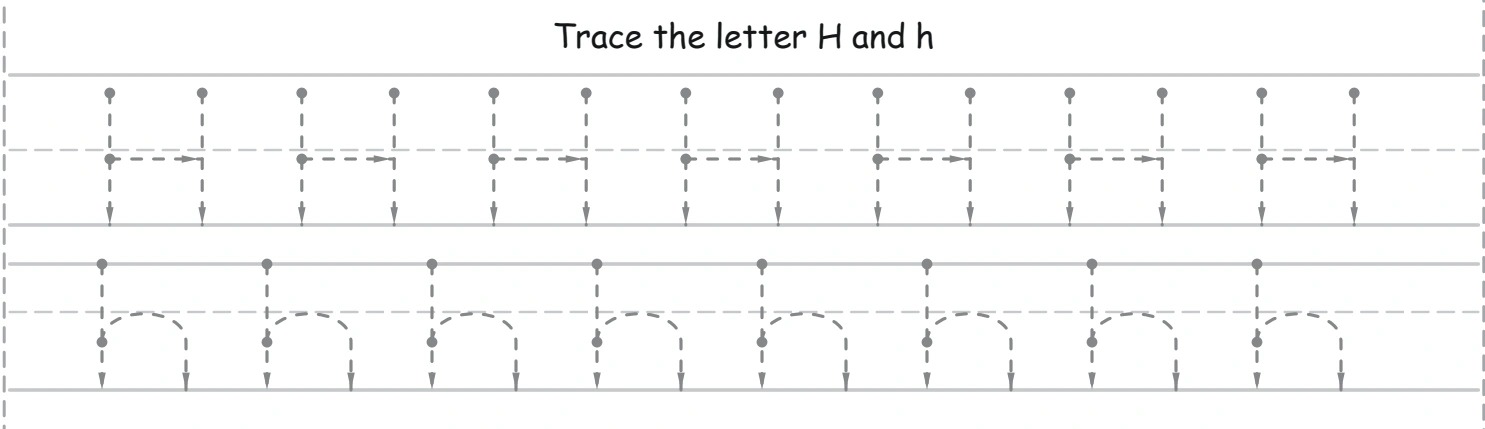
Describe one feature at a time: the H joining bar, or the height of the h stem. Asking about both while also correcting grip, speed and spacing can overwhelm the original purpose. If the paper moves, help anchor it. If pressure becomes heavy, pause for a finger trace and relax the hand before trying another guide in Hh Letter Search.
Some marks will lean or extend beyond a printed guide. Compare them gently with the nearby model and choose one feature to revisit. “Your stem reaches high; let's give the arch a little room” offers an observable next action. Repeated erasing can be less useful than leaving a first attempt and trying the following guide with a clearer intention.
The mixed field needs a complete sweep: Hh Letter Search
The tile field in Hh Letter Search contains twenty-seven letters distributed as ten tiles on top, nine centrally and eight below. Four are targets: two H forms and two h forms. For adult checking, the first row starts with h. The second row contains H at its fifth position and h at its sixth. The third row begins with H.
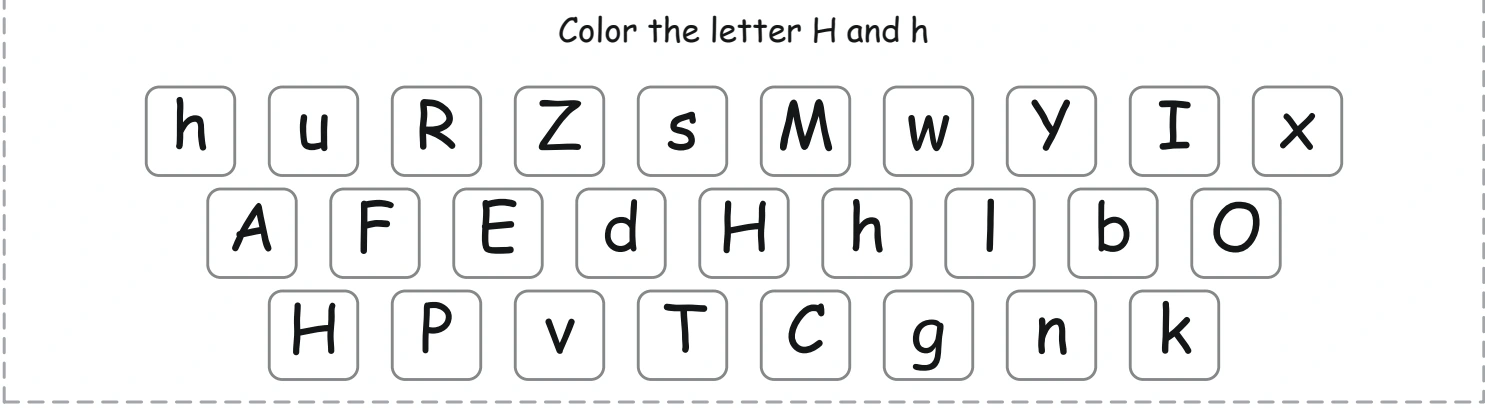
Do not turn those coordinates into a counting requirement for the child. They are a checking reference for the accompanying adult. A learner can scan one row at a time, mark a match, and then continue past it. Finding one H does not mean that the row has been fully inspected. The neighbouring lowercase h and capital H in the middle row make that return especially useful.
Ask what distinguishes a candidate from the large models. If n attracts attention, revisit the tall h stem. If a different upright letter is chosen, look for the connecting bar or arch. Hh Letter Search supports a reasoned change of mind; an initial selection need not become a permanent mistake or a reason to stop exploring.
House colours can open a conversation: Hh Letter Search
The house drawing on Hh Letter Search has no prescribed colour key. Let the child choose a roof, wall or door colour, and invite a description of one decision. A purple roof can be a playful choice for Hh Letter Search. Colouring here offers a pause from small printed symbols while keeping the house vocabulary available for conversation.
An adult can write a separate completed label such as “Hana's house” on a card and point to its H and h. That extra example belongs to the conversation; it is not another answer that must be added to the worksheet. Keep the original letter and word tasks easy to recognise after any off-page extension.
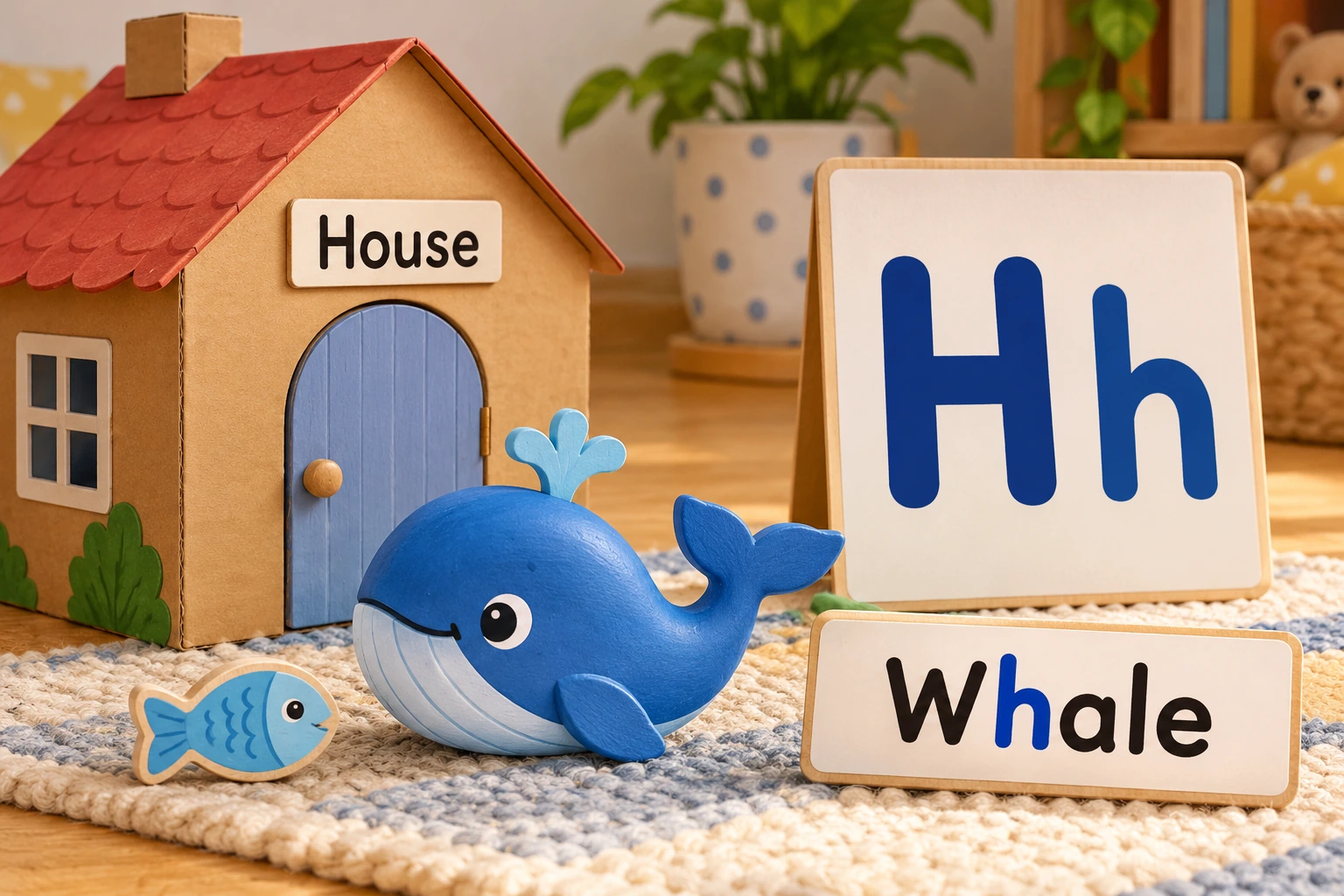
The accompanying illustration offers another way to discuss Hh and labelled objects. Use it to ask where a visible h sits in a word. It is a supporting teaching picture, while the full worksheet preview shows the actual printable layout. A child may prefer talking about the picture before returning to Hh Letter Search with a pencil.
Five games for a letter address hunt: Hh Letter Search
Doorway delivery: Hh Letter Search
Place large H and small h cards at two pretend doors. Say which case is waiting for a letter and let the child deliver a matching card. Bring the pair back to Hh Letter Search and find one example of each. This Hh Letter Search extension ends after a few thoughtful deliveries rather than a speed contest.
Beginning, middle, end mats: Hh Letter Search
Use three labelled mats reading FIRST, INSIDE and LAST. Read House, Whale and Fish on cards and ask where each target belongs. Keep the complete printed word visible as evidence. This arrangement for Hh Letter Search makes the three positions physical without asking the learner to decode an unfamiliar label.
Build a tall arch: Hh Letter Search
Offer a long craft stick and a curved cord to suggest h. Let the child arrange the parts beside the model in Hh Letter Search. The materials demonstrate height and curvature; they do not replace the printed movement cues when handwriting resumes.
Quiet neighbour check: Hh Letter Search
After finding a tile, inspect the tile next to it before moving on. The middle-row H/h neighbourhood in Hh Letter Search gives this game a concrete purpose. Partners can take turns pointing and comparing, with no points lost for asking to see the model again.
House storyteller: Hh Letter Search
Choose a house colour and complete a spoken sentence about who might live there. An adult writes the finished sentence on separate paper and helps locate one H or h if it contains one. Keep the story enjoyable even when no extra target happens to appear.
A kitchen label visit, imagined: Hh Letter Search
Picture Hana at home beside a toy house and a small fish drawing. An adult reads Fish from Hh Letter Search and asks whether the target is at the front. Hana points to F. The adult names F, then places the h model near the word's end. Hana notices the different outline and shifts her finger to h.
That revision is worth describing specifically: she used the model to check the label. Later, she shows a family member the h inside Whale and explains that it comes after W. This imagined home visit can last only a few minutes. It leaves room for dinner, play and a later return without treating a single session as proof of lasting mastery.
Adjust the visit and choose a useful return: Hh Letter Search
For children around three to six, support can range from shared pointing to independent circling and a spoken explanation. A younger learner may colour and compare the large H/h pair. A more experienced child may inspect all three labels and describe why a tempting n is different. Follow the child's present comfort with print and hand movement, rather than using age as a pass mark.
On a return to Hh Letter Search, change the starting section. Begin with the final h in Fish, or ask the learner to show the H joining bar before tracing. Revisit a specific discovery over several short encounters. If tiredness appears, stop at a recognised letter and leave the rest for another occasion. Predictable, manageable practice gives the next visit a welcoming beginning.
Avoid circling whole words when the instruction asks for letters, overlooking the interior h, or insisting that every written h represents the same spoken sound. Those are different confusions and need different responses. A finger tracking the word helps with location; a model comparison helps with shape; an adult explanation keeps the spelling discussion accurate.
Read, download and continue: Hh Letter Search
Compare Hh Letter Search with Hh Worksheet. A listening follow-up to Hh Letter Search is First Sound Choices. For Hh Letter Search, explore Ii Worksheet.
For adult background, NAEYC's play resources offer ideas for keeping learning participatory. PBS Parents literacy resources can support further shared reading and conversation. These are optional extensions to the House, Fish and Whale work, not extra tasks required to finish this sheet.
The original sample of Hh Letter Search is available through the page's download controls. An eligible active membership provides the separate clean single-sheet version without website branding. Check the print preview so the complete page and its outer frame fit the chosen paper. Keep the large pair, word labels and tile field visible at a useful reading size.
The linked Alphabet Wordwork Collection is a separate $5 premium purchase containing all twenty-six clean letter sheets in one PDF. Its package card offers a direct route from Hh Letter Search when a complete A–Z file would suit the next stage of practice. Membership access to a single clean worksheet does not itself purchase that collection.
Popular Worksheets
Printable resources families and teachers are downloading now.
 Free
 Free
 Free
 Free