
Ll Letter Inspector: 4 Brilliant Lion-and-Ball Finds
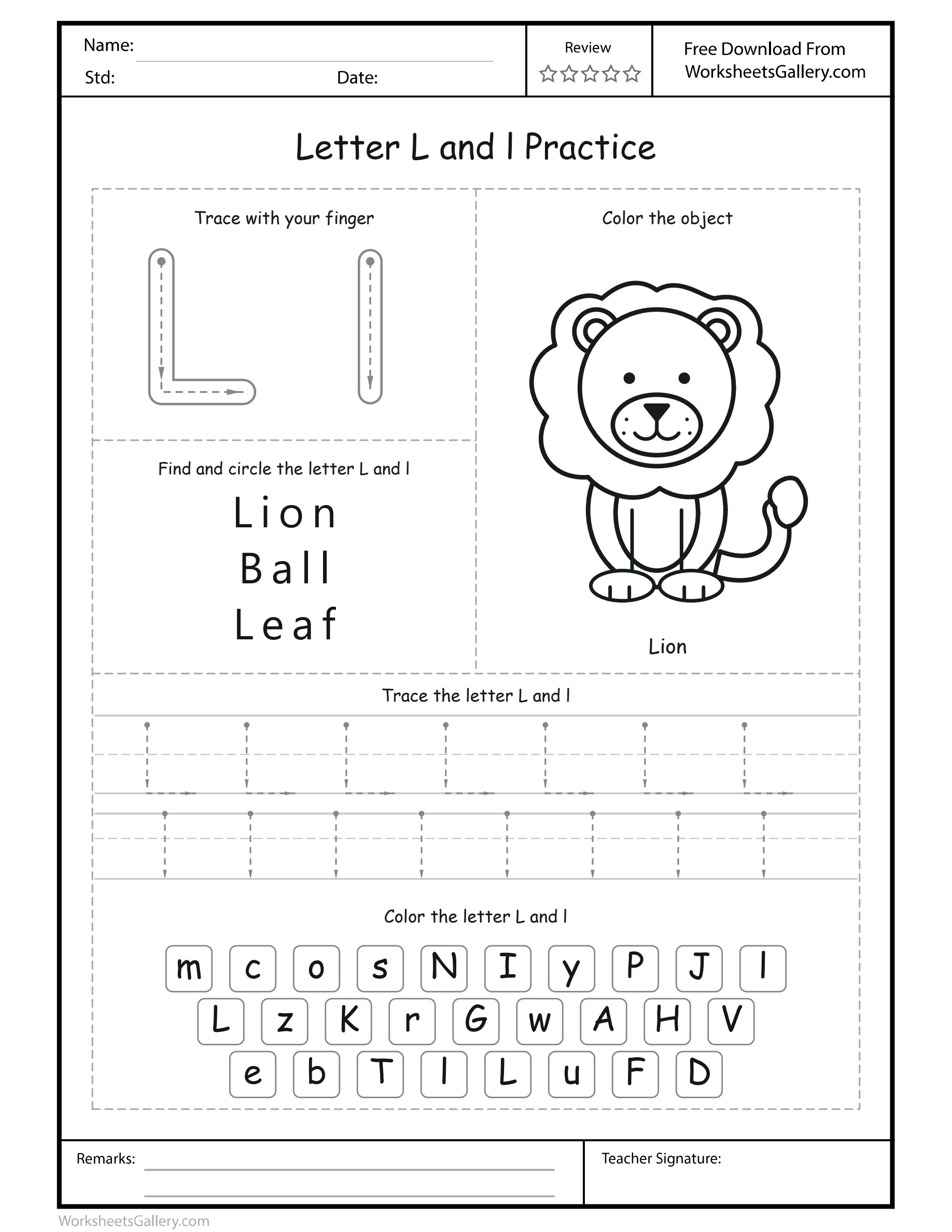
Ll Letter Inspector belongs to the 26-page collection. Preserve both l marks in Ball and compare the supplied plain lowercase stroke with capital L.
Ball has a pair of l letters waiting side by side. Ll Letter Inspector turns that small double discovery into a reason to look carefully, even after one target has been found. Lion and Leaf add capital L at the beginning of their labels, while the model pair introduces a clear corner and a plain lowercase stroke. Children can join an adult for reading, choose lion colours and try manageable tracing. The page welcomes pointing and discussion as well as pencil marks, so its letter work can fit different preschool starting points.
Two neighbours at the end of Ball — Ll Letter Inspector
Show the word panel of Ll Letter Inspector and read Lion, Ball and Leaf. Ask which labels begin with L, then inspect Ball from its first character to its last. Its third and fourth characters are both lowercase l. A circle around only one leaves a second valid target waiting beside it.
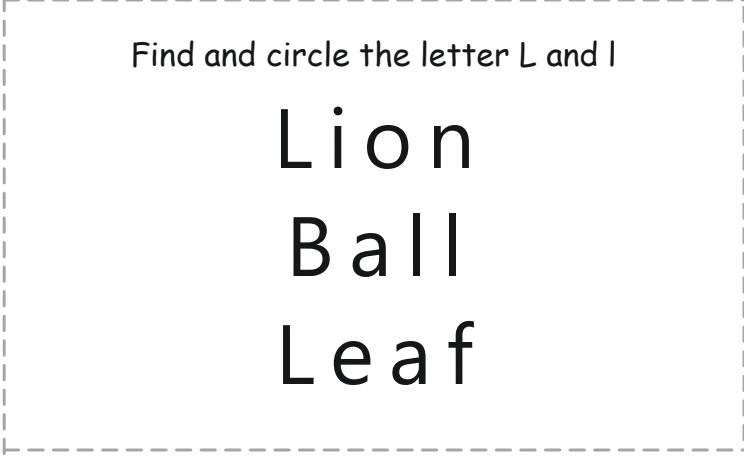
Four letters belong in this panel's answer set: L in Lion, two l characters in Ball and L in Leaf. The picture label does not create an extra word-panel answer. Keep the three explicit search labels in view and circle the characters themselves, rather than enclosing the entire labels.
| Read together | Letter evidence | Question after a discovery |
|---|---|---|
| Lion | L begins the label | What makes its corner visible? |
| Ball | l at positions 3 and 4 | Is its neighbour another match? |
| Leaf | L begins the label | Does it share Lion's opening? |
The paired ending makes Ll Letter Inspector useful for practising completion. “You found one; let's inspect beside it” gives a learner a concrete next action. It avoids treating the missed neighbour as carelessness. Some children need several supported encounters before continuing a search after its first success feels natural.
An imagined classroom book repair desk: Ll Letter Inspector
Imagine Lena helping arrange a pretend book repair desk. A picture book has a lion on its cover, and the teacher provides a completed Lion card. Lena matches its capital to Ll Letter Inspector. Next, a Ball card becomes a label for a basket of soft play balls. Lena circles the first l and moves away.
The teacher asks her to check the character immediately beside that circle. Lena compares the two upright strokes and notices that both match the lowercase model. She adds a second circle. The teacher records her explanation: she checked the neighbour rather than stopping with the first answer.
A Leaf card finishes the desk display. Lena can show its capital and talk about the corner. This imagined class use does not require independent reading or an actual repair project. It gives Ll Letter Inspector a setting in which adult-provided words and a child's visual decisions have different, complementary roles.
A corner is different from a plain upright: Ll Letter Inspector
Compare the large pair on Ll Letter Inspector. Capital L descends and turns along the bottom. The supplied lowercase l is a plain tall stroke. Name the case forms together and point to the capital's corner. A lowercase letter is not identified solely by being small; the printed shape provides more reliable evidence here.
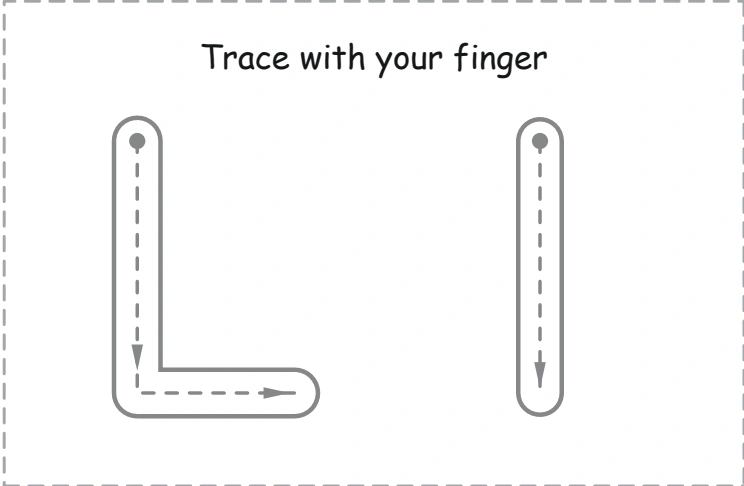
The plain lowercase model can resemble other narrow characters in some fonts. Keep the supplied pair nearby for the tile task and avoid inventing a decorative hook that the sheet does not show. If another book prints l differently, explain that letter styles vary and compare that book's form separately.
Finger tracing lets a learner feel the difference between the capital's turn and the lowercase movement. Follow the sheet's starting cues. In Ll Letter Inspector, an adult can name one direction change without demanding a recital of stroke language. A calm demonstration followed by a child's own attempt is enough to begin.
Six things a neighbour check can support: Ll Letter Inspector
Persistence after success: Ball offers a second target directly beside the first. Ll Letter Inspector gives “keep looking” an immediate purpose rather than making it a general instruction with no visible destination.
Case relationships: the two capital word openings can be connected with the lowercase pair. Naming L while showing the different forms helps preserve both their identity and their shape differences.
Close visual discrimination: a corner and a plain upright can be inspected separately. An adult can ask about the actual feature that made a tile seem suitable.
Short movement control: the capital's turn gives the hand one manageable direction change. A relaxed grip and steady paper make it easier to attend to that feature.
Language about position: beginning, end, beside and next describe evidence the learner can point to. Ll Letter Inspector allows spoken explanation without requiring written sentences.
Confidence in review: adding the missed neighbouring l demonstrates that answers can improve through checking. An adult can describe the useful strategy without exaggerating what one completed worksheet proves.
Lion colours belong to the learner: Ll Letter Inspector
Invite a colour plan for the lion drawing on Ll Letter Inspector. The source does not assign particular colours to its parts. A learner may prefer a familiar-looking mane, a rainbow mane or a few broad areas of colour. Ask about a decision instead of using the picture as another correctness test.
Talk can connect the object with its printed name: an adult reads Lion and points to L, then returns attention to the child's picture story. If an additional label is wanted, write a completed word card away from the exercise area. Preserve the original panel's three labels so the answer set stays easy to understand.
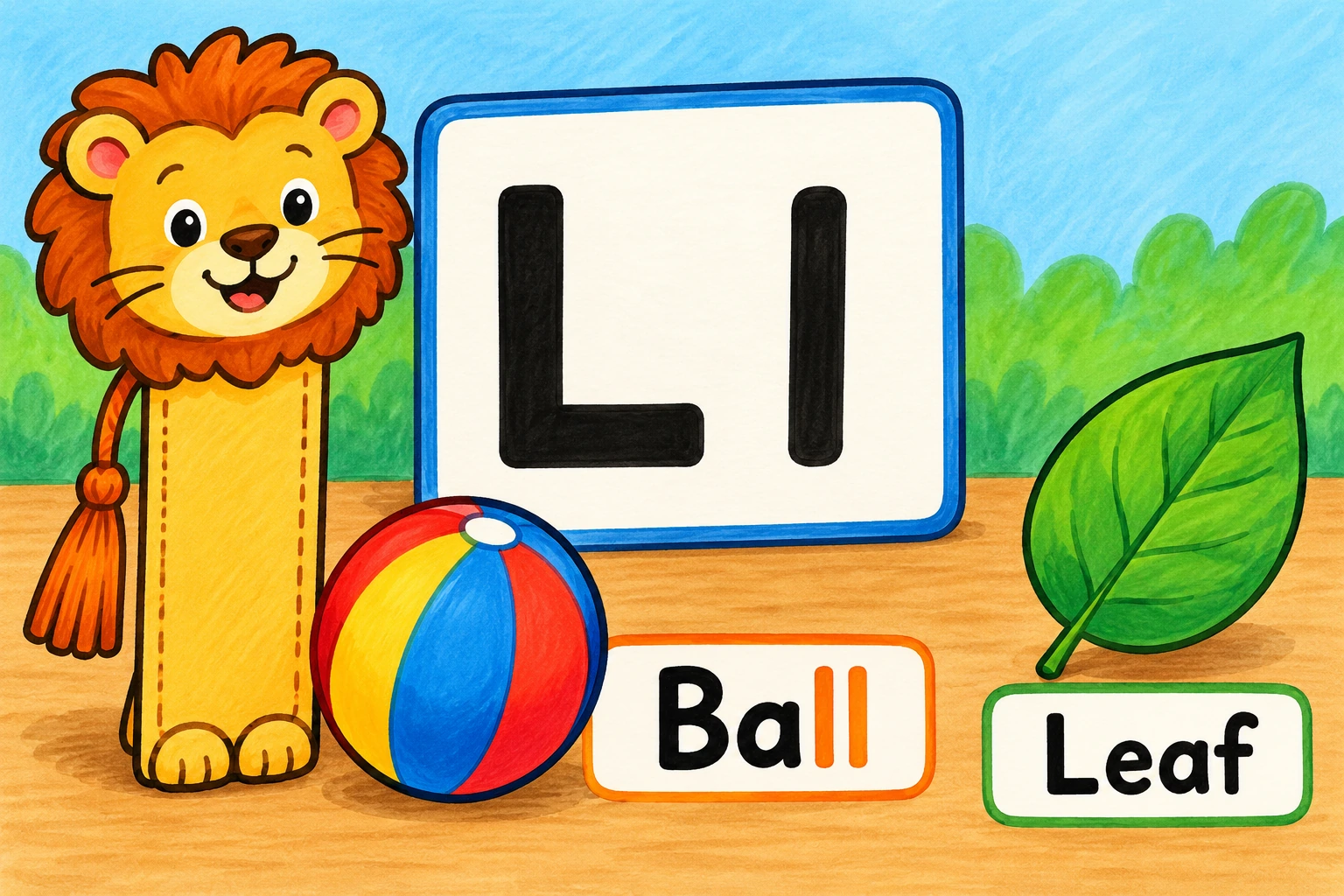
The supporting scene puts Ll beside a lion, a ball and a leaf. Its completed Ball label makes the two l characters conspicuous for discussion. Compare that example with the ordinary black print in Ll Letter Inspector, where the learner must find the targets without colour highlighting.
Trace a little, then inspect the result: Ll Letter Inspector
The practice rows of Ll Letter Inspector contain seven capital guides and eight lowercase guides. Show both rows before choosing how many to try. A child may make one capital with a careful bottom turn, then one lowercase upright, and pause to compare them with the large models.
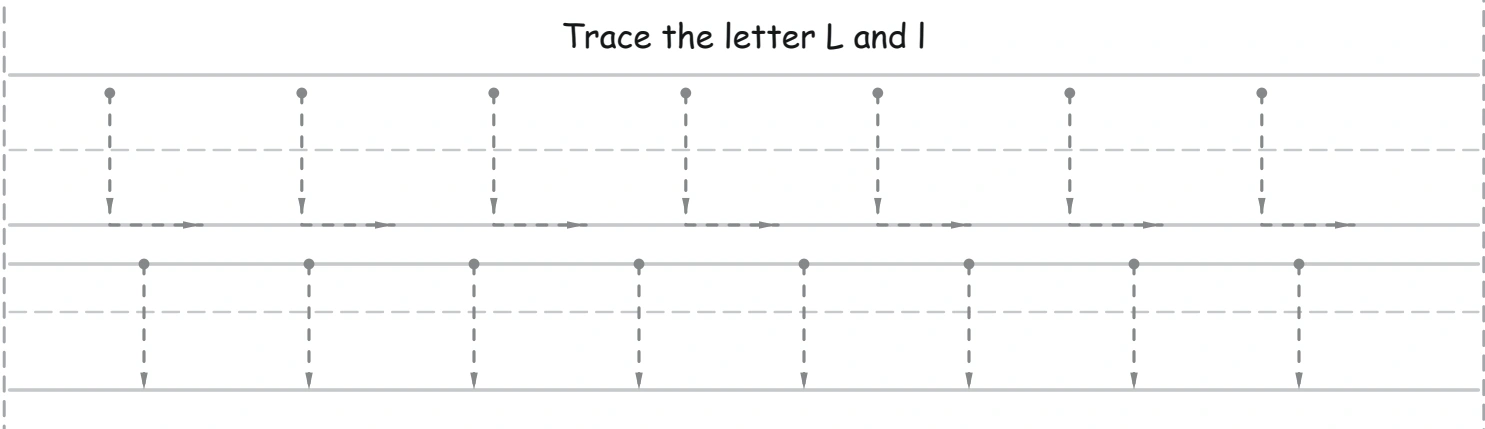
If the capital loses its bottom stroke, point to the model's corner and invite a fresh attempt at the following guide. If the lowercase becomes very short, compare its height with the supplied reference. Avoid correcting every difference in pressure, tilt and spacing simultaneously; the chosen feature needs room for attention.
An adult may hold the page steady or indicate the next printed cue without directing the child's pencil. Finger movement remains an alternative when pencil work is tiring. Ll Letter Inspector offers a sequence of opportunities, not a demand that all fifteen guides be filled before the child can discuss a successful comparison.
The tile field has four L/l visitors: Ll Letter Inspector
Scan the twenty-seven tiles in Ll Letter Inspector with a consistent route. The printed rows have ten, nine and eight characters. Two capital L forms and two lowercase l forms are the targets. Adult checking positions across the whole field are 10, 11, 23 and 24.
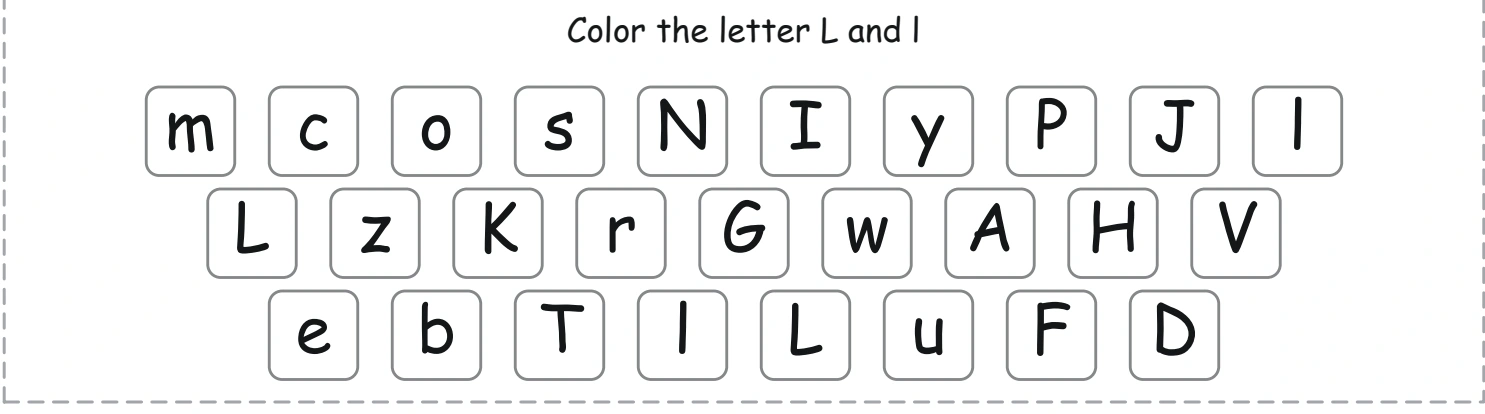
Those positions are an adult reference, not a number exercise added for the child. A pointer can travel through each row while the learner compares shapes with the model. Notice that a match at one row's edge does not remove the need to inspect the next row's beginning. Later, neighbouring targets again reward checking beside an answer.
Ask the learner to show the feature they used. For a capital, the bottom corner is useful evidence. For lowercase l, compare the supplied plain form as a whole. Ll Letter Inspector can include uncertainty: set a candidate beside the model visually, discuss it, and decide together whether the match holds.
A home leaf collection, imagined: Ll Letter Inspector
Picture Lena bringing a leaf to a kitchen table. A family member writes Leaf on a completed card and reads it aloud. Lena compares the opening capital with the one in Lion on Ll Letter Inspector. She sees the same corner in two labels that name different objects.
The adult then sets down a Ball card and asks whether its two final characters look alike. Lena touches both in order and returns to the printed word panel. She can explain the paired ending by pointing, even if reading the complete word still needs adult help.
This imagined home return could take only the time needed for those comparisons. The leaf may become part of a separate drawing afterward. The important continuity with Ll Letter Inspector is the observed letter feature and the habit of checking a neighbour, not a requirement to produce another finished worksheet.
Five short ways to revisit Ll: Ll Letter Inspector
Corner construction: Ll Letter Inspector
Join two strips at a right angle to make L. Compare the finished construction with the capital in Ll Letter Inspector, then place a plain upright strip beside it for lowercase l. Name both before clearing the table.
Ball ending echo: Ll Letter Inspector
Read Ball on a card and touch its two final l characters separately. Invite the learner to echo those two touches. The action makes the repeated print visible without claiming that two written letters require two separate spoken sounds.
Leaf label swap: Ll Letter Inspector
Put a completed Leaf card beside the lion picture and discuss why the object label does not fit. Then return each label to its object and inspect the shared initial L. Meaning and letter identity can be discussed as different observations.
Edge-to-edge inspection: Ll Letter Inspector
Use a pointer to finish one tile row of Ll Letter Inspector and begin the next. Pause only after the next row's first character has been checked. This game addresses the edge positions directly and needs no score.
Explain a pair: Ll Letter Inspector
Ask the child to show a partner the two l characters in Ball. The partner asks which one was found first. The answer may be a gesture, giving the learner a chance to describe a search route in a comfortable way.
Support, common slips and a next visit: Ll Letter Inspector
Around ages three to six, learners may need very different levels of adult participation. Shared pointing can show recognition on Ll Letter Inspector; independently circling and explaining can suit another child. Let the amount of tracing follow hand comfort rather than treating age as a deadline for finishing the rows.
A missed second l calls for a neighbour check. A circled whole word calls for a demonstration around one character on another example. Confusion about the plain lowercase form calls for a direct comparison with the model. These are specific responses, so the adult need not turn one uncertain choice into a broad judgement about attention.
Return to Ll Letter Inspector by asking what was special about Ball, then let the child show it. Another visit may begin with the capital's bottom turn. Small, repeated encounters give an observation time to become familiar. End while the learner can still name or point to something they have noticed, leaving an inviting place to resume.
Printing options and related reading: Ll Letter Inspector
Compare Ll Letter Inspector with Ll Worksheet. A listening follow-up to Ll Letter Inspector is First Sound Choices. For Ll Letter Inspector, explore Mm Worksheet.
For adult planning, NAEYC's material on play can suggest participatory approaches. PBS Parents' literacy collection offers further conversation and reading ideas. Use those resources selectively alongside the child's interests in animals, objects or books.
Download the original Ll Letter Inspector sample using the page controls. Eligible active membership also opens the separately protected clean single-sheet file. In the print preview, keep the outer frame complete and the small lowercase strokes distinct. Check Ball in particular: its two neighbours should remain visibly separate at the chosen scale.
The premium package card points to the $5 Alphabet Wordwork Collection. That separate purchase combines twenty-six clean letter worksheets into one PDF for a fuller sequence of visits. It is distinct from membership access to this individual clean worksheet. The card makes the collection available when a complete A–Z file is the useful next choice from Ll Letter Inspector.
Popular Worksheets
Printable resources families and teachers are downloading now.
 Free
 Free
 Free
 Free