
Xx Letter Sleuth: 3 Brilliant Xylophone-and-Fox Finds
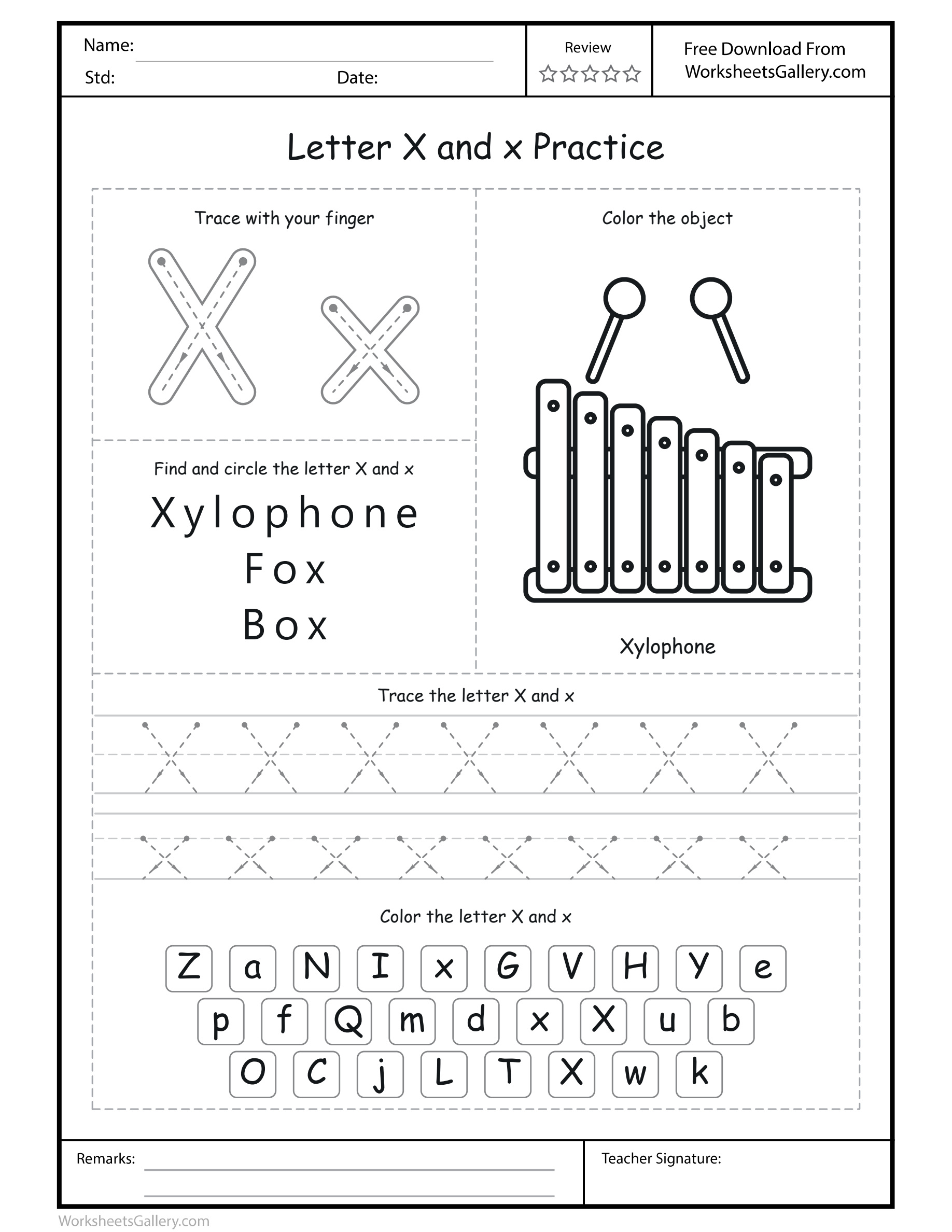
Xx Letter Sleuth belongs to the 26-page collection. Explain that Xylophone begins with a different sound from the final x in Fox and Box.
Xylophone starts with the written letter X, but its opening sound is different from the ending of Fox and Box. Xx Letter Sleuth keeps that distinction clear while inviting children to inspect the printed family. An adult reads the three labels, and the learner finds crossing strokes at an opening or an ending. Large models, a colouring picture, small guides and mixed tiles provide different ways to participate. The visit can include a careful point, a short trace and an explanation, with time to reconsider a candidate instead of chasing a quick finish.
A printed-letter search with an important sound note — Xx Letter Sleuth
Read Xylophone, Fox and Box on Xx Letter Sleuth. Xylophone has capital X first. Fox ends with lowercase x as its third character, and Box also ends with x third. The word panel has three target characters. A small circle around each X or x shows the written evidence more clearly than a loop around a whole label.
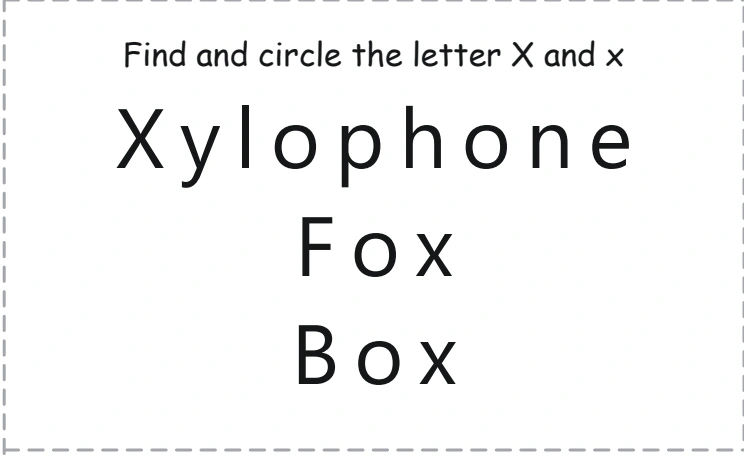
Say Xylophone normally, with its usual initial /z/ sound. Fox and Box have final /ks/. Do not present all three as examples of one shared initial sound. In Xx Letter Sleuth, the child is locating the same written letter family in words with different pronunciation contexts. That is a valid visual task without an added requirement to explain the sound difference independently.
| Read aloud | Where X/x is printed | Adult accuracy note |
|---|---|---|
| Xylophone | First character | The usual opening sound is /z/. |
| Fox | Third, final character | The ending contains /ks/. |
| Box | Third, final character | The ending also contains /ks/. |
An adult can read every label while a learner compares shapes. Independent decoding of the long instrument name is unnecessary. If the child points to F or B, acknowledge the word's beginning and track onward. Xx Letter Sleuth gives both endings an inspection role, with the models available whenever a candidate feels uncertain.
Crossing strokes provide the visual clue: Xx Letter Sleuth
Look at the large X and x models on Xx Letter Sleuth. Two slanting strokes cross, with the capital and lowercase shown in their supplied proportions. Follow the printed start cues and arrows with a finger, noticing where the second movement meets the first.
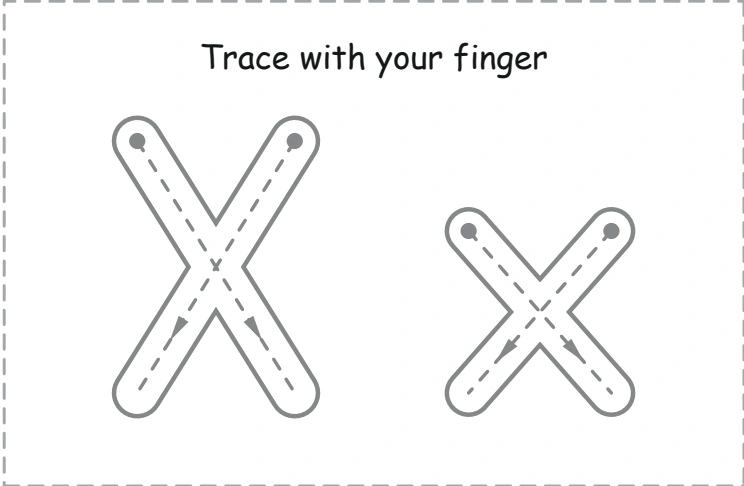
If an attempted form has two separated slants, compare the meeting point. If the strokes only touch at an end, look at the crossing in the model. Keep the discussion on one visible feature. A learner can show the central intersection without needing formal geometric language.
Name the two cases together rather than identifying them only by physical size. Xx Letter Sleuth offers a family comparison across the page's different print contexts. Finger tracing can introduce the route before pencil pressure and guide size add further demands, with the source cues remaining the movement reference.
A classroom instrument store, imagined: Xx Letter Sleuth
Imagine Xavi helping label a pretend instrument store. The teacher reads Xylophone on a completed card beside a toy instrument. Xavi matches its first X with Xx Letter Sleuth. A fox puppet and a storage box arrive with Fox and Box labels, which the adult also reads aloud.
Xavi initially searches the labels' beginnings. The teacher tracks Fox through to its ending and asks him to compare the final character with the lowercase model. Box supplies another ending in the same position. The teacher reads the words naturally, without trying to force Xylophone's opening into a /ks/ sound.
The children next choose a capital X guide from Xx Letter Sleuth. This imagined store keeps spoken word reading with the adult and visible letter choices with the child. It does not require a learner to spell the instrument name or explain pronunciation notation before making a useful discovery.
Six clues a sleuth can use: Xx Letter Sleuth
Print and sound can be discussed separately. Xx Letter Sleuth shows the same letter family in labels with different pronunciation contexts. An adult can preserve accuracy while keeping the child's task visual.
Endings deserve inspection. Fox and Box reward tracking beyond their first characters. The learner can demonstrate that route with a finger before making any circle.
Cases can be connected. Naming capital X and lowercase x links their identity across the panel. The child can compare proportions without assuming physical size alone determines case.
A crossing is concrete evidence. The central intersection gives a reason for accepting a candidate. Xx Letter Sleuth lets the adult ask what feature was noticed rather than simply requesting another guess.
Movement can be previewed. Finger tracing rehearses two slants and their meeting. This can make the later pencil attempt more understandable without demanding an immediately perfect copy.
Revision can follow evidence. An uncertain answer can be checked against the model. A changed choice is useful when the learner can point to the feature that changed their mind.
Colour the instrument with a free palette: Xx Letter Sleuth
The xylophone drawing on Xx Letter Sleuth offers several visible bars and separate mallets to colour. The source gives no fixed colour code. A child may invent a bar pattern or choose a few favourite colours, with the creative decision kept separate from letter-search accuracy.
Read the instrument name again if the learner asks about it. A brief conversation about playing music can follow, while any extra adult-written caption stays on separate paper. Preserve the original word panel so its three target positions remain easy to compare after the picture interval.
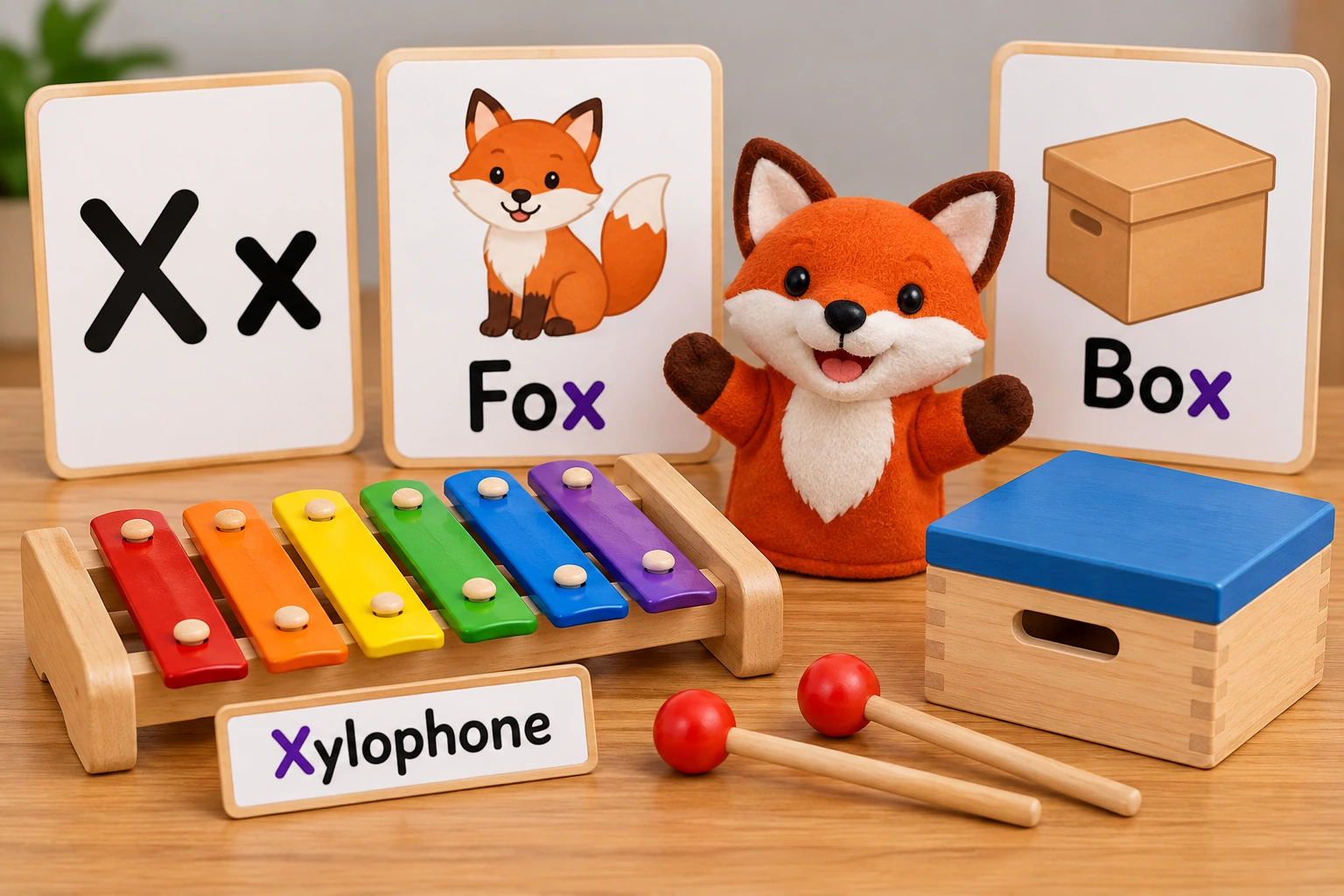
The supporting toy-instrument scene includes completed Xylophone, Fox and Box labels and an X/x reference. It makes the two final x characters conspicuous for discussion. Return to ordinary source print on Xx Letter Sleuth, where the learner can locate those endings without relying on the colour cue.
Choose a few crossing movements: Xx Letter Sleuth
The handwriting area of Xx Letter Sleuth provides seven X guides along with eight x guides. Inspect their movement cues and select a small number. Try an X and an x, then inspect where their strokes meet. That comparison can guide the next amount of pencil practice.
If the strokes fail to meet, compare their intersection with the large model. If the guide feels too small at first, use a broader finger movement on the table and then return. Keep the sheet anchored and pressure comfortable. A single clear comparison is more actionable than several simultaneous corrections about tilt, width and speed.
Invite the learner to show a mark with a visible crossing. It can vary from the model and still support a useful discussion. Xx Letter Sleuth leaves further guides available for another visit, allowing handwriting practice to be spread across comfortable intervals rather than becoming a one-sitting completion requirement.
Four X/x matches in the lower field: Xx Letter Sleuth
Twenty-seven mixed tiles appear on Xx Letter Sleuth. The first row contains ten characters, the next nine and the last eight. Two capital X forms and two lowercase x forms make four matches. Adult checking positions across the field are 5, 16, 17 and 25.
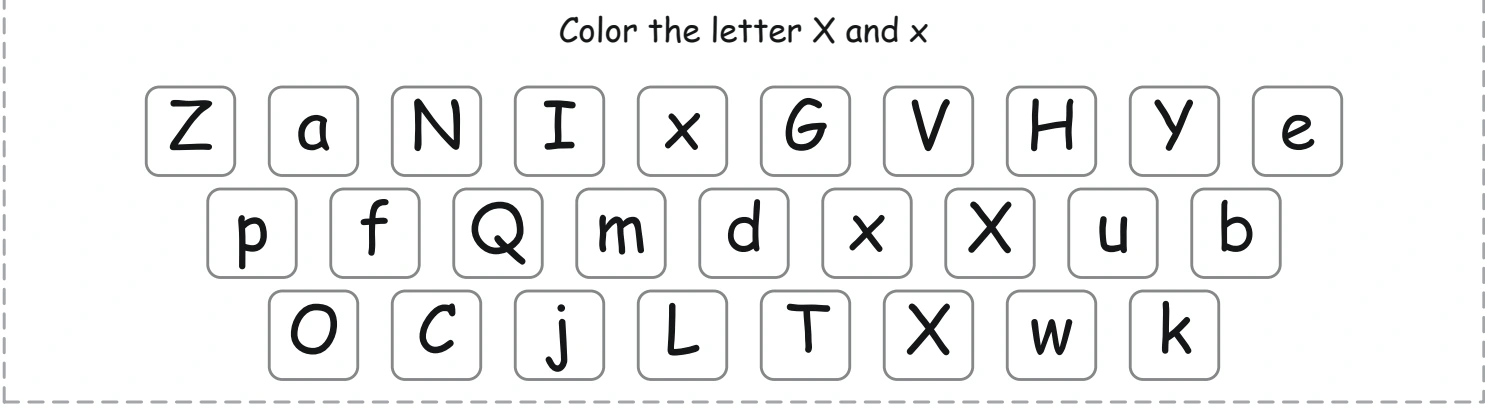
Children can inspect the print visually without calculating those coordinates. Keep the large models visible and compare each candidate's complete outline. The neighbouring targets in the middle row give a practical reason to inspect the next character after a successful circle rather than moving away immediately.
Ask where the strokes cross and whether the full form matches. A slanted fragment alone is not enough evidence. Xx Letter Sleuth supports a model-based second look whenever a quick impression is uncertain. A pointer next to the current tile can hold the route while the learner looks back at the reference.
A home box label, imagined: Xx Letter Sleuth
Picture Xavi putting toys into a small box with a family member. The adult writes Box on a completed card and reads it. Xavi follows the word to its end, points to x and compares it with the lowercase model on Xx Letter Sleuth. A Fox card gives the same ending position another context.
The family member then reads Xylophone and shows its opening X. “The written letter matches, while the word sounds different here” is enough explanation for this visit. Xavi can point to the shared crossing strokes without being asked to imitate an inaccurate sound pattern.
This imagined home return may finish with a finger trace or one selected guide. The box label has a practical purpose, while the worksheet remains a clear reference. A later encounter can revisit the neighbouring middle-row tiles, keeping the letter family familiar through a different starting task.
Five sleuth games with completed print: Xx Letter Sleuth
Box ending inspector: Xx Letter Sleuth
Read a finished Box card and move a token beneath its characters to x. Remove the token and find the same final character on Xx Letter Sleuth. The adult keeps the complete word available through reading.
Fox partner: Xx Letter Sleuth
Place Fox beside Box and compare their endings. Ask the learner to show the shared letter rather than read both words alone. A gesture can demonstrate the relationship clearly.
Crossing workshop: Xx Letter Sleuth
Arrange two strips into a completed X beside the supplied model. Point to the intersection and compare it with the printed form. Clear the strips before following the source arrows for a trace.
Instrument name guide: Xx Letter Sleuth
Read Xylophone normally beside an instrument picture. Invite the child to show its initial X and compare it with Xx Letter Sleuth. Keep the /z/ opening accurate instead of turning the game into a false common-sound lesson.
Neighbour replay: Xx Letter Sleuth
After a middle-row match, inspect the following tile. Partners can alternate pointing and model checking. The purpose is complete comparison, with no timer and the reference kept freely available whenever a partner wants another look.
Support a precise next action: Xx Letter Sleuth
For children roughly three to six, Xx Letter Sleuth can involve shared pointing, assisted circles or more independent inspection. A learner may identify x before controlling its pencil crossing comfortably. Choose a response method that shows the visual decision, and address the X/x pencil route as its own supported activity.
If the search stops at openings, track Fox or Box to the end. A whole-label loop calls for another X/x example showing the intended character circle. If the strokes do not cross, compare the meeting place. If Xylophone is given a false /ks/ opening, read it naturally and explain that the written-letter task does not require identical sounds.
Return to Xx Letter Sleuth with a remembered feature, such as the crossing or the shared final position. Short regular encounters can alternate talk, colour and tracing. Finish with a detail the learner can show, preserving a comfortable starting point for another day rather than insisting on a complete repeat.
Download routes and further resources: Xx Letter Sleuth
Compare Xx Letter Sleuth with Xx Worksheet. A listening follow-up to Xx Letter Sleuth is First Sound Choices. For Xx Letter Sleuth, explore Yy Worksheet.
For adults considering another playful extension, NAEYC's play resources offer background ideas. Shared reading and language activities are also available through PBS Parents' literacy pages. Select a relevant idea when it fits the learner's interest in music, animals or labelled objects.
The original Xx Letter Sleuth sample is offered by the page's controls. Eligible active membership gives access to a separate protected clean single-sheet PDF. Before printing, inspect the complete frame and ensure that the small crossing strokes remain clear. A comfortable scale helps the learner compare precisely the feature discussed throughout this page.
The premium collection card leads to the $5 Alphabet Wordwork Collection, a separate purchase combining twenty-six clean A–Z sheets into one PDF. That file supports a complete sequence when wanted. Purchasing that X/x collection option does not replace the separate member route to this single sheet, with the direct collection route available from Xx Letter Sleuth.
Popular Worksheets
Printable resources families and teachers are downloading now.
 Free
 Free
 Free
 Free