
Mm Letter Mapper: 3 Wonderful Moon-to-Drum Stops
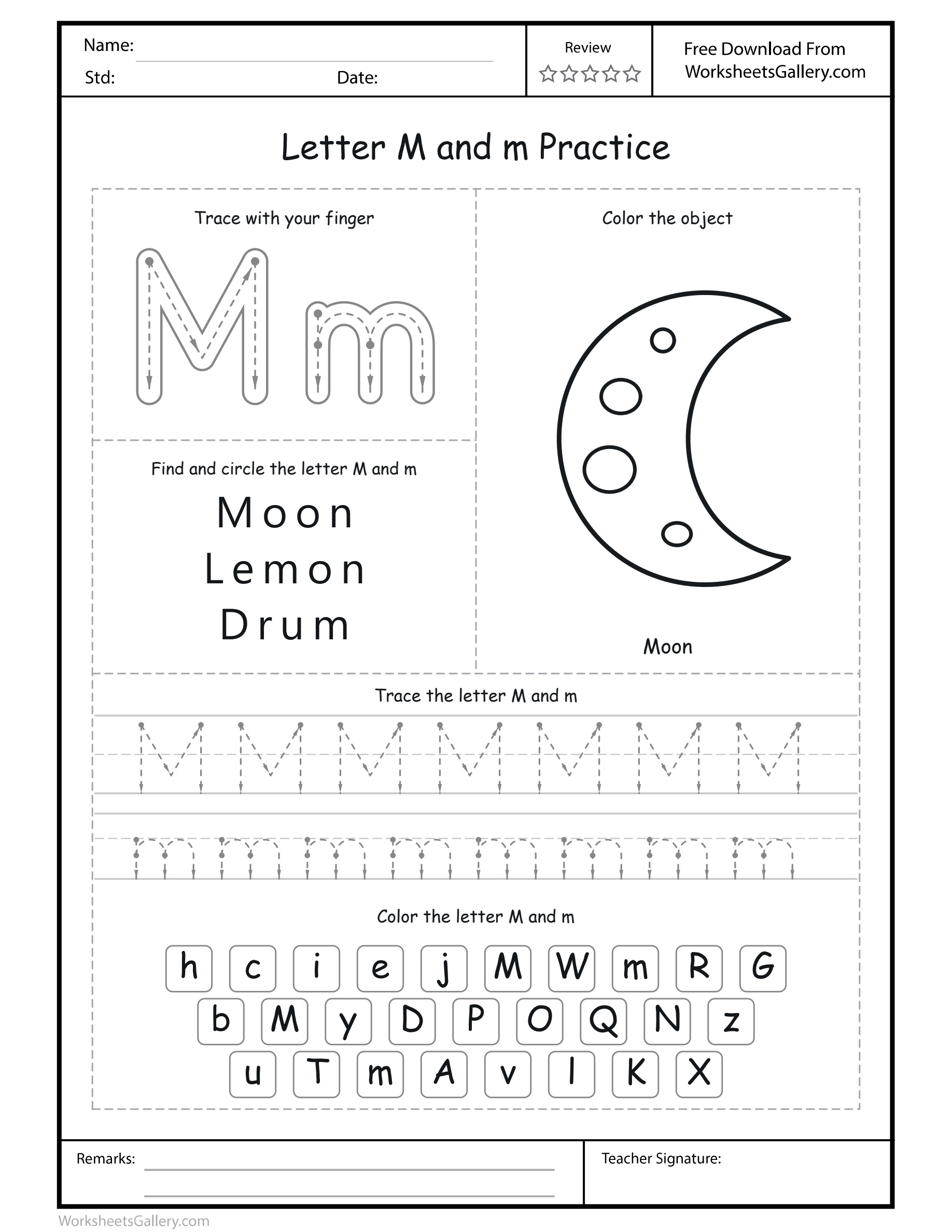
Mm Letter Mapper belongs to the 26-page collection. Use Moon, Lemon and Drum to locate M/m at three different word positions.
Moon starts with M, Lemon holds m inside, and Drum saves m for its ending. Mm Letter Mapper makes that changing position the heart of a shared letter activity. A child can follow the printed forms, colour the moon, inspect word labels and search mixed tiles while an adult supplies the reading. The capital's diagonal joins and the lowercase arches offer different features to discuss. With a manageable amount of tracing and time to explain a discovery, the page can become a thoughtful preschool visit rather than a hurried finishing task.
A letter travels through three labels — Mm Letter Mapper
Read Moon, Lemon and Drum in the word panel of Mm Letter Mapper. Touch the printed characters as you read, then ask where M or m appears. Moon has capital M first. Lemon has lowercase m third. Drum has lowercase m fourth and last. Each label contributes one target, making three in the explicit word search.
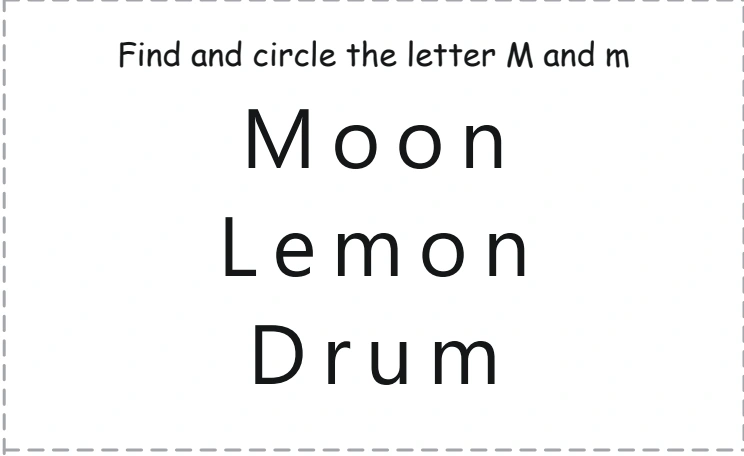
Use a small circle around the letter itself. The activity does not ask for a circle around every whole word that contains the target. If the child recognises the picture name but cannot locate m, hold the large model close to the label and compare. Knowing a spoken word and identifying its printed parts are different tasks.
| Word on the page | M/m location | A question to share |
|---|---|---|
| Moon | Opening character | Which capital begins this label? |
| Lemon | Third character | What sits after e? |
| Drum | Final character | Did your search reach the end? |
The sequence gives Mm Letter Mapper a beginning, interior and ending comparison without introducing a new list of words. Let the child revisit the labels in another order. A learner who finds m in Drum before returning to Moon is still making a useful connection between the two cases.
A moon mobile at home, imagined: Mm Letter Mapper
Imagine Miro making a simple mobile with a family member. They use finished cards reading Moon, Lemon and Drum, each attached beside a corresponding picture. The adult reads the labels and opens Mm Letter Mapper. Miro matches the first M in Moon, then looks at the beginnings of the other cards and pauses.
The family member slides a finger through Lemon and asks what comes after e. Miro compares the third character with the lowercase model. Drum becomes a chance to keep searching to the word's end. He can point rather than circle if the hanging cards are awkward to mark.
Returning to Mm Letter Mapper, Miro chooses which printed word to show another person. The adult describes his route: he checked more than the first character. This imagined home use needs no elaborate mobile to work; the completed labels alone can provide the same supported comparison on a table.
Diagonal joins and two small arches: Mm Letter Mapper
The large capital model on Mm Letter Mapper uses joined diagonal movement within its upright structure. The lowercase m presents two arches. Compare those features while naming the same letter family. Do not ask the learner to count humps on every unfamiliar font; the supplied model is the reference for this particular visit.
Trace with a finger according to the start cues and arrows. An adult can point to the next change of direction while the child controls the movement. For m, notice that one arch does not complete the printed form. If the attempt stops early and resembles n, compare the model's remaining arch before trying another movement.
The seven M practice guides alongside eight m examples in Mm Letter Mapper offer repeated opportunities. Pick a few rather than automatically requiring the whole area. A child can practise a capital, compare its joins, then switch to an m and notice the different motion. Keep the paper stable and the hand relaxed.
Six outcomes that can be seen or heard: Mm Letter Mapper
Position flexibility. Moon, Lemon and Drum move the target through different parts of a word. Mm Letter Mapper lets a learner demonstrate that a known letter remains recognisable away from the first position.
Case connection. Naming M and m together links the prominent capital with the smaller interior and final forms. The association can be shown through pointing before writing is comfortable.
Arch completion. Comparing two m arches with a one-arch attempt makes a correction specific. The adult can ask what is still missing rather than describing the whole attempt as wrong.
Direction planning. The capital's joins and lowercase curves require attention to different routes. Finger tracing on Mm Letter Mapper gives the learner time to preview those routes without managing pencil pressure as well.
Explanatory vocabulary. First, inside, last and after help a child describe print evidence. An adult can accept gestures and add the matching word naturally.
A review habit. Checking the model after uncertainty provides a practical strategy. A changed answer can show that the comparison became more complete, which is useful to notice explicitly.
Colour the moon without a hidden code: Mm Letter Mapper
The moon drawing on Mm Letter Mapper is available for free colouring. There is no required palette or number-colour key. A learner may choose a warm moon, a cool moon or an invented pattern. Ask which part they want to colour and what story the picture suggests.
Read Moon again if the child wants to connect the drawing with its label. Keep that conversation brief enough to preserve the colouring choice. A child absorbed in the picture can return to small symbols later. The object is part of the page's invitation, not a prize withheld until every search and guide is complete.
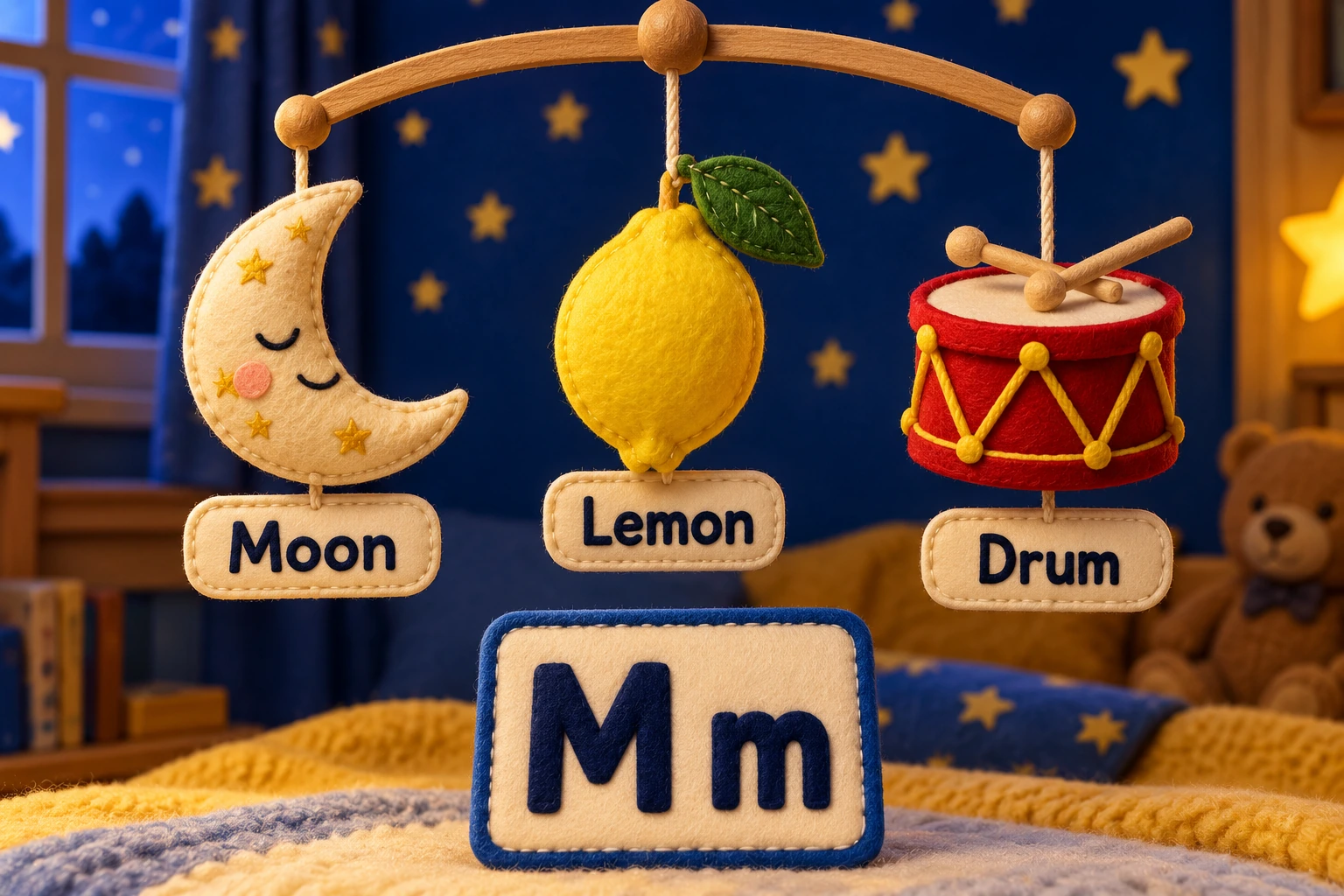
The supporting illustration groups Moon, Lemon and Drum in a different completed display. It can encourage conversation about where m occurs, then lead back to the ordinary print on Mm Letter Mapper. The worksheet's uncropped preview shows the actual activity layout; the illustration supplies a separate visual example for discussion.
Four matching tiles across three rows: Mm Letter Mapper
The tile field in Mm Letter Mapper contains twenty-seven characters: the upper line has ten, the central line nine, and the last line eight. Its M/m answer set has two of each case. Adult checking positions across the field are 6, 8, 12 and 22. A child can search by following each row visually without being asked to calculate a tile number.
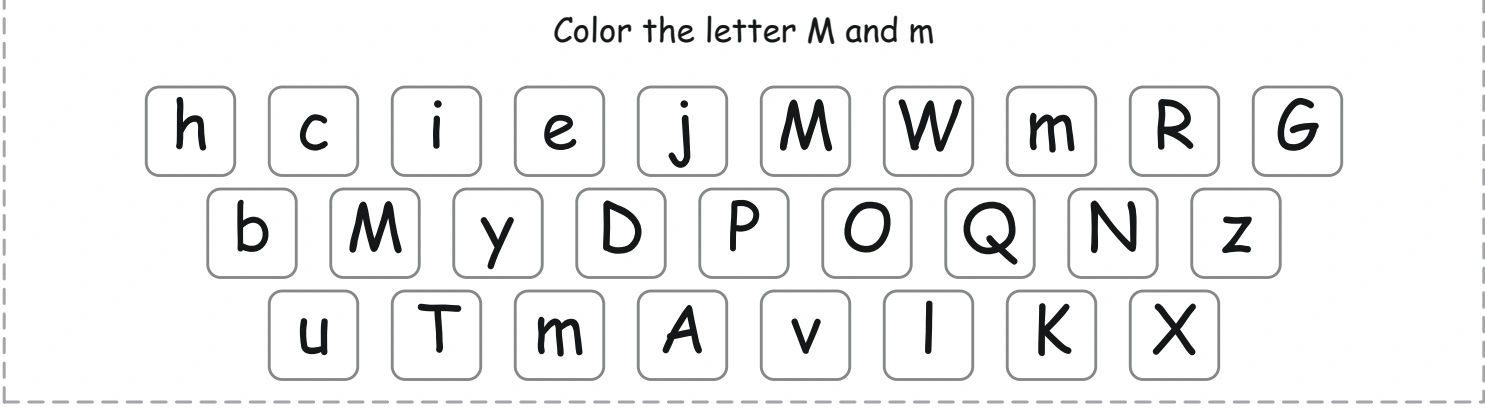
Compare a candidate with the complete model. For lowercase m, look for both arches. For the capital, check the joined internal diagonals as well as the outer strokes. A character sharing one upright is not automatically a match. Ask which M/m feature justified that selection.
Continue after a discovery. The first row has more than one target, so a single successful circle does not finish that row's inspection. Mm Letter Mapper allows an adult to model a steady route: inspect, mark if appropriate, and move to the following character. A movable pointer can keep the place during a glance back at the model.
A class sound table, imagined: Mm Letter Mapper
Picture Miro at a classroom table with a small drum, a moon picture and a lemon model. The teacher reads completed labels before anyone searches. Miro taps the drum once, then finds the final m in Drum on Mm Letter Mapper. The tap is simply a playful connection to the object, not a signal that the letter occurs first.
Another child shows m inside Lemon. Miro compares its two arches with the model and then points to M in Moon. The teacher invites a spoken explanation or a gesture about where each target sits. Adult reading keeps the printed search open to children who know the objects but are still learning to read their labels.
The group finishes with a chosen handwriting guide rather than a race through the rows. The teacher notes whether Miro checked both arches and whether he inspected the end of Drum. This imagined scene makes the observation specific enough to guide a later return to Mm Letter Mapper.
Five Moon–Lemon–Drum games: Mm Letter Mapper
Mobile inspector: Mm Letter Mapper
Lay three completed labelled pictures on a table as a flat mobile. Read each and let the learner place an M/m reference beside its target. Return to Mm Letter Mapper and show the same positions in its word panel.
Arch workshop: Mm Letter Mapper
Use two curved cords to suggest the arches of m beside its stem. Compare the finished arrangement with the printed lowercase model. Naming the two arches can prepare a finger trace, while the worksheet's arrows remain the handwriting guide.
Last-letter drumbeat: Mm Letter Mapper
Read Drum, move through its print and make one gentle tap after locating the final m. Keep the entire label visible. This Mm Letter Mapper activity rewards reaching the ending rather than guessing a target from the picture alone.
Inside visitor: Mm Letter Mapper
Put a token just beneath m on a completed Lemon card. Ask what letters sit before and after it if the learner is interested. Naming those neighbours is optional; locating m is the central Mm Letter Mapper connection.
Model tour: Mm Letter Mapper
Invite the child to show a partner how M and m look different. A finger can follow one diagonal join and one arch. The partner then points to a tile for comparison, giving the explanation an immediate use.
When a small change is enough: Mm Letter Mapper
For learners roughly three to six, Mm Letter Mapper can support shared pointing, adult-assisted circling or a more independent search. A child with emerging hand control might explain an interior m without tracing it yet. Another may enjoy the handwriting and need support scanning labels. Choose the next action from the observation in front of you.
If m becomes n, compare the second arch. If a word is circled entirely, demonstrate a character-sized loop on a separate example. If Lemon seems to contain no target, track beyond its opening. If a tile row is abandoned after one match, place a pointer at the next character and resume. Each response has a visible purpose.
On a return to Mm Letter Mapper, ask which word saved m for the end, or begin with a finger trace of the lowercase arches. Keep the session short enough for the child to remain willing to compare. Regular encounters can include conversation and play as well as marks; a finished sheet alone does not establish lasting mastery.
Reading connections and download routes: Mm Letter Mapper
Compare Mm Letter Mapper with Mm Worksheet. A listening follow-up to Mm Letter Mapper is First Sound Choices. For Mm Letter Mapper, explore Nn Worksheet.
Adults interested in playful learning can use NAEYC's play resources for further ideas. PBS Parents' literacy resources provide other starting points for family book conversations. Select an idea that fits the child's interest in the three objects rather than adding unrelated tasks to this page.
The original Mm Letter Mapper sample is offered through the download controls. Eligible active members can access the separately protected clean individual PDF. Inspect the print preview before printing: keep the frame complete and check whether the small m arches remain distinct. A comfortable scale helps the learner compare the features discussed here.
The linked premium collection card leads to the separate $5 Alphabet Wordwork Collection, which contains the twenty-six clean A–Z sheets in one combined PDF. It provides a route to a fuller sequence when needed. Membership access to the individual clean sheet and purchase of the complete collection are different options linked from Mm Letter Mapper.
Popular Worksheets
Printable resources families and teachers are downloading now.
 Free
 Free
 Free
 Free