
Nn Letter Gatherer: 4 Joyful Nest-and-Banana Finds
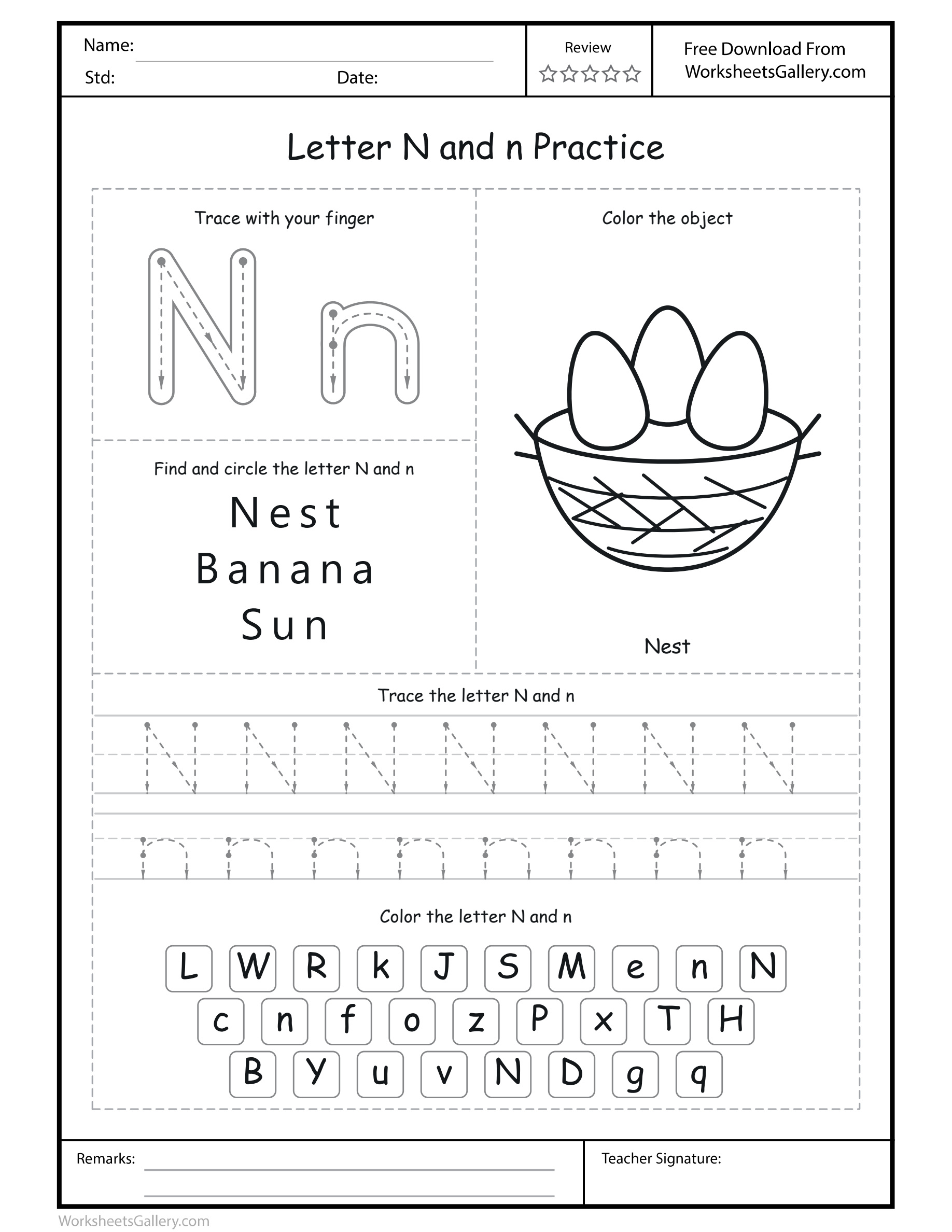
Nn Letter Gatherer belongs to the 26-page collection. Inspect both n letters in Banana while separating a single lowercase arch from m.
Banana offers two n letters, with another character between them. Nn Letter Gatherer invites a child to gather both instead of stopping after the first find. Nest introduces the capital at the front of a label, while Sun places lowercase n at the end. Large movement models, a nest picture, handwriting guides and mixed tiles provide several ways into the same letter family. An adult reads alongside the learner, leaving attention free for shape and position. There is space for a thoughtful pause, a colour choice and a useful second look.
Gather the separated pair in Banana — Nn Letter Gatherer
Read the explicit word-search labels in Nn Letter Gatherer: Nest, Banana and Sun. Nest has N at its opening. Banana contains n as its third and fifth characters. Sun ends with n at position three. Four target characters are available across the three labels, and each can receive its own small circle.
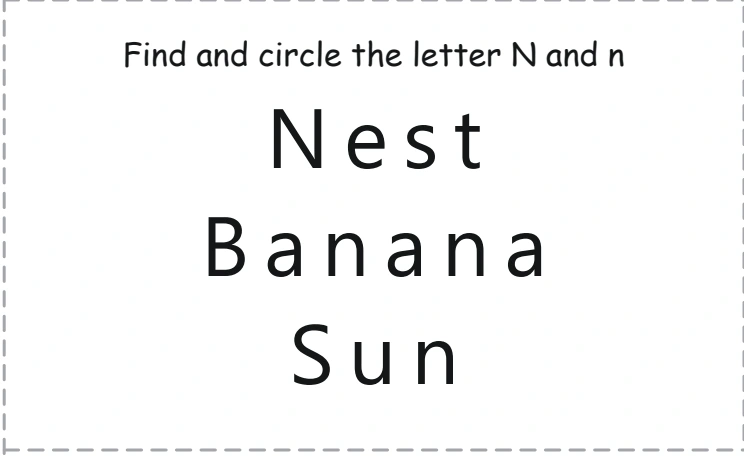
The Banana pair is not adjacent. Move a finger through the label slowly enough to notice the a between the two n forms. After finding the first n, ask which character comes next and whether the search has reached the end. This gives continuing attention a specific route on Nn Letter Gatherer, with the complete word still visible as evidence.
| Label | Targets to inspect | What makes it useful |
|---|---|---|
| Nest | N at 1 | A capital opening |
| Banana | n at 3 and 5 | Two separated lowercase matches |
| Sun | n at 3 | A target at the ending |
Adult reading is welcome throughout Nn Letter Gatherer. A child can recognise the target shape before reading Banana independently. Say the whole word, name N, and invite comparison. Avoid requiring the learner to spell all six characters or explain every sound before allowing a correct visual discovery to count.
A nest with a diagonal companion: Nn Letter Gatherer
The large pair on Nn Letter Gatherer contrasts a capital N containing a diagonal with a lowercase n containing one arch. Follow the supplied start marks and arrows with a finger. Point to the part that changes direction, then name both forms as members of the same family.
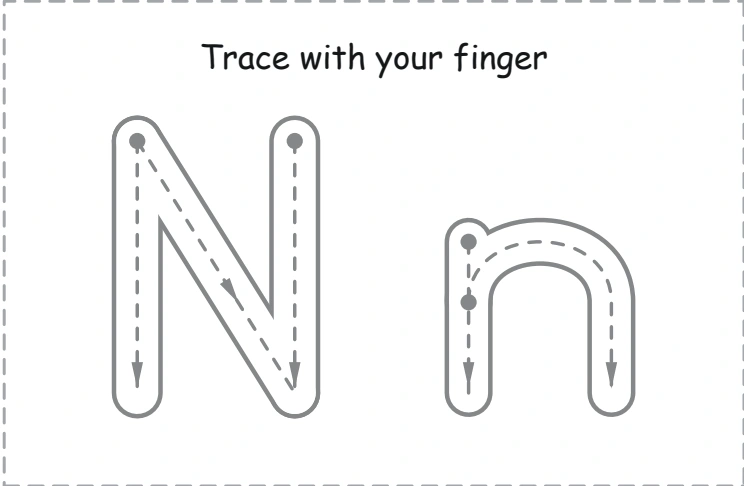
The lowercase arch can be compared with m when that confusion actually arises. Use the visible n model to show the single arch rather than giving a long lecture about several other letters. A child who has drawn another hump can inspect the model and choose a fresh guide for another attempt.
For capital N, notice how the diagonal connects the upright parts. A learner does not need formal angle language to describe that slant. “Across to the other side” can accompany a finger movement if it matches the printed route. In Nn Letter Gatherer, the movement cues and the model work together as a local reference.
An imagined class collection shelf: Nn Letter Gatherer
Imagine Nadia helping label a classroom nature shelf. The teacher provides a completed Nest card and reads it aloud. Nadia finds its first N and compares it with Nn Letter Gatherer. A Banana card is placed beside a snack picture, and Nadia locates the first lowercase n but assumes the label is finished for this search.
The teacher keeps a finger just beyond the circle and asks Nadia to continue. She passes a and discovers another n. They discuss the gap between the pair: both are targets even though they do not touch. Sun becomes a final label to inspect all the way to its ending.
Nadia can show her findings through pointing while a partner makes the circles, then exchange roles on a later visit. This imagined activity gives cooperation a clear structure. It does not make independent decoding or a full row of handwriting a condition for using Nn Letter Gatherer meaningfully.
Six reasons the separated pair is valuable: Nn Letter Gatherer
Search continuation. Banana asks the learner to resume after a successful match. Nn Letter Gatherer makes it possible to observe whether attention continues through the intervening character.
Case recognition. Nest's capital can be linked with the lowercase targets in two different labels. Naming N and n together supports the family relationship without ignoring their outlines.
Arch discrimination. A single lowercase arch offers a feature to compare. If m is selected, the adult can show the extra arch rather than simply replacing the answer.
Direction awareness. The capital diagonal and lowercase curve require different planned movements. Finger work on Nn Letter Gatherer allows those routes to be previewed before pencil control is added.
Position talk. Between, after, first and last help the learner describe exactly where a target was found. An adult may add those words to a gesture, keeping explanation accessible.
Review ownership. Discovering a missed second n through checking gives the child an active role in improving an answer. The useful strategy can be named and revisited later.
Colour a nest, tell a small story: Nn Letter Gatherer
The nest drawing on Nn Letter Gatherer carries no fixed colour instructions. Let the child choose its appearance and talk about what the picture might shelter. A patterned or unusually coloured nest is a creative response, with no bearing on the accuracy of the letter search beside it.
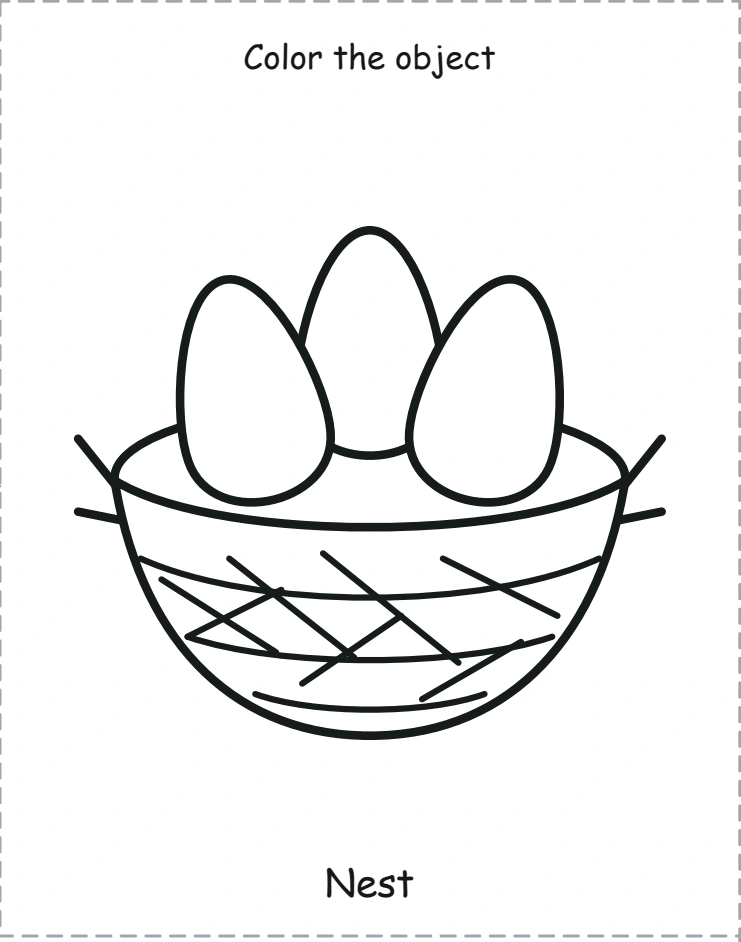
An adult can read Nest again and point to its capital if the conversation naturally returns to print. Keep any extra written story on separate paper so the original word panel remains easy to inspect. Colouring can be a restful interval, especially after a careful search through Banana's separated pair.
Handwriting with one arch in mind: Nn Letter Gatherer
The tracing section of Nn Letter Gatherer supplies seven capital guides followed by eight lowercase guides. Preview their different forms, then choose a modest amount of practice. A learner may trace two n examples and compare their single arches before deciding whether to continue.
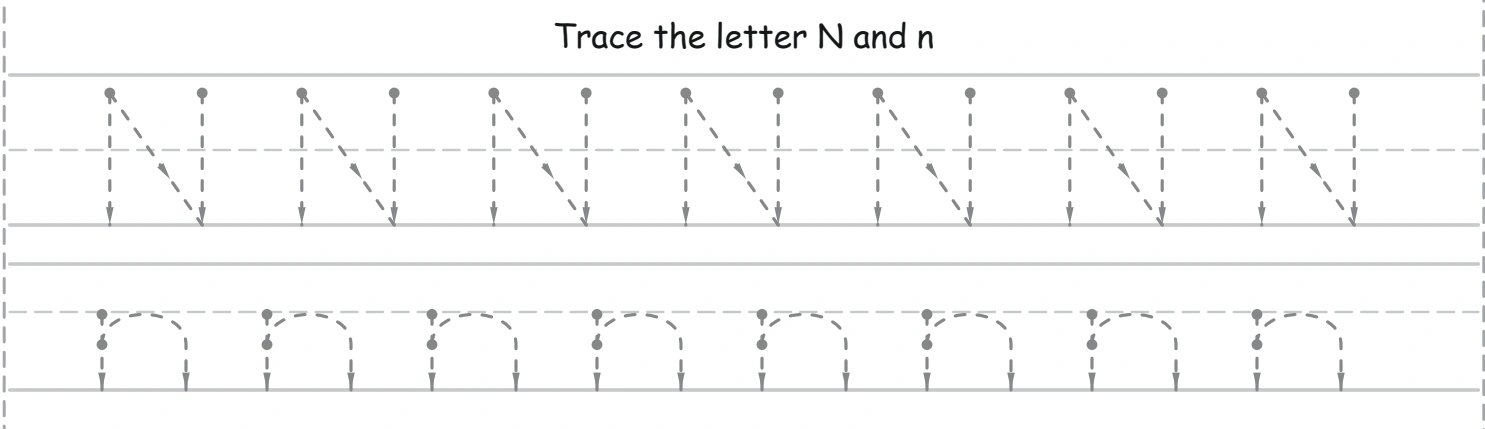
If a capital loses its diagonal connection, revisit that part of the large model. If lowercase n grows an extra arch, stop beside the guide and compare the whole shape. Select one issue rather than correcting direction, pressure, size and spacing in the same breath. A comfortable pencil and steady paper give the chosen feature more attention.
Use a fresh guide for another attempt where possible. The earlier mark can remain as a record of what was tried. Nn Letter Gatherer has enough opportunities for practice to be spread over short encounters; completing all fifteen does not need to become the central goal of one session.
Find four family members in the tiles: Nn Letter Gatherer
The lower search field on Nn Letter Gatherer contains twenty-seven characters, with ten on its top line, nine on the next and eight at the bottom. N/n contributes four targets split evenly by case. For adult checking, whole-field positions 9, 10, 12 and 24 hold the targets. Children can follow the rows visually and compare each candidate with the models.
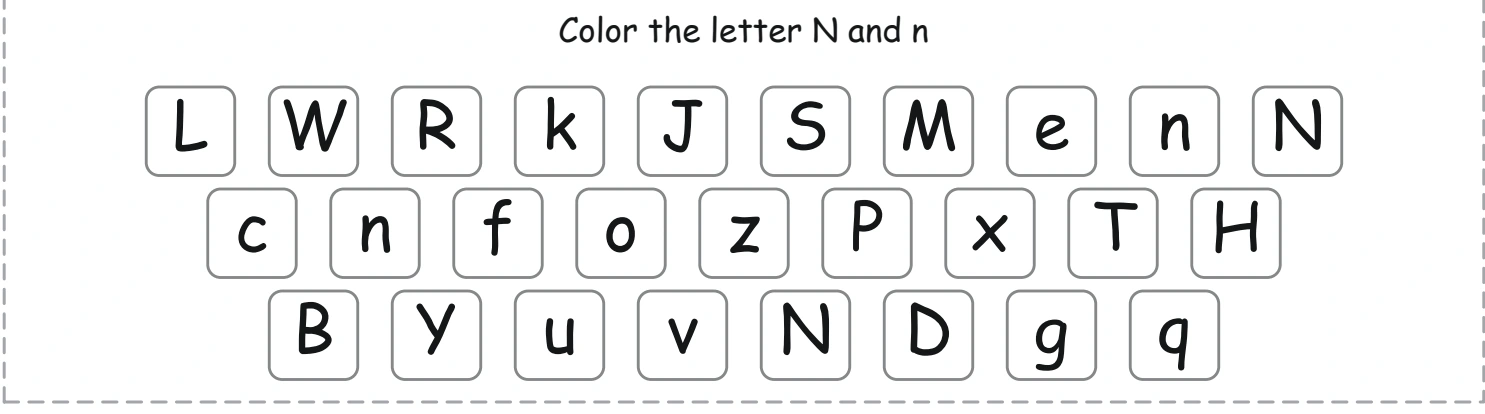
The first row's neighbouring matches reward inspection right to its edge. The next row still needs its own start. Place a pointer at the next N/n candidate before consulting the large pair, then resume from that marked place. Do not turn the adult coordinates into a separate counting demand.
For lowercase choices, check the full arch rather than accepting any upright-and-curve shape. For capitals, look for the N diagonal. Nn Letter Gatherer allows a brief conversation about why a candidate fits. If the reason does not hold against the model, the child can revise the selection with support.
Five gathering games for Nn: Nn Letter Gatherer
Banana stepping stones: Nn Letter Gatherer
Write Banana as a completed word on a long card. Move a token beneath its characters, stopping at each n. Keep the intervening a visible. Return to Nn Letter Gatherer and show the same separated pair in ordinary print.
Single-arch builder: Nn Letter Gatherer
Use an upright strip and one curved cord to suggest n. Compare the finished arrangement with the lowercase model. The construction is a shape discussion, while the worksheet arrows remain the reference for tracing direction.
Nest nameplate: Nn Letter Gatherer
Place a completed Nest label beside a nest picture and read it together. Invite the child to find N before moving the label back to the word panel. The object supports meaning without supplying the letter answer automatically.
Sun ending stop: Nn Letter Gatherer
Read Sun, then track its print from S to n. Pause at the last character and compare it with n on Nn Letter Gatherer. This short routine makes the word's ending worth checking.
Row-edge partners: Nn Letter Gatherer
One partner points through the tile row while another checks against the models. Continue through the last character, then exchange roles. The adjacent edge targets give the pair a practical reason to complete their inspection.
A home fruit note, imagined: Nn Letter Gatherer
Picture Nadia helping a family member prepare a fruit note. The adult writes Banana on a completed card and reads it. Nadia finds one n, then remembers to keep going. She touches a and reaches the second n, showing the family member that the pair is separated.
They compare the card with Banana in Nn Letter Gatherer, then look at Sun's final n. Nadia may explain the difference with gestures: two touches inside one word and one touch at another word's end. The adult can describe the comparison without asking for a written explanation or a lesson on word spelling.
This imagined return can finish with the child choosing one n guide to trace. The fruit note remains a real reason to look at print, while the worksheet provides the clear model. A later visit might begin with the capital diagonal instead, keeping the letter family familiar through a new starting point.
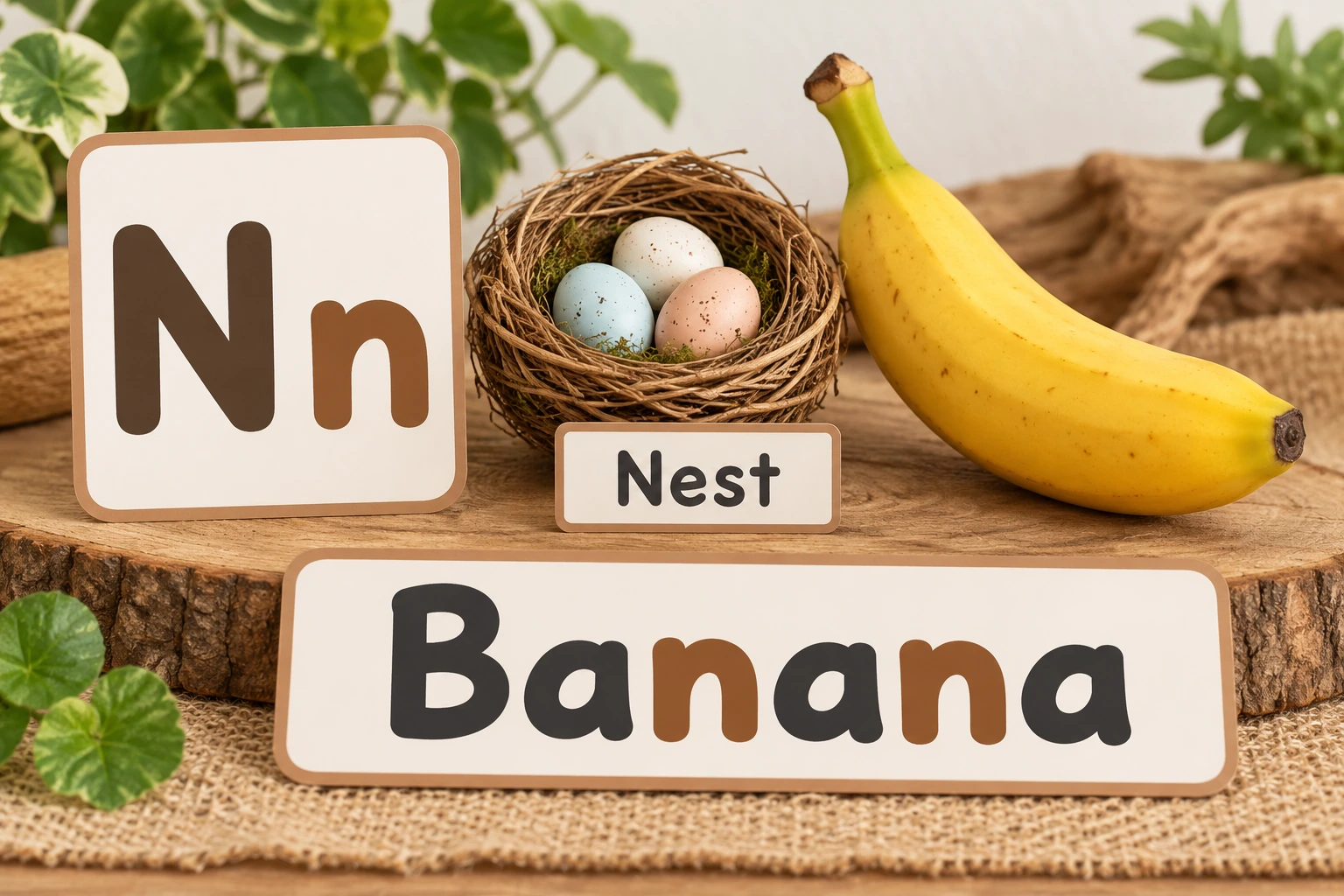
The illustration pairs a nest and banana with completed labels and an N/n reference. Its visible Banana targets can start a discussion, then the learner can inspect the unhighlighted source label. Use Nn Letter Gatherer for the exact answer locations and the full preview for the actual printable arrangement.
Keep the next encounter welcoming: Nn Letter Gatherer
Children around three to six may participate through shared pointing, assisted circling or independent inspection. In Nn Letter Gatherer, pencil control and letter recognition need not progress at the same pace. An adult can make a mark chosen by the child, then offer handwriting separately when the hand is ready.
Watch for a search that stops after the first n, a circle around a whole word, a lowercase form with two arches or a capital without its diagonal. Respond with the corresponding comparison. A learner who needs a reminder is being given a route to check, not a reason to feel that the entire visit has gone badly.
Brief, regular returns can start with a remembered question: “What was between the two n letters?” Another day, inspect only one tile row. End on a feature the child can show and name. Nn Letter Gatherer can support repeated encounters without becoming an identical long routine every time.
Choose a download and an extension: Nn Letter Gatherer
Compare Nn Letter Gatherer with Nn Worksheet. A listening follow-up to Nn Letter Gatherer is First Sound Choices. For Nn Letter Gatherer, explore Oo Worksheet.
For additional adult ideas, explore NAEYC's play topic resources. PBS Parents' literacy activities can support shared talk around print. These optional resources can inform another playful encounter without changing the source worksheet's instructions.
Use the controls to obtain the original Nn Letter Gatherer sample. The clean individual version is a separate protected download for an eligible active member. Inspect the complete frame before printing and check that Banana's n characters are easy to distinguish. A scale that makes the arches clear is more useful than fitting extra copies onto a crowded sheet.
The page's collection card leads to the separately priced $5 Alphabet Wordwork Collection. Its single combined PDF holds all twenty-six clean letter worksheets. That purchase suits a planned A–Z sequence, while membership access to this clean individual file remains a separate route. The card keeps the full set within reach from Nn Letter Gatherer.
Popular Worksheets
Printable resources families and teachers are downloading now.
 Free
 Free
 Free
 Free