
Oo Letter Watch: 4 Clever Owl-and-Robot Discoveries
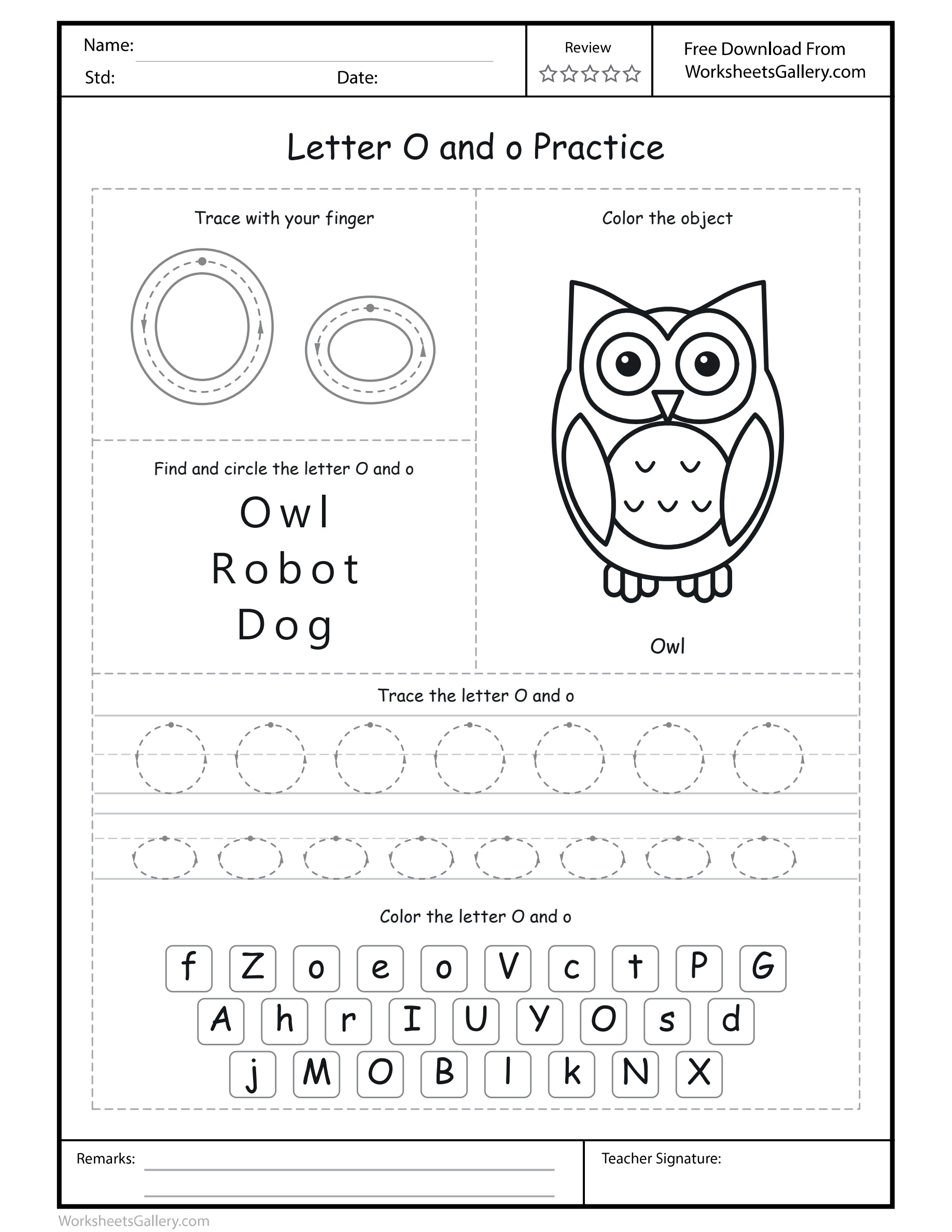
Oo Letter Watch belongs to the 26-page collection. Record both o occurrences in Robot and compare closed forms with open c distractors.
Robot keeps two o letters apart, and both deserve a careful look. Oo Letter Watch brings that separated pair together with the opening O in Owl and the interior o in Dog. Children can inspect closed round forms, follow the supplied movement cues and colour an owl while an adult reads the labels. A mixed tile field adds another setting for recognising the same letter family. The visit can stay small and conversational, with a learner pointing to evidence before choosing a few handwriting guides or returning to a missed match.
Robot has another round visitor — Oo Letter Watch
Read the three search labels on Oo Letter Watch: Owl, Robot and Dog. Owl begins with O. Robot contains o at positions two and four, with b between them. Dog contains o at position two. Four target characters appear across this panel. Ask for a small circle around each relevant character, keeping the rest of the word readable.
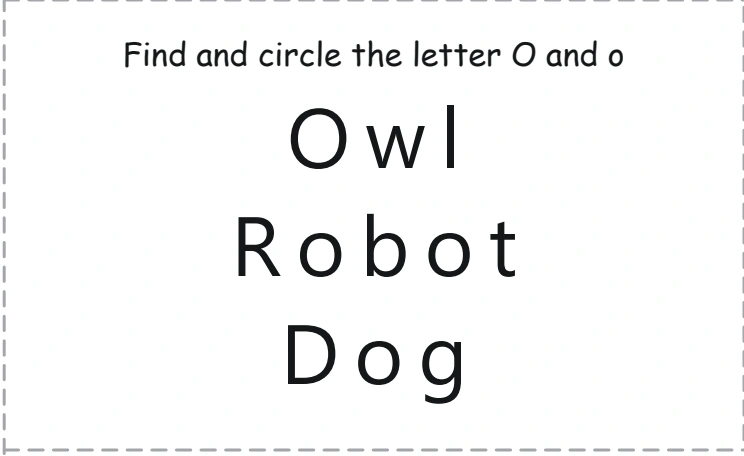
After the first o in Robot is found, keep tracking the word. A learner may recognise the spoken object and assume its label has been fully checked. Move a finger past b and compare the next round form. The second discovery gives Oo Letter Watch a concrete reason to resume a search after success.
| Printed word | Target positions | Inspection idea |
|---|---|---|
| Owl | O first | Meet the capital at the opening. |
| Robot | o second and fourth | Look on both sides of b. |
| Dog | o second | Check between D and g. |
Adult reading keeps the task accessible before independent decoding. Say each whole label naturally, then name O as the visual target. Oo Letter Watch is asking where the written character occurs; it does not require a claim that every o in these words has an identical pronunciation.
Closed shapes provide the comparison: Oo Letter Watch
The large O and o models on Oo Letter Watch show closed round outlines with different case proportions. Point to a complete journey around each. Follow the supplied start cues and arrows rather than introducing a different movement route from memory. A finger can preview the curve before pencil work begins.
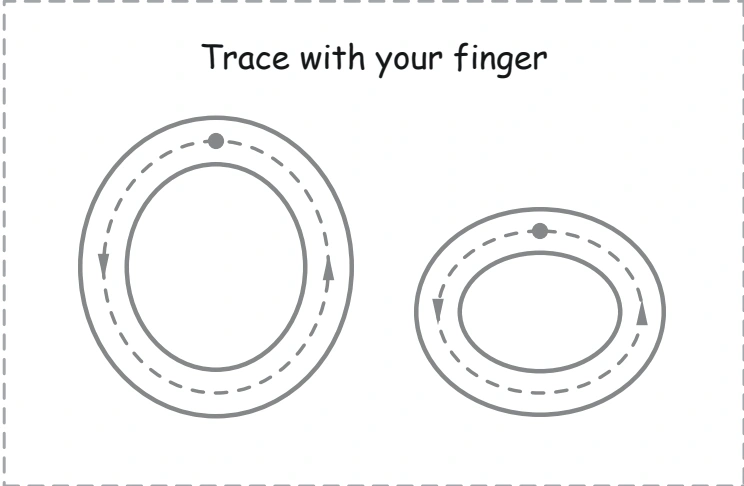
If c is mistaken for o, compare the opening. O/o closes; c leaves a gap. Keep that distinction visible on the actual candidate and the model. Avoid accepting a symbol simply because it contains a curved side. A complete outline provides stronger evidence than one familiar fragment.
Talk about capital O and lowercase o by name as well as size. A large display can make a lowercase letter physically bigger than a small printed capital elsewhere, so “the big one” is only a local description. Oo Letter Watch lets the adult connect the two case forms while pointing to their supplied proportions.
A robot workshop in class, imagined: Oo Letter Watch
Imagine Orin at a pretend robot repair bench. The teacher writes Robot on a completed sign and reads it aloud. Orin puts an O/o reference beside the first o, then says the sign has been checked. The teacher asks whether the characters beyond b have been inspected.
Orin follows the label and finds the second o. He compares both with the large model on Oo Letter Watch. A partner brings Owl and Dog cards, which the teacher reads. Orin points to the capital opening and the interior lowercase target, explaining with gestures how their positions differ.
The class can return to the printable and make the four word-panel circles together. This imagined workshop gives the search a purpose without requiring a child to read Robot alone or assemble a real craft. The useful record is that Orin continued through the label and used closed shapes as evidence.
Six observations to carry forward: Oo Letter Watch
Continuing beyond one match. Robot's two o letters make search completion visible. Oo Letter Watch can reveal whether a learner checks the remaining print after the first successful comparison.
Case naming. Owl supplies a capital while the other labels provide lowercase examples. Naming both connects their identity without reducing the distinction to physical size alone.
Closure awareness. The O/o and c comparison focuses attention on a small but meaningful gap. A child can point to that difference even before describing it fluently.
Curved movement control. Following a round model asks for a continuous planned route. Finger tracing on Oo Letter Watch allows that route to be explored with less pressure than a pencil attempt.
Spatial explanation. Words such as between, around and closed give language to visible evidence. An adult can add a positional word to the child's gesture naturally.
Constructive revision. Checking a candidate against the model offers an action when uncertainty appears. A changed selection can show a more complete comparison rather than a spoiled page.
Colour the owl as a separate decision: Oo Letter Watch
The owl drawing in Oo Letter Watch has no required colour pattern. Let the child decide how to colour its visible areas and invite a brief description. An imagined purple owl can be a perfectly reasonable creative choice. Letter-search accuracy and picture colour are different parts of the encounter.
If the child wants to talk about the owl, read its label and point to the opening O. Keep the conversation responsive instead of turning every colour stroke into another question. A quiet picture interval can help a learner return to the smaller lettering with renewed attention.
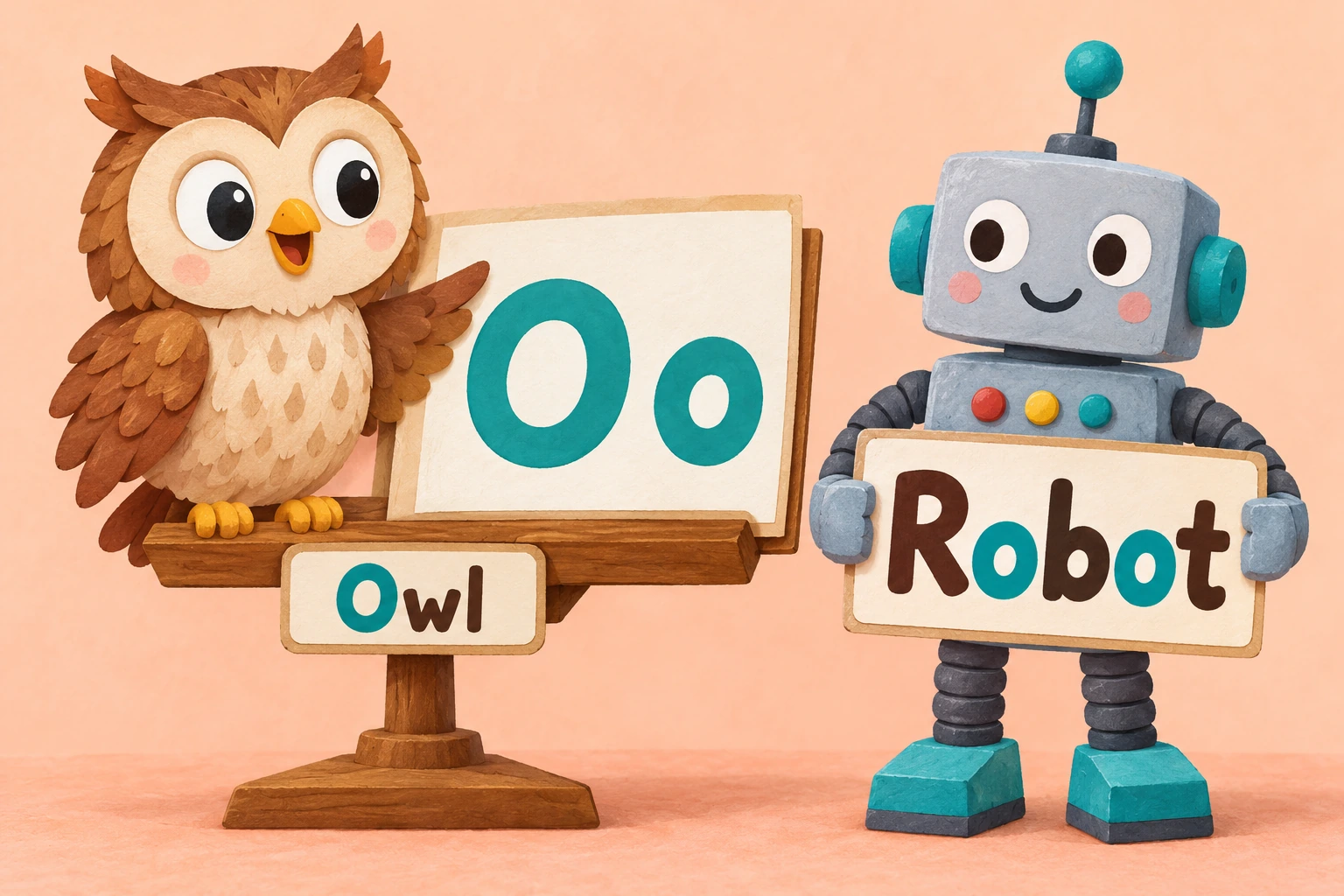
The supporting illustration pairs an owl with a robot and completed O/o examples. Its Robot label can make the separated round targets easier to discuss. Compare the highlighted example with the ordinary printed label on Oo Letter Watch, and use the whole-page preview to see the actual downloadable worksheet arrangement.
A small handwriting plan: Oo Letter Watch
Seven capital guides and eight lowercase guides make up the tracing opportunity on Oo Letter Watch. Preview the rows, then choose a few to try. A child can compare one completed curve with the large model before moving to the next guide. The unused examples remain available for later practice.
Notice where the stroke starts and where it returns. If an attempt stays open, point to the model's closure and ask what difference the child sees. If pressure becomes heavy, pause for a larger finger movement and relax the hand. Avoid combining closure, size, grip and speed into one long correction.
An adult may support the paper or show a printed cue without taking over the learner's pencil. Oo Letter Watch can spread those fifteen movement opportunities across several brief encounters. A few observed movements can help decide whether the next visit should begin with tracing or with shape comparison.
Four O/o matches among mixed print: Oo Letter Watch
The lower tile field of Oo Letter Watch has twenty-seven characters distributed ten across its upper line, nine centrally and eight below. Its four O/o answers include a pair from each case. Adult whole-field checking positions are 3, 5, 17 and 22. A child can search visually without counting to those coordinates.
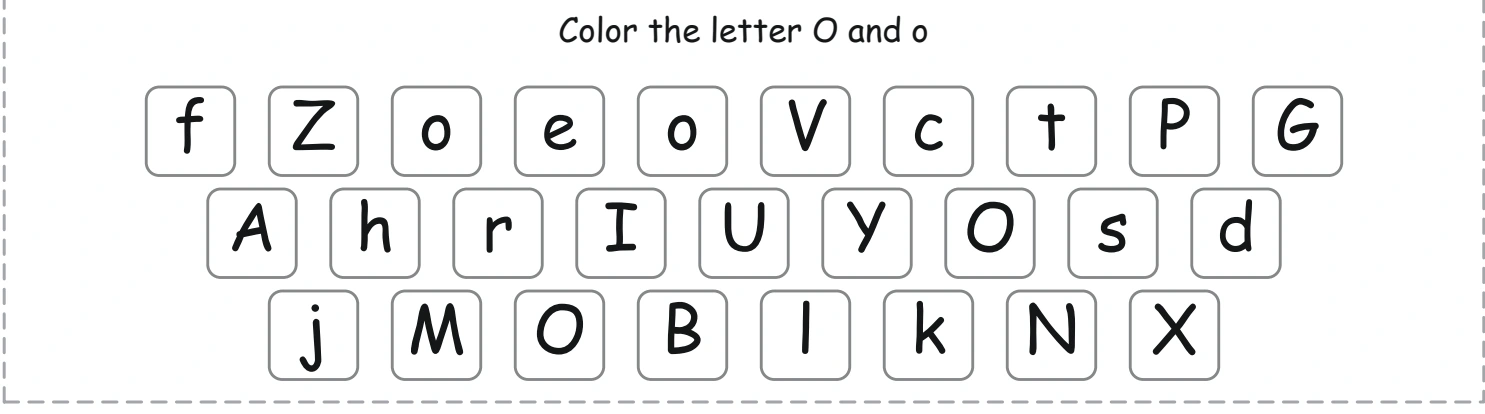
The first row offers more than one match. Inspect the tiles between and beyond the circles, then continue into the next row. Leave a pointer beside the current round candidate before consulting the O/o reference. This reduces the extra memory demand of remembering where the search paused.
For each round-looking candidate, check whether the outline closes and whether it matches the supplied letter form. Oo Letter Watch invites the learner to explain a choice through pointing or speech. When an open c seems close, place the two forms in visual comparison and allow the child time to reconsider.
A home dog drawing, imagined: Oo Letter Watch
Picture Orin drawing a dog at home with a family member. The adult writes Dog underneath and reads the finished label. Orin points between D and g and compares that o with the one in Oo Letter Watch. The drawing gives a familiar spoken word a fresh printed setting.
The family member then writes Robot on another completed card. Orin finds one o and checks beyond b for the second. The adult describes the strategy specifically: he continued until the label had been inspected. They do not need to add a spelling test or ask for several new sentences.
This imagined home return can end with one chosen circle on the worksheet or a short finger trace. The lasting intention is repeated supported attention to print. One successful visit does not promise automatic recognition in every future font or context, so later comparisons can remain welcome.
Five round-form games: Oo Letter Watch
Robot checkpoints: Oo Letter Watch
Place a token under each o on a completed Robot card, leaving b visible between them. Read the label and touch both targets. Then remove the tokens and locate the pair again on Oo Letter Watch without the highlighting.
Open or closed: Oo Letter Watch
Show an O/o reference and a c reference. Compare the gap directly and let the child explain with a finger. Keep this a discussion about the shown print rather than a speed sort of many unfamiliar fonts.
Owl sign keeper: Oo Letter Watch
Read a completed Owl card beside an owl picture. Invite the learner to match its opening capital with the large O. Return the card to Oo Letter Watch and inspect the printed word's first character.
Between two neighbours: Oo Letter Watch
Read Dog and point to D and g. Ask what sits between them, using the o model as support. The learner can answer by touching the middle character without needing to name the neighbours independently.
Curve narrator: Oo Letter Watch
Trace one large model with a finger while a partner says “around” and “closed” at appropriate moments. Exchange roles if desired. Follow the model's arrows so the playful narration supports the movement on Oo Letter Watch.
A comfortable return route: Oo Letter Watch
Children in the approximate three-to-six range may use Oo Letter Watch through shared pointing, assisted marking or more independent comparison. Handwriting comfort and visual recognition can differ within the same child. Choose a response method that makes the observation visible without adding an unnecessary motor hurdle.
Common slips include stopping after Robot's first o, circling a whole label, accepting an open curve and leaving a tracing attempt unclosed. Each has a matching response: continue beyond b, demonstrate a character circle, compare the gap, or revisit the model's return point. Keep the response narrow enough for the learner to act on it.
On another day, start with Dog's interior letter or ask the child to explain the two Robot checkpoints. Regular short encounters can alternate talking, colouring and tracing. End with one feature the learner can show, so returning to Oo Letter Watch feels like continuing an investigation rather than repeating a long test.
Related resources and available files: Oo Letter Watch
Compare Oo Letter Watch with Oo Worksheet. A listening follow-up to Oo Letter Watch is First Sound Choices. For Oo Letter Watch, explore Pp Worksheet.
Adults planning further play may consult NAEYC's play resource pages. For shared reading and print conversation, PBS Parents' literacy area offers additional ideas. Select an extension when it connects with the child's interests in the owl, robot or dog.
The original Oo Letter Watch sample is reached through this page's download controls. An eligible active member has a separate route to the protected clean individual PDF without website branding. Check the entire page in print preview and preserve clear round outlines at the chosen scale. A clipped frame or very small print can make the comparisons less comfortable.
The premium collection card links to the separately purchased $5 Alphabet Wordwork Collection. Its combined PDF contains all twenty-six clean letter sheets for a complete A–Z sequence. The O/o member download remains separate from this purchase of the full letter collection. The link offers the larger collection directly from Oo Letter Watch when a full set would be useful.
Popular Worksheets
Printable resources families and teachers are downloading now.
 Free
 Free
 Free
 Free