
Ww Letter Wanderer: 3 Clever Whale-to-Cow Word Stops
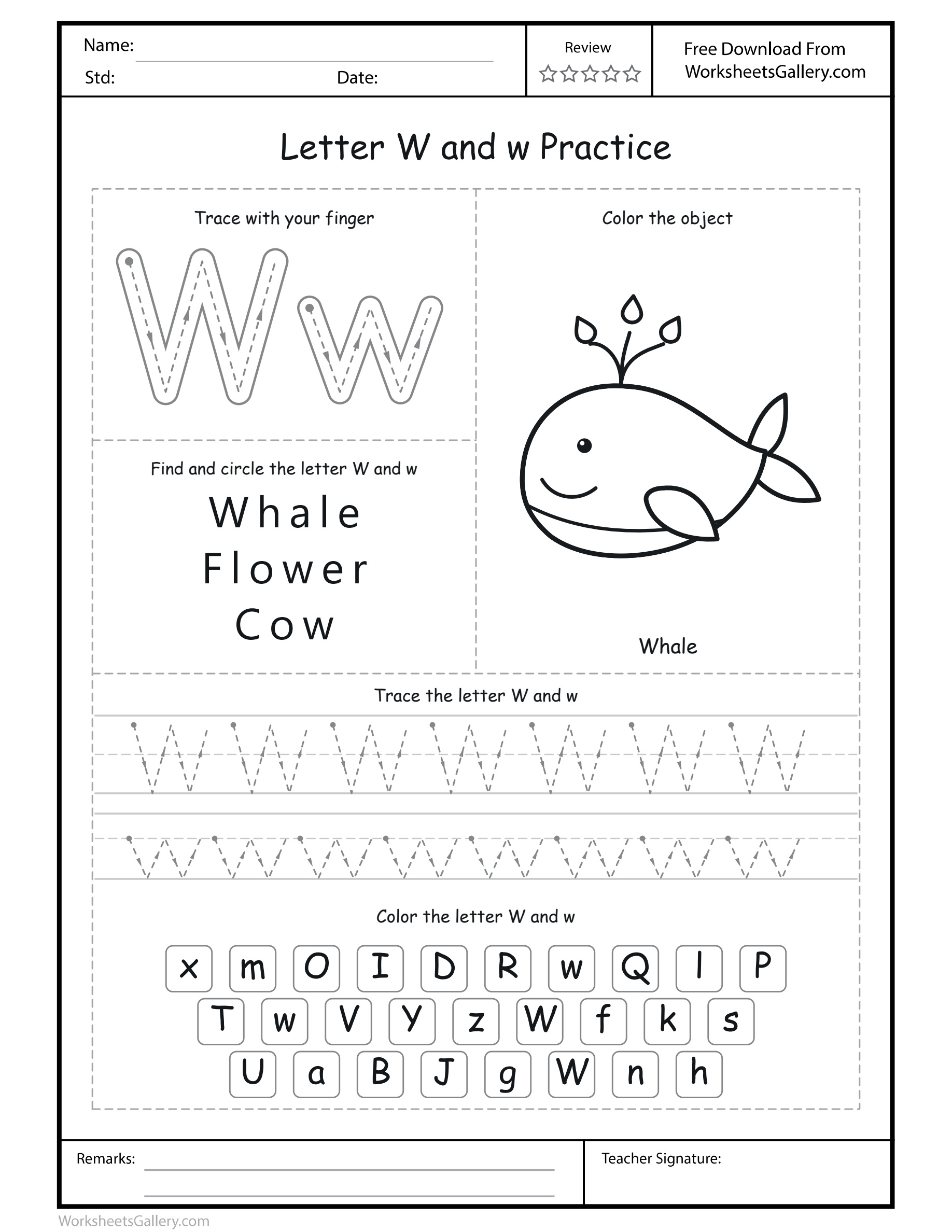
Ww Letter Wanderer belongs to the 26-page collection. Follow two joined valleys and find W/w across beginning, middle and end positions.
A whale, a flower and a cow share a written letter family across very different labels. Ww Letter Wanderer asks a child to find W at the beginning, w inside a word and w at an ending. The models offer two joined valleys to inspect before tracing, while the whale picture invites an individual colour plan. With an adult reading the labels, a learner can focus on shapes and positions through pointing or circles. The page leaves room for a small discovery, a second look and selected handwriting rather than a hurried full-page finish.
Wander from Whale to Cow — Ww Letter Wanderer
Read Whale, Flower and Cow in the search panel of Ww Letter Wanderer. Whale begins with capital W. Flower contains lowercase w fourth, after o. Cow ends with lowercase w as its third character. Three target characters belong in this explicit word panel, each available for a separate small circle.
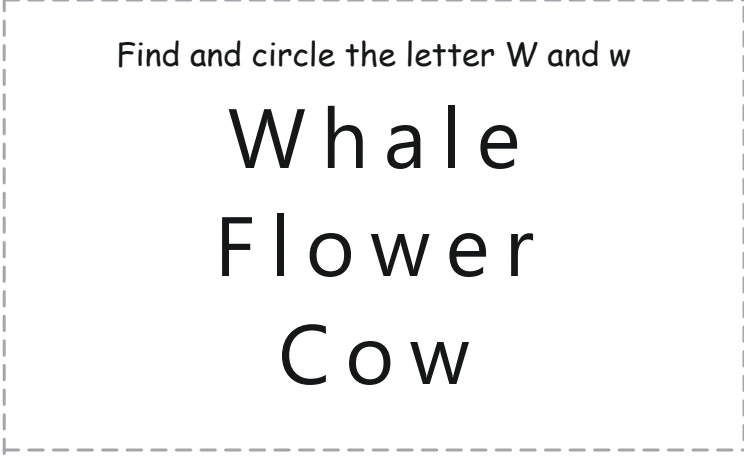
| Word label | W/w location | Wandering cue |
|---|---|---|
| Whale | First character | Start with the capital. |
| Flower | Fourth character | Inspect the print after o. |
| Cow | Final character | Follow through to the ending. |
An adult supplies the complete spoken word, then names the letter target. Ww Letter Wanderer does not require the child to decode Whale, Flower or Cow alone. Nor does locating written w mean imposing one identical sound explanation on all three words. The visual decision is where W/w appears and whether its outline matches the model.
If the learner circles a whole label, show the smaller intended mark on a different completed W/w example. Keep the word readable so its position can still be discussed. A finger travelling through Flower helps attention move beyond its opening F, while Cow gives the ending a clear inspection role.
Two joined valleys are worth a pause: Ww Letter Wanderer
The supplied W and w models on Ww Letter Wanderer show connected slanting movement with two lower turns. Point to the whole outline and compare the case proportions. Follow a W/w finger route using the printed arrows, pausing to inspect the rise between its lower turns.
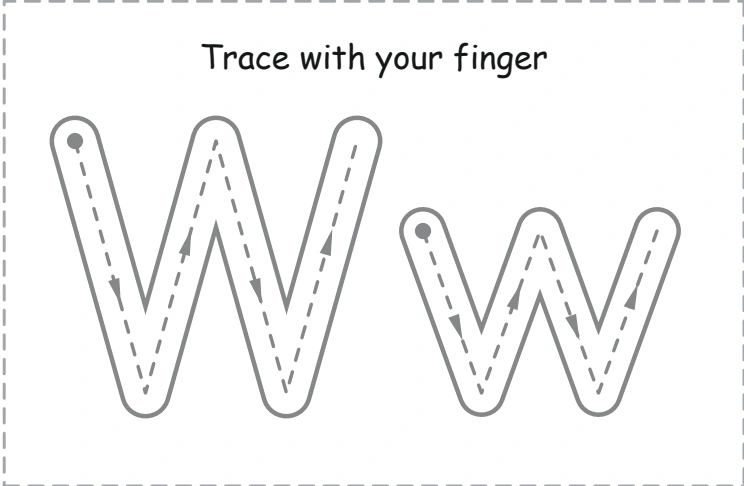
A single V-shaped part is not the complete W/w form. If a tracing attempt stops after one valley, compare what remains on the large model. Invite another movement at a fresh guide. The aim is a useful observation about completion rather than a demand for geometrically perfect angles.
Name capital W and lowercase w together. In Ww Letter Wanderer, the same family appears at different sizes and positions, but the model keeps its connected outline available. A learner can point to the middle rise when words are difficult to find, giving the adult a concrete feature to discuss.
An imagined classroom harbour display: Ww Letter Wanderer
Imagine Willa helping build a pretend harbour display. A whale-shaped paper boat sits beside a flower and a cow figure brought in as a playful visitor. The teacher reads completed Whale, Flower and Cow cards. Willa locates Whale's opening W and compares it with Ww Letter Wanderer.
Flower needs a longer inspection. The teacher tracks the label while Willa holds the lowercase model in view. She finds w after o. Cow then asks her to continue to the ending. A partner can point while Willa compares the shape, and the roles can change afterward.
This imagined harbour does not require children to explain why every object belongs together. It simply gives the three source labels a shared setting. The teacher records Willa's position comparisons and offers one tracing guide, preserving the distinction between adult reading and the child's visual evidence.
Six things a wandering search can show: Ww Letter Wanderer
Position flexibility. The three labels move W/w from an opening to an interior location and an ending. Ww Letter Wanderer lets a learner show that the family remains recognisable beyond the first character.
Case connection. Naming W and w while pointing to both forms links their identity. The child need not write them independently to participate in that comparison.
Whole-shape attention. Two valleys and their joining rise offer more evidence than one slant. The learner can explain why a partial-looking candidate does not match the complete model.
Movement continuity. Finger tracing previews the changing direction across the outline. On Ww Letter Wanderer, that rehearsal can happen before small pencil control becomes an extra demand.
Location vocabulary. Beginning, after, inside and last describe the word evidence. An adult can supply these words alongside a pointing response.
Active checking. Returning to a model gives an uncertain learner a practical next step. Revising a selection can show a fuller comparison rather than a spoiled first attempt.
The whale can tell a colour story: Ww Letter Wanderer
The whale drawing on Ww Letter Wanderer is open to the child's colour choices. There is no fixed palette or number-based colour key. Ask which part they want to colour first and what story the whale suggests. A patterned whale can be an imaginative decision without changing the letter answers.
Read Whale again if the conversation returns to its name. If the child wants a story caption, an adult can write a completed phrase on separate paper. Preserve the source word panel so the three W/w positions remain easy to inspect after the picture pause.
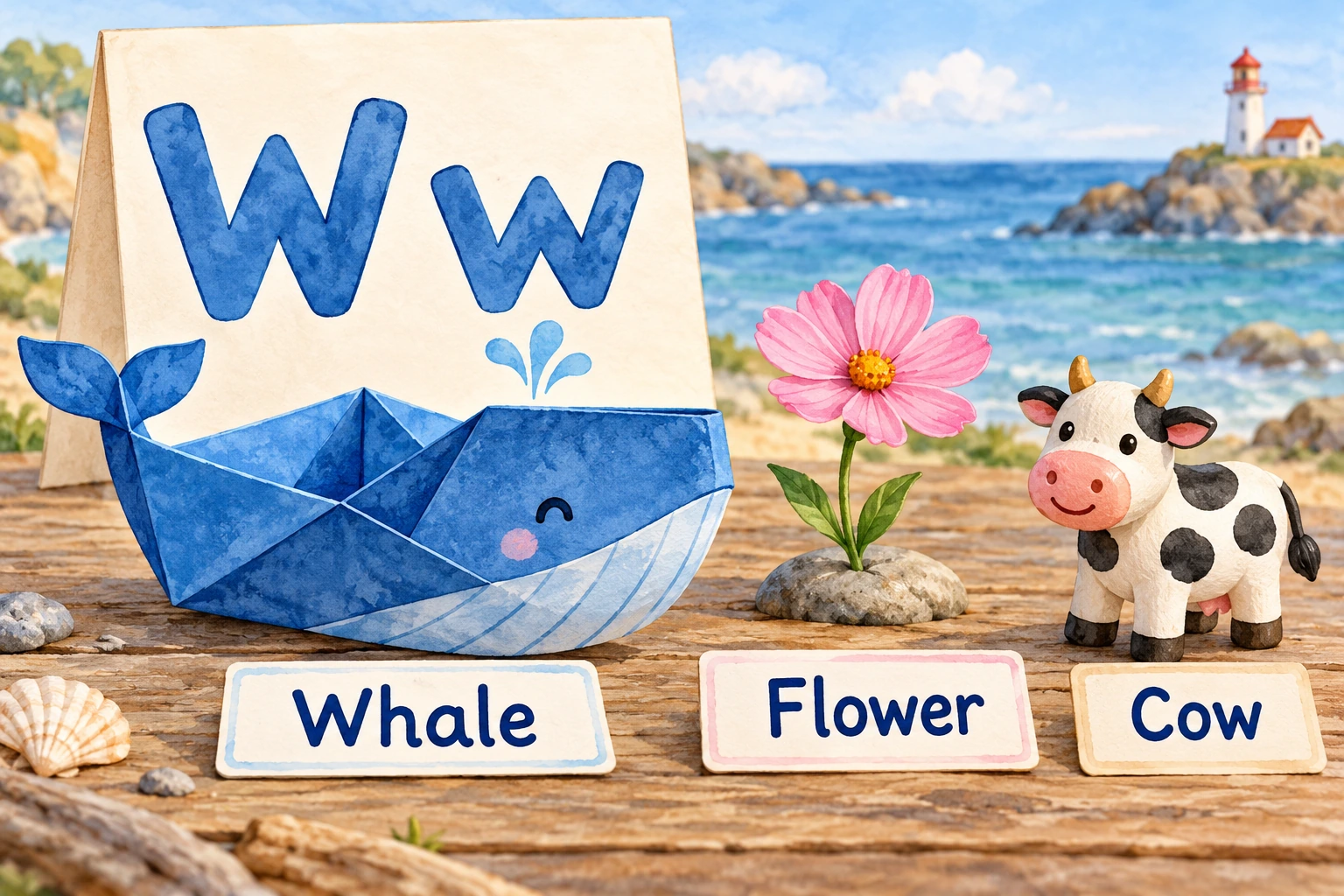
The supporting seaside illustration presents a whale-shaped boat, flower and cow with completed labels and a W/w reference. It gives the same three positions another setting for conversation. Return to Ww Letter Wanderer for the exact exercises, and consult the full-page image for a faithful view of the downloadable sheet.
Choose a few connected movements: Ww Letter Wanderer
The handwriting area on Ww Letter Wanderer provides seven W opportunities and eight w opportunities. Inspect both rows and select a small amount. A learner can trace one outline, then point to its two lower turns before choosing whether to try the other case.
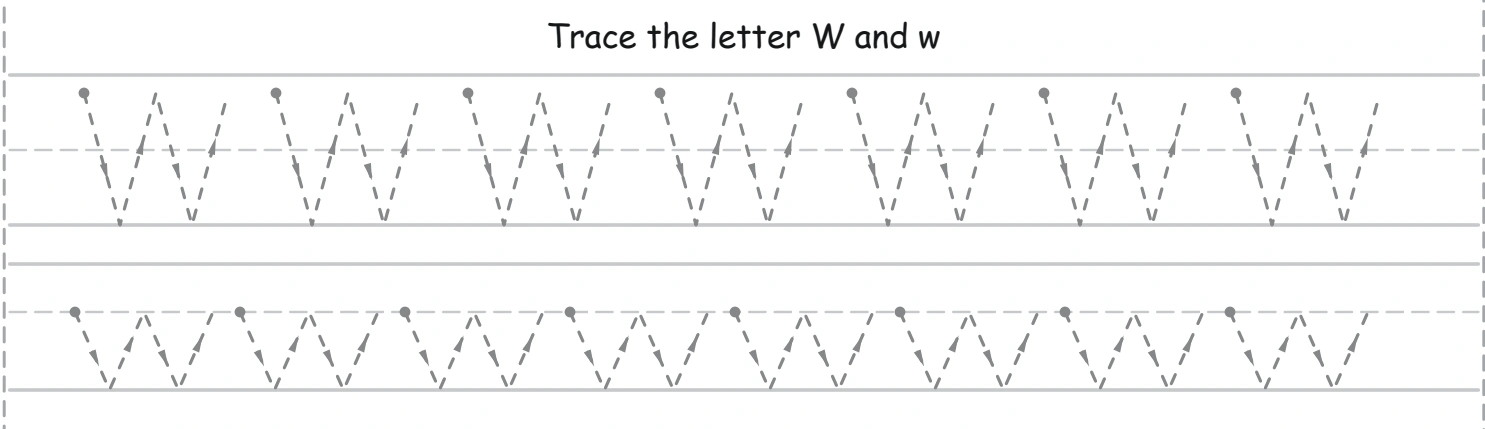
If an attempt ends after one valley, compare the remaining path with the model. If the page slides, help anchor it before adding another correction. Keep pressure comfortable and feedback focused. Discussing joins, tilt, width and speed at once can obscure the one movement the child is trying to understand.
Invite a review through pointing: where is the middle rise, and does the movement continue beyond it? A mark can vary in size and still support that discussion. Ww Letter Wanderer can be spread across short returns, with unused guides available whenever the hand is ready for another attempt.
Four W/w forms in a mixed field: Ww Letter Wanderer
The tile area of Ww Letter Wanderer contains twenty-seven characters. Ten appear in its upper row, nine in its centre row and eight below. Two capital W forms and two lowercase w forms make four matches. For adult verification, whole-field positions 7, 12, 16 and 25 are the targets.
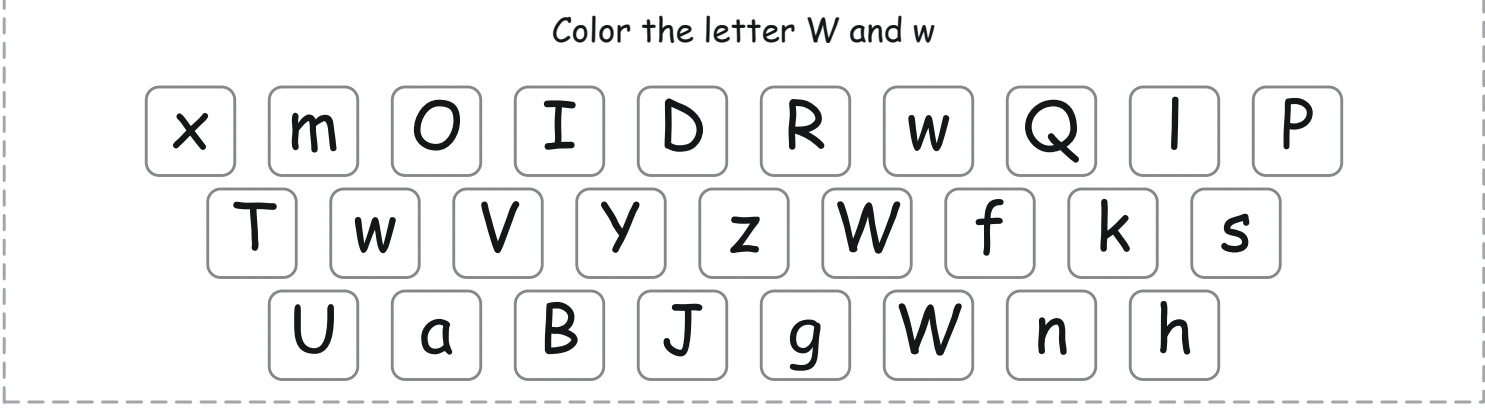
Those coordinates do not need to become a counting exercise for the learner. Inspect each printed row with the large pair visible. A pointer beside the next unexamined tile can keep the search route clear while the child compares a candidate's full outline.
Look for both valleys and the connection between them. If a one-valley character seems close, compare the rest of the model. Continue after each found target, including through the middle row where more than one match appears. Ww Letter Wanderer supports finishing the inspection route rather than guessing that one circle completes a row.
Five W/w wandering games: Ww Letter Wanderer
Harbour label walk: Ww Letter Wanderer
Read completed Whale, Flower and Cow cards in a line. Let a token stop beneath each W/w target. Then find the same positions on Ww Letter Wanderer, with the extra cards set aside.
Two-valley builder: Ww Letter Wanderer
Arrange short strips into a finished W outline. Point to both lower turns and the rise between them. Compare with the model before clearing the strips and following the worksheet's tracing arrows.
Flower interior visitor: Ww Letter Wanderer
Track Flower to the character after o. Ask the learner to compare that w with the large lowercase reference. Reading every other character independently is optional; the adult can keep the word meaning available.
Cow ending tour: Ww Letter Wanderer
Read Cow and move through its print to the final w. Invite the child to show a partner where the search ended. A pointing explanation can connect the ending with the target on Ww Letter Wanderer.
Middle-row partners: Ww Letter Wanderer
One partner points through the centre tile row while another compares with the models. Continue past the first match to inspect the rest. Exchange roles without awarding a speed score.
A home flower drawing, imagined: Ww Letter Wanderer
Picture Willa drawing a flower with a family member. The adult writes Flower underneath and reads the completed label. Willa looks after o and finds w, then compares it with Flower in Ww Letter Wanderer. The drawing gives the same printed word a different physical setting.
The family member asks what makes the letter more than one V-shaped valley. Willa follows the connected form with her finger and points to the second lower turn. “You checked the whole outline” describes the action she used. The exchange can finish there without requiring a new written sentence.
Later, Cow's ending may provide another brief return. The stable worksheet model can anchor the comparison while the object setting changes. This imagined use illustrates repeated supported attention, with no promise that one encounter establishes recognition in every future font.
Keep support connected to the evidence: Ww Letter Wanderer
For learners roughly three to six, Ww Letter Wanderer can involve shared pointing, assisted circles or independent checking. Pencil movement and visual recognition may need different support. Allow a child to show the target decision without making a difficult handwriting stroke the only response method.
If the search stops at first letters, track inside Flower or to Cow's end. If a whole word is marked, demonstrate a character circle elsewhere. If a W attempt loses half its outline, compare the second valley. If a row is abandoned early, park the pointer beside the next W/w candidate. Each response has a visible purpose.
Regular short visits might start by recalling W/w's two valleys or showing Cow's final target. Let the learner choose a small starting section of Ww Letter Wanderer. Stop while they can still show a useful discovery, leaving an inviting place to resume the next day.
File choices and further reading: Ww Letter Wanderer
Compare Ww Letter Wanderer with Ww Worksheet. A listening follow-up to Ww Letter Wanderer is First Sound Choices. For Ww Letter Wanderer, explore Xx Worksheet.
Adults planning a playful extension can consult NAEYC's resources about play. For more shared language activities, explore the literacy pages from PBS Parents. These are optional adult resources, with no extra steps required to complete the source worksheet.
Use the controls for the original Ww Letter Wanderer sample. The separately protected clean single-sheet PDF is available to an eligible active member. Inspect the page frame in print preview and confirm that the small W/w joins remain distinct. A comfortable print scale helps the learner compare the connected outline.
The Alphabet Wordwork Collection premium card offers a separate purchase priced at $5. It contains twenty-six clean letter worksheets in one PDF for a complete sequence. Membership access to this individual clean file remains a different option from buying that collection. The card keeps the full A–Z set within reach from Ww Letter Wanderer.
Popular Worksheets
Printable resources families and teachers are downloading now.
 Free
 Free
 Free
 Free