
Gg Letter Observer: 4 Brilliant Grapes-to-Dog Finds
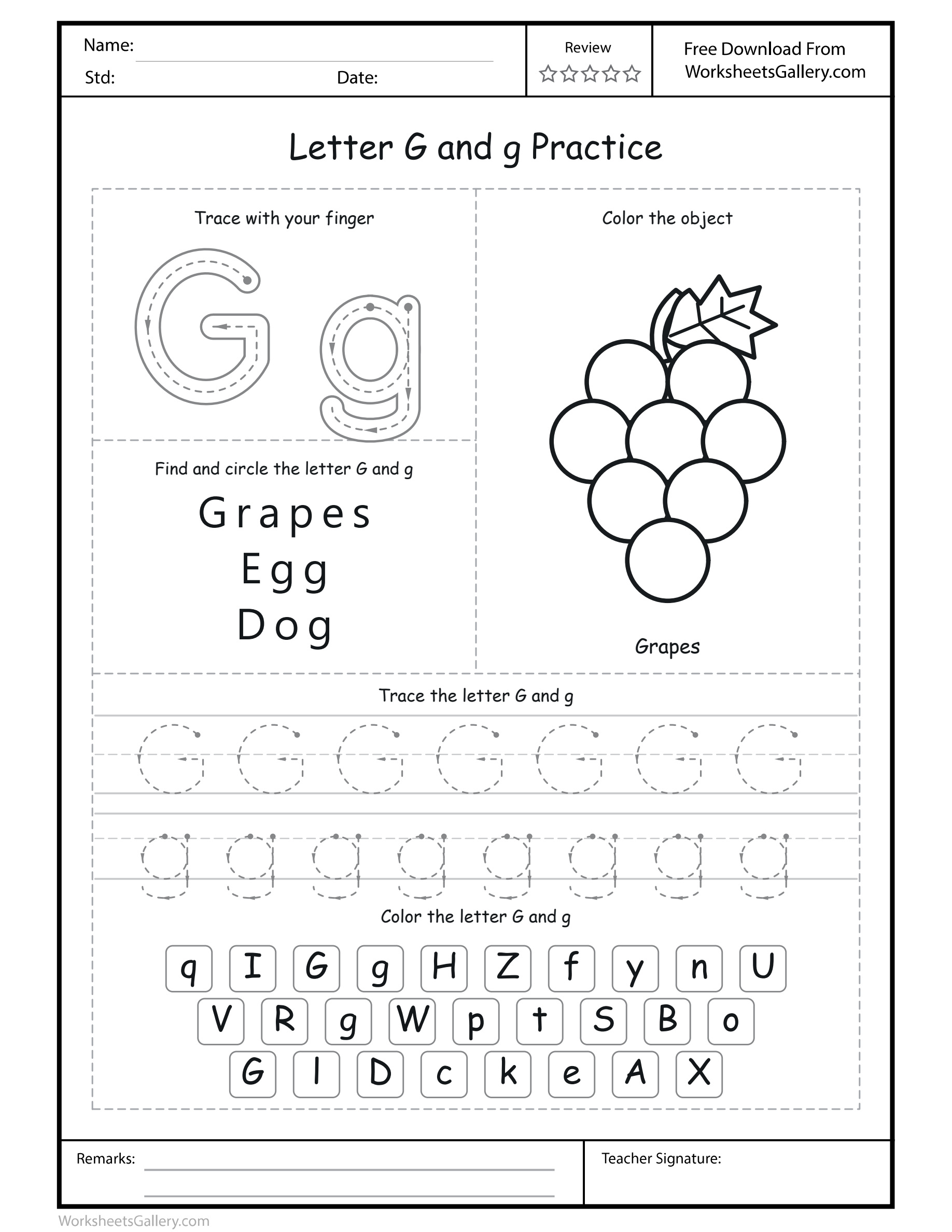
Gg Letter Observer belongs to the 26-page collection. Compare the two adjacent g letters in Egg with uppercase G and the supplied looped model.
Egg puts two g letters together, while Dog places its g at the end. Gg Letter Observer adds those word positions to a grapes picture and two large case models, giving Galen several reasons to inspect the same letter family carefully. The capital includes an inward stroke, and the supplied lowercase form carries a loop and a lower extension. Read the labels with Galen, compare a visible feature and choose a manageable marking task. The aim is an explained discovery across print, finger movement, guided writing and selective colouring.
Begin with the lowercase pair in Egg — Gg Letter Observer
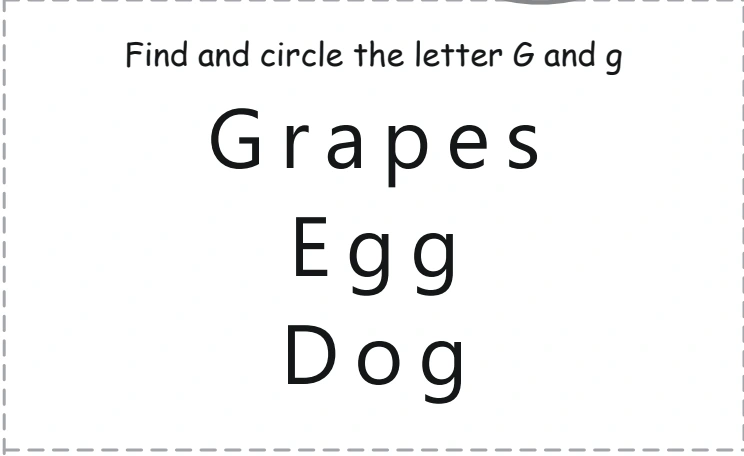
An adult can read Egg and ask Galen what follows its first character. The two g letters occupy positions two and three. In Gg Letter Observer, they are separate targets even though they stand beside one another in a short word.
Invite Galen to indicate each occurrence before circling. If he makes one broad oval around gg, ask whether he meant both characters. A separate point or clearer pair of marks can make that intention available to a checking partner.
Keep looking after a successful match: Gg Letter Observer
The first g is not a signal that Egg has been fully inspected. Ask Galen which part remains. This offers a practical reason to continue his scan without announcing the complete answer before he has looked at the final character.
A small word map for a checking adult: Gg Letter Observer
| Printed label | G/g positions | Visible context |
|---|---|---|
| Grapes | 1 | A capital G begins the word. |
| Egg | 2 and 3 | Two lowercase targets sit together. |
| Dog | 3 | A lowercase target is last. |
The word panel in Gg Letter Observer therefore has four matching characters. The numbers in this adult map describe locations within the source spellings. They are not an additional written response for the learner; the printed task asks for circles around the target letters.
The object label does not replace the search panel: Gg Letter Observer
Grapes also names the bunch beneath the colouring picture. It can be read during a picture conversation, but establish which area you are using for the explicit three-word search. Otherwise a learner may add marks to several repeated captions without understanding the current instruction.
An inward capital stroke deserves attention: Gg Letter Observer
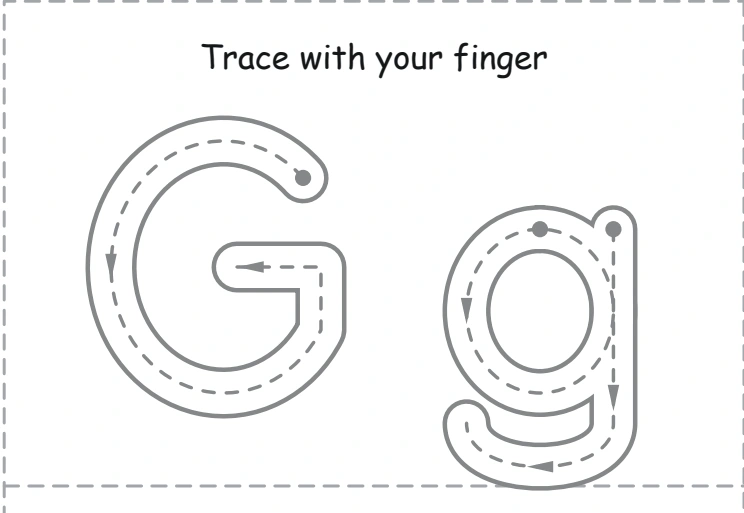
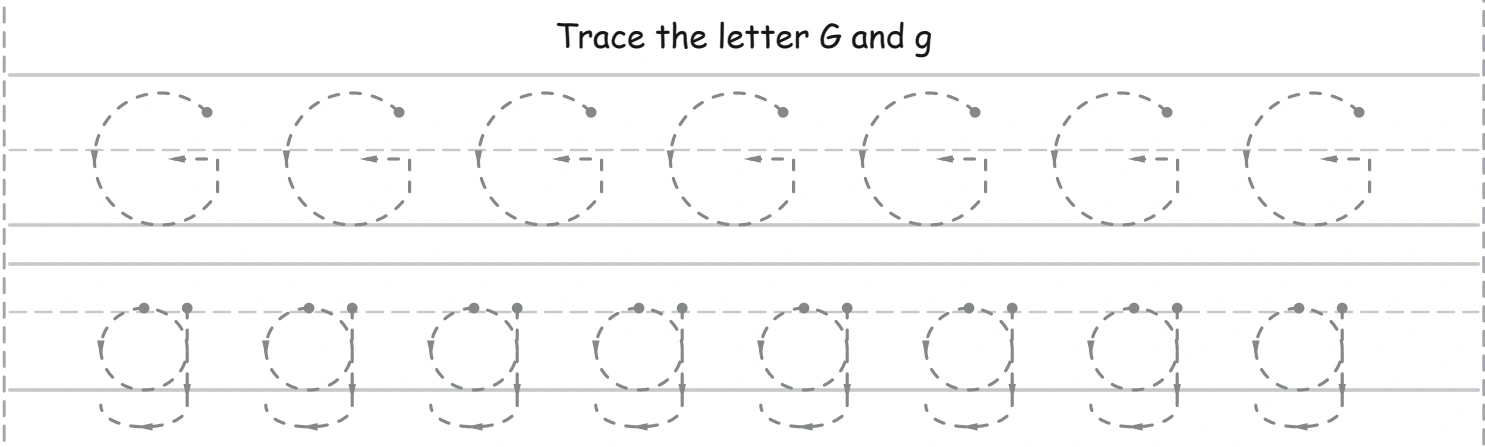
The large G is not merely a closed circle. Its supplied model includes an inward stroke that changes the open curved outline. Ask Galen to show that feature in Gg Letter Observer and compare it with the whole form before tracing.
The lowercase model has its own loop and downward extension. It should be inspected directly rather than formed by shrinking the capital. Letter styles can vary across other books or labels, so use this page's references when planning its finger and pencil routes.
Read the dots as movement information: Gg Letter Observer
Starting dots and arrows remain printed within the models. Galen can locate the start and follow the route with a fingertip. A pause to inspect the turn or inner stroke makes the movement deliberate instead of relying on an adult's verbal label alone.
A classroom grape basket with a word-checking role: Gg Letter Observer
Imagine a teacher placing a toy grape basket beside cards labelled Grapes, Egg and Dog. The teacher reads each card, then asks learners to inspect its G/g evidence. Galen chooses Egg and explains that both later characters match the lowercase family.
A partner listens and points to the positions being described. They reverse roles for Dog, where the target comes at the end. The teacher can ask what changed about the location while the letter being sought stayed the same.
Children then make their own circles on Gg Letter Observer. The shared card discussion prepares the method without requiring identical pencil records. A clear spoken explanation can help the teacher distinguish a letter decision from a circle that happens to overlap a neighbour.
Six observations for a Gg learning conversation: Gg Letter Observer
A capital is checked beyond its outer curve: Gg Letter Observer
The inward stroke gives Galen a specific feature to inspect. Gg Letter Observer makes that comparison visible in a large reference. A choice based only on roundness may need a more complete look at the form.
Lowercase details are observed rather than assumed: Gg Letter Observer
Ask Galen to point out the loop and lower extension on the supplied g. This keeps the current model available for a smaller-word or tile comparison. Another font elsewhere can be discussed separately when it is encountered.
Adjacent matches retain their separate places: Gg Letter Observer
The gg pair in Egg offers two discoveries. One point per character helps a listener follow the count. Galen can show which part was inspected after his initial success.
Word location changes without changing the target: Gg Letter Observer
Grapes, Egg and Dog position their G/g characters differently. Gg Letter Observer lets an adult ask for a location report rather than accepting a first-letter-only search. Beginning, inside and last become useful descriptive language.
The hand records an intended selection: Gg Letter Observer
A child may identify a character accurately but draw an imprecise circle. Ask for the intended target before judging the mark. The explanation can guide support with movement while preserving the recognition already shown.
A check can use the reference again: Gg Letter Observer
Returning to the large case model is a sensible response to uncertainty. Galen can compare a candidate, explain a feature and revise a choice. The activity remains a supported investigation instead of becoming a test of how much he can hold in memory.
Let the picture invite an unrelated colour decision: Gg Letter Observer
The grapes illustration contains overlapping round fruit and a leafy top. Galen can choose which regions to colour and describe the bunch. Gg Letter Observer provides no number-colour key for this object, so the supporting scene's purple grapes are only one possible palette.
An adult might ask which grape lies in front of another or how the leaf differs from the fruit shapes. Keep those observations conversational. Counting every drawn grape or reproducing a realistic colour scheme would be a separate extension rather than an unstated requirement of the source.
Four targets sit in the mixed-letter field: Gg Letter Observer
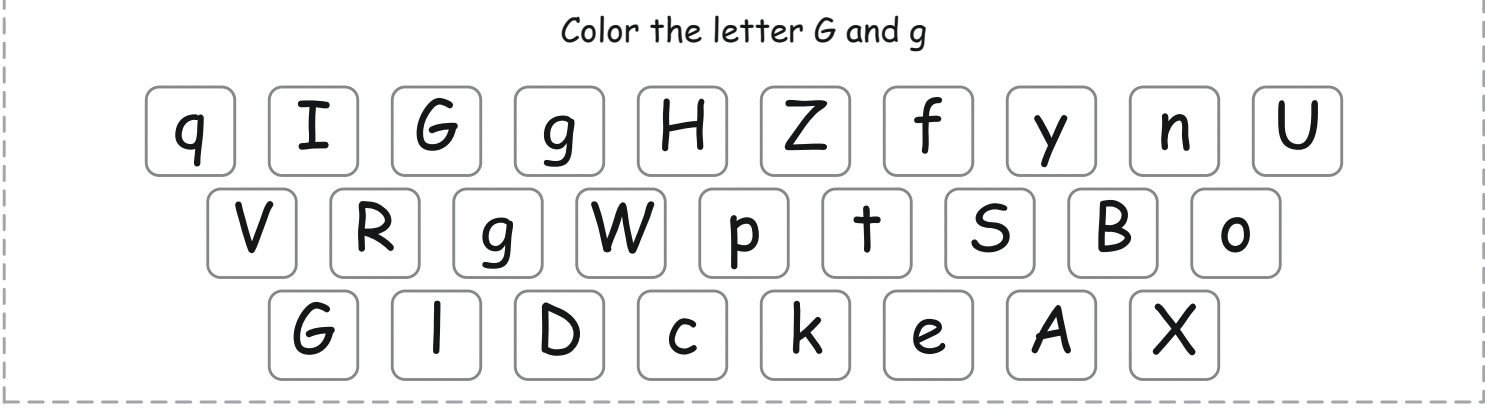
The lower Gg Letter Observer field contains twenty-seven tiles. Its G/g choices occupy positions 3, 4, 13 and 20 when the rows are counted across in reading order. The arrangement uses ten tiles, then nine, then eight.
The first row includes capital G in column three and lowercase g in column four. Row two has g in column three. The bottom row begins with G. These adult coordinates verify the particular source, while the learner's selection should still be supported by a visible letter comparison.
Adjacent tiles are a different kind of pair
The G and g beside each other in the first row share a letter family but use different cases. That differs from the two lowercase characters inside Egg. Ask Galen what is alike and what changes in these two neighbouring arrangements.
A home egg card with room to revise: Gg Letter Observer
For a hypothetical home visit, Galen's aunt writes Egg on a large spare card and reads it. He places a counter beneath each g. When she asks why there are two counters, he points to the separate printed positions rather than recounting the toy objects on the table.
They compare the card with Gg Letter Observer, then remove the counters and let Galen rebuild the record. The complete spelling stays visible, so the game does not depend on memorising an unfamiliar label. A later circle can be guided by a decision already made through pointing.
They finish with a freely drawn bunch of grapes. Galen dictates a short description for his aunt to write beside it. The message gives the picture a listener without changing the fixed targets in the worksheet search.
Handwriting routes can be inspected in small pieces: Gg Letter Observer
Seven capital G guides and eight lowercase g guides appear in the writing area. Choose a selected form, locate its starting cue and rehearse it before making a pencil trace. In Gg Letter Observer, the lower extension of g deserves enough room to remain visible beneath the loop.
After one attempt, Galen can identify the inner stroke, curve or lower part he wants to compare again. A deliberate revision to one feature can be more useful than several rapid repetitions. Keep the larger models available whenever the smaller pattern is difficult to inspect.
Distinguish a planned route from a developing pencil record: Gg Letter Observer
If Galen points through the intended path but his drawn line strays, acknowledge the plan. The next support may involve movement size or tool control. It need not assume that the letter itself has become unrecognisable to him.
Five grape-basket extensions with a clear purpose: Gg Letter Observer
1. Present two Egg discoveries to a toy: Gg Letter Observer
Write the word on a separate model card and let Galen point once to each g. A toy asks whether anything remains after the first target. The visible spelling allows him to justify his answer.
2. Compare an outer curve and an inner stroke: Gg Letter Observer
Show clear C and G forms on spare cards. Galen uses the source model to explain a difference. Keep the task a straightforward feature comparison, with both cards held in their ordinary orientation.
3. Deliver a final-letter label: Gg Letter Observer
Put a Dog card beside a toy animal and ask where its g sits. An adult reads the label while Galen describes the last position. This gives a short explanation an immediate listener.
4. Make a named grape picture: Gg Letter Observer
Invite a new grape drawing and supply the Grapes spelling as a model. The child can find the capital G while dictating a message about the picture. Adult writing keeps the unfamiliar spelling available without demanding independent production.
5. Rebuild a case pairing: Gg Letter Observer
Use separate G and g model cards and ask Galen to match a copied target to its case reference. He explains which visible features support the choice. An obvious distractor can be discussed after the intended pair is clear.
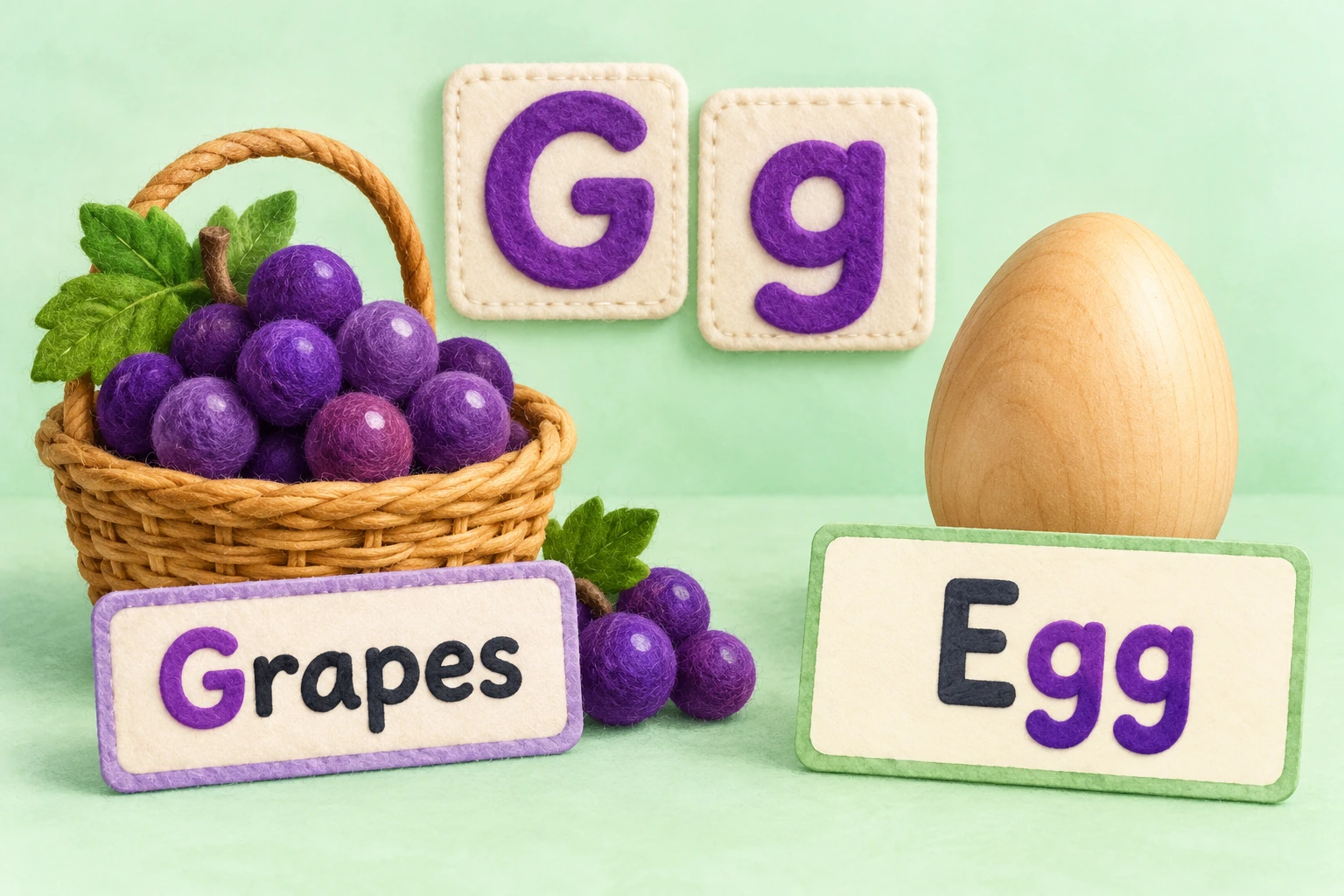
The Egg card keeps two g letters visible beneath the felt models.Felt G and g accompany a grape basket and wooden egg, while Egg gives the purple target letters a named context.
Plan support around the current observation: Gg Letter Observer
Children approximately three to six can explore Gg Letter Observer with an adult reading words, organising short visits and adapting the marking demand. A first session can involve the grape picture and a large finger route. A later visit may focus on the two Egg positions or the first-row case pair.
Common misunderstandings include selecting any round form as G, forgetting the lowercase extension, counting Egg as one discovery or overlooking Dog's final target. Return to the relevant source feature. Regular practice can revisit one explanation with a clearer scan rather than require a fully completed sheet on every occasion.
Download the complete grape-practice layout: Gg Letter Observer
For the clean Gg Letter Observer single sheet, members need an active plan that grants access. The grape member file clears the promotional edge material and carries the original exercises without website branding. The original upload remains a distinct sample file in the download choices.
Use portrait print preview to retain the full lowercase models, all three word labels and the lowest handwriting extensions. The associated Alphabet Wordwork Collection contains this sheet and the other twenty-five supplied clean pages in one PDF, sold separately for $5.
Keep another observation available for next time: Gg Letter Observer
Compare Gg Letter Observer with Gg Worksheet. A listening follow-up to Gg Letter Observer is First Sound Choices. For Gg Letter Observer, explore Hh Worksheet.
For additional family ideas, read NAEYC's suggestions for purposeful drawing and writing and explore PBS Parents' resources for literacy conversation at home. In Gg Letter Observer, connect a visible G/g feature, the position being reported and the check that makes the report convincing.
Popular Worksheets
Printable resources families and teachers are downloading now.
 Free
 Free
 Free
 Free