
Kk Letter Scout: 3 Amazing Key-to-Rocket Discoveries
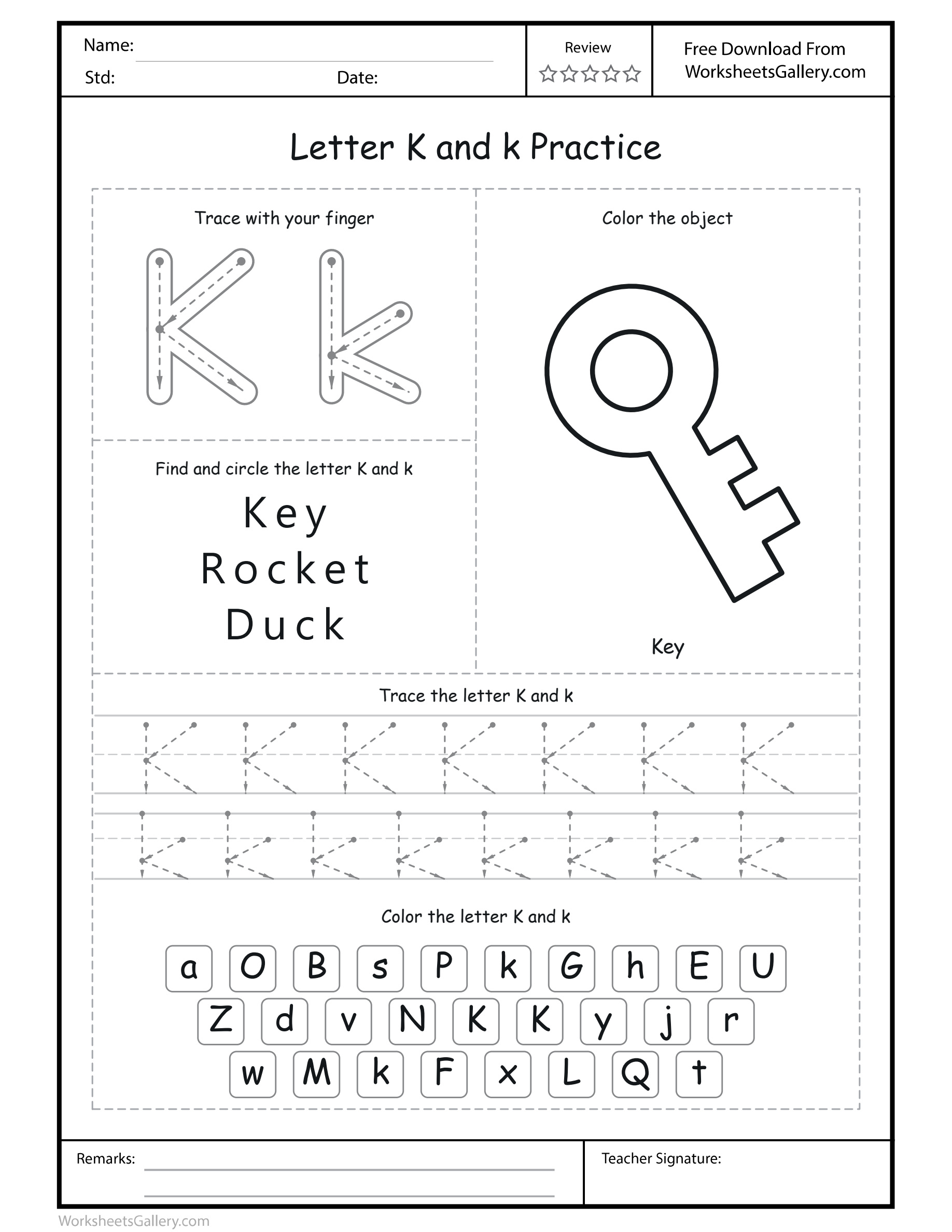
Kk Letter Scout belongs to the 26-page collection. Identify k in Rocket and Duck by print evidence without teaching ck as an extra task.
A key, a rocket and a duck give this letter search three different stopping places. Kk Letter Scout begins with a clear capital K, then asks children to notice lowercase k farther along two other labels. The large pair provides a reference for comparing upright stems and diagonal arms. An adult can read the words while a preschooler points, circles, colours and tries selected handwriting guides. The aim is a careful encounter with visible print, allowing a learner to explain an observation or change a choice without a race.
Unlock the label before following the rocket — Kk Letter Scout
Read Key, Rocket and Duck on Kk Letter Scout. Key begins with K. Rocket contains k as its fourth character, and Duck ends with k as its fourth character. The panel therefore has three target letters. In Rocket and Duck, k follows c; the present task is to recognise the written k, with no extra requirement to explain the spelling pair ck.
Move a finger beneath each label and stop at the target. A child who knows the spoken word rocket may still need help locating its printed k. Read the whole word naturally, name the target letter, and allow the child to compare it with the model. Kk Letter Scout separates an accessible visual search from independent word reading.
| Label | Where K/k appears | Inspection cue |
|---|---|---|
| Key | First character | Look at the opening capital. |
| Rocket | Fourth character | Check after c. |
| Duck | Fourth and final character | Keep looking to the end. |
Ask for a circle around each letter rather than a loop around the word. If Rocket's r is selected, compare that character directly with k. Keep the child's original reasoning available: perhaps the word was recognised and the first letter seemed the obvious place. Kk Letter Scout offers a useful opportunity to expand that search route.
Two arms meet one stem: Kk Letter Scout
The supplied K/k pair has a tall upright and diagonal branches. Point to the meeting area, then follow the printed arrows and starting marks with a finger. Notice the proportions of the capital and lowercase model instead of assuming one is just a scaled copy of the other. The actual model on Kk Letter Scout should guide this handwriting visit.
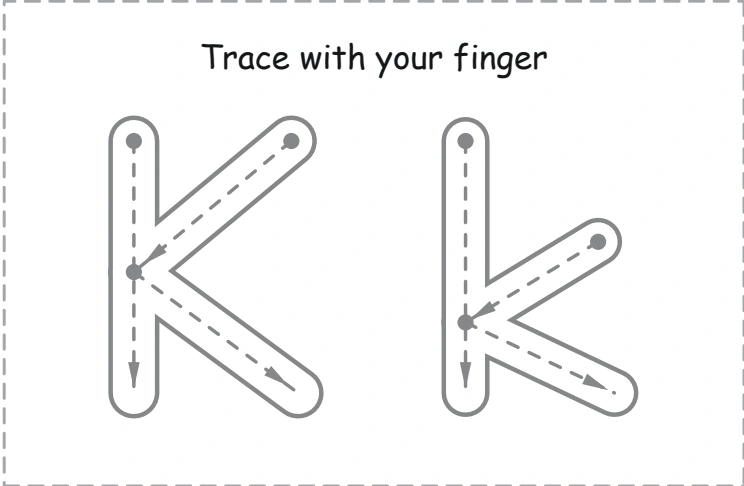
Describe the junction in familiar terms such as “the arms meet the stem.” Avoid asking for perfect angles or measuring the parts. A learner can compare where the diagonals join and whether both are visible. The language gives an adult a specific way to respond when an attempted k loses a branch or becomes difficult to recognise.
If several features look confusing, cover the word and tile areas briefly and look only at the large pair. Say the name K as the finger follows each form. Kk Letter Scout can be approached through touch and conversation before any smaller pencil movement. Clear attention to one model is a useful beginning in itself.
A pretend key desk at home, imagined: Kk Letter Scout
Imagine Kavi arranging toy keys beside a completed Key card. A family member reads the card and asks him to match its capital with Kk Letter Scout. He finds K quickly, then expects every target in the word panel to be first. Rocket interrupts that expectation. The adult tracks the word and invites Kavi to stop after c.
Kavi points to k and compares its branching outline with the model. On Duck, he follows the letters all the way to the final character. The family member describes what changed: he checked the end as well as the beginning. This imagined exchange provides a reason to notice position without turning the exercise into a test of spelling terminology.
Kavi can then choose a colour for the key drawing or trace one guide. If the search has used his concentration, the rest of Kk Letter Scout can wait. A brief successful explanation is a sensible stopping point when a longer session would become a struggle over pencil marks.
Six benefits with visible evidence: Kk Letter Scout
Complete-word inspection. Rocket and Duck reward looking beyond the first character. Kk Letter Scout gives an adult a way to notice whether the learner's scanning route is expanding.
Case association. The capital in Key and the lowercase targets can be named together. The child sees the family relationship while retaining the differences between the printed forms.
Feature comparison. A stem with two diagonal branches provides a concrete description. Pointing to those parts supports a reason for accepting or rejecting a tile.
Movement planning. The model's joining strokes invite a pause before changing direction. Finger tracing on Kk Letter Scout can introduce that sequence without the extra pressure of pencil control.
Shared vocabulary. Key, Rocket and Duck offer recognisable spoken labels for conversation. An adult supplies the reading while the child contributes observations about print and objects.
Revision as a useful action. Returning to a model after an uncertain choice gives the learner a constructive next step. The adult can value that checking behaviour rather than only counting immediate answers.
Fifteen guides do not demand one long sitting: Kk Letter Scout
The handwriting area of Kk Letter Scout has seven capital practice examples plus eight lowercase examples. Preview both rows and select a few. Follow the printed cues, keeping the hand comfortable and the page steady. A child may benefit from an adult indicating the next start position, especially after lifting the pencil between strokes.
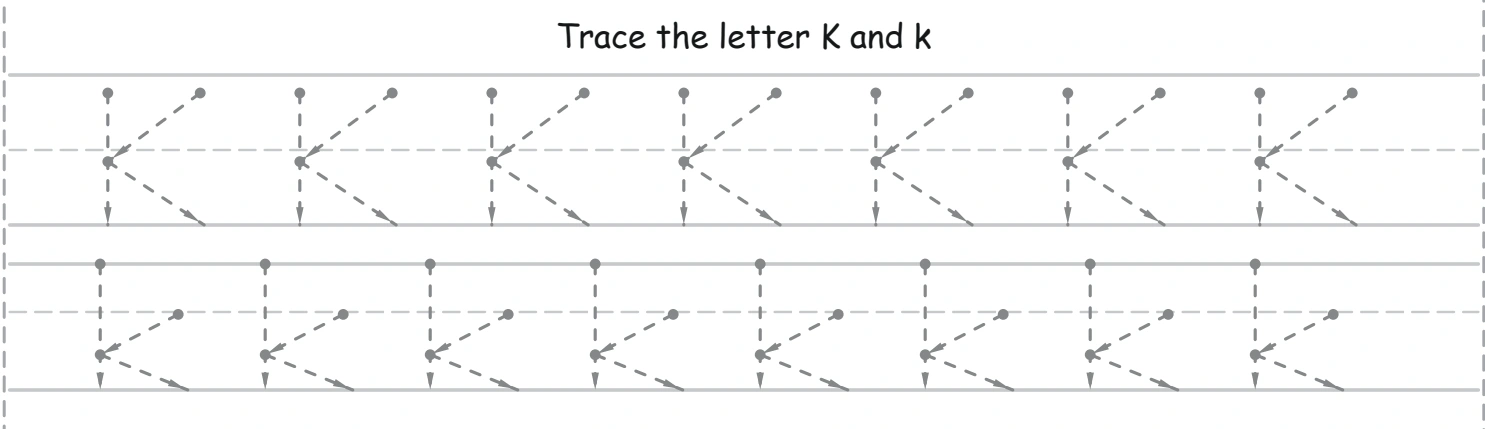
Watch one feature at a time. If the diagonal junction is unclear, compare it with the large model before discussing spacing. If the stem is difficult, revisit that upright movement first. Kk Letter Scout supplies repeated opportunities, so the next guide can become a fresh attempt rather than a reason to erase the previous one repeatedly.
Ask the child which attempt shows the branches most clearly. A pointing answer lets them review their own work without having to judge every mark. Stop for a hand break if pressure rises or the wrist becomes tense. The remaining guides can support another encounter when movement feels comfortable again.
A classroom launch cupboard, imagined: Kk Letter Scout
Picture Kavi helping a teacher label a pretend launch cupboard. The completed cards read Key and Rocket. The teacher reads them and asks where k appears in each. Kavi notices the opening capital on Key and the interior character on Rocket. They place the relevant models beside the labels as evidence.
A Duck card becomes a humorous visitor to the cupboard. Kavi checks its ending and shows the final k. Returning to Kk Letter Scout, he explains that the target is not always at the front. Another child can point while Kavi compares the shape, giving both partners a role without making the activity a contest.
The teacher may keep a short note about that explanation and offer only one tile row next. This imagined classroom use gives the printed search a practical setting. It does not require extra craft preparation or a completed pretend play scene before the worksheet itself can be useful.
Scan the tile rows with the model nearby: Kk Letter Scout
There are twenty-seven tiles on Kk Letter Scout, arranged ten, nine and eight across the three rows. Four belong to the K/k family: two capitals and two lowercase forms. Adult whole-field checking positions are 6, 15, 16 and 22. The child's job can remain a visual comparison rather than calculating those coordinates.
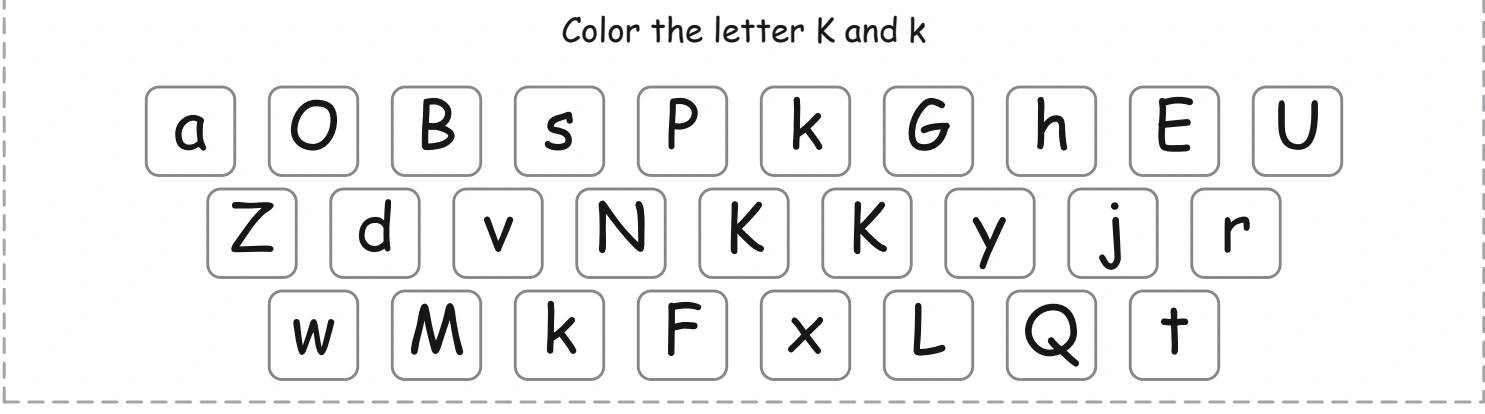
Inspect one row fully, including the tile after a discovered match. Two of the middle-row targets sit next to one another, so finding the first does not finish that local search. Keep a pointer beside the current K/k candidate during a glance toward the reference.
If a character with a diagonal seems tempting, compare the entire outline, including the upright and both branches. Kk Letter Scout asks for K or k, not any symbol containing a slant. Invite a pointing explanation for the selected K/k shape. If the explanation reveals a mismatch, compare and reconsider together.
Five key-and-rocket extensions: Kk Letter Scout
Branch builder: Kk Letter Scout
Arrange a long strip and two shorter diagonal strips into a completed K beside Kk Letter Scout. Name the joining point and compare it with the model. Clear the strips before handwriting so the craft does not distract from the printed cues.
Label parking: Kk Letter Scout
Put Key, Rocket and Duck cards on a table and read them. Let the learner park a K/k reference beside each target. The different positions make the same letter family feel portable across labels.
End inspector: Kk Letter Scout
Read Duck and invite a finger to travel to its end. Find the final k, then return to Duck in Kk Letter Scout. The game reinforces a complete inspection route without introducing extra written answers.
Rocket passenger: Kk Letter Scout
Place a small token after the k on a completed Rocket card. Ask which letter the passenger sits beside. Move the token away after the target is identified so the printed word remains the evidence.
Neighbour watch: Kk Letter Scout
After circling a tile, compare the next tile before moving farther. The adjacent middle-row targets give this Kk Letter Scout game a particular purpose. Partners can alternate pointing and checking with the model.
A colour pause and a fresh setting: Kk Letter Scout
The key drawing offers a free colour choice. Ask which part the child wants to colour first and what sort of door the imagined key might open. There is no prescribed colour code on Kk Letter Scout; a patterned key can be as welcome as a metallic-looking one.

The supporting illustration shows a key and rocket with completed labels and a K/k reference. Use the highlighted interior letter as a conversation starter, then inspect the actual printed word panel. The illustration adds a setting for discussion, while the worksheet preview remains the faithful view of the downloadable exercises.
Adapt the amount, retain the observation: Kk Letter Scout
For learners around three to six, Kk Letter Scout can involve shared pointing, adult marking, a little tracing or a fuller independent search. Choose a response method that lets the child show recognition. A learner with limited pencil control can still identify the target and explain where it sits in Rocket.
Frequent mix-ups include selecting the first character automatically, circling a whole label, omitting one branch while tracing and treating a found tile as the end of a row. Demonstrate the relevant next action on one example. Do not give a long correction speech covering every possible issue at once.
Return to Kk Letter Scout with a different entry point, perhaps Duck before Key or a lowercase guide before the capital. Short, regular visits can build familiarity while preserving curiosity. End with a named observation, such as checking both branches, so the learner has something specific to carry into the next encounter.
Continue reading and choose a file: Kk Letter Scout
Compare Kk Letter Scout with Kk Worksheet. A listening follow-up to Kk Letter Scout is First Sound Choices. For Kk Letter Scout, explore Ll Worksheet.
Adults can draw on NAEYC's play resources when planning a participatory extension. PBS Parents literacy ideas offer more ways to talk about books and print. Select what fits the child; these links are optional background rather than extra worksheet instructions.
The page's controls provide the original Kk Letter Scout sample. An eligible active member can also download the separately protected clean single worksheet without website branding. Before printing, confirm that the outer frame fits and that both diagonal branches remain legible in the smaller guides. Choose a size that preserves those details.
The collection card connects this page with the $5 Alphabet Wordwork Collection, a separate premium purchase containing all twenty-six clean sheets in one PDF. That file is useful for planning a complete A–Z sequence. Membership access to the individual clean worksheet and purchase of the full collection remain distinct options available from Kk Letter Scout.
Popular Worksheets
Printable resources families and teachers are downloading now.
 Free
 Free
 Free
 Free