
Jj Letter Locator: 3 Delightful Jug-and-Juice Visits
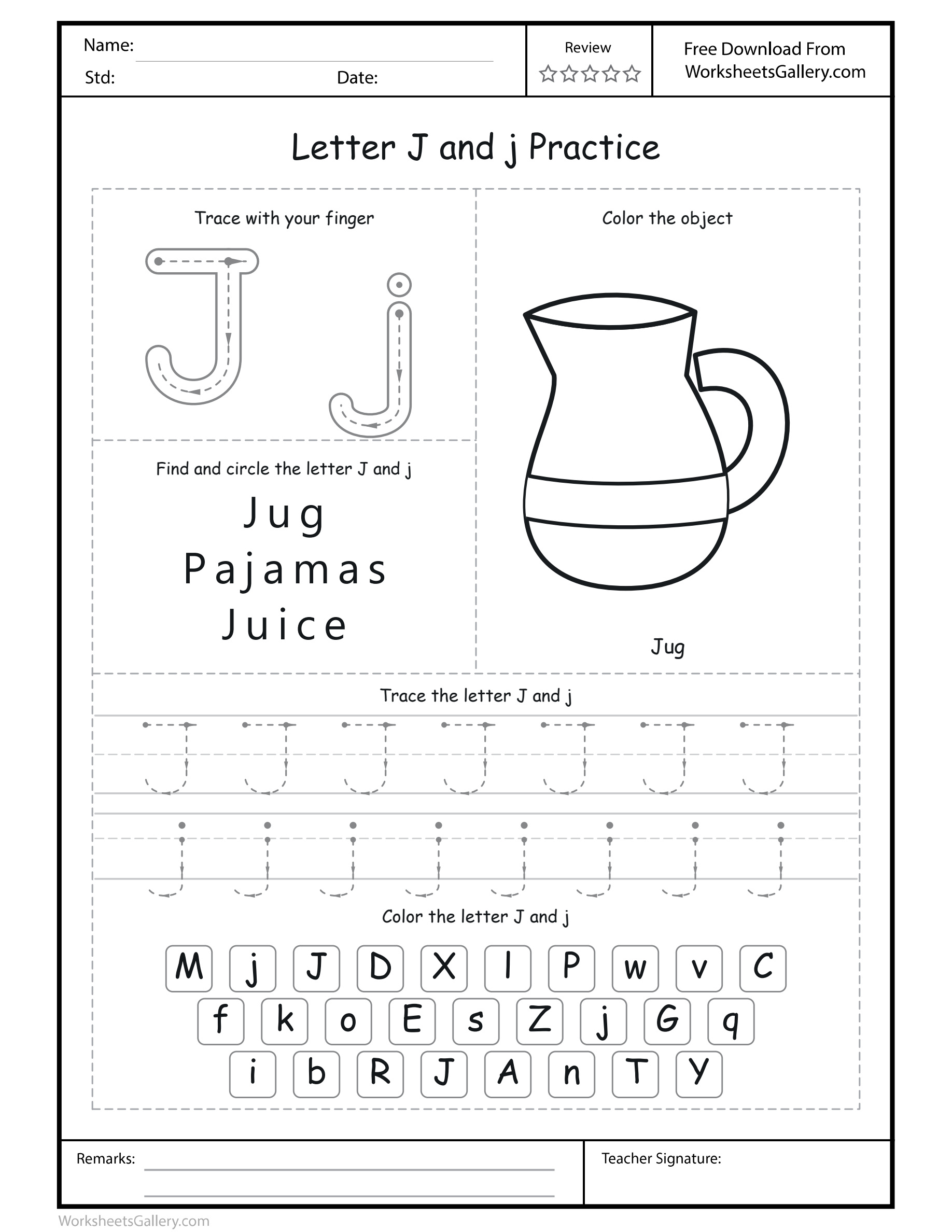
Jj Letter Locator belongs to the 26-page collection. Find the internal j in Pajamas and distinguish a hooked descender from its separate dot.
Pajamas puts a little j where a first-letter search would miss it. Jj Letter Locator pairs that interior discovery with Jug and Juice, two labels that begin with capital J. Children can connect the cases, follow a hooked model, colour the jug and find matching tiles. An accompanying adult supplies the word reading and helps keep the separate dot in view. This is a letter visit for noticing details, with room to talk about a choice and try a small amount of handwriting before returning another day.
Pajamas is the interesting interruption — Jj Letter Locator
Read the three labels on Jj Letter Locator without asking the learner to decode them. Jug starts with J and Juice starts with J. Pajamas has j as its third character, after P and a. The word panel contains three target letters altogether. A finger moving through Pajamas can make the hidden-looking position easier to inspect.
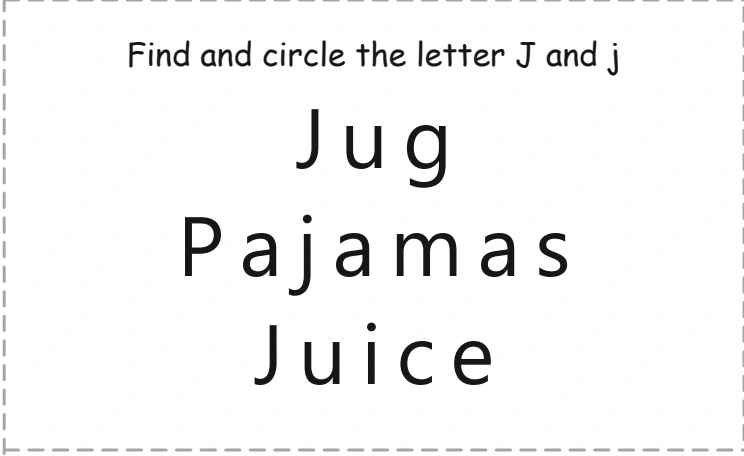
Show how a small circle surrounds the actual J or j. A circle around the complete word would hide the distinction the task is asking a child to notice. In Jj Letter Locator, an initial capital and an interior lowercase character belong to the same search, even though their places and outlines differ.
| Label to read together | J/j evidence | Prompt to try |
|---|---|---|
| Jug | J at position 1 | Where does this word begin? |
| Pajamas | j at position 3 | Look after the first a. |
| Juice | J at position 1 | Which capital do these drink words share? |
A home pyjama label, imagined: Jj Letter Locator
Imagine Jori looking at a completed Pajamas card beside a folded pair of nightclothes. A family member reads the label and opens Jj Letter Locator. Jori searches the word's first character, then says there is no J. The adult places the large lowercase model near the printed word and asks whether the small letter might be farther along.
Jori notices the dot before noticing the hook. The family member helps compare the full j outline with the model, and Jori points to the third character. They circle it together. This imagined moment values a changed search strategy: the learner looked beyond the beginning instead of simply receiving an answer.
Later, Jori chooses a colour for the jug on Jj Letter Locator and tells a short story about a bedtime drink. The adult can write a finished label on separate paper if requested. The story need not contain extra target words, and the worksheet need not be completed in that sitting to make the discovery useful.
The hook has a separate companion: Jj Letter Locator
Compare the supplied large J and j models before tracing. Capital J turns into a hook near its lower end. Lowercase j has a descending hooked stroke and a separate dot above it. In Jj Letter Locator, the full outline matters: choosing a character because it has a dot alone can confuse j with i.
Use the printed movement cues as the guide. Follow with a finger, lift as the model requires, and notice where the dot belongs. Keep the lower extension visible keeping fingers and any comparison card clear of that descending part. If the child begins at an unexpected place, return to the start mark and talk through one slow journey.
Seven uppercase guides and eight lowercase guides provide the handwriting practice on Jj Letter Locator. Try a few, pause, and look back at the large pair. A child may need help anchoring the paper or judging where the descending stroke fits. Gentle pressure and a comfortable posture support that work better than repeated demands to make every mark identical.
Six observations worth keeping: Jj Letter Locator
A letter can live inside a label. Pajamas gives Jj Letter Locator a specific reason to inspect beyond the first character. The learner can demonstrate this by pointing, without spelling the whole word aloud.
Two cases share an identity. Jug and Juice place capital J in familiar spoken labels, while Pajamas provides lowercase j. Saying the letter name as each is found links the visual forms.
A dot is only part of the evidence. Looking for the hook as well encourages a fuller comparison. This helps an adult explain why a tempting dotted character may still be different.
Hand movements can be planned. Following the turn and then adding a separate dot gives Jj Letter Locator two small actions to discuss. Finger tracing can prepare those actions before a pencil is introduced.
Review can be cooperative. An adult and child can compare an uncertain mark together. A question about a visible feature gives the learner a way to participate in the correction.
Conversation gives print a purpose. Talking about a jug or nightclothes connects the printed labels with an experience the child can describe. Recognition can grow alongside shared language, with no promise of instant independent reading.
The jug can carry a colour story: Jj Letter Locator
The jug drawing in Jj Letter Locator is a colouring opportunity with an open palette. Ask whether the learner wants one colour, several bands or an imagined pattern. A bright green jug is a valid creative decision. Do not turn the object into a colour-answer exercise when the source provides no such key.
A short spoken story can follow: who might use the jug, or what could it hold? Keep the object name available by reading its label naturally. If the child becomes absorbed in colouring, save the smaller lettering for another visit. The picture can help the page feel welcoming without being used as a reward withheld until every guide is filled.
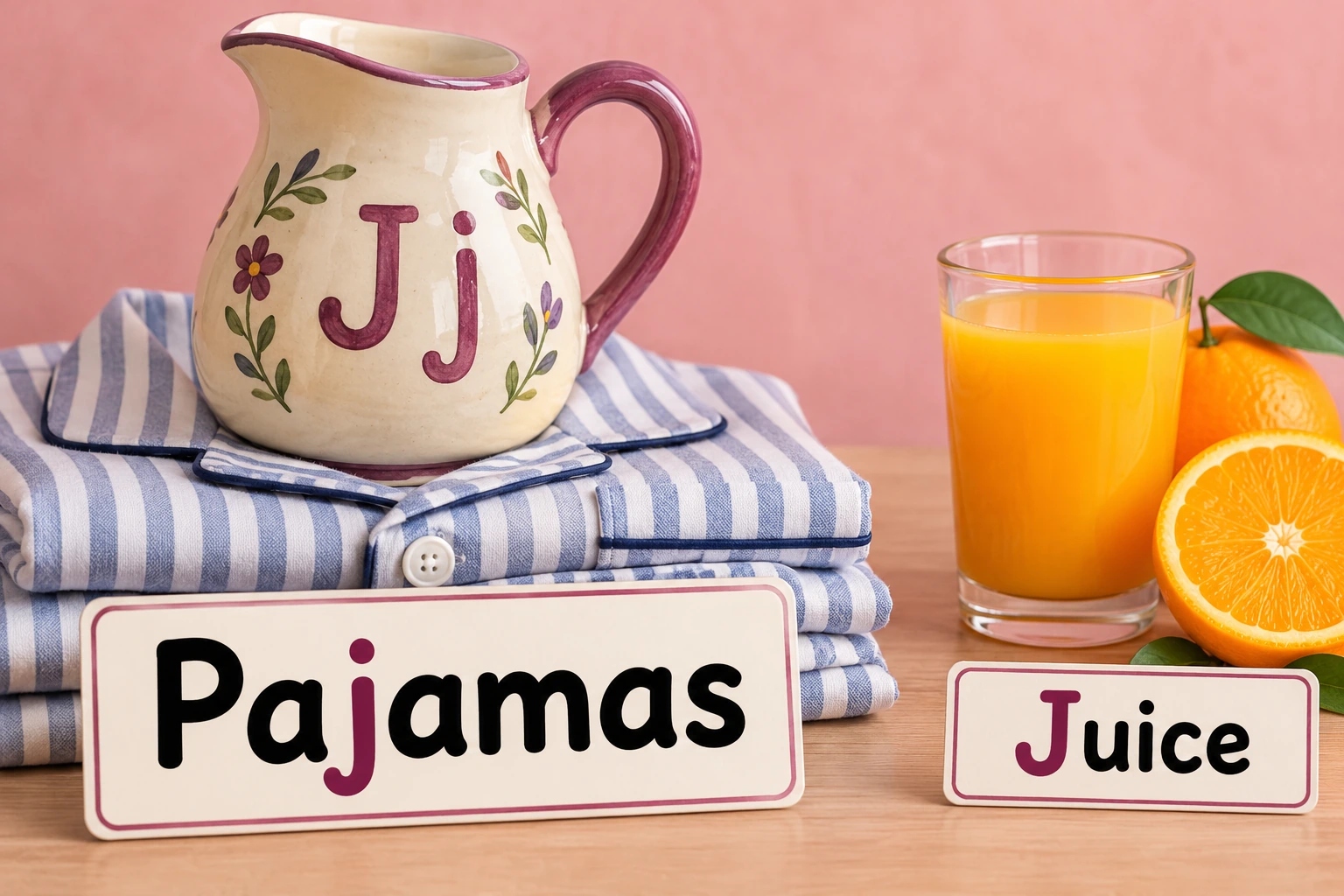
The illustration beside this discussion gives Jj, a jug and completed word labels another visual setting. Its readable Pajamas example can invite a new interior-letter inspection. Use Jj Letter Locator itself for the exact printed tasks; the supporting scene is a conversation aid rather than an extra answer panel.
A classroom drink shop, imagined: Jj Letter Locator
Picture Jori helping arrange a pretend drink shop in class. The teacher provides finished Jug and Juice cards and reads them at the counter. Jori finds their shared capital J. The teacher then introduces Pajamas from Jj Letter Locator as an unexpected visitor to the shop's letter collection, rather than pretending it names another drink.
Jori places the lowercase model beside that word and locates j. Another child points to i on a separate comparison card. The teacher invites both children to describe the lower end and the dot. Jori notices that j descends and curves. The children can disagree and then inspect the model together, without losing turns or points.
Returning to Jj Letter Locator, Jori chooses one capital guide to trace. The teacher records the explanation about the hook, because that observation says more about the comparison than a tally of completed pencil marks would. This imagined class scene is one possible use of the page, not a required lesson script.
Four tile matches need four complete comparisons: Jj Letter Locator
The mixed field on Jj Letter Locator has twenty-seven tiles: ten in the top row, nine in the middle and eight below. It includes two J targets and two j targets. An adult checking the whole field can use positions 2, 3, 17 and 23, counted across its rows. Children can simply inspect each tile in a clear visual route.
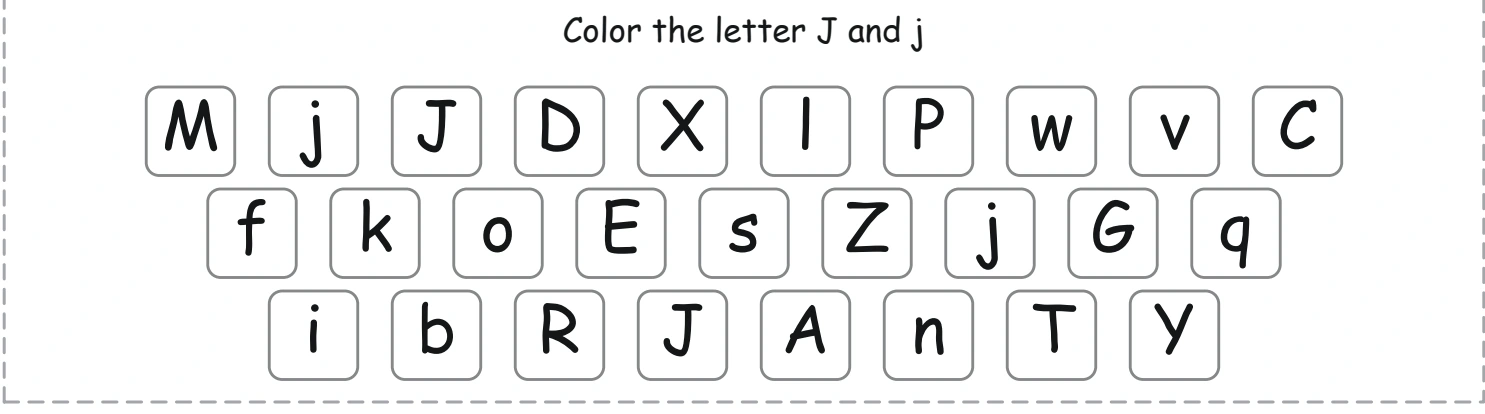
The two adjacent early targets make it useful to continue after the first discovery. A learner who circles one and jumps away may overlook its neighbour. Place a finger just beyond the marked tile and ask what should be inspected next. That prompt preserves the child's role in finding the remaining evidence.
Compare both the upper and lower parts of a candidate. For lowercase j, locate the dot and descending hook; for capital J, compare the supplied capital outline. Jj Letter Locator does not require children to calculate tile coordinates. The adult reference exists to check completeness after the visual search, with support matched to the learner.
Five extensions with finished labels: Jj Letter Locator
Bedtime word visitor: Jj Letter Locator
Read a completed Pajamas card and let the child park a J/j model beside its target. Then return to the word panel on Jj Letter Locator. The extra card for Jj Letter Locator gives the same position a fresh setting without requiring a new spelling list.
Hook-and-dot builder: Jj Letter Locator
Arrange a curved cord as j and place a paper dot above it. Compare the finished shape with the worksheet model. Invite the learner to name the two parts before clearing the materials away and trying a finger trace.
Shop sign pair: Jj Letter Locator
Put Jug and Juice cards beside two pretend shop objects. Read both signs and point to their shared first letter. A child can act as the sign inspector, checking the capital shape against Jj Letter Locator whenever needed.
Neighbour replay: Jj Letter Locator
After a tile match, inspect the next tile deliberately. Say “continue” only when the neighbour has been compared. This small rule addresses the adjacent targets directly, rather than adding a timer or an unrelated memory demand.
Letter tour guide: Jj Letter Locator
Ask the learner to show a partner one capital J and one lowercase j somewhere on Jj Letter Locator. The Jj Letter Locator partner can ask about a hook or dot. A pointing response counts; the goal is a visible comparison, not a rehearsed explanation.
Make a return manageable: Jj Letter Locator
For preschoolers around three to six, a first visit to Jj Letter Locator might involve pointing and colouring while an adult reads. A more confident learner could circle all word targets and discuss the interior j. Adjust the response method and the amount of pencil work to the child, rather than expecting every section at a particular birthday.
If j loses its dot, compare that attempt with the model and invite one addition. If it is mistaken for i, look below the writing line at the hook. If Pajamas seems target-free, slide a finger through the word after the first character. These responses address different misunderstandings and keep the next action concrete.
Regular practice can begin with a remembered feature: “Show me the part that goes down.” Another day might begin with Juice or with a single tile row. Let the learner choose between two short starting tasks. Jj Letter Locator can remain familiar while the route changes, giving attention a specific job without demanding a complete repeat.
Praise the observation you can see, such as checking the lower end or returning to a missed neighbour. Avoid describing a slow search as careless or promising that this page will resolve all letter confusion. A comfortable finish might be one correctly explained comparison and a plan to revisit the rest later.
Download choices and further reading: Jj Letter Locator
Compare Jj Letter Locator with Jj Worksheet. A listening follow-up to Jj Letter Locator is First Sound Choices. For Jj Letter Locator, explore Kk Worksheet.
For ideas about participatory early learning, adults can consult NAEYC's play topic collection. PBS Parents' literacy resources offer additional ways to share words and stories. Pick a relevant suggestion when it serves the child's interest; the worksheet has no prerequisite reading assignment for families.
The original Jj Letter Locator sample uses the page's download controls. Eligible active members can obtain its separate clean single-sheet version without the website promotion. Before printing, inspect the entire frame and check that the small dots and descending j strokes remain clear at the selected size. Keep those details visible when placing the sheet on the table.
For $5, the Alphabet Wordwork Collection can be purchased through the collection card. It combines all twenty-six clean A–Z sheets into one PDF, useful when a full sequence is wanted. Access to the individual clean worksheet through membership and purchase of that complete collection are separate choices. The linked card makes the larger file easy to find from Jj Letter Locator.
Popular Worksheets
Printable resources families and teachers are downloading now.
 Free
 Free
 Free
 Free