
Jellyfish J Junction: 4 Amazing Letter Learning Stops
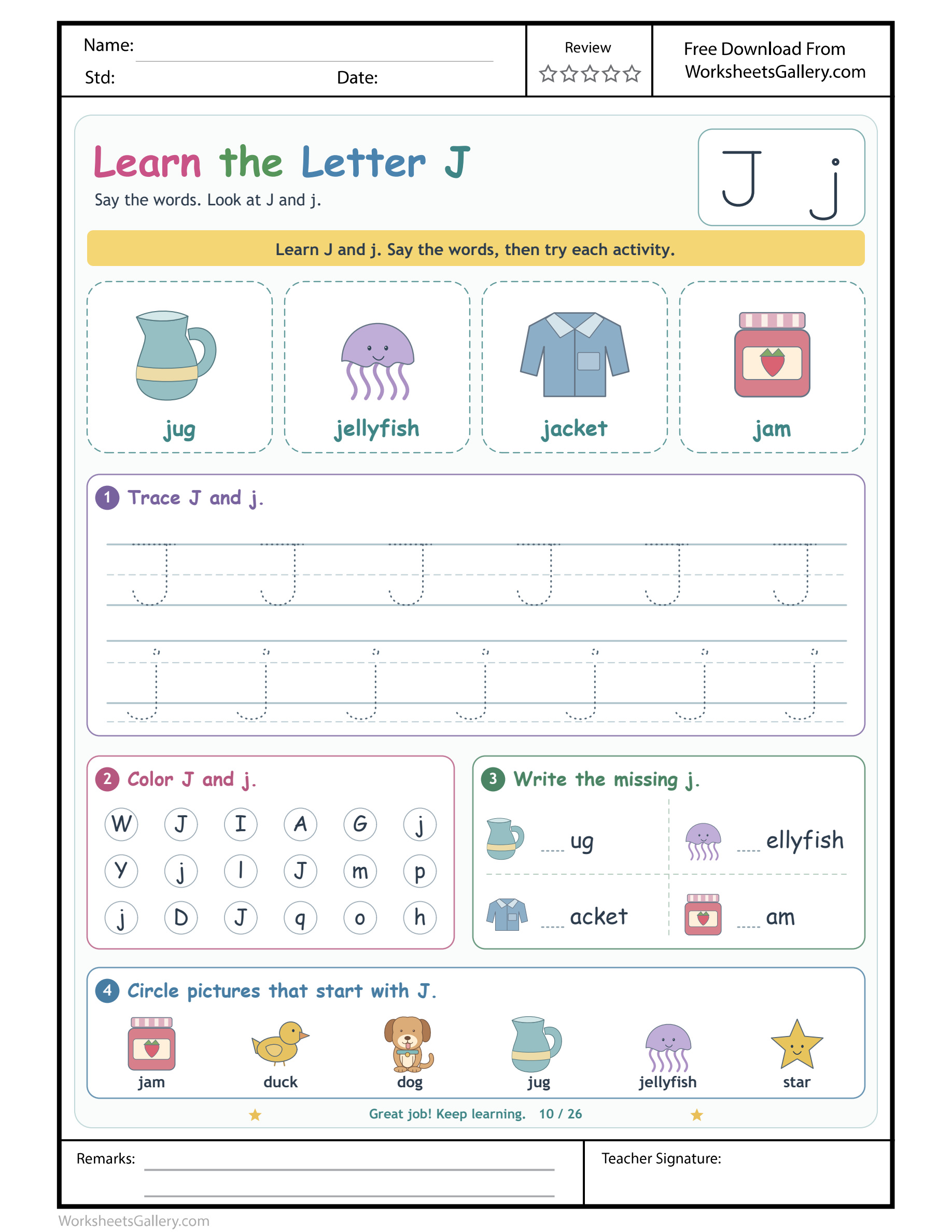
Jellyfish J Junction: Link the j hook and dot to four named pictures, with a lowercase j restored in every word.
Jellyfish can start a wonderfully unusual conversation at a pretend café: would one order jam from a jug? Jellyfish J Junction turns that playful mix of ideas into a clear Jj print activity. Its picture bank names jug, jellyfish, jacket and jam, followed by tracing, case searching, lowercase completion and picture selection. Read the names together before deciding which panel to try. Children can recognise an initial with adult help long before they read every long label independently. Let their questions about the pictures provide a friendly route into a small, purposeful letter comparison.
A miniature café introduces Jj — Jellyfish J Junction
Consider an invented home scene with Juno arranging a toy jug and a jar labelled jam. An adult reads those names on Jellyfish J Junction, and Juno notices the shared first character. A jellyfish picture becomes a pretend customer. The adult can accept that imaginative idea while keeping the actual worksheet direction simple: compare the written beginning of the supplied names.
Nothing about this scenario implies a documented result. Juno might choose one initial gap, or simply explain which label goes with the jug. There is room for a useful print observation even if the café play soon takes a different direction and no pencil is used.
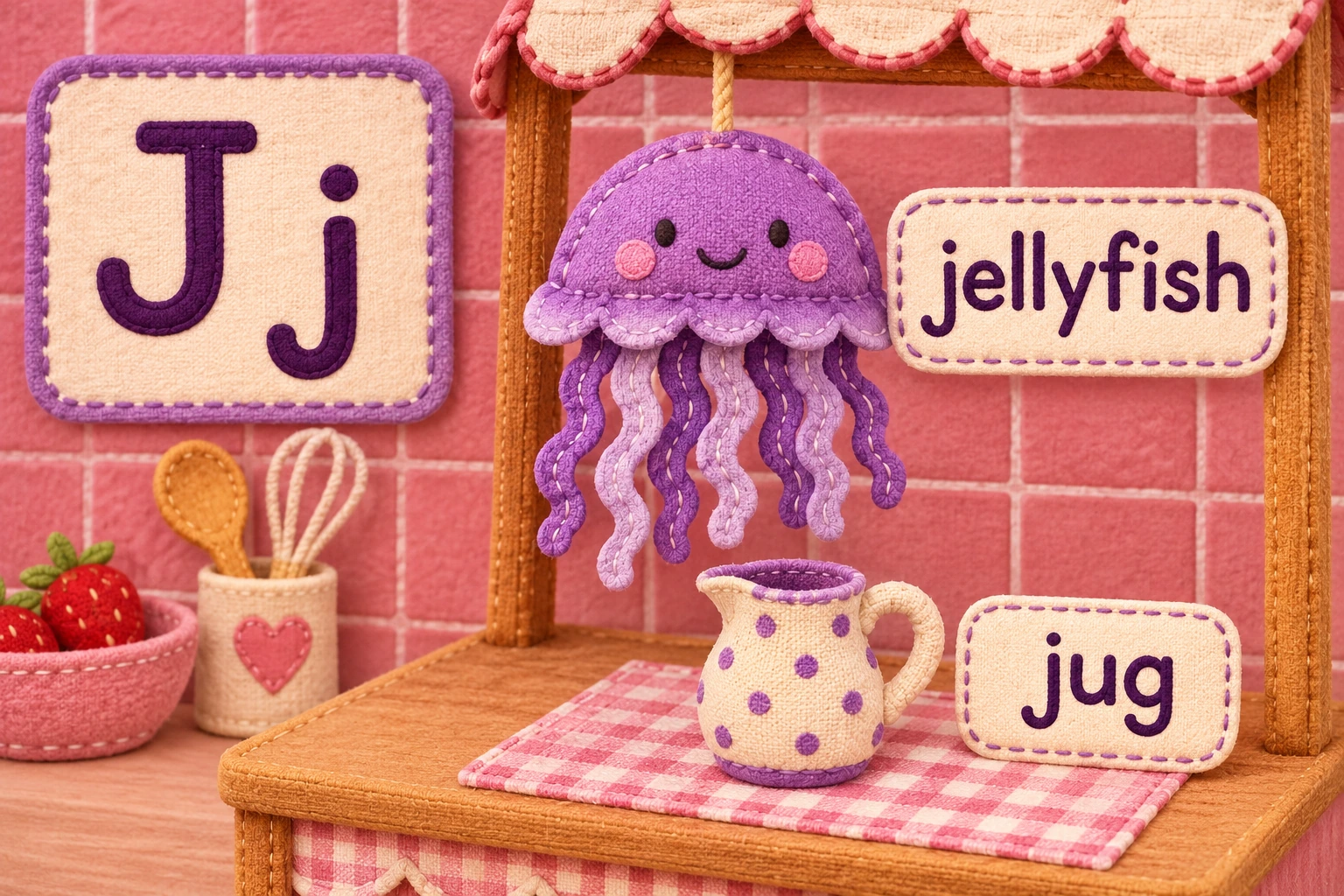
Understand what each numbered panel requests: Jellyfish J Junction
| Jellyfish J Junction activity | Adult quick check | Source detail |
|---|---|---|
| Trace J/j | 6 J models;7 j models | Jellyfish J Junction guide rows |
| Find Jj cases | 2, 6, 8, 10, 13, 15 | 6 matches in the Jj circle field |
| Complete jug through jam | j | Jj: initial j |
| Picture-name check | jam, jug, jellyfish | 3 choices fit Jj |
The Jellyfish J Junction table is an adult reference for checking the source. Count circle positions left to right in rows of six. Its six matching letters differ from the three matching pictures below. Reading the relevant instruction again is more helpful than carrying one answer count into every part of the page.
A hook and dot deserve separate attention: Jellyfish J Junction
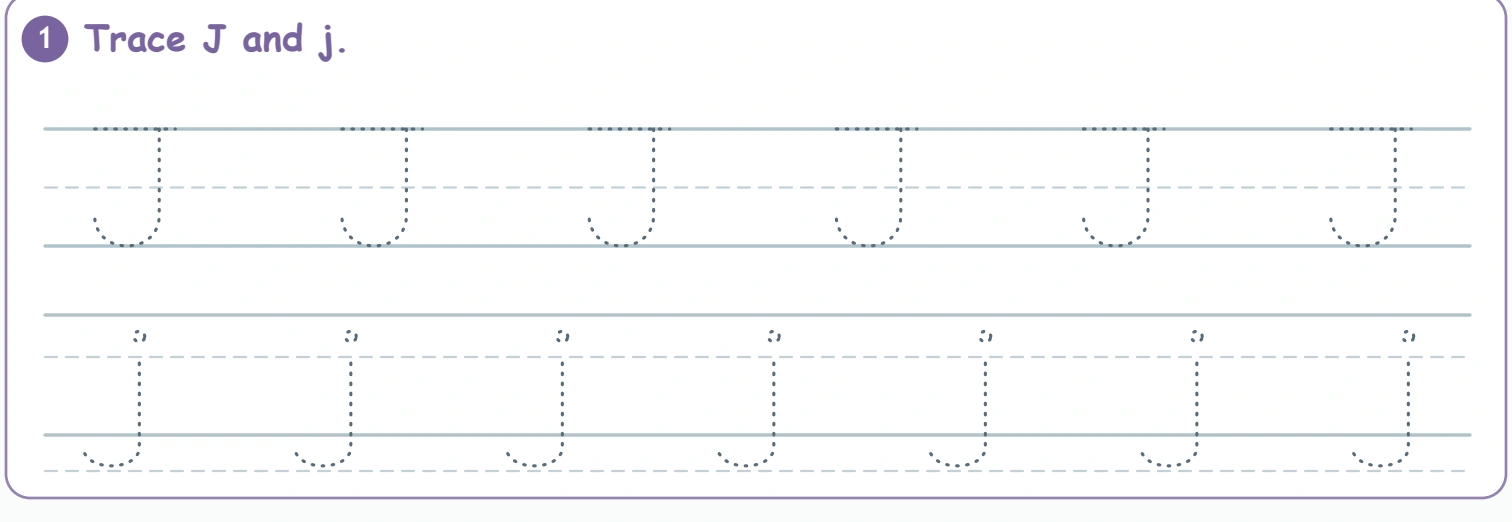
Capital J and lowercase j are related, but the small form needs its own inspection. Use the models on Jellyfish J Junction to notice the lower curve and the dot belonging to the lowercase form. A child who recognises the capital may still need the smaller partner explicitly introduced.
Trace the supplied outlines with a finger before choosing a pencil example. The six capital guides and seven lowercase guides are available models, not a compulsory amount. Because the PDF contains no numbered formation arrows, an adult demonstration should be described as guidance offered beside the page rather than a route dictated by the source.
Read the whole word, then inspect its beginning: Jellyfish J Junction
Jug and jam are short labels; jacket and jellyfish provide longer ones. On Jellyfish J Junction, their different lengths do not change the one-letter focus. Say each name naturally, point to its initial j and let the learner compare. The child need not decode every internal spelling or write the names from memory.
For jellyfish, pause if the learner wants to talk about the animal. A meaningful discussion can coexist with a modest letter task. Avoid turning an interesting picture into a vocabulary quiz that must be passed before the child is allowed to inspect the print.
Find both cases among eighteen circles: Jellyfish J Junction
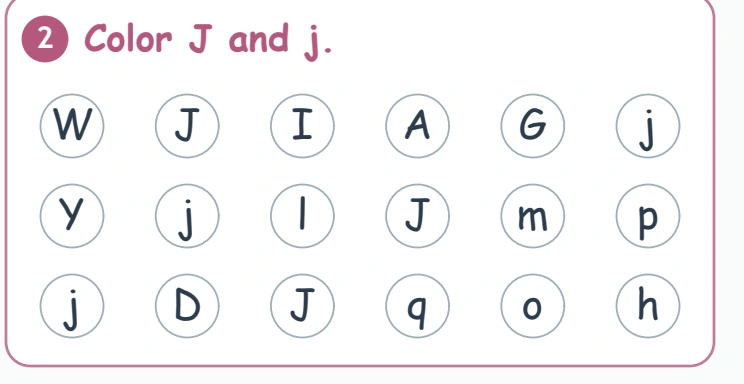
The recognition field in Jellyfish J Junction contains three capital J matches and three lowercase j matches. Keep the references above visible, especially when a candidate resembles only part of the target. Pointing to the dot or curve can explain a decision without formal language about letter anatomy.
Some learners work more comfortably across one row before moving down. A separate cover sheet can temporarily reduce the number of visible choices. Mark a circle after deciding that it fits. The adult's total check can happen afterwards, so that a child is not pushed to colour an uncertain candidate simply because another answer is expected.
Six things a thoughtful Jj visit can reveal: Jellyfish J Junction
- Detail awareness. A learner may notice that a lowercase dot contributes to the complete letter.
- Case association. Different-looking J and j can both be recognised as belonging to the named letter.
- Vocabulary use. Talking about a jug's purpose gives its printed name a meaningful reference.
- Controlled movement. Following a short dotted model asks for a manageable hand action.
- Checking a label. Consulting jacket before repairing acket is a practical use of a visible example.
- Instruction awareness. Choosing a picture by its name requires a different decision from finding a shape in a circle.
Treat these as observations to make around Jellyfish J Junction, not outcomes guaranteed by printing it. A clear explanation may appear through pointing rather than writing. If precise pencil control is still difficult, preserve the reasoning task and make the physical response larger or simpler.
One lowercase j fits four waiting spaces: Jellyfish J Junction
The Jellyfish J Junction completion fragments are ug, ellyfish, acket and am. Compare each with the intact bank, then add a lowercase j at the beginning. Longer jellyfish still requires only one missing character, just as jam does. Leave all the already printed letters unchanged.
If a child offers capital J, explain that the letter identity is sensible but the requested case is smaller. Show the lowercase model immediately. An answer made with a large movable j can demonstrate the same comparison when the small printed space is uncomfortable for handwriting.
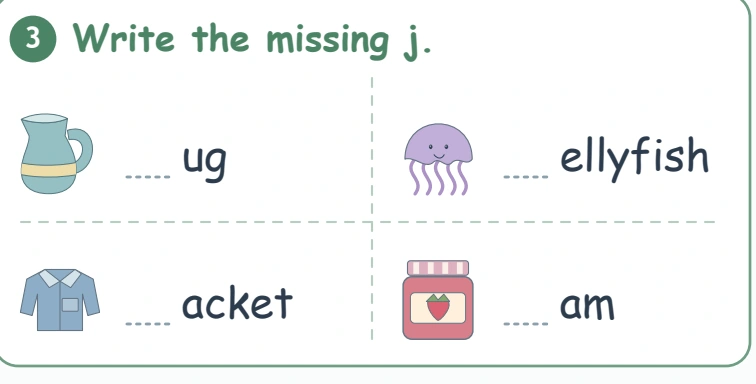
Jam, jug and jellyfish are the lower selections: Jellyfish J Junction
The six Jellyfish J Junction pictures below are jam, duck, dog, jug, jellyfish and star. Their labels make jam, jug and jellyfish the initial-J answers. Jacket is part of the upper vocabulary but does not appear as another choice in this lower set.
A jug might be called a pitcher in everyday conversation. Acknowledge that reasonable name, then read the supplied jug label so that the worksheet comparison has a clear word to use. The aim is to inspect the printed name chosen here, not to deny that an object can have more than one name.

An imagined jacket-check classroom corner: Jellyfish J Junction
For a possible group invitation, a teacher places a jacket picture, a toy jug and completed labels near Jellyfish J Junction. Children describe the objects, hear their names and choose a case reference to compare. The longer jacket word can introduce the initial without becoming an independent reading test.
Pupils then respond on their own sheets by pointing, searching or adding one character. A teacher might note a child's reason for accepting small j. This hypothetical classroom sequence illustrates an option for supporting different learners; it does not report a trial, a success rate or a fixed teaching timetable.
Five café extensions with different kinds of thinking: Jellyfish J Junction
Set out a jug's name card: Jellyfish J Junction
Place a completed jug card beside a toy jug. Ask which first letter links it with jam. A meaningful printed label lets the learner look back whenever needed, rather than turning the object into a guessing challenge.
Tell the jellyfish's order: Jellyfish J Junction
Invite a silly café order and write the child's dictated sentence on spare paper. Read it back with expression. Return to Jellyfish J Junction's jellyfish initial only if the child wants to; the story does not need four target words to count as enjoyable language play.
Make a large j repair: Jellyfish J Junction
Offer an am fragment, a completed jam reference and a movable lowercase j. The learner can place the missing beginning before attempting a smaller written version. This changes the hand demand while keeping the word decision recognisable.
Group by use, then by print: Jellyfish J Junction
Put jug and cup together as drink containers, then put jug and jacket together under a j card. Discuss why the groups changed. Both are sensible outside the worksheet, while its final panel asks specifically about the printed initial.
Inspect a dotted-letter partner: Jellyfish J Junction
Draw an adult-sized lowercase j next to a capital J and let the learner describe their differences. Keep the examples complete and visible. This discussion can prepare a later search without copying additional marks onto the original page.
Readiness can vary within the same child: Jellyfish J Junction
Juno’s café offers an entry to Jellyfish J Junction for preschool or kindergarten children, typically three to six, when an adult helps with the print. A child ready for lively picture talk may not yet enjoy narrow tracing guides. Begin with the accessible task, provide a stable surface and offer a writing tool that feels comfortable.
Hand control, language and visual comparison contribute in different ways. Needing help with one does not erase an understood answer in another. A short visit that ends with one explained choice is a reasonable use of the sheet, even when many spaces remain for later.
Deal with the dot, the case or the picture name: Jellyfish J Junction
A Jj repair may concern an omitted dot, a picture judged by another name, or capital J supplied where the small j is requested. Ask which reference will resolve the particular uncertainty. Make the next comparison visible instead of requesting a complete restart.
If correction becomes tiring, finish with an oral choice or a larger letter card. Specific feedback such as “You checked the small model before adding that beginning.” describes an action the learner can repeat. It is more useful than treating a heavily erased row as the measure of effort.
Revisit a favourite café character: Jellyfish J Junction
Let a later Jellyfish J Junction encounter start with a different customer: jellyfish one day, jacket-wearing toy another. One search row or one word gap can provide sufficient focus. Repeated practice can stay varied, with the page joining storytelling rather than replacing it.
Ask the learner which part feels interesting next and stop before frustration takes over. Familiarity with a label can build through everyday reading and play as well as through marking a sheet. Keeping the reference available makes a return feel like another investigation, not a memory examination.
Select a Jj download and check the paper view: Jellyfish J Junction
The free Jj file is the original Learn the Letter Jj upload. Qualifying members whose access is active can select the separate clean Jellyfish J Junction premium edition. Website watermark, web-domain text and promotional advertisements are removed there, with the jug, jellyfish and writing activities retained.
Use the library's linked product page for a separate $5 purchase of all twenty-six clean sheets in one PDF. Save whichever edition your account is authorised to obtain. A US Letter preview at original dimensions lets you check Jellyfish J Junction's lower j shapes before printing; the illustrated close-ups are intended to explain the work, not replace the print file.
Further ideas for purposeful language play: Jellyfish J Junction
Jellyfish J Junction connections: Jellyfish storytelling can accompany Jj Letter Locator. Another Jj invitation appears in Jj Worksheet; a separate sequence task is offered by Builder Letter Check when the learner wants a change from named pictures.
For adult reading beyond Jellyfish J Junction, try family play guidance from NAEYC or PBS Parents' Learn and Grow resources. These links lead to independent organisations and imply neither endorsement nor extra files included with this download.
Popular Worksheets
Printable resources families and teachers are downloading now.
 Free
 Free
 Free
 Free