
Ink Letter Inspector: 4 Brilliant Ii Picture Checks
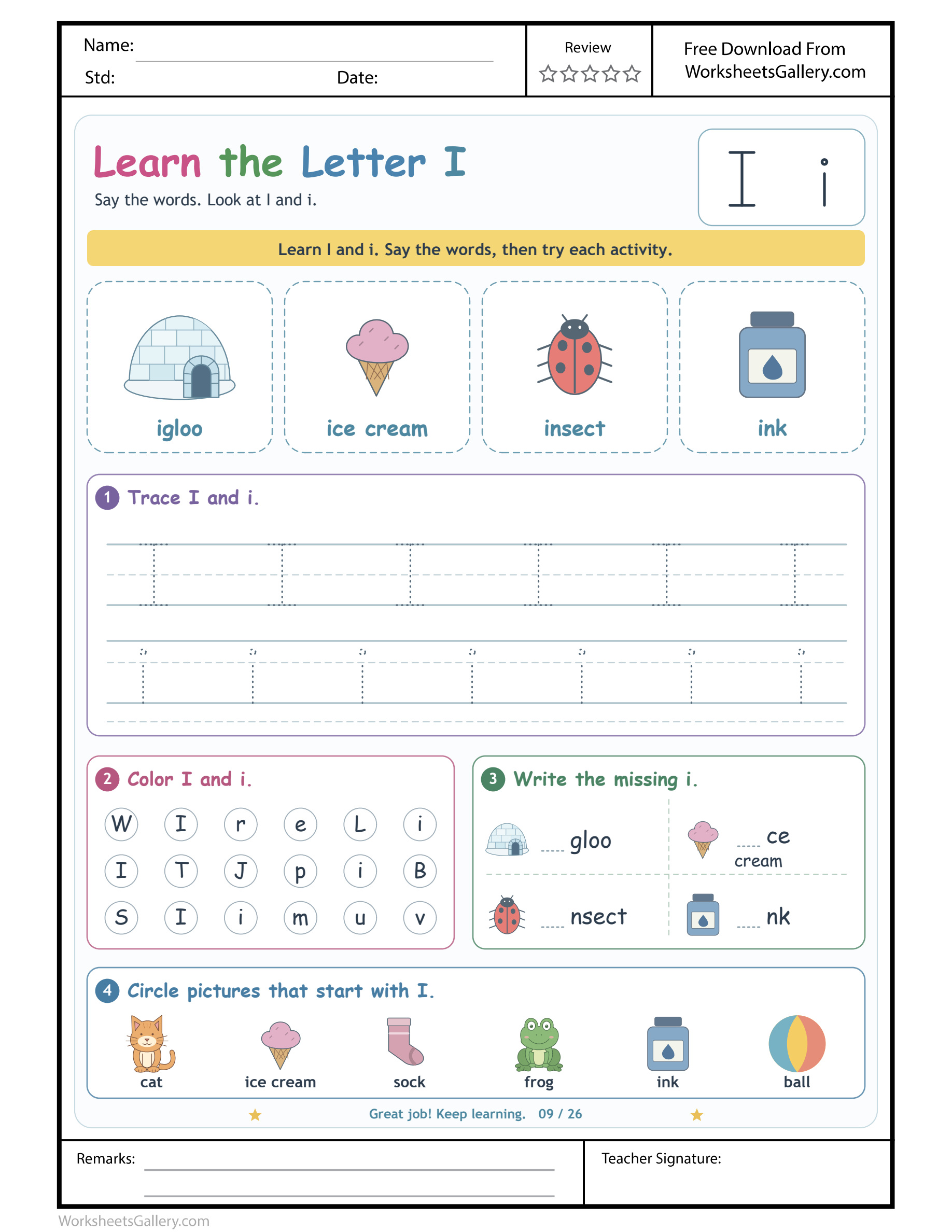
Ink Letter Inspector: Recognise I and dotted i across igloo, ice cream, insect and ink without forcing one vowel sound.
Igloos and ink may have little in common during play, but their written names begin with the same letter. Ink Letter Inspector invites children to inspect Ii through picture vocabulary, dotted models, a mixed-case search and four small word repairs. Ice cream and insect complete the upper bank, giving an adult several familiar names to read aloud. The point is to connect a visible initial with a named picture while recognising both cases. Begin with whichever example catches the learner's attention, and let a short conversation lead into a comfortable amount of pointing, colouring or writing.
One letter, more than one spoken vowel — Ink Letter Inspector
The printed bank in Ink Letter Inspector contains igloo, ice cream, insect and ink. Say each label in your ordinary voice. Ice cream begins differently from ink in common pronunciation, so the page should not be used to claim that every initial i represents one identical sound here.
The first written character is the connection. A learner can notice that connection while an adult supplies the spoken names. Understanding the print task does not require independently decoding the entire two-word ice cream label or reading insect without help. Keep these different demands visible when deciding how much support to offer.

Inspect capital bars and a lowercase dot: Ink Letter Inspector
Look at the models provided by Ink Letter Inspector. Its capital I has its own printed form, while the small i includes a dot above the stem. Compare candidates with those actual references. A child looking only at an upright line may miss information needed to distinguish the intended letter from another shape.
The dot is a useful observation, not a separate letter to count in the field. If another book displays a different capital-I font, acknowledge the variation and return to this sheet's model for the immediate decision. Learning to consult a local reference is more useful than insisting that every printed font must look exactly alike.
Imani's imagined writing-ink counter: Ink Letter Inspector
Suppose Imani sees a closed ink bottle in an adult's writing area at home. The adult reads ink on Ink Letter Inspector and points at the small i. Imani notices the dot and chooses to find the same form in one search row. A real bottle need not be opened; a picture or toy can introduce the same vocabulary.
This scene is offered as a fictional example. It does not report a child's tested improvement. Imani may finish with an oral comparison between I and i while the grown-up writes a short dictated message elsewhere. The worksheet remains a source of visible print, rather than a condition for access to the pretend writing activity.
Four panels with four different jobs: Ink Letter Inspector
| Ink Letter Inspector activity | Adult quick check | Source detail |
|---|---|---|
| Trace I/i | 6 I models;7 i models | Ink Letter Inspector guide rows |
| Find Ii cases | 2, 6, 7, 11, 14, 15 | 6 matches in the Ii circle field |
| Complete igloo through ink | i | Ii: initial i |
| Picture-name check | ice cream, ink | 2 choices fit Ii |
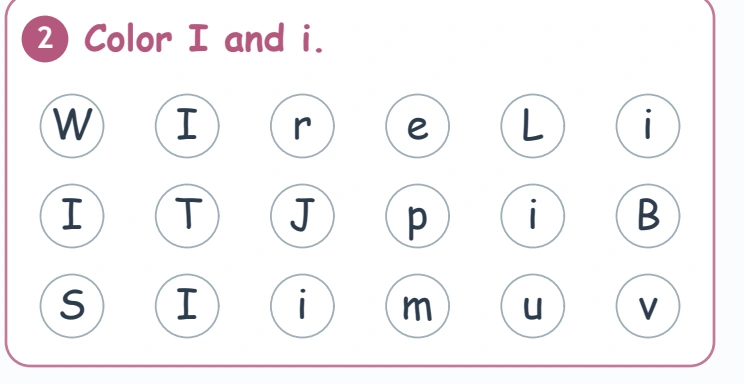
In the Ink Letter Inspector recognition area, eighteen choices occupy three rows of six. Read position numbers across the page before moving down. There are six case matches, with three of each form. The final picture strip has two initial-I selections, so its answer total must be checked separately.
Tracing can begin with a single contrast: Ink Letter Inspector
Six capital I guides and seven lowercase i guides appear on Ink Letter Inspector. Choose one from each row to compare before making marks. Show where the small dot belongs in relation to its stem, then invite an attempt using the printed model as a reference.
No arrows or numbered strokes prescribe a route on this PDF. Demonstrate a larger form separately if that helps, but do not describe a compulsory sequence as source content. A learner who understands the dot's role may still find its small placement awkward. Finger pointing, a larger model or a pause can preserve the comparison without requiring repeated erasing.
An orderly search gives small details a chance: Ink Letter Inspector
When scanning the Ink Letter Inspector circles, leave the two case examples in view. Ask whether a candidate matches either reference. One row can be considered at a time, perhaps with the other rows temporarily covered by separate paper. Look for an explained choice before adding colour.
Finding only the capitals may mean the lowercase form needs a more explicit introduction. Conversely, a child may recognise the dotted i while overlooking the capital's wider shape. Describe the next comparison specifically. A total of six is useful for adult checking after the search, but should not encourage colouring an uncertain letter just to fill a quota.
Four initial spaces ask for lowercase i: Ink Letter Inspector
Below the complete bank, the fragments are gloo, ce cream, nsect and nk. Each Ink Letter Inspector gap needs one lowercase i. Ice cream keeps its remaining letters and word space; the learner supplies only the missing beginning, not a new label or another entire word.
Read the full name and show the corresponding fragment. If the child proposes capital I, acknowledge the letter identity and compare the requested small form. The distinction concerns case, not whether the child knows the name of the letter. Looking back at the bank is part of a sensible checking process.
Two names fit the lower picture instruction: Ink Letter Inspector
Cat, ice cream, sock, frog, ink and ball are the bottom choices. Ice cream and ink meet the Ink Letter Inspector initial-I rule. Igloo and insect appear in the upper bank but are absent from this final strip. Avoid adding imagined answer pictures that are not printed there.
An adult can read every lower label before selection. If a learner calls the ink container paint, clarify the supplied ink name and discuss its first letter. Alternative everyday descriptions can be reasonable; the worksheet's printed label establishes which word is being compared in this activity.
Five observations to carry away from Ii: Ink Letter Inspector
- A whole letter has small features. The dot helps a learner compare the lowercase reference with its candidates.
- Case changes appearance. Capital I and small i remain connected despite their visual differences.
- Written beginnings can match across different pronunciations. Ice cream and ink offer a useful reminder to read the particular instruction.
- A reference can guide a repair. The intact bank makes a missing initial visible rather than a memory test.
- Different responses reveal different skills. Pointing, naming and making a small mark can each contribute information about the learner's current approach.
These are possible learning opportunities around Ink Letter Inspector, not a guaranteed sequence of development. Notice what the child actually does. Clear spoken reasoning may coexist with uncertain pencil control, and that combination calls for an adjusted response method rather than a judgement based only on a finished row.
Picture a classroom print-inspection tray: Ink Letter Inspector
An imagined classroom tray could hold an insect picture, a paper igloo and completed word labels beside Ink Letter Inspector. A teacher names each item, then invites pupils to locate the shared written initial. Ice cream can join the discussion as another i label with a different spoken beginning.
Children might choose between a case circle and a word gap on individual copies. The adult can ask how they checked, without requiring every pupil to produce the same number of marks. This hypothetical arrangement supports a discussion about evidence in print; it is not a claim that the sheet has been trialled with a particular class.
Four extensions for an observant Ii investigator: Ink Letter Inspector
Inspect a fully written label: Ink Letter Inspector
Display ink on a large card and let the child point to the stem and dot of i. Then read the whole word. A completed example keeps the print meaningful and offers a larger view than the small writing panel.
Give an igloo a caption: Ink Letter Inspector
Build a simple paper dome and invite the learner to dictate a sentence about it. Write that sentence on separate paper and read it back. Find igloo if it appears, while leaving the rest of the storytelling free from target-word requirements.
Compare two spoken openings: Ink Letter Inspector
Say ink and ice cream beside their printed cards. Listen to their different beginnings, then find the same first written character. This extends Ink Letter Inspector's vocabulary without treating the pair as a demonstration of a single universal vowel sound.
Place the missing character by hand: Ink Letter Inspector
Put a large lowercase i card next to an nk fragment and an intact ink reference. Let the child move the card into the opening position. The letter decision stays clear even when precise small writing is not the comfortable response today.
Let readiness determine the size of the task: Ink Letter Inspector
For Imani, an Ii task can begin with a named picture; Ink Letter Inspector is intended for supported preschool and kindergarten exploration, approximately ages three to six. An interest in ice cream pictures does not establish readiness to trace every small dotted model. Start with naming or pointing, then offer handwriting in an amount the learner can manage willingly.
If an error appears, identify its particular cause: a missed dot, an unrecognised capital, a case mismatch in a gap or a picture called by another name. Return to a useful reference before asking for a repair. Avoid treating all these different situations as the same careless response.
Make another visit feel possible: Ink Letter Inspector
The variety of Ink Letter Inspector examples allows a later session to begin differently. Try an insect label after an earlier ink search, or compare one case pair before making a single word repair. Regular print encounters can be brief and varied, with stories and play carrying much of the wider language experience.
Offer feedback such as “You looked for the dot when you checked that little letter.” Stop when the learner is tired or no longer interested. A remembered detail is a useful starting point next time, and a partly completed sheet can still record a meaningful observation rather than an unfinished obligation.
Obtain the printable Ii edition: Ink Letter Inspector
Save the supplied Learn the Letter Ii original through the free option. The clean Ink Letter Inspector premium file requires a currently eligible member account. It removes promotional advertising, website-name watermark and domain branding while keeping the dot, letter guides, labels and learner information fields.
A separate $5 library purchase supplies the complete clean A–Z PDF with twenty-six sheets. Follow its linked page if that is the product you want. For Ink Letter Inspector, inspect the US Letter page view and retain source sizing where the printer allows. The downloaded PDF preserves the small i details more faithfully than a print made from an article thumbnail.
Broader places to look for print ideas: Ink Letter Inspector
Ink Letter Inspector connections: Ink's written beginning can be revisited through Ii Letter Investigator. Compare another Ii approach in Ii Worksheet. For a wider capital route after this close inspection, consider Arctic Alphabet Route.
Adults planning related play around Ink Letter Inspector can read Learn and Grow articles on PBS Parents or NAEYC's family-focused play resources. Those independent websites offer their own information and do not endorse or add content to this particular PDF.
Popular Worksheets
Printable resources families and teachers are downloading now.
 Free
 Free
 Free
 Free