
Envelope E Explorer: 4 Amazing Letter Activities
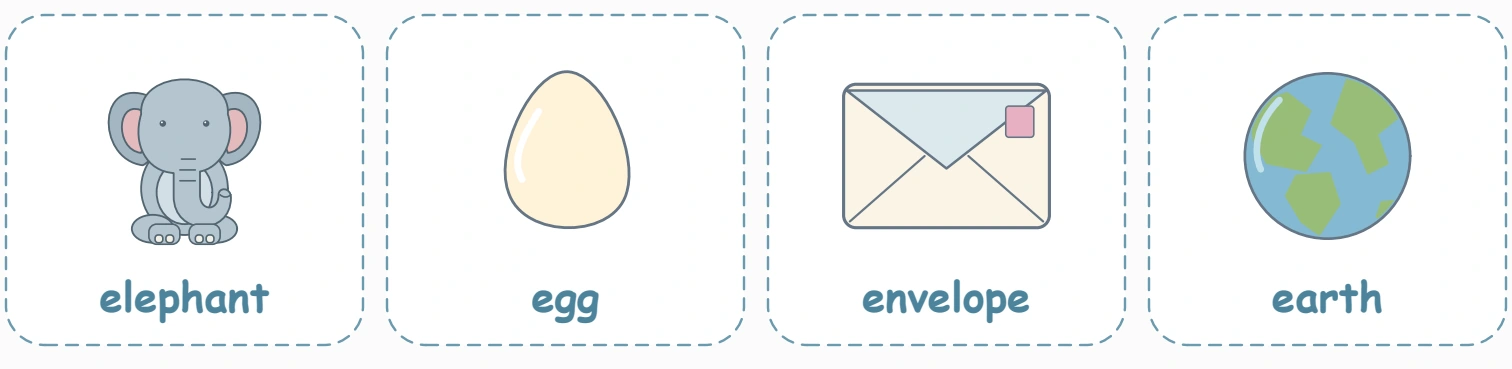
Envelope E Explorer: Use the envelope label as a print reference while keeping letter identity separate from vowel pronunciation.
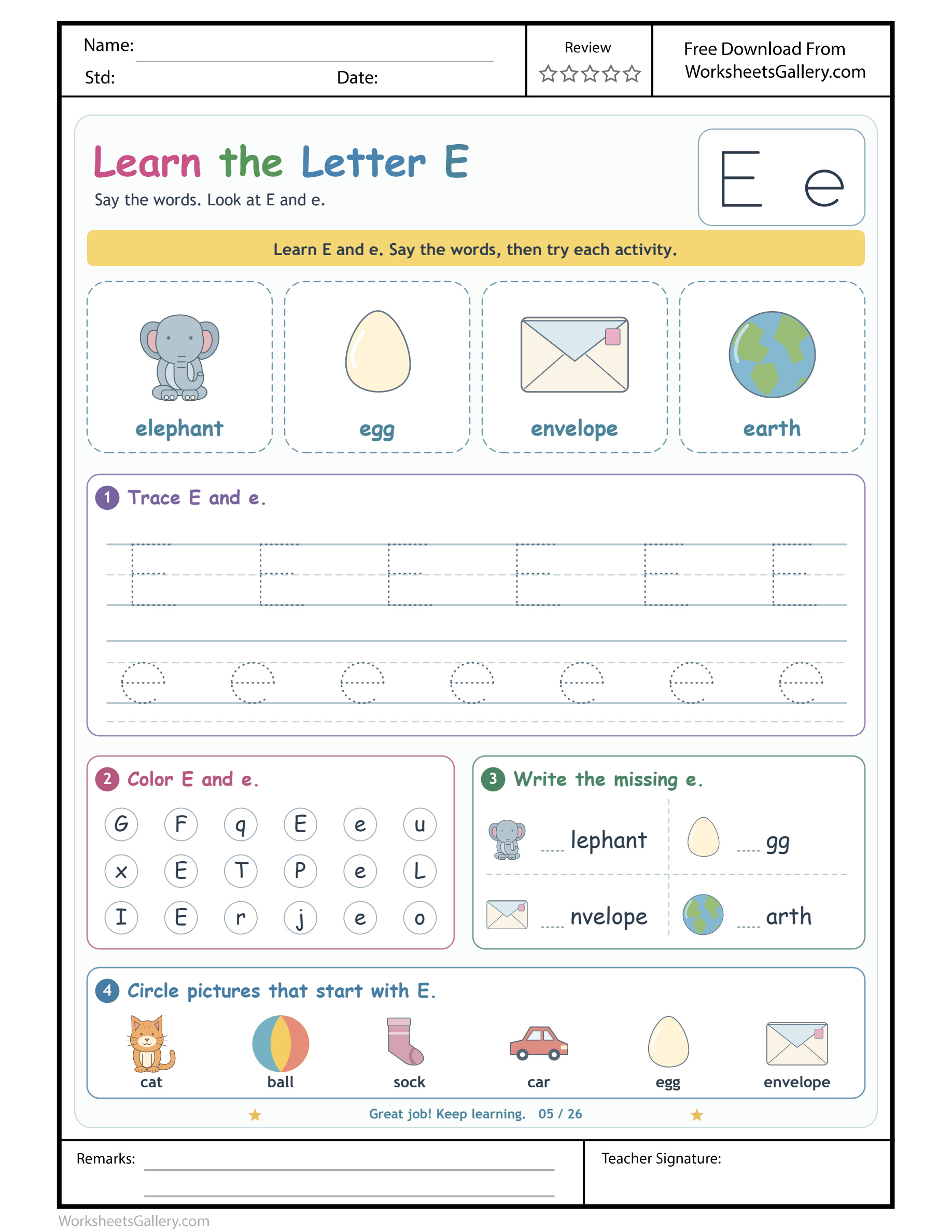
Posting a pretend letter gives envelope a useful meaning before its printed initial is examined. Envelope E Explorer brings envelope together with elephant, egg and earth on a four-activity Ee sheet. Children can trace the supplied cases, colour matching letter circles, write a missing lowercase e and choose pictures by their labelled names. The page supports recognising a shared written initial without requiring every word to begin with an identical spoken vowel. Keep the complete picture labels nearby, name unfamiliar examples together and choose a small task that fits the learner's interest and writing comfort today.
A shared letter does not make four identical beginnings — Envelope E Explorer
The Envelope E Explorer bank contains elephant, egg, envelope and earth. Read each name naturally. A child can inspect the first written e while hearing the whole word, rather than being asked to flatten all four words into one simple vowel-sound example.
The printed letter is the shared feature here. Ee recognition can begin with an adult-read name, while writing remains one small initial; neither task requires unaided reading of all four labels. Earth can remain an adult-read word, and the longer elephant label can still provide clear information about the one small character missing below.
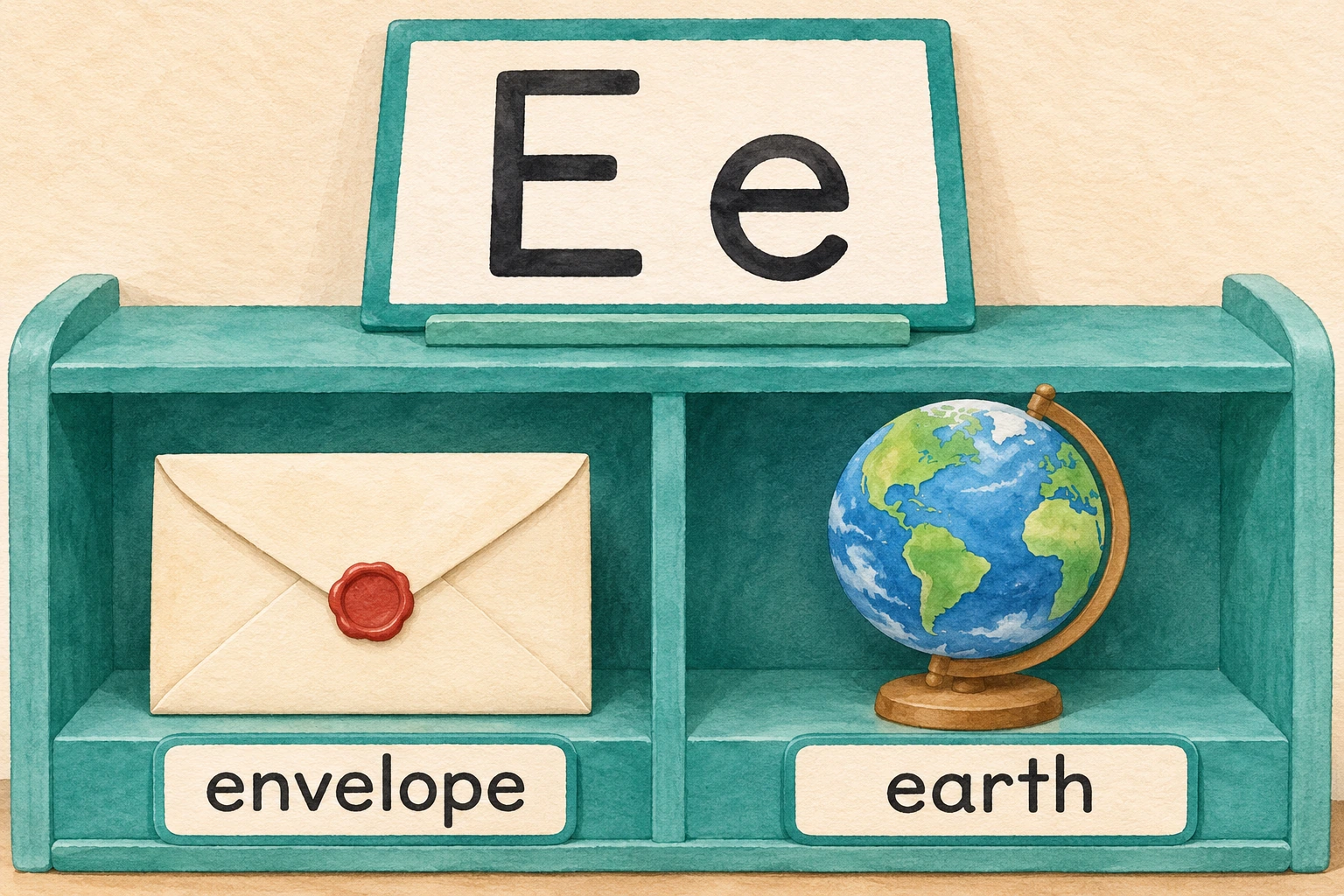
Esme's imagined post-office table: Envelope E Explorer
Picture Esme placing a sealed envelope beside a toy postbox at home. An adult introduces Envelope E Explorer and names the four upper cards. Esme calls the envelope a letter, which is a reasonable description of what it might carry. They read the supplied envelope label before discussing why this particular word belongs on an E page.
This example is invented to illustrate a teaching response, not a documented result. The adult acknowledges Esme's idea while clarifying the printed vocabulary. Esme may inspect one initial e and return to delivering pretend mail. The small comparison can have a clear purpose without becoming a demand to complete every section.
Four Ee tasks in one adult reference: Envelope E Explorer
| Envelope E Explorer activity | Adult quick check | Source detail |
|---|---|---|
| Trace E/e | 6 E models;7 e models | Envelope E Explorer guide rows |
| Find Ee cases | 4, 5, 8, 11, 14, 17 | 6 matches in the Ee circle field |
| Complete elephant through earth | e | Ee: initial e |
| Picture-name check | egg, envelope | 2 choices fit Ee |
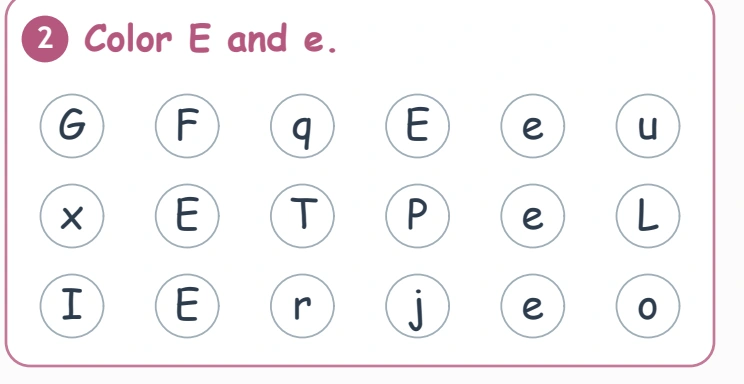
The Envelope E Explorer circle positions are counted left to right across rows of six. Eighteen choices include three capital E matches and three lowercase e matches. The final picture selection follows a different rule and offers two answers, so do not carry the six-match search count into that lower activity.
Compare the whole E, including its lower bar: Envelope E Explorer
The case models in Envelope E Explorer provide useful visual information. Capital E has three horizontal parts connected to an upright; capital F in the choice field does not have the same complete arrangement. A child who looks only at the top portion may need to inspect the lower difference.
Lowercase e also needs its own comparison. Its inner stroke distinguishes the supplied form from a simple o in the field. Ask the learner to locate the inner e line on its larger reference, then compare one small candidate. There is no need to name every distractor before making a target decision.
Five ways the E page can support observation: Envelope E Explorer
- Feature checking. Small details such as a lower bar or inner stroke help distinguish a whole letter from a plausible distractor.
- Case recognition. The visibly different E and e models both belong in the target group.
- Vocabulary clarification. A picture's supplied name is read before its initial is judged.
- Reference use. Complete words remain available when a learner restores a single missing e.
- Purposeful marking. Tracing, colouring and writing give the hand different small jobs tied to visible information.
These are opportunities within Envelope E Explorer, not a prediction of fixed progress. A learner may explain the E/F difference clearly while finding the small tracing guides demanding. Recognise that comparison and adjust the movement task, rather than making the appearance of one pencil mark stand for every part of the child's understanding.
Trace a few forms with a reason to look back: Envelope E Explorer
Six dotted capital E models and seven lowercase e models appear in Envelope E Explorer. Point to the chosen row and inspect its supplied letter shape. An adult can demonstrate a larger version separately, then invite a short printed attempt without insisting on all thirteen models.
No numbered arrows prescribe a single stroke route on the source. Keep the model available for comparison and use a comfortable amount. If the close lowercase shape is tiring, switch to a pointing choice or picture discussion. Another activity can preserve the letter-learning purpose without requiring repeated dark tracing over an uncomfortable spot.
The waiting e belongs before an existing fragment: Envelope E Explorer
The Envelope E Explorer writing panel leaves gaps before lephant, gg, nvelope and arth. The complete bank labels show what each fragment becomes. Encourage a child to inspect the first letter in that full word, then supply one lowercase e in its waiting space.
A capital E would name the same letter but would not match the requested case for this panel. Explain the distinction using the printed little e. Recopying the complete word is unnecessary, and the reference can stay visible while the learner decides. Consultation is a sensible part of the task.
Egg and envelope are the lower-row selections: Envelope E Explorer
The six Envelope E Explorer choices below are cat, ball, sock, car, egg and envelope. Egg and envelope fit the initial-E direction. Elephant and earth are still important upper-bank examples, but neither appears as another picture in that bottom strip.
An adult can read all six labels before the learner decides. If the Earth picture above is called planet, or envelope is called letter, clarify the supplied name rather than rejecting the child's vocabulary. The worksheet decision concerns the initial of the written label it actually provides.
An imagined classroom label-reading corner: Envelope E Explorer
For a possible classroom use of Envelope E Explorer, a teacher places an envelope, an egg picture and a small globe beside separate pupil copies. Children name what they recognise. The adult then shows the source labels and explains that earth is the chosen name for the globe-like picture on the sheet.
This hypothetical exchange can lead into a case search or a single word gap. A teacher may note that a pupil looked at the lower bar before rejecting F. Other learners can respond by pointing while an adult reads. Equal handwriting amounts are unnecessary for a shared discussion about what the print shows.
Four mail-room extensions with different letter jobs: Envelope E Explorer
Set up a naming counter: Envelope E Explorer
Present a sealed envelope beside a completed envelope label. A toy customer calls it mail. Discuss that reasonable name, then read the particular label being used. Relate the distinction to Envelope E Explorer's picture-choice task without treating everyday alternative vocabulary as wrong.
Inspect an E-shaped shelf: Envelope E Explorer
Build a large E from broad strips, then remove the lowest horizontal piece. Compare the new arrangement with the printed capital model. The child can point to what changed. Keep the game about a visible feature rather than the speed of naming letters.
Deliver lowercase help to a word gap: Envelope E Explorer
A pretend postbox receives an incomplete nvelope card. The learner consults a complete reference and chooses a large e card to place before it. This makes the one-character repair concrete while avoiding another small writing demand.
Dictate an elephant's postcard: Envelope E Explorer
Let the child invent a short message from a toy elephant. An adult writes the complete message on spare paper and reads it back. Enjoy the story freely, keeping that open-ended writing activity separate from Envelope E Explorer's exact letter gaps and supplied picture names.
Choose the panel that fits today's readiness: Envelope E Explorer
Supported preschool or kindergarten learners around three to six may explore Envelope E Explorer. Picture naming and letter pointing can be comfortable before close handwriting is. Try a simple invitation, such as finding the upper envelope label or comparing E with one circle choice.
Larger models, pretend mail and spoken explanations offer useful alternatives if the print feels crowded. A session can end after one clear observation. Let the next post-office visit introduce a different Ee panel, using hand comfort and attention as guides instead of treating the sheet's four numbers as a deadline.
Make a repair specific enough to understand: Envelope E Explorer
Likely Envelope E Explorer slips include accepting F as E, overlooking the small e's inner stroke, writing a capital into a lowercase gap or choosing by an alternative picture name without checking the label. Return to the relevant reference and inspect one detail together.
A spoken picture name deserves clarification before its first letter is judged. If correction turns into repeated erasing, discuss a larger example or let the child point to the intended form. The learner can demonstrate an understood distinction without producing an entirely finished page during that visit.
Bring a small discovery back to the postbox: Envelope E Explorer
The envelope theme may make Envelope E Explorer feel connected to purposeful pretend play. Let the child choose whether another visit begins with a mail label, a tracing model or a single search row. A small choice can keep a familiar sheet interesting without requiring a completely new task each time.
Use feedback such as “You looked for the bottom bar before deciding about E.” Mix brief worksheet opportunities with stories, objects and free drawing. Regular practice can stay short. Finish with Esme describing one useful E detail; her next pretend mail delivery can begin by recognising that familiar feature.
Download the Ee edition with your account's access: Envelope E Explorer
The mail-room activity is available as the free uploaded Learn the Letter Ee original. To print the clean Envelope E Explorer premium edition, use an account with active membership eligibility. The Ee tasks and pupil fields are preserved after removal of website watermark, domain labels and promotional worksheet ads.
All twenty-six clean letters can also be bought together for $5 from the linked library product. Choose that separate purchase when you want the combined PDF. Check Envelope E Explorer on US Letter paper before producing copies, keeping original sizing where possible. Save the authorised download itself rather than treating an envelope close-up as a printable sheet.
Other letter choices and adult learning ideas: Envelope E Explorer
Envelope E Explorer connections: Envelope vocabulary can sit beside Ee Letter Collector. The case work in Ee Worksheet offers another Ee route, while Builder Letter Check changes the focus to checking a broader capital sequence.
Adults using Envelope E Explorer can explore the PBS Parents Learn and Grow collection and play resources for families from NAEYC. These independent education links offer optional activity ideas and do not imply endorsement or include additional pages in this download.
Popular Worksheets
Printable resources families and teachers are downloading now.
 Free
 Free
 Free
 Free