
Ee Letter Collector: 6 Amazing Elephant-and-Bee Finds
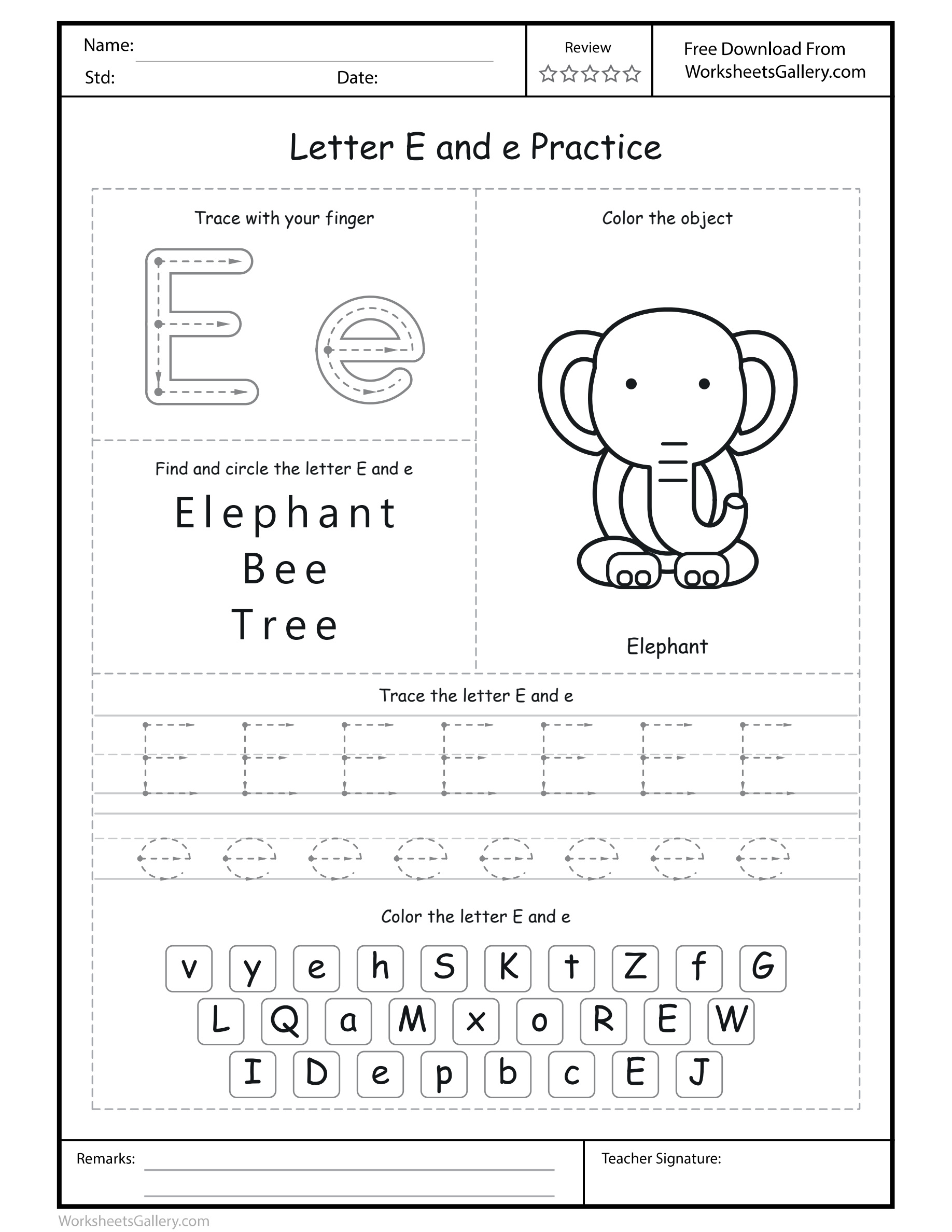
Ee Letter Collector belongs to the 26-page collection. Account for six E/e occurrences across Elephant, Bee and Tree without counting whole words.
Six matching letters are spread across just three word labels. Ee Letter Collector pairs Elephant, Bee and Tree with large E/e finger routes, a friendly elephant illustration, smaller writing guides and a mixed-case colouring field. Each label contributes two target occurrences, though they occupy different positions. Emil can inspect those characters while an adult reads the words, then decide which marks show the discoveries clearly. The page also makes a useful shape comparison: a capital built from straight bars sits beside a compact lowercase curve with an opening.
Start with a claim that can be checked — Ee Letter Collector
“Each word has two” is an interesting observation only after the printed evidence has been inspected. In Ee Letter Collector, invite Emil to search one label at a time before comparing the three results. An adult can read Elephant while he follows its sequence with a finger.
The capital E comes first, and a lowercase e appears at the third position. Bee places its two e letters at the end, while Tree has another ending pair. The equal count does not mean the arrangements are identical. Ask Emil where his two targets are, rather than accepting a remembered total alone.
Keep the word and the count connected: Ee Letter Collector
Three labels are printed, but six E/e occurrences are available to circle. If Emil reports three, ask what he counted. He may have counted words accurately while answering a different question. Returning to a specific character helps clarify what the current task asks him to record.
A six-letter reference for the adult: Ee Letter Collector
| Word | Matching positions | Target arrangement |
|---|---|---|
| Elephant | 1 and 3 | A capital E followed later by e |
| Bee | 2 and 3 | Two adjacent lowercase e letters |
| Tree | 3 and 4 | A second adjacent lowercase pair |
These Ee Letter Collector coordinates are for checking the source spellings. The learner circles characters rather than writing position numbers. A whole-label oval would not show whether Emil identified both targets, so invite a point to each intended letter before making separate circles.
The picture caption has another role: Ee Letter Collector
The elephant illustration carries its own name beneath the drawing. That caption can support naming and conversation. The explicit three-word search panel is the area containing Elephant, Bee and Tree; establish that boundary before adding marks across every repeated label on the sheet.
Compare bars with an open curved form: Ee Letter Collector
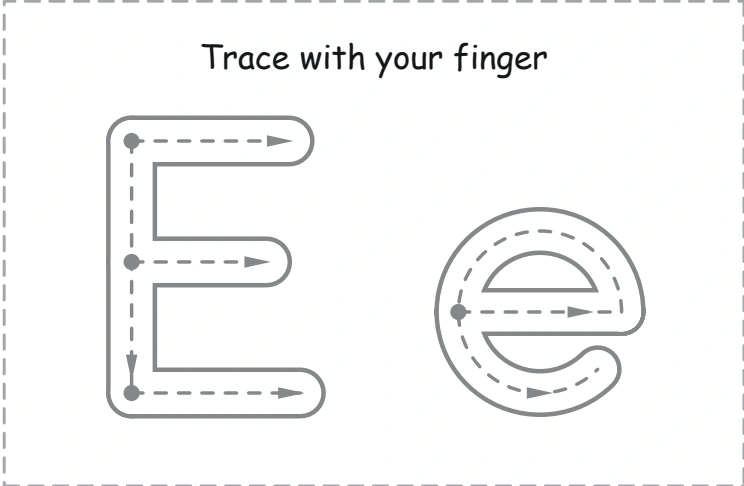
Capital E has a tall straight side and three horizontal bars in the supplied model. Lowercase e uses a smaller curved route and interior opening. Ee Letter Collector presents them together, allowing Emil to compare two visibly different shapes within one letter family.
Ask him to indicate a feature before tracing. Where do the capital bars meet the upright? Where is the lowercase opening? A finger can follow the printed arrows while the large model stays easy to inspect. This makes the planned route available before the smaller handwriting area demands more controlled movement.
A capital bar is not a fourth task to invent: Ee Letter Collector
Use the start dots and arrows actually printed on the model. Avoid adding a compulsory stroke sequence unrelated to the provided route. The adult's explanation should help Emil read the guide rather than replace its visible information with a different diagram.
A home label collection with an elephant visitor: Ee Letter Collector
Imagine Emil arranging an elephant toy beside a bee picture and a small tree model. His grandmother writes their names on separate cards and reads them. Emil inspects Elephant first and places counters beneath the capital and lowercase targets.
For Bee, he notices that the matching letters stand together. For Tree, he finds another pair but has to move farther into the label before reaching it. His grandmother asks which cards have adjacent e letters and which keep their targets apart.
They compare these spare cards with Ee Letter Collector and return to the worksheet's circling instruction. The counters provide a temporary record, while the source remains the authority for its own printed letters. Emil can explain the arrangement without needing to spell Elephant independently.
Six observations inside an Ee search: Ee Letter Collector
Tracking two occurrences within a word: Ee Letter Collector
Emil needs to continue after the first target. Ee Letter Collector offers a different reason to continue in Elephant than in Bee, where the next e sits immediately beside the first. Watch how the learner checks the remaining sequence.
Separating quantity from location: Ee Letter Collector
Two targets can occupy different places. Ask Emil to describe both the number found and their positions. A matching total across labels becomes more informative when he can also show where the characters occur.
Recognising capital and lowercase together: Ee Letter Collector
Elephant includes both E and e in the search. The adult can ask which large reference supports each selection. This gives the shared letter identity a visible comparison rather than assuming the case difference is already understood.
Using an opening as shape evidence: Ee Letter Collector
The lowercase e is not simply any small loop. In Ee Letter Collector, compare its interior stroke and open area with the supplied model. A child can point to the feature before being expected to describe it in a full sentence.
Keeping counting attached to individual marks: Ee Letter Collector
One point per target helps a partner follow Emil's count. If the circles overlap, ask what each mark was intended to include. The explanation can preserve evidence of recognition while an adult supports clearer recording.
Revisiting a claim with the source available: Ee Letter Collector
A statement about six occurrences can be checked against three complete labels. Encourage Emil to show how the total was obtained. Looking again is a useful way to strengthen an explanation, especially when an earlier scan missed the third character in Elephant.
A classroom discussion about matching totals: Ee Letter Collector
For an imagined small-group task, the teacher asks learners to explain whether Bee and Tree contain the same number of e letters. Children point to the characters rather than judging by word length. Tree has more letters overall, but that does not make its target count larger.
The class then inspects Elephant on Ee Letter Collector. Its two targets are separated and use different cases. A teacher can ask what stayed the same about the count and what changed about the arrangement. This gives the comparison more substance than repeating “two” three times.
Partners can take turns offering a count and checking its evidence. Each later records their own circles. Keep the complete word models visible, and read the names aloud for children who are still exploring how those spoken words connect to print.
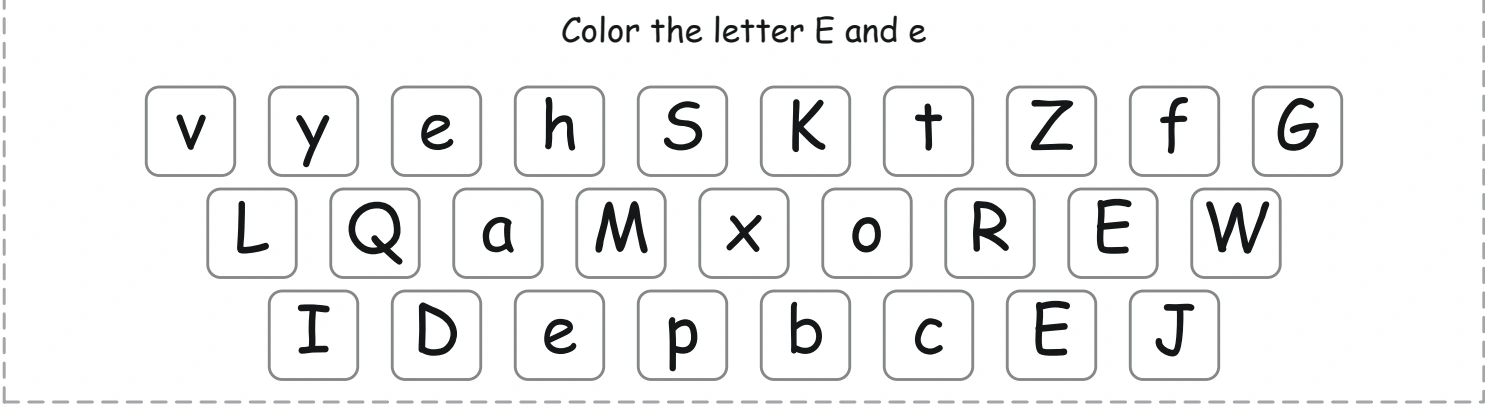
The tile field asks for only four matches: Ee Letter Collector
The three-word panel has six targets, but the lower mixed-letter field in Ee Letter Collector has four. These are separate collections with different instructions. Its E/e targets occupy positions 3, 18, 22 and 26 across rows of ten, nine and eight tiles.
The first row contains e in column three. The second row has capital E at column eight. The bottom row includes e at column three and E at column seven. An adult can use these locations to check a selected tile after Emil has compared its shape with the case models.
Do not carry the previous total into a new panel: Ee Letter Collector
Searching for six tile matches because six letters were circled above would change the task. Read the colouring instruction afresh and inspect the actual alternatives. A clear panel boundary can help the learner decide what needs checking now.
Handwriting can focus on one visible difference: Ee Letter Collector
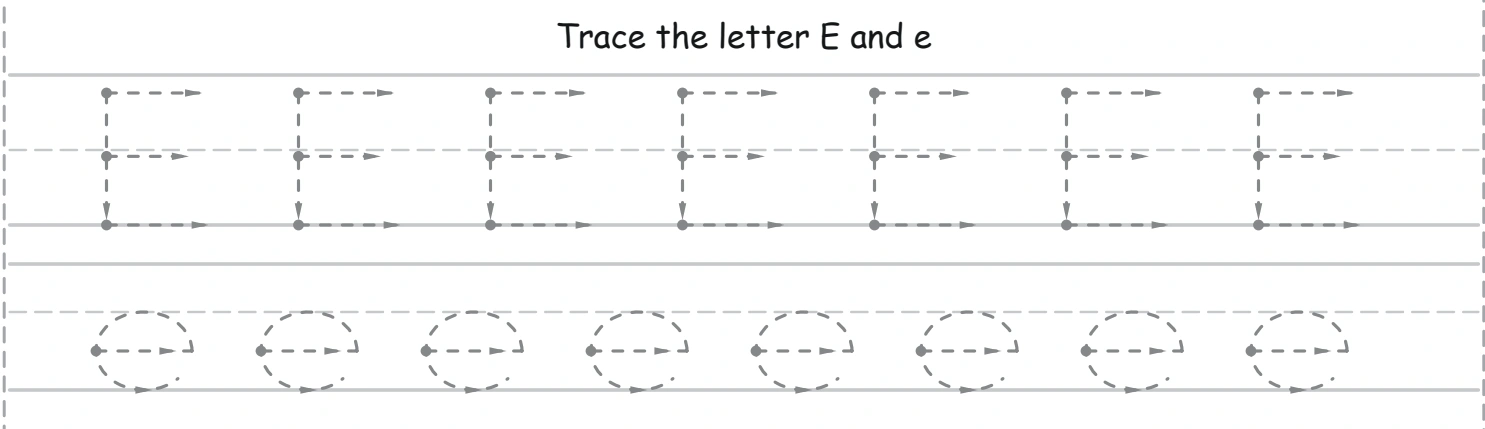
The source offers seven capital E guides and eight lowercase e guides. Emil can choose a small number to attempt, rehearse a route and then inspect a specific feature. One visit might focus on capital bars; another might compare the opening in a lowercase form.
The tracing marks are guided practice rather than a demand to produce an independent word. A child can understand which route is intended while still needing support with tool pressure or movement size. A short spoken plan may reveal that understanding before the pencil trace is complete.
Give the elephant room for free expression: Ee Letter Collector
The colouring illustration includes broad ears, a trunk and small feet. Its regions can invite a comfortable change of activity after close letter inspection. Emil may choose the colours, because the source does not assign a colour key to the elephant.
Five ways to extend the six-discovery conversation: Ee Letter Collector
1. Make two counters tell a word story: Ee Letter Collector
Write Elephant on a spare model card and place one counter below each E/e. Emil tells a listener why the counters are not next to each other. The full spelling supplies the visible evidence for the explanation.
2. Compare word length with target count: Ee Letter Collector
Show Bee and Tree together. Ask which word has more letters overall and then which has more e targets. Keep the two questions distinct so the equal target count does not become a guess based on the label's width.
3. Give a toy a checking mistake: Ee Letter Collector
A toy points to only one e in Bee and claims the search is complete. Emil inspects the remaining character and explains what was overlooked. Use an obvious example that invites a correction through evidence.
4. Draw an elephant greeting: Ee Letter Collector
On new paper, let the child draw an elephant and dictate a short greeting to someone. An adult writes unfamiliar words. The open picture message complements the fixed search without changing the worksheet's required responses.
5. Pair a large model with a chosen small form: Ee Letter Collector
Use separate E and e reference cards and ask Emil to place a copied target beside its case partner. He explains the match through a bar, curve or opening. This gives the comparison another setting beyond the printed tile row.
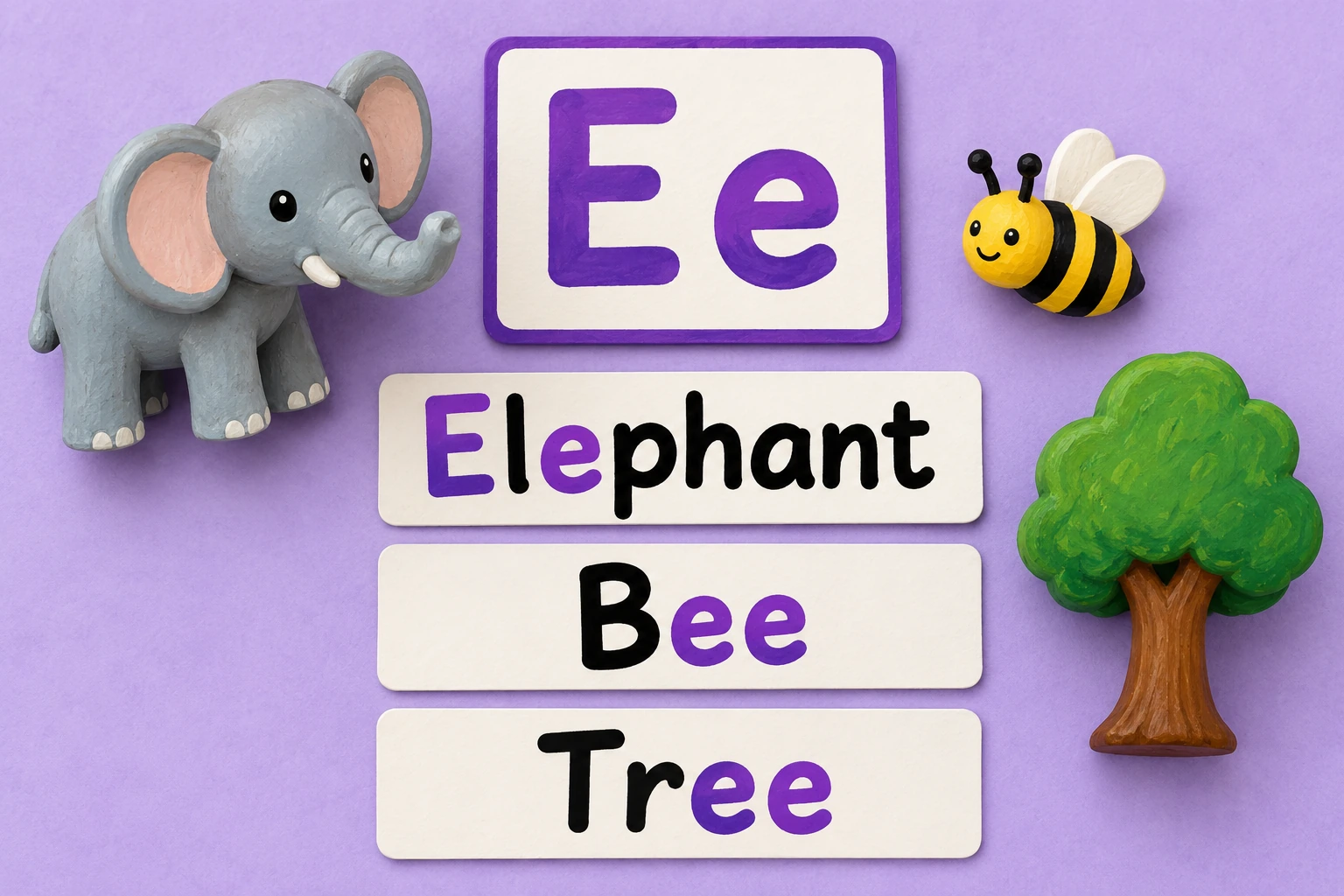
Two targets per word produce six E/e discoveries on this mat.An elephant mat places Ee above Elephant, Bee and Tree, with six violet target letters distributed across those words.
Choose a stopping point that leaves an explanation intact: Ee Letter Collector
For children in the broad three-to-six age range, Ee Letter Collector can be adapted through adult reading, finger rehearsal and a smaller selection of panels. Some learners will begin with an object conversation and one large trace. Others can compare all three target arrangements and explain the tile choices.
Common difficulties include counting the three words instead of six target characters, overlooking Elephant's internal e, colouring six tiles because of the earlier total or tracing a closed shape where the supplied e remains open. Use one current example to identify the issue rather than increasing the number of repetitions immediately.
A later visit can return to a specific observation: did Emil scan farther after the first match, or distinguish word length from target count? That gives regular practice a clear purpose. It also allows a short successful session to feel complete without filling every available guide.
Save the clean elephant worksheet: Ee Letter Collector
Members with qualifying active access can obtain the premium Ee Letter Collector single-page PDF. The elephant member file excludes the website promotion from its header and footer, with the original letter activities retained in place. The original supplied edition remains under a separate sample option.
Check the portrait printing view for the complete three-word panel, model starts and bottom-row E tile. The $5 Alphabet Wordwork Collection includes this elephant sheet in its twenty-six-page clean A–Z PDF, offered through a separate bundle purchase.
Take the observation to another activity: Ee Letter Collector
Compare Ee Letter Collector with Ee Worksheet. A listening follow-up to Ee Letter Collector is First Sound Choices. For Ee Letter Collector, explore Ff Worksheet.
Families can explore NAEYC's guidance on giving early writing a meaningful use and PBS Parents' ideas for language during shared activities. With Ee Letter Collector, attend to the number of matching characters, their different arrangements and the visible evidence supporting the learner's report.
Popular Worksheets
Printable resources families and teachers are downloading now.
 Free
 Free
 Free
 Free