
Dinosaur D Practice: 4 Joyful Case-and-Word Games
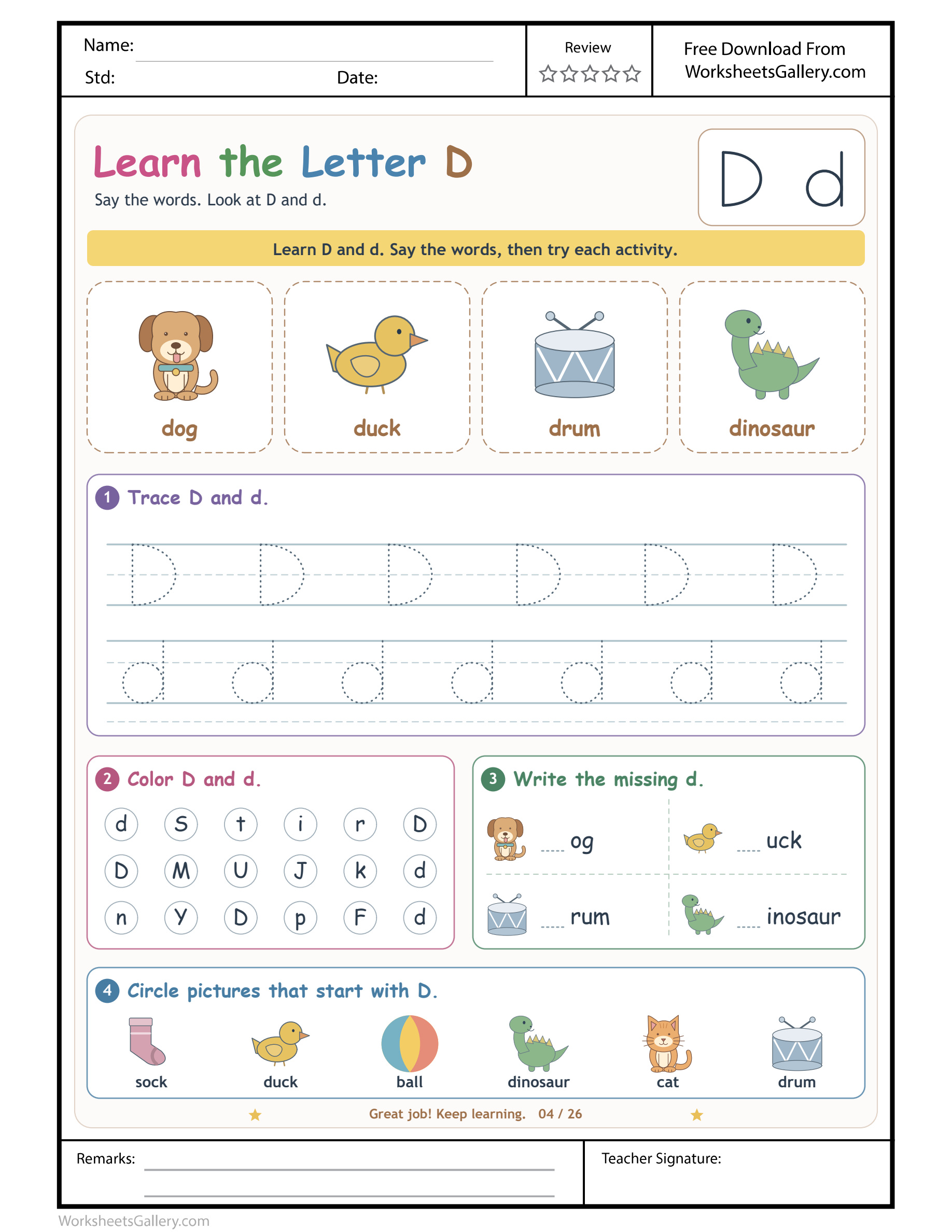
Dinosaur D Practice: Compare the tall lowercase d with uppercase D before checking duck, dinosaur and drum.
Dinosaurs can draw a child's attention to a surprisingly small detail: the position of a lowercase d stem. Dinosaur D Practice introduces dog, duck, drum and dinosaur, then connects those named pictures with four Dd activities. Children can follow dotted case models, colour matching letters, restore d at the start of incomplete words and select pictures by their supplied names. Keep the complete labels available and name unfamiliar vocabulary together. The page can begin with a toy, a spoken observation or a single printed choice, rather than an expectation that every task must be finished immediately.
Inspect the little d before borrowing the capital's shape — Dinosaur D Practice
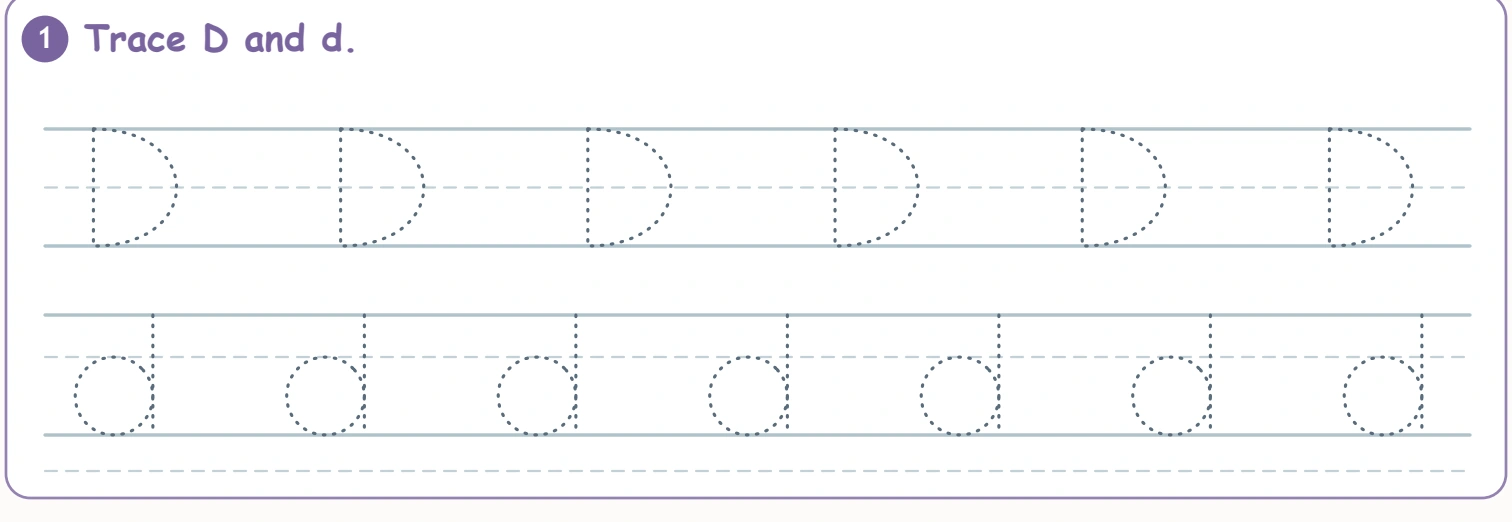
The two Dinosaur D Practice models represent the same letter but organise their parts differently. Capital D places its upright beside a large curved section. The lowercase d has a rounded part with a tall stem on its right. Point to that particular stem location before searching among smaller symbols.
The case partner is a reference to inspect, not a shape to guess. The letter field includes a lowercase p distractor, so recognising a rounded section alone will not settle every choice. Let the child compare the whole small model with the selected circle, using a finger before committing to colour if helpful.
Meet the four D picture names
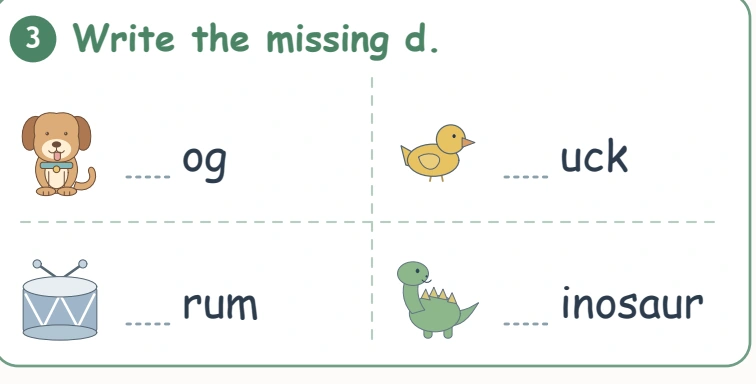
Dog, duck, drum and dinosaur form the upper bank in Dinosaur D Practice. Say each word clearly and let the learner point to the named illustration. The short dog label and longer dinosaur label both provide the same initial-letter information without being equally easy words to read independently.
A child can discuss what a dinosaur might do or demonstrate a pretend drumbeat while an adult reads the print. Keep those stories welcome, then return to the actual letter being inspected. Naming a picture accurately can support the next step, but it does not require testing the child's knowledge of every remaining letter in its label.
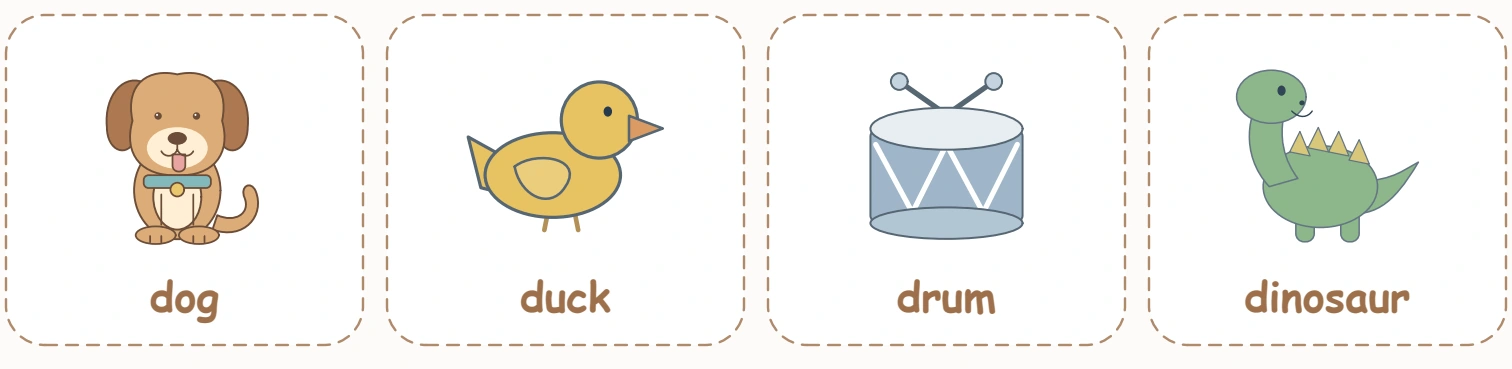
Four Dd activities with different marking jobs: Dinosaur D Practice
| Dinosaur D Practice activity | Adult quick check | Source detail |
|---|---|---|
| Trace D/d | 6 D models;7 d models | Dinosaur D Practice guide rows |
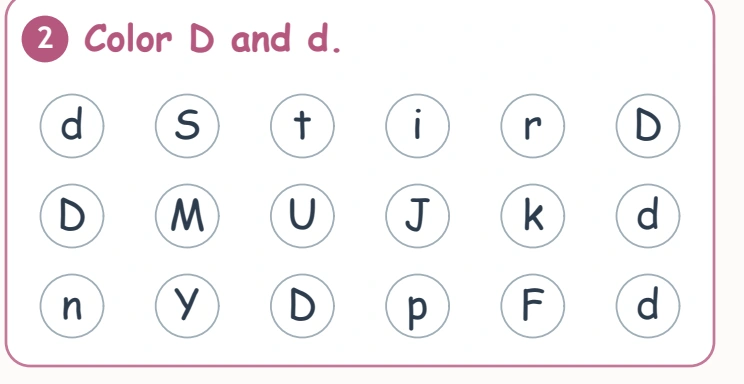
| Find Dd cases | 1, 6, 7, 12, 15, 18 | 6 matches in the Dd circle field |
| Complete dog through dinosaur | d | Dd: initial d |
| Picture-name check | duck, dinosaur, drum | 3 choices fit Dd |
The Dinosaur D Practice circle positions are adult checking references, counted across three six-choice rows. There are three D targets and three d targets. The picture strip asks a separate question and has three matching names. Read the active panel's direction before assuming that a mark used elsewhere on the sheet belongs here too.
A tracing invitation that can stay short: Dinosaur D Practice
The source gives Dinosaur D Practice six uppercase D models and seven lowercase d models on dotted guide rows. Select one row and inspect its model together. An adult may demonstrate the broad shape on another surface before the child attempts the smaller version.
The printed page does not supply a numbered stroke route or require every model in one sitting. A learner can trace a few forms and stop. Notice whether the child understands the stem's position even if the pencil curve wavers. A comfortable larger demonstration can be more useful than repeatedly darkening a difficult small shape.
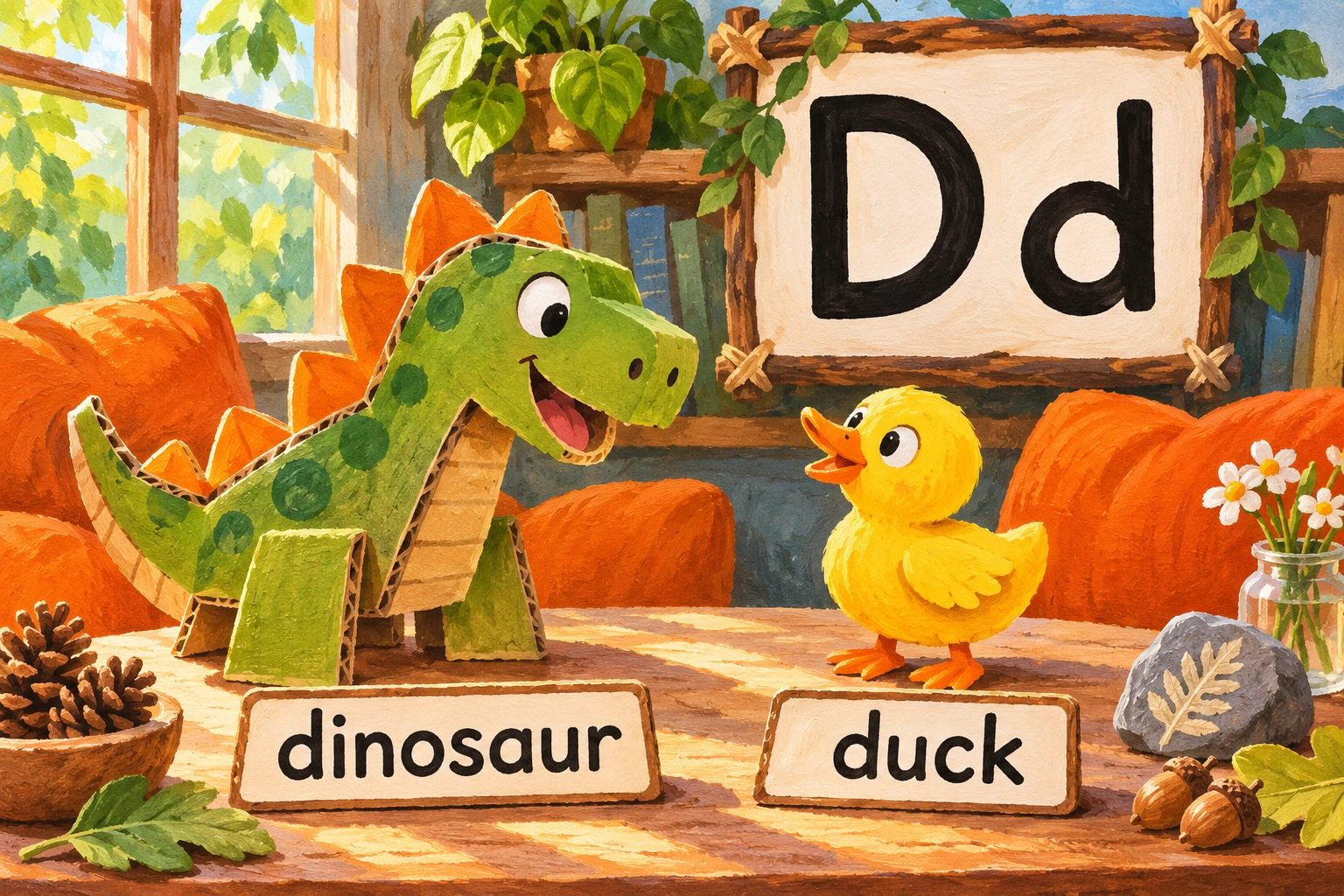
Davi's imaginary dinosaur naming station: Dinosaur D Practice
Imagine Davi bringing a toy dinosaur to a home table beside a little drum. An adult opens Dinosaur D Practice and names the four cards. Davi recognises both props, then points to the first d in the complete dinosaur label before examining the waiting space beside inosaur.
This invented home scenario illustrates how a long word can support a tiny writing decision. The adult reads the label and helps keep the job to one initial letter. Davi may restore that d and return to pretend play, leaving the other panels available instead of treating them as unfinished obligations for the same session.
Six learning opportunities inside the D visit: Dinosaur D Practice
- Stem-location comparison. The learner looks at where the lowercase upright belongs rather than accepting any rounded letter.
- Case association. Different D and d outlines are grouped as targets in one recognition field.
- Initial awareness. A common first letter is identified in short and long picture labels.
- Purposeful tracing. Dotted models provide a clear visual aim for controlled curves and tall marks.
- Vocabulary breadth. Animals and an instrument can share an initial despite belonging to different everyday categories.
- Reference-based repair. A complete printed word gives information when one small character is missing.
Treat these as possible Dinosaur D Practice experiences, not a guarantee that a particular ability will change. A learner's explanation of a stem can be informative even when the written letter remains awkward. Recognise the visual decision while adjusting the fine-movement demand to a comfortable level.
Search the complete symbol, including its tall part: Dinosaur D Practice
The Dinosaur D Practice letter field contains eighteen circles. Invite the child to inspect one row, comparing both supplied cases with each candidate. Six target symbols are distributed across the field, so the search is not a request to colour every familiar letter or to choose only capitals.
When a distractor looks plausible, ask the learner to show its stem and compare that feature with d. Keep the discussion specific and brief. Pointing to the correct target can precede colouring; there is no need to turn uncertainty into repeated guessing or to require that the child name every distractor.
Restore d before the existing fragments: Dinosaur D Practice
The writing panel in Dinosaur D Practice leaves d missing before og, uck, rum and inosaur. Compare each fragment with its complete bank word. Only the first lowercase character needs to be supplied; the remaining printed letters already belong to the label.
If a child writes capital D, show the panel's lowercase request and the small model. The search accepts either case, but this writing job does not. Explain that difference before asking for a repair, and use spare paper when a tiny erased patch becomes hard to inspect.
A classroom grouping conversation, imagined: Dinosaur D Practice
For a possible classroom use of Dinosaur D Practice, a teacher asks which bank pictures name animals and which names an instrument. Children can discuss those meanings, then notice that all four supplied labels still begin with D. The second grouping rule is about print, not about whether an object is alive.
In this hypothetical lesson, each learner then chooses one small page task. A teacher may observe a pupil checking lowercase d before colouring, or using the bank to begin duck. Keep the references visible. These observations can inform another invitation without asking every child to complete an identical number of traces or circles.
Duck, dinosaur and drum belong below: Dinosaur D Practice
The final Dinosaur D Practice strip shows sock, duck, ball, dinosaur, cat and drum. Duck, dinosaur and drum fit the printed initial-D direction. Dog remains a bank word and a completion example above, but it is not an additional lower-row picture to search for.
An adult can read any label the learner does not know. If a child uses a different reasonable name for an image, explain the supplied label before deciding about its first letter. That keeps a vocabulary question from being mistaken for a difficulty recognising D.

Five dinosaur-desk extensions away from the small guides: Dinosaur D Practice
Set up a word-repair clinic: Dinosaur D Practice
A toy dinosaur brings an incomplete large inosaur label to a pretend desk. The child consults the complete dinosaur card and explains what is missing. Keep the original reference available, as it is in Dinosaur D Practice, rather than making the activity a memory challenge.
Make a tall-stem construction: Dinosaur D Practice
Arrange a broad rounded piece and an upright strip to resemble the supplied d. Compare where the upright sits, then move it deliberately and discuss the change. This gives the positional idea a larger physical scale before another small pencil attempt.
Sort a drum with animal pictures: Dinosaur D Practice
First sort a drum, dog and duck by meaning. Then use adult-written complete labels to compare their initials. The change of rule can be explained orally, showing how unlike things can belong together for a letter task.
Let a toy inspect the wrong case: Dinosaur D Practice
A pretend visitor proposes capital D for a panel asking for lowercase d. Ask the child to compare the visible request and model. Keep the mistake friendly and swap roles so the learner can offer a new question to the adult.
Invent a dinosaur performance poster: Dinosaur D Practice
Use spare paper for an original dinosaur-and-drum picture. An adult writes a complete dictated caption. Welcome imaginative additions there while preserving Dinosaur D Practice's particular printed names and choices during the reference task.
Readiness can differ between talking and tracing: Dinosaur D Practice
Children around three to six may explore Dinosaur D Practice with preschool or kindergarten support. A child might enthusiastically name dinosaur yet find a small d difficult to draw. Start with a spoken or pointing decision and judge whether the close pencil work feels comfortable today.
Larger case cards and movable parts provide alternatives. One understood word-gap decision can end a session. Return to another panel when the learner is willing, keeping the amount manageable rather than using the four task numbers as a completion deadline.
Keep a clear repair and a willing return: Dinosaur D Practice
Frequent Dinosaur D Practice mix-ups include accepting p, colouring only capitals, adding D to a lowercase space or searching for dog in the bottom strip. Choose the particular comparison that changed and revisit its visible reference. A precise question about the stem is more useful than a general demand for neatness.
Offer feedback such as “You checked the little d before you chose that circle.” Alternate brief worksheet visits with objects, stories and open drawing. Regular practice can mean one selected action at a time. End while the learner can still explain a discovery comfortably, then use that detail to open a later visit.
Obtain the Dd edition you intend to print: Dinosaur D Practice
Download the original Learn the Letter Dd through the free option. Members with current qualifying access can obtain the separate clean Dinosaur D Practice file from the premium control. That version preserves dog, duck, drum and dinosaur activities while removing worksheet watermark, web-domain branding and promotional advertising.
A $5 purchase on the linked library page provides twenty-six clean sheets together, rather than changing the membership requirement for this individual premium variant. Save the authorised Dinosaur D Practice PDF, inspect the US Letter layout and retain its original dimensions when printing. A full-size file keeps the d models and word gaps more useful than an enlarged screenshot.
More letter decisions and adult play resources: Dinosaur D Practice
Dinosaur D Practice connections: Dinosaur naming gives Dd Letter Spotter a natural place nearby. Revisit Dd through Dd Worksheet, or let Arctic Alphabet Route introduce a capital-sequence question after the duck-and-drum comparisons.
Adults planning around Dinosaur D Practice can browse NAEYC material on family play and PBS Parents' activities for everyday learning. These independent education sites provide optional reading outside the printable and do not endorse this product or add pages to the purchase.
Popular Worksheets
Printable resources families and teachers are downloading now.
 Free
 Free
 Free
 Free