
Crayon Letter Choices: 4 Clever Cc Discovery Tasks
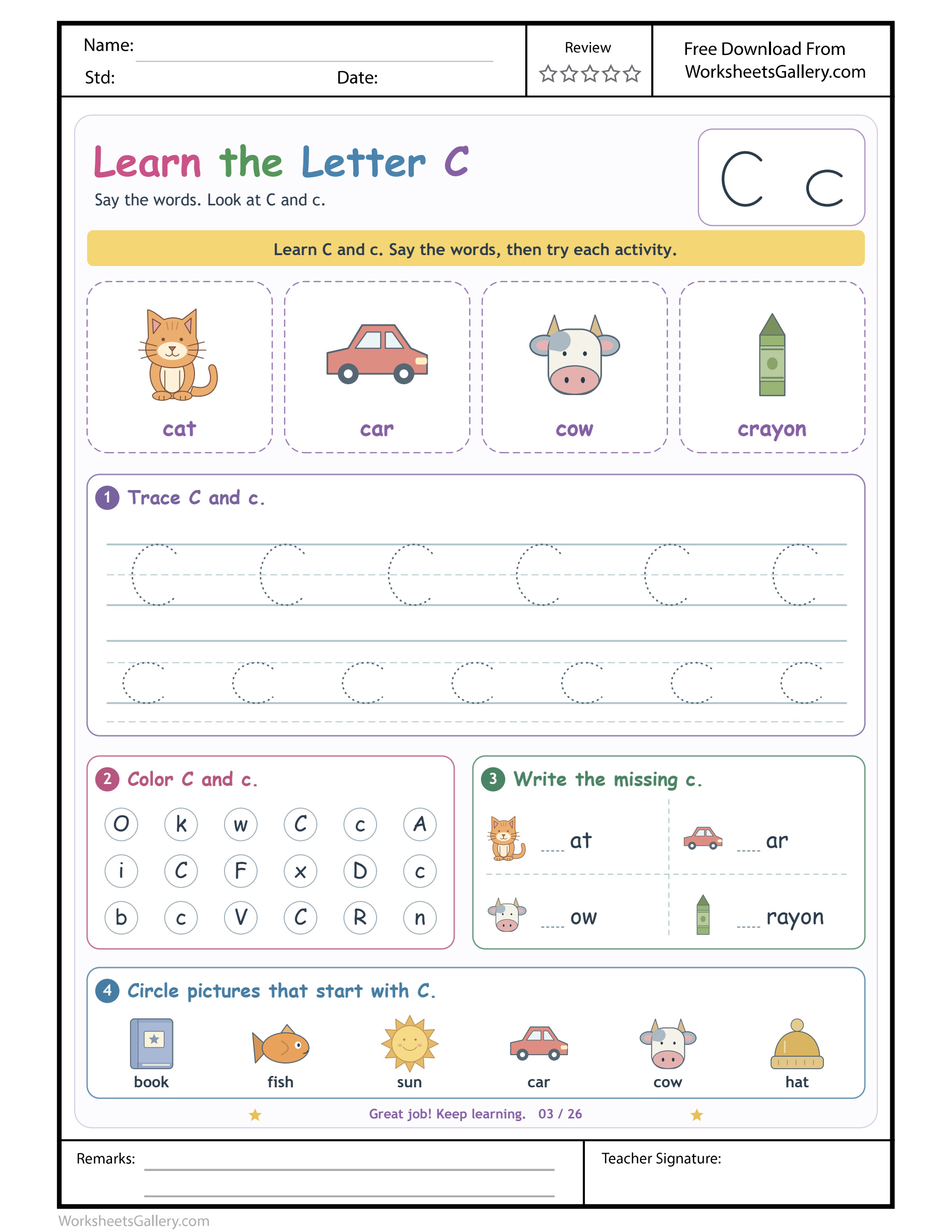
Crayon Letter Choices: Distinguish a matching letter in a circle from a matching initial in a picture name.
Crayons make a pleasant invitation to this page, but the important choices concern print. Crayon Letter Choices introduces cat, car, cow and crayon above four Cc activities. A learner can trace the case models, colour matching letter circles, restore lowercase c in word fragments and circle pictures whose supplied names begin with C. Adults can name the pictures and keep the word bank available throughout. Choose one action to begin, making it clear whether the child is following a dotted form, selecting a letter or comparing a picture name before the first mark is made.
A crayon is a tool and a named example — Crayon Letter Choices
The crayon picture in Crayon Letter Choices belongs to the vocabulary bank. The learner may also use a real crayon for colouring, but its physical colour does not determine which letters match. The small symbols need comparison with the large C and c models, not with the violet tint used elsewhere on the page.
Look at the letter's shape before choosing where to colour. C and c share an open curved appearance at different sizes. A complete circle, or another familiar curved letter, is not automatically a match. Keep the printed models within view whenever a choice needs another inspection.
Keep three kinds of comparison distinct: Crayon Letter Choices
In Crayon Letter Choices, the letter field compares C/c with other symbols. The word-completion panel compares a full name with an incomplete version. The picture strip compares each printed name's initial with the requested letter. Those are related decisions, but they do not receive the same kind of mark.
Explain one panel at a time. A child who circles a matching letter instead of colouring it may understand the target while needing the action clarified. Likewise, recognising a cow does not by itself settle how its written label begins. Read that name together when necessary and make the printed comparison visible.
The four Cc tasks and an adult's quick check: Crayon Letter Choices
| Crayon Letter Choices activity | Adult quick check | Source detail |
|---|---|---|
| Trace C/c | 6 C models;7 c models | Crayon Letter Choices guide rows |
| Find Cc cases | 4, 5, 8, 12, 14, 16 | 6 matches in the Cc circle field |
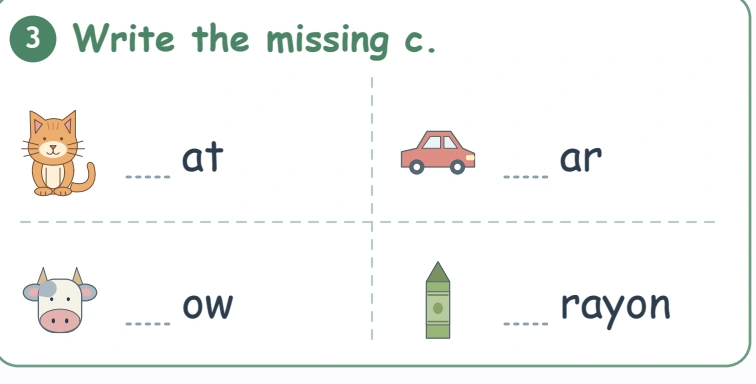
| Complete cat through crayon | c | Cc: initial c |
| Picture-name check | car, cow | 2 choices fit Cc |
The Crayon Letter Choices case-search numbers read across rows of six, making eighteen choices altogether. Three uppercase and three lowercase targets are present. The picture row has a different answer count: car and cow are its two matches. An adult can consult these details without making the child memorise a positional sequence.
Cleo's imagined drawing-corner question: Crayon Letter Choices
Picture Cleo choosing a green crayon at home while an adult opens Crayon Letter Choices. Cleo wants to colour only green-looking pictures. They talk about the task's actual request, then compare the c in crayon with a small target in the letter field. The tool's colour can stay a creative choice while the target remains a printed letter.
This scenario is invented as a practical example. Cleo might inspect one circle and stop, or choose a word gap afterward. The adult's useful move is separating a colour preference from a recognition decision, without treating an imaginative response as a reason to criticise the whole attempt.
Seven useful things to observe without scoring the page: Crayon Letter Choices
- Open-curve recognition. C and c can be compared with the visible model rather than treated as any rounded symbol.
- Case partnership. The learner accepts two different sizes and forms as targets in one search.
- Reference consultation. A complete cat or cow label supplies information for its shortened counterpart.
- Initial placement. Lowercase c belongs before the existing fragment rather than after its final letter.
- Purposeful movement. Tracing a curve and making a picture circle offer distinct controlled marking opportunities.
- Vocabulary comparison. An animal, a vehicle and an art tool can share a written initial despite different meanings.
- Action awareness. The child notices when the instruction changes from colour to write or circle.
These possibilities in Crayon Letter Choices do not promise a particular developmental result. A clear spoken explanation may reveal understanding even when a small handwritten curve is uneven. Offer a larger model when needed and recognise the letter decision separately from current pencil comfort.
Use the complete words before restoring c: Crayon Letter Choices
The Crayon Letter Choices writing spaces appear before at, ar, ow and rayon. Each asks for c, producing cat, car, cow and crayon. The full labels above provide the exact vocabulary; the child does not have to generate those spellings independently from an adult's spoken clue.
The longer crayon fragment can be discussed just as simply as at: identify its first letter in the complete word and place that lowercase form in the gap. The panel does not ask the learner to rewrite the entire label or remove letters that are already printed correctly.
The tracing models preserve a useful size difference: Crayon Letter Choices
Six dotted capital C models sit above seven lowercase c models in Crayon Letter Choices. Invite the learner to choose a short portion of one row. Show how the supplied form relates to its guide space, keeping the open side visible rather than closing the curve into a circle.
The source contains no compulsory arrow sequence. An adult can model a comfortable broad movement on spare paper before the small attempt. If the close guide feels difficult, move to picture naming or case pointing. A recognition activity can remain worthwhile when the learner is not ready to complete every tracing model.
An imagined classroom naming table: Crayon Letter Choices
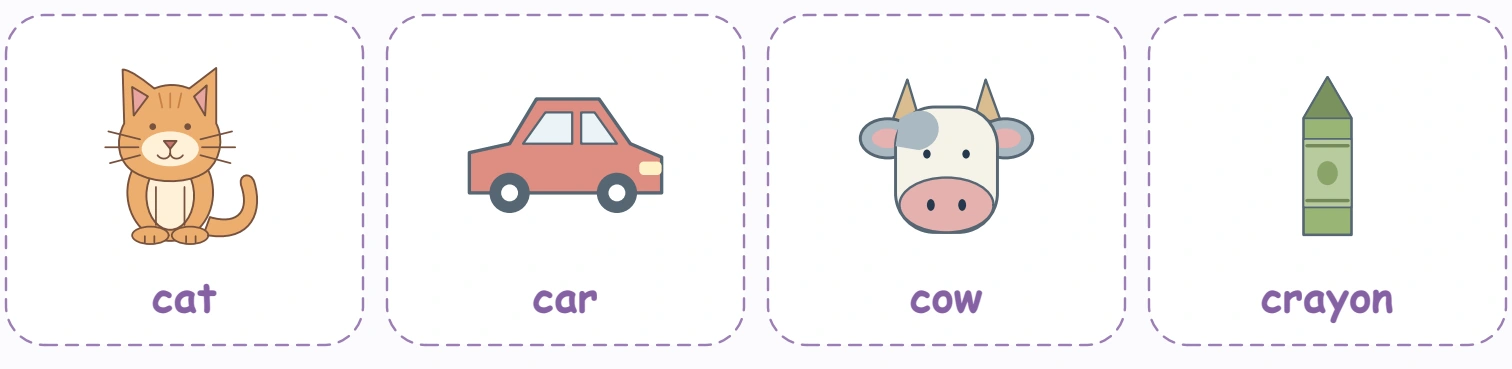
For a possible class activity, a teacher offers Crayon Letter Choices beside a toy car, a cow picture and a crayon. Learners name an example, then find the corresponding upper label. The teacher points out that the objects belong to different everyday groups even though their supplied names begin with the same letter.
Children can then choose one task on their own copies. A teacher might observe that a pupil consulted the C/c models before rejecting a distractor. This hypothetical lesson does not require equal writing amounts. Some learners may explain a picture choice orally while others work on a short tracing section.
The lower row does not repeat the whole word bank: Crayon Letter Choices
The six Crayon Letter Choices picture choices are book, fish, sun, car, cow and hat. Car and cow fit the direction. Cat and crayon remain visible above as vocabulary references, but neither is another lower-row answer waiting to be discovered.
If a learner names the car as a vehicle, read the supplied car label together before deciding. A reasonable alternative name should not be confused with failure to recognise C. The activity uses the printed vocabulary, so the adult can clarify that vocabulary before requesting a letter judgement.

Four art-corner extensions with different purposes: Crayon Letter Choices
Sort by meaning, then sort by initial: Crayon Letter Choices
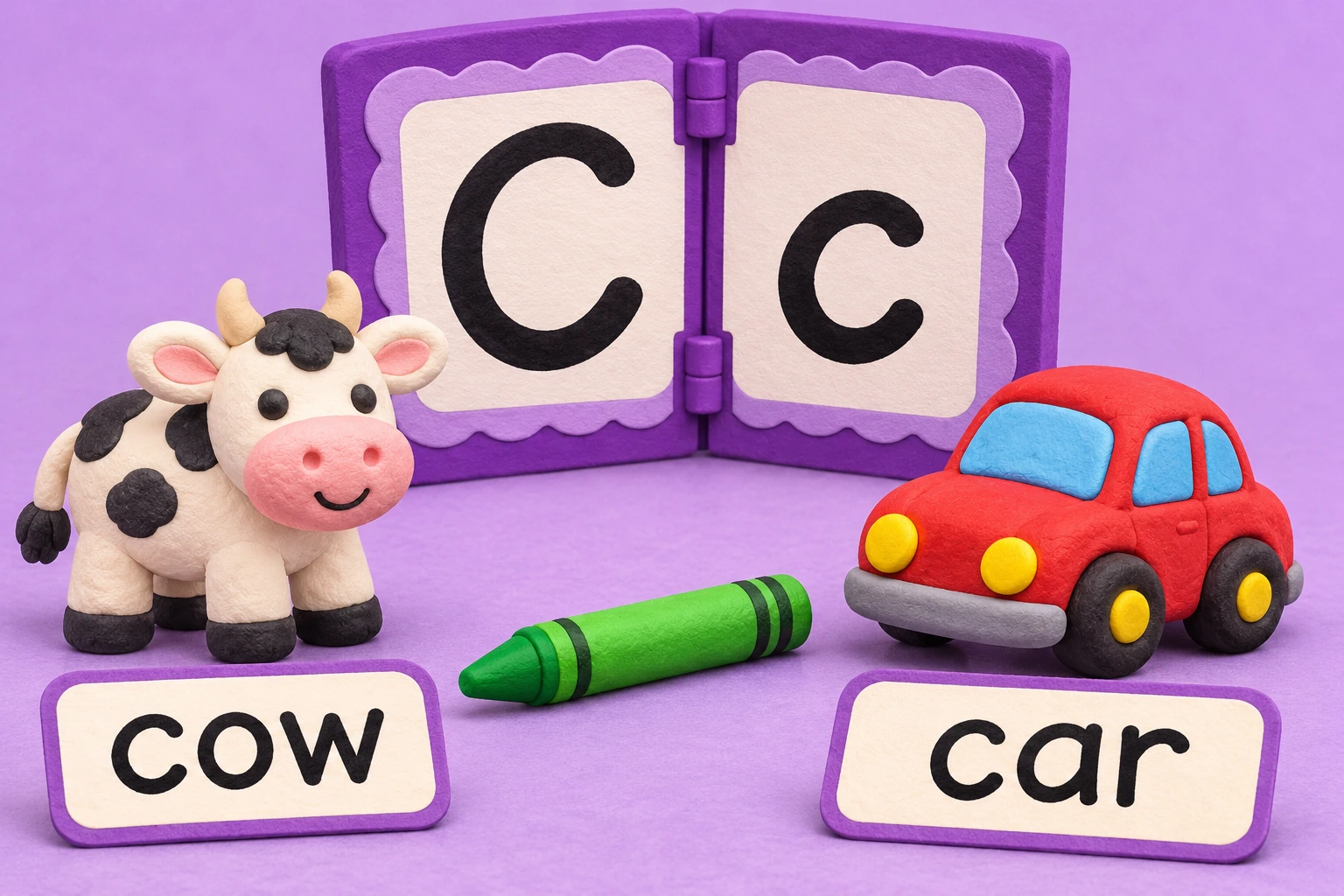
Use a car, a cow picture and a crayon on a table. First group them by an everyday idea, such as things that move or things used for art. Then inspect their written initials together. Relate the change of sorting rule to Crayon Letter Choices without expecting independent reading.
Run a curve-repair studio: Crayon Letter Choices
An adult makes a large C-shaped strip arrangement and a second version closed into a loop. Invite the child to identify which corresponds to the visible case model. Keep the comparison friendly and avoid turning it into a judgement about the child's own handwriting.
Ask a puppet to find its missing first mark: Crayon Letter Choices
A toy cow brings a large incomplete ow label to a pretend help counter. The learner points to the full cow card as the grown-up names cow. This help-counter exchange makes the word bank useful and keeps the requested repair to one lowercase letter.
Create an original crayon caption: Crayon Letter Choices
Offer spare paper for any picture the child wishes to draw. An adult records a complete spoken caption. Welcome colour choices and invented details there, explaining that Crayon Letter Choices's reference comparisons have a different purpose from open-ended artwork.
Offer the page when a small comparison feels comfortable: Crayon Letter Choices
Preschool and kindergarten learners roughly three to six may explore Crayon Letter Choices with adult help. Picture naming, case recognition and close handwriting do not always feel equally easy. Try a pointing choice before assuming that a full tracing row is appropriate.
Large letter cards, objects and broad drawing space can provide alternatives when the print feels crowded. A single understood comparison can end a visit. Return to the remaining tasks when the learner is interested, keeping hand comfort and willingness more central than the number of unfilled spaces.
Untangle the mistake before asking for another mark: Crayon Letter Choices
Common Crayon Letter Choices changes include choosing by colour, accepting a closed circle as c, writing capital C in a lowercase gap or looking for every upper-bank object below. Revisit the exact panel direction and compare one visible example. A specific explanation identifies the repair more clearly than a request to make the page neater.
The target comes from print, while crayon colour can remain a choice. If correcting a tiny mark becomes frustrating, discuss the intended selection or draw a larger model. The learner does not need to erase an entire section to show that the distinction now makes sense.
Make another visit about a chosen observation: Crayon Letter Choices
The familiar art-tool picture can make Crayon Letter Choices personally meaningful, especially for a child who enjoys drawing. Let the learner choose whether to revisit an open curve or a picture name. Offer feedback such as “You checked the label before deciding about car.”
Alternate short worksheet invitations with art, stories and object play. A regular routine can involve one task-sized observation rather than repeated full-page completion. Stop with enough energy for the child to explain something they noticed, then begin a later visit with that familiar detail before offering another choice.
Save the Cc file and check its page border: Crayon Letter Choices
Crayon work begins with a choice of edition: the free Learn the Letter Cc original or the clean Crayon Letter Choices premium PDF for an actively eligible member. The clean copy contains the same Cc activities without website-name watermark, domain promotion or worksheet ads.
The full library has its own $5 checkout and combines all twenty-six clean letter sheets. Open that linked product when you want the whole set. For a single Crayon Letter Choices printout, save an edition permitted by your access, inspect its US Letter border and keep the dotted curves at source size. Article images explain the panels; the PDF holds the printing version.
Related comparisons for another learning corner: Crayon Letter Choices
Crayon Letter Choices connections: Crayon choices can be followed by Cc Letter Explorer, with Cc Worksheet providing another Cc reference. For a dinosaur-themed change of task, look at Dino Missing Capitals after this picture discussion.
For activities around Crayon Letter Choices, adults can explore family play suggestions at NAEYC and PBS Parents' Learn and Grow resources. These outside education links offer optional ideas, not extra collection files, and do not imply either organisation's endorsement.
Popular Worksheets
Printable resources families and teachers are downloading now.
 Free
 Free
 Free
 Free