
Joyful Letter J: 4 Powerful Hook and Jar Activities
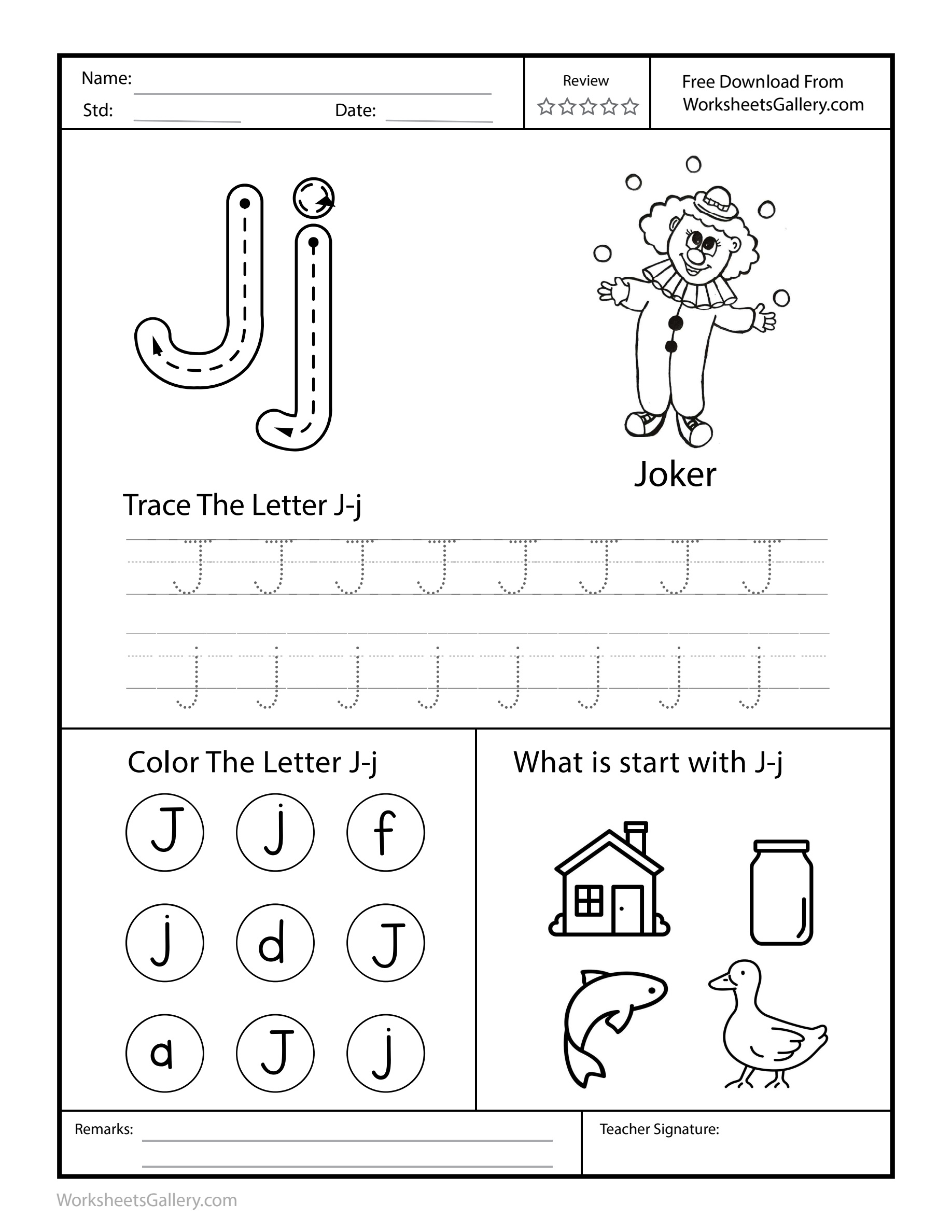
↶ Watch the turn at the foot of the stroke
Down is only the beginning of this pencil trip. A J needs its curved finish, and a little j carries that turn below the writing line. This Letter J worksheet brings those routes together with a character labeled Joker, a jar picture and six matching circles. There are eight dotted examples in each case, so you can choose a manageable portion instead of filling every space immediately. Use the hook as your observation point: where does the stroke stop descending, and which way does it turn? A short conversation can make the movement clearer.
Read the Letter J picture choices before giving directions
The introduction character looks like a clown and is labeled Joker. A child who says clown has named the drawing sensibly. Read the printed word and explain that joker begins with J. Avoid treating an unfamiliar label as a test of alphabet knowledge. In the lower panel, the clearest Letter J word is jar, at the upper right.
The remaining options are a house, a dolphin-like aquatic animal and a duck. None of those usual names begins with J. Agree on jar as the target before asking for the initial sound. Letter J commonly represents the beginning heard in jar and jump; pronounce a brief /dʒ/ rather than adding a long extra vowel.
Try naming before selecting: “house, jar, dolphin, duck.” If a learner uses another sensible name for the aquatic drawing, accept it and return to the jar. Your aim is a clear Letter J connection, not agreement over every illustration's species.
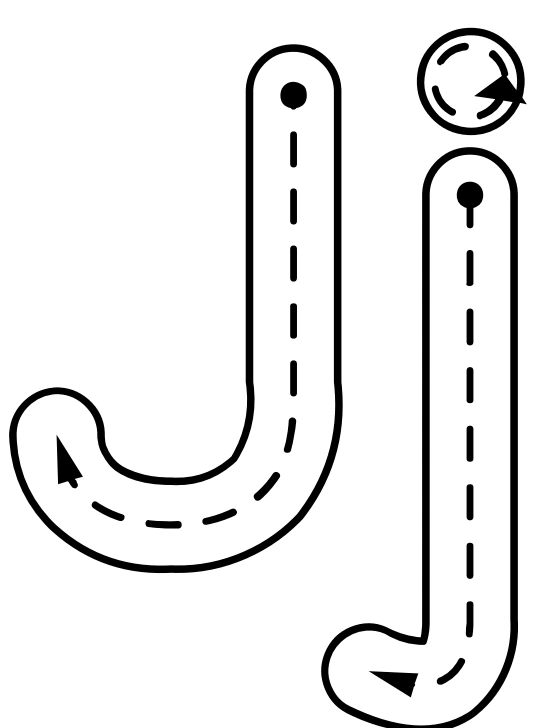
Let Letter J travel down, then turn
Place the Letter J sheet in the same orientation for the adult and learner. Point to a start dot, follow the printed route downward and notice the leftward curve. A model facing the child upside down can make this simple direction unnecessarily confusing.
The lowercase j adds a separate dot. On the ruled examples, its stem begins in the smaller writing space and its hook passes below the baseline. Capital J uses the taller writing space. The oversized Letter J introduction forms show movement, while the small rows give a more useful guide to writing-line position.
Watch for a straight line that stops before turning or a hook that turns the opposite way. Show the route again with a finger and invite one fresh attempt. The goal is a recognizable Letter J movement, with enough control to change direction deliberately.
Use your setting's handwriting sequence alongside the printed guide. Some fonts show a top bar on capital J and others do not. This Letter J page's practice examples include a top stroke; compare the actual model rather than introducing several styles during one short lesson.
Six observations worth more than a completed row
A planned curve
The child anticipates where Letter J bends instead of discovering the turn after the pencil has left the model. Slow looking supports a more deliberate movement.
Space below a rule
Lowercase j invites attention to a part that descends. In Letter J practice, writing-line position is a visible feature to compare, not an abstract instruction.
A remembered dot
A separate small mark completes the lowercase form. Returning for it gives the learner a reason to check Letter J after the main movement is finished.
An inclusive search rule
Both J and j count as Letter J. The child applies one category to two shapes while leaving f, d and a untouched in the recognition panel.
A named sound anchor
Jar links a visible object with its beginning. Naming and hearing come before the choice, keeping Letter J sound practice grounded in understood vocabulary.
A child's explanation
“It turns this way” can reveal a useful Letter J observation. Invite a gesture or a short phrase rather than requiring a long verbal account of every decision.
Fine movement, visual comparison and spoken language all appear here. They need not progress at the same rate. A learner may explain Letter J clearly while still steering a large, uneven curve. Respond to the successful observation and reduce the physical demand if necessary.
Choose a route that fits today's learner
This Letter J sheet is suitable for guided preschool and kindergarten work, commonly around ages three to six. A younger or less experienced learner may name the jar and finger-follow one model. A child with steadier pencil control can try several examples and explain a search choice.
- Set the page straight and choose either capital or lowercase Letter J to introduce first.
- Demonstrate the start, downward movement and curved finish on one model. Make the dot a separate observation when using j.
- Offer a small number of guided attempts, then invite a comparison with an untouched example.
- Finish with a picture name or a few matching circles. Leave the remaining Letter J examples available for another session.
There are sixteen dotted tracing models altogether, not a separate blank handwriting exercise. Independent writing can go on scrap paper later. Within this activity, the visible Letter J guide is a support the child is allowed to use.
Six Letter J matches, in their actual positions
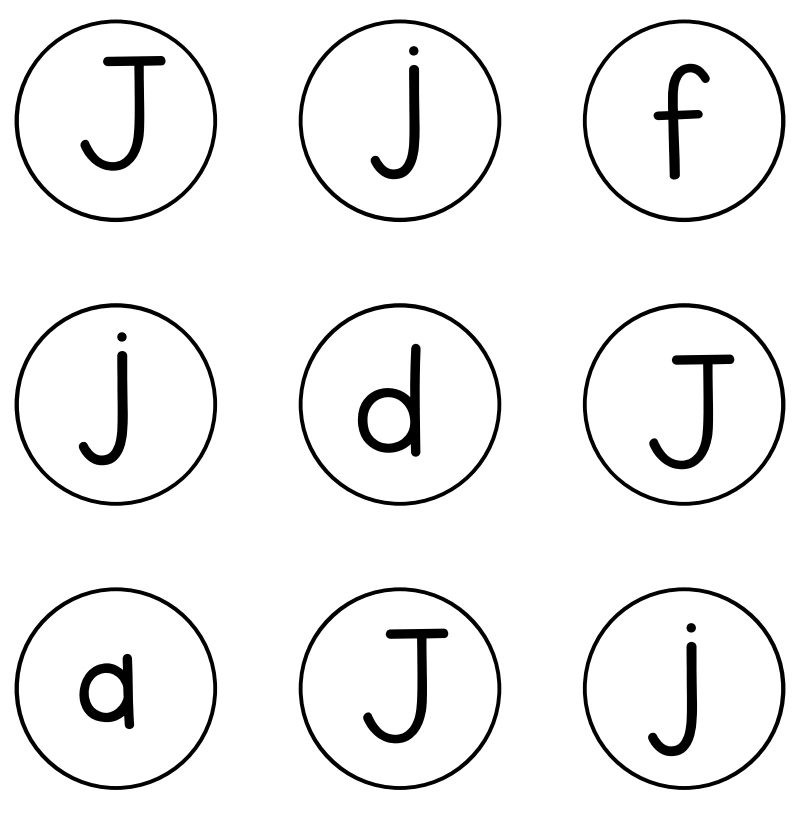
First row: left and middle. Second row: left and right. Third row: middle and right. The f, d and a remain unselected.
Ask the child to point to Letter J before filling a circle. If f attracts attention, compare the visible top and bottom features. The page gives a reference, so checking is part of the work. You can pause coloring while the learner explains a difference.
Give recognition and coloring separate feedback. A correct Letter J selection with color outside the circle still shows a successful letter decision. If the target itself is uncertain, return to a large model before presenting more circles.
At home, make the jar a button-story prop
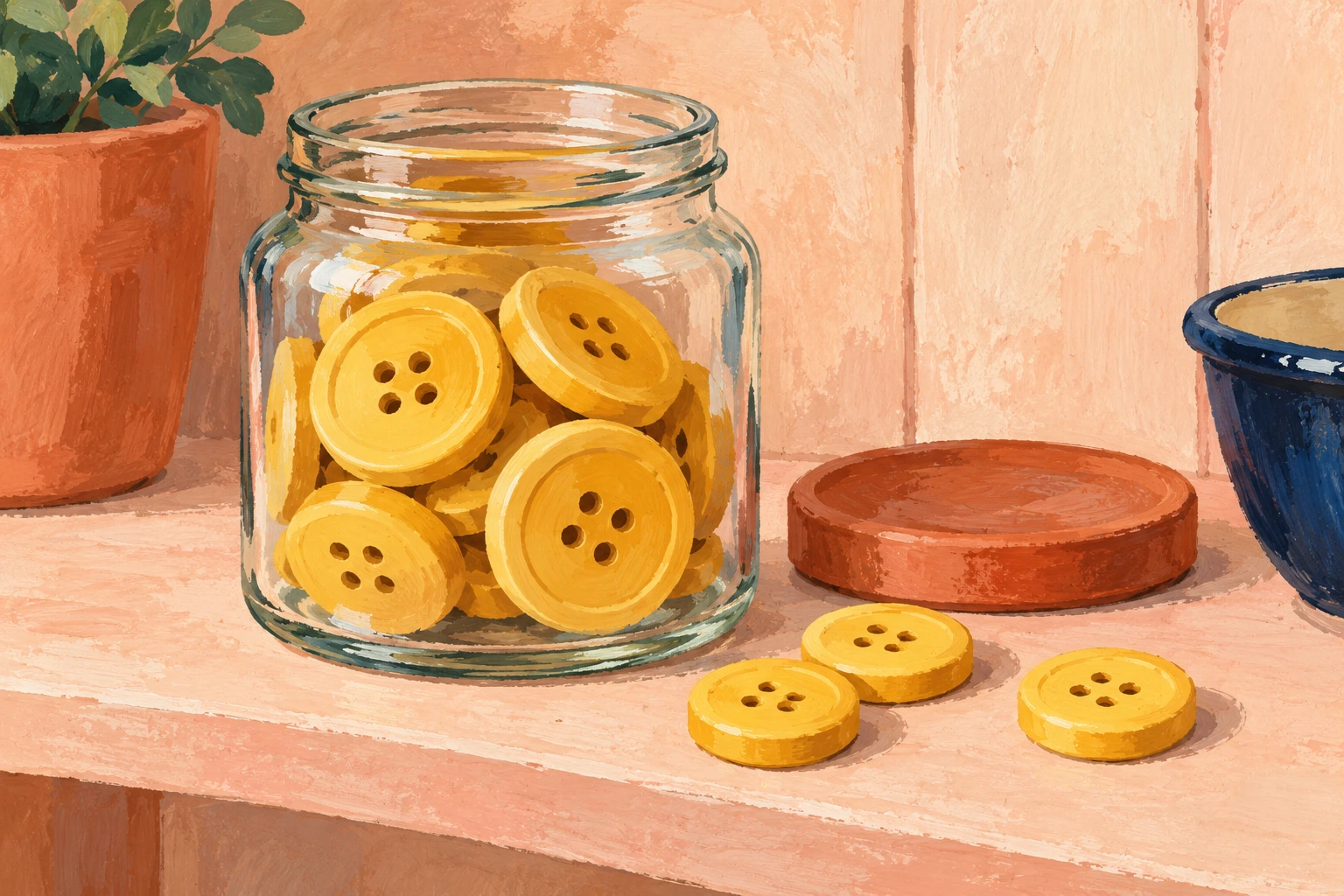
Ravi looks at the painted jar and decides it belongs to a coat maker who has lost one yellow button. His sister asks where the missing button might be. They say jar, notice its beginning and return to one Letter J model. No actual jar or small buttons are required; pointing at the picture keeps the story easy to arrange.
At home, let the learner choose what an imaginary jar contains. Write the spoken word jar on a separate card and show its initial Letter J. Keep the story brief enough that the child can return to the worksheet willingly. The connection is a remembered object name, not a demand to read the entire word independently.
A classroom partner describes the hook
During a small-group Letter J session, one child follows the large route with a finger while a partner describes the change: “Down, then round to the left.” The teacher sits beside them and checks that both are viewing the page upright. Children switch roles before trying a short tracing selection.
Afterward, the teacher asks each learner to show a lowercase dot and a curve below the writing rule. Those two observations make Letter J feedback specific. A child who needs help finding the jar can receive a vocabulary prompt without losing credit for an accurate pencil movement.
For a contrasting next step, capital I tracing offers straighter features. A different J-and-clown resource provides another page format. The prewriting line collection is useful when controlling a route needs attention before a longer alphabet task.
Four invitations beyond the printed Letter J models
| Invitation | Adult setup and child's choice |
|---|---|
| Curved road rescue | Draw a broad downward road that bends left on spare paper. The child moves a toy along it and describes the turn before comparing the route with Letter J. |
| Jar-label editor | Write jar on one card and house on another. Read both aloud. The learner chooses the label for the jar picture and points to its first letter, with adult reading support. |
| The dot appointment | Draw a large j without its dot and let a puppet announce the missing appointment. The child directs the puppet to the place above the Letter J stem. |
| Jump or stay | Say jar, moon, jump and dog at an unhurried pace. Invite a small hand jump for the J beginnings. Repeat the words naturally and discuss a choice before adding more. |
Each invitation extends one feature, so select the one connected to the child's current question. You do not need to stage all four after every Letter J visit.
When the curve feels difficult, change the invitation
A reversed hook, forgotten dot or stem that stops above the lower writing area can be addressed with one larger demonstration. Finger-following reduces the demand while preserving the Letter J route. Avoid repeatedly tracing over the child's attempt until it becomes a heavy dark shape with no clear starting point.
Children often enjoy the hook's surprising turn and the freedom to invent jar contents. Preserve that interest with a choice of one movement task and one talking task. For a regular Letter J routine, return at a familiar quiet moment and leave after a useful attempt. Note an actual change: “You remembered to let the little hook go below the line.”
Print the Letter J version that suits your access
The free PDF is the original branded sample. For the clean premium Letter J file, use the membership option while signed in to an eligible current plan. That edition has no website watermark or added advertisements inside the printable PDF; its tracing and picture activities are preserved.
- Choose the free sample, or sign in and use the membership premium control for the clean copy.
- Open the saved PDF and preview its single portrait US Letter page before sending it to a printer.
- Check the 8.5-by-11-inch page at actual size. Fit to the printable area if your printer clips an outer edge.
- Inspect the lowercase hooks, all nine search circles and the complete picture panel on one trial copy. Prepare the first Letter J task before printing a group set.
Popular Worksheets
Printable resources families and teachers are downloading now.
 Free
Free
 Free
Free
 Free
Free
 Free
Free