
Ran Sight Word: 5 Joyful Running-Boot Discoveries
Explore ran here, then choose the complete now-to-please Word Maps collection: 26 clean printable sheets together for $5.
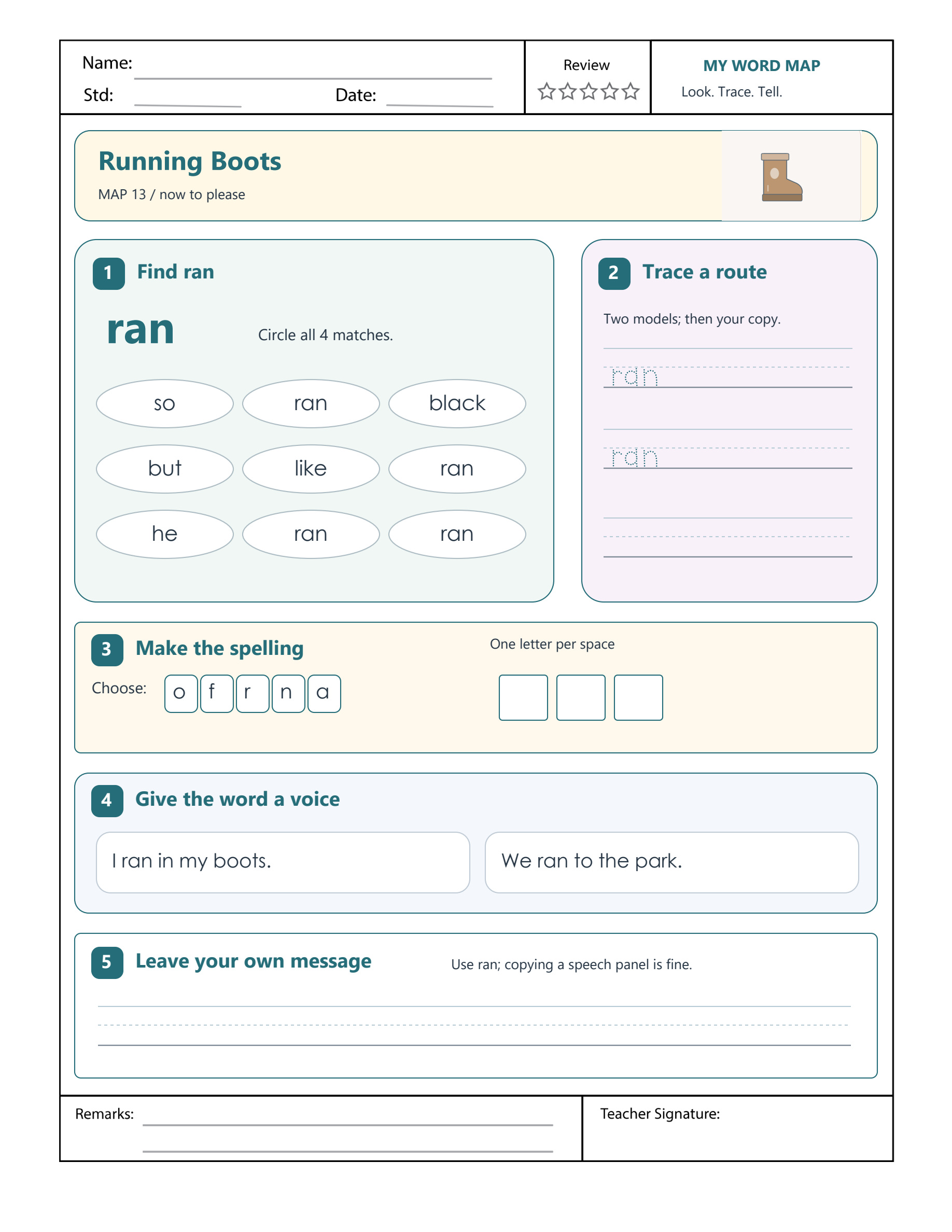
The whole ran map remains uncropped.
Running Boots combines its ran search hub, tracing side route, spelling rail, speech panels and message strip.
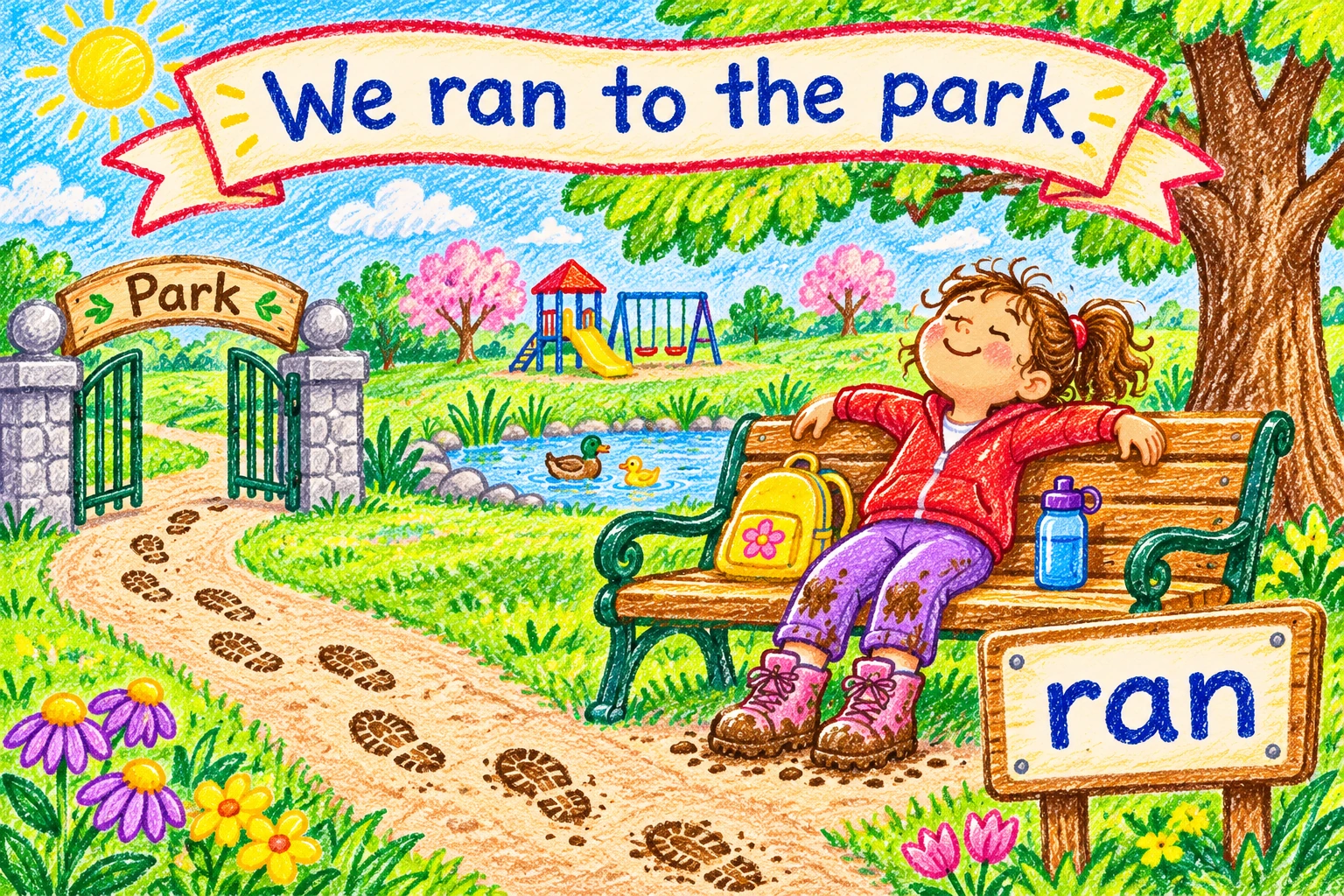
Footprints lead away from the gate, but Opal is resting now and can tell someone about the earlier journey. Ran reports that completed running event. This Ran Sight Word worksheet uses boots and a park visit to connect a short spoken recount with r-a-n, search choices and pencil practice. Its clean word-map interior retains the original messages and activity types inside the familiar frame. A pretend trail, a toy figure or a drawing is enough to begin; the child does not need to run, race or disclose a personal experience to explore the word.
A past action can be described while everyone rests
Ran is the past form of run in these sentences. Establish that the journey happened before the current telling. The child can use the word while sitting still, just as a writer can record an event after it has finished. A still picture of boots may provide context, but it cannot by itself explain when the action occurred.
The first message describes a speaker running in boots. The second includes a group travelling to the park. Ask who belongs to we before retelling the group event. If Opal prefers a fictional character, use one; the worksheet does not require a true autobiographical story as proof of reading understanding.
The spelling has three positions, r-a-n. An adult can blend the spoken form when the relevant sound knowledge is familiar, keeping the model visible. Do not replace the middle a because another past-event word or similar short spelling has already been practised.
A home trail that can be told afterwards
Make a short footprint path for a toy figure between a cardboard gate and a paper park. Move the figure along it, stop at the destination and invite Opal to recount the event. The adult can model ran without correcting every alternative expression the child uses to communicate the same idea.
Read the source messages together after the toy rests. Identify the target and build it using large movable pieces. A search decision or one dotted copy can follow if the learner remains interested. A dictated park sentence may be a useful finish when oral storytelling is stronger than handwriting. The play can stay entirely seated and still establish the action's time reference.
Six discoveries along a finished footprint path
- Time reference: Opal distinguishes an earlier run from an action happening during the telling.
Recounting: the listener receives information about the completed route. - Subject awareness: I and we are connected with the intended speaker or group.
- Letter sequence: r-a-n is selected and ordered despite the shuffled bank.
- Search precision: each candidate is compared as a whole word.
- Message planning: a spoken event can be rehearsed before a copied or original written sentence.
A running boots message using ran
The ran finish accepts a copied running boots example or a new ran sentence. Let Opal speak the running boots message before writing ran. Check how the listener understands Opal's idea. Supply unfamiliar spellings around ran if Opal needs them. Preserve this running boots thought while helping Opal with print. Provide Opal with spelling help that preserves ran.
Ran Sight Word inspection on the running boots map
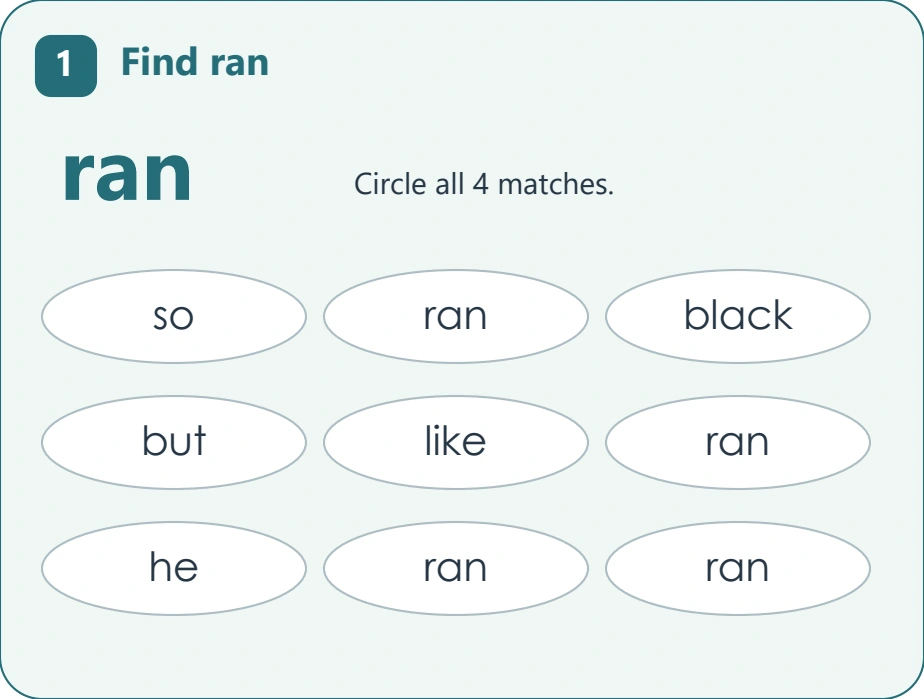
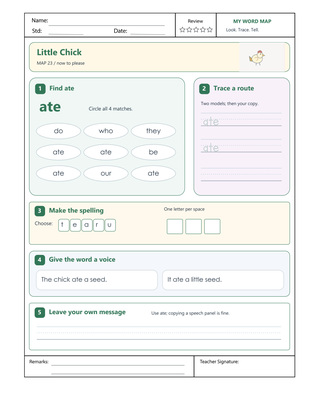
The running boots search contains nine ovals. Begin at ran's large model, then compare each ran choice. For ran, number the top row 1–3; continue the running boots middle row 4–6, then the ran bottom row 7–9. Review these running boots notes after Opal's own ran attempt; reveal answers when that ran comparison needs support.
| Ran cell | Choice | Ran check |
|---|---|---|
| 1 | so | Opal: reject so when searching for ran. so has s at position 1; ran needs r there. Compare r-a-n before ruling out so on this running boots map. |
| 2 | ran | Ran is complete at cell 2: r-a-n. Opal can compare its final n with ran's ending before making this running boots circle. |
| 3 | black | Opal: reject black when searching for ran. black has b at position 1; ran needs r there. Compare r-a-n before ruling out black on this running boots map. |
| 4 | but | Opal: reject but when searching for ran. but has b at position 1; ran needs r there. Compare r-a-n before ruling out but on this running boots map. |
| 5 | like | Opal: reject like when searching for ran. like has l at position 1; ran needs r there. Compare r-a-n before ruling out like on this running boots map. |
Finish checking the running boots choices
| Ran cell | Choice | Ran check |
|---|---|---|
| 6 | ran | Cell 6 holds another exact ran. Let Opal inspect ran's neighbours too; one successful ran find does not decide adjacent running boots choices. |
| 7 | he | Opal: reject he when searching for ran. he has h at position 1; ran needs r there. Compare r-a-n before ruling out he on this running boots map. |
| 8 | ran | This r-a-n matches ran. Ask Opal to show each ran position before circling the entry on the running boots map. |
| 9 | ran | The fourth matching ran occupies cell 9. Its r-a-n agrees with the model; Opal can point to every ran position before including it. |
Four ovals match ran. If Opal circles a different quantity, revisit the running boots choices. Compare each selection against r-a-n before adding a ran circle. Ask Opal to explain a selected ran and a rejected running boots candidate. Listen to Opal's comparison as well as counting ran marks.
The ran speech windows
Read the first running boots message: “I ran in my boots.” Its ran companion says “We ran to the park.” Share the running boots meaning before asking Opal to locate ran in print. An adult may supply other running boots vocabulary, leaving Opal to inspect the ran positions. If Opal guesses ran from the picture, cover that running boots illustration briefly and point back to r-a-n.

A pencil route for the running boots word
Two dotted ran examples sit on separate running boots guides. Follow r-a-n once while Opal watches a useful demonstration. The third ran band is for an untraced running boots attempt. Choose a quantity of ran practice that fits Opal's hand control, rather than asking Opal to fill the entire running boots sidebar.
Understanding the running boots message and writing ran are different questions. Opal may explain ran correctly while its ran letters still need motor support. Dictating ran can preserve a running boots idea when independent ran writing is tiring. Keep ran's model visible for Opal; offer formation help on ran separately instead of turning running boots sentence practice into repeated correction.
Assemble r-a-n on the spelling rail
The ran bank presents o, f, r, n, a. Make 3 positions for r-a-n; leave o and f unused. Opal selects the ran sequence rather than transcribing the running boots display order. Movable ran pieces can reduce Opal's pencil load during this running boots spelling decision.
Point from ran's large model to each r-a-n position. If Opal misplaces a ran letter, move that piece while the running boots materials remain adjustable. Name r-a-n for the written sequence; read ran naturally within its running boots message. Check Opal's completed construction, then offer a ran pencil copy.
A classroom journey with an accessible reporter role
Set out a tabletop gate and park, then let one learner move the figure while another tells a puppet what happened. A third learner can point to ran on the written Running Boots caption. Swap the three jobs; gestures and supported speech are welcome. No physical race is needed, and children should not be compared by speed or mobility.
If a learner names boots instead of reporting the event, acknowledge the object and model the action sentence. If Opal recounts accurately but circles a different three-letter word, inspect its middle and ending with the model. A child who needs a language demonstration does not necessarily need additional handwriting, and a spelling error does not erase a clear explanation of the event.
Five invitations to retell a completed route
1. Keep the figure still, keep the story moving
After the toy reaches the paper park, leave it motionless while Opal tells the recount. The listener can ask where it went or who was involved. The target describes the earlier running event rather than demanding continuous movement during speech.
2. Make two stage pictures
Draw a figure before the route and another after arrival. Add a completed ran caption to the later picture. The child explains the change while the adult supports unfamiliar words. Keep both pictures available if recalling the sequence becomes difficult.
3. Change the destination
Replace the park with a cardboard house and invent another short toy journey. Reread the ran card after the event. The changed destination helps show that the target is not simply another name for park or boots.
4. Let a second figure join
Use two travellers for a we message and clarify who belongs to the group. Opal may point to both figures before speaking. Compare the group statement with a single-character recount, keeping the target spelling visible in each case.
5. Tell an absent listener
A puppet that did not watch the toy journey asks what happened. The child dictates a brief report, which an adult records and rereads. This creates a reason for the sentence to be clear without requiring every unfamiliar surrounding word to be written independently.
Support the recount without adding pressure
Early readers such as Opal, typically four to six and supported by an adult, may enter through a toy action, a spoken report or a letter comparison. A learner who understands ran can still hesitate while forming r. Demonstrate that particular movement separately and accept a manageable attempt rather than repeatedly correcting a full sentence.
Avoid treating ran as a boots label, requiring an actual running performance or using unsupported personal recall as the only route into the activity. Revisit after another fictional journey on a later day. Notice a precise contribution, such as keeping the event in the past or preserving the middle a, then let the learner choose whether more paper work is useful.
Explore another completed journey or an earlier word
The went journey page offers a related recount. The first pre-primer reading collection provides another entry point, and the prewriting discovery activities can separate hand movements from storytelling. For broader play possibilities, see NAEYC's family play suggestions and PBS Parents' learn-and-grow resources.
Save a boots-and-park printable for your next recount
The free Running Boots file preserves the uploaded original. Eligible members with an active plan can choose a clean ran map from their downloads. Its printable practice is free of domain labels, website marks and promotional material. A $5 collection purchase, reached from the related card, assembles all twenty-six maps into one file.
Inspect a US Letter test for every border edge, the dotted a and both park messages. Keep the intended PDF easy to retrieve and print only when another short recount will serve the learner, rather than making completion of a stack the purpose of the play.
Related Topics
Popular Worksheets
Printable resources families and teachers are downloading now.
 Free
 Free
 Free
 Free