
Now Sight Word: 5 Amazing Space-Visitor Tasks
Explore now here, then choose the complete now-to-please Word Maps collection: 26 clean printable sheets together for $5.
The whole now map remains uncropped.
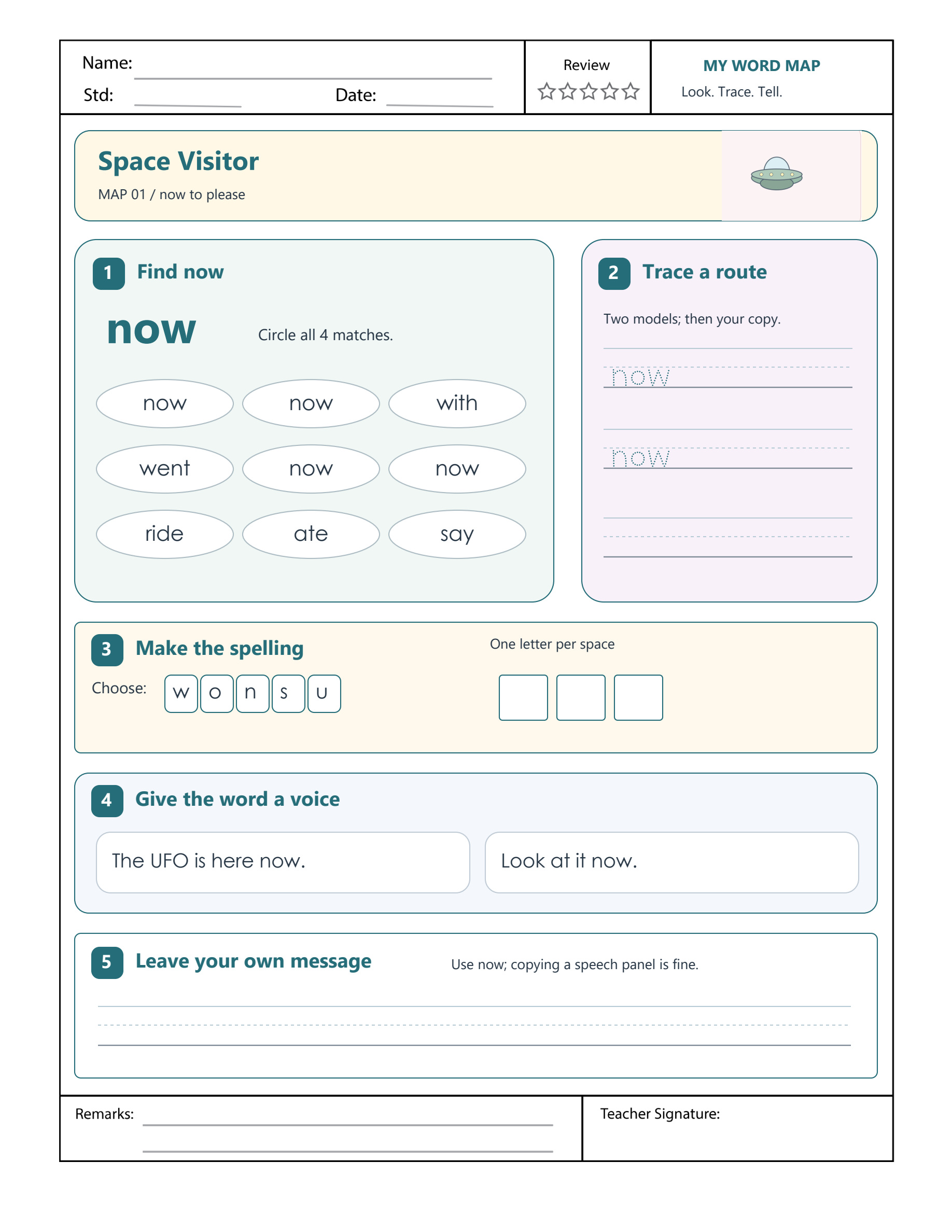
Space Visitor combines its now search hub, tracing side route, spelling rail, speech panels and message strip.
Asha has been waiting for a pretend visitor from space. When the little UFO appears on the table, the timing word matters: it is here now. This Now Sight Word page uses that small change to connect conversation with a complete printed spelling. The Space Visitor worksheet includes searching, tracing, letter selection, two messages and sentence writing. Its clean word-map edition puts those tasks into a fresh arrangement inside the familiar frame. Begin with the visible event, then choose a short piece of paper practice that matches the child's experience.
Now belongs to the moment being discussed
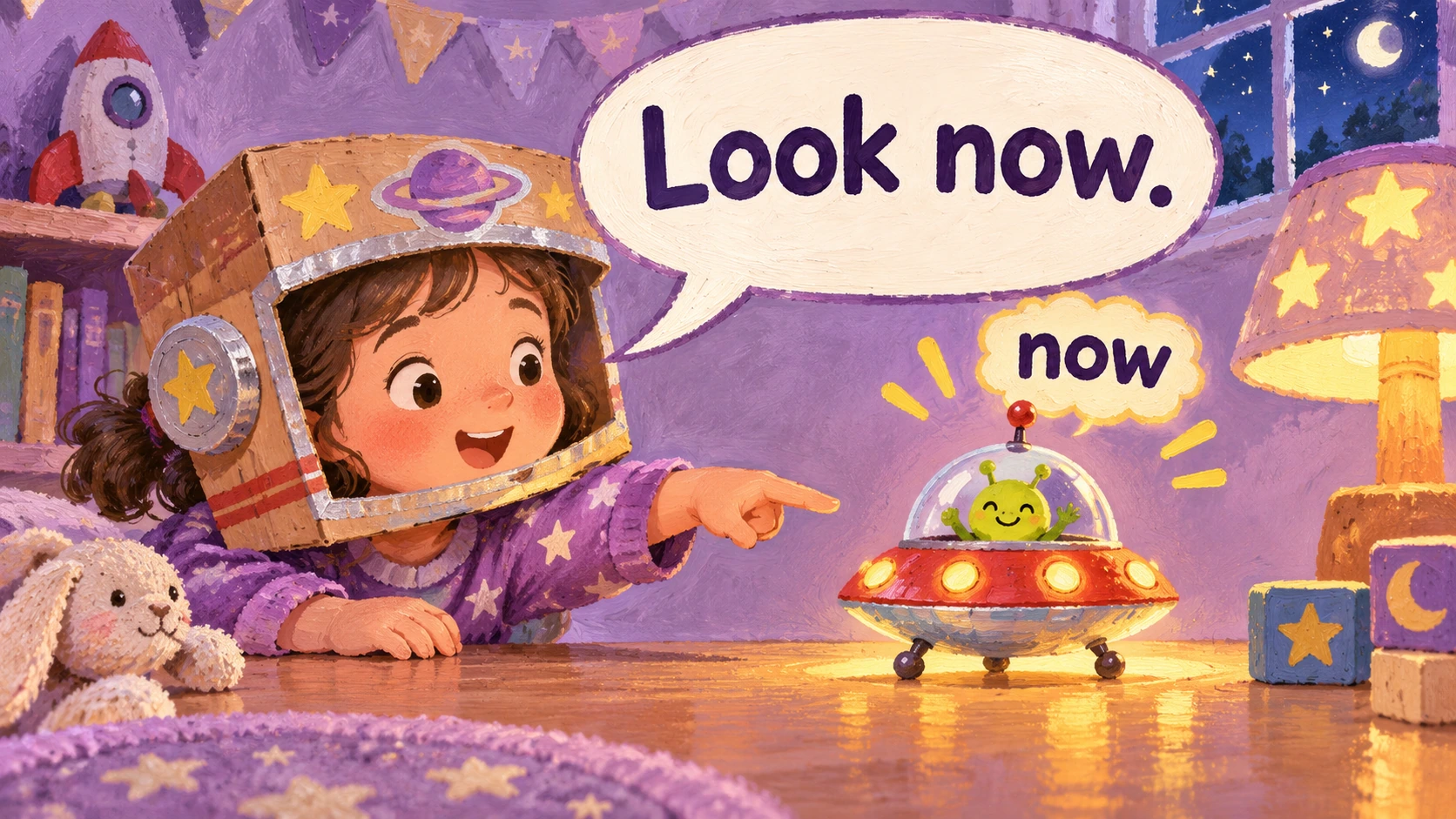
Say “Look now” while revealing the toy, then cover it and recall the earlier moment. Asha can notice that the instruction directed attention at a particular time. Now is not another name for the UFO and does not describe its colour or shape. The same word can apply when a light turns on, a puppet enters or a drawing is finally ready to show.
The sample's two messages use now at the end. Read each entire line before asking Asha to locate the target. Putting the word in a different position in an oral example can be useful later, but the printed practice does not require a lesson about every possible sentence arrangement. Keep the first contrast simple: the expected visitor was absent earlier and is visible at the moment of speaking.
Adults should avoid turning now into a demand for instant compliance. A pretend timing game gives the child a reason to listen, while allowing a pause, a question or a different turn. Understanding the time word is the reading purpose. Obeying a hurried adult is not evidence that the spelling has been understood.
A tabletop reveal before the pencil appears
At home, place a toy under a cloth and let Asha choose who will reveal it. The adult reads the UFO statement, lifts the cloth and invites an explanation of what changed. Swap the roles for another reveal. Asha might supply the word orally while the adult points underneath its letters on the page.
Next, offer n, o and w as movable pieces alongside the worksheet's extra choices. Let the child arrange the word before attempting handwriting. If attention is still comfortable, inspect one search row and explain a choice. That is enough for an initial visit; the tracing route can wait until another reveal. A short conversation with a clear time reference is preferable to completing the page while the child has stopped following the event.
Six small discoveries worth noticing
- Time reference: Asha links now with the current reveal instead of treating it as a toy label.
Shared attention: speaker and listener look towards the same event after a meaningful timing cue. - Letter order: n-o-w remains stable even when the bank presents w before the other required letters.
- Careful discrimination: the reader checks the complete search entry rather than circling every familiar-looking short word.
- Pencil planning: tracing offers a supported route before the child chooses an untraced attempt.
- Message making: a spoken present-moment idea can become a copied, dictated or independently written sentence.
Now Sight Word inspection on the space visitor map
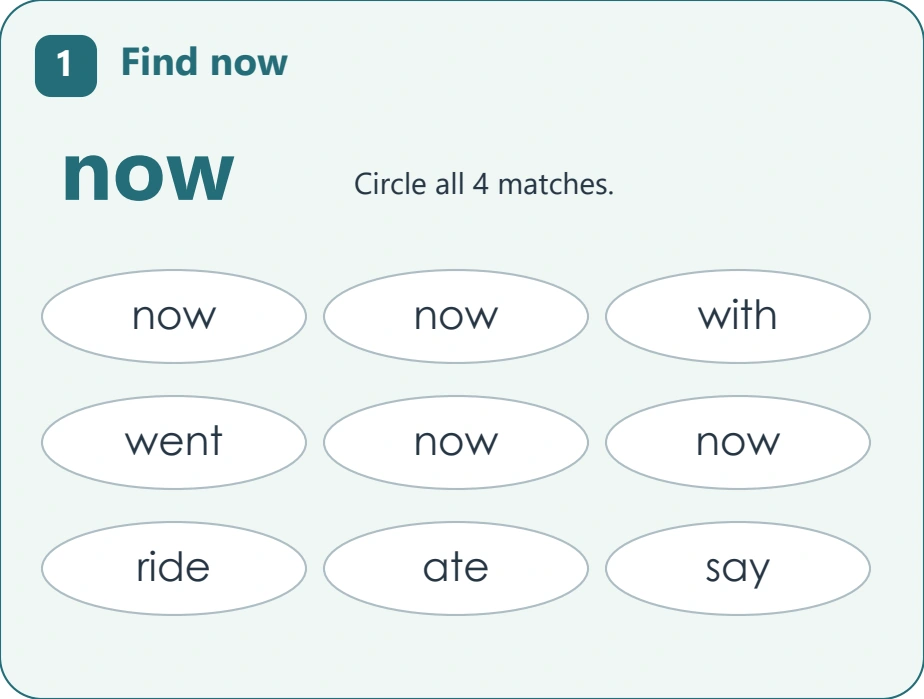
The space visitor search contains nine ovals. Begin at now's large model, then compare each now choice. For now, number the top row 1–3; continue the space visitor middle row 4–6, then the now bottom row 7–9. Review these space visitor notes after Asha's own now attempt; reveal answers when that now comparison needs support.
| Now cell | Choice | Now check |
|---|---|---|
| 1 | now | Now is complete at cell 1: n-o-w. Asha can compare its final w with now's ending before making this space visitor circle. |
| 2 | now | Cell 2 holds another exact now. Let Asha inspect now's neighbours too; one successful now find does not decide adjacent space visitor choices. |
| 3 | with | Asha: reject with when searching for now. with has w at position 1; now needs n there. Compare n-o-w before ruling out with on this space visitor map. |
| 4 | went | Asha: reject went when searching for now. went has w at position 1; now needs n there. Compare n-o-w before ruling out went on this space visitor map. |
| 5 | now | This n-o-w matches now. Ask Asha to show each now position before circling the entry on the space visitor map. |
Finish checking the space visitor choices
| Now cell | Choice | Now check |
|---|---|---|
| 6 | now | The fourth matching now occupies cell 6. Its n-o-w agrees with the model; Asha can point to every now position before including it. |
| 7 | ride | Asha: reject ride when searching for now. ride has r at position 1; now needs n there. Compare n-o-w before ruling out ride on this space visitor map. |
| 8 | ate | Asha: reject ate when searching for now. ate has a at position 1; now needs n there. Compare n-o-w before ruling out ate on this space visitor map. |
| 9 | say | Asha: reject say when searching for now. say has s at position 1; now needs n there. Compare n-o-w before ruling out say on this space visitor map. |
Four ovals match now. If Asha circles a different quantity, revisit the space visitor choices. Compare each selection against n-o-w before adding a now circle. Ask Asha to explain a selected now and a rejected space visitor candidate. Listen to Asha's comparison as well as counting now marks.
The now speech windows
Read the first space visitor message: “The UFO is here now.” Its now companion says “Look at it now.” Share the space visitor meaning before asking Asha to locate now in print. An adult may supply other space visitor vocabulary, leaving Asha to inspect the now positions. If Asha guesses now from the picture, cover that space visitor illustration briefly and point back to n-o-w.

A space visitor message using now
The now finish accepts a copied space visitor example or a new now sentence. Let Asha speak the space visitor message before writing now. Check how the listener understands Asha's idea. Supply unfamiliar spellings around now if Asha needs them. Preserve this space visitor thought while helping Asha with print. Provide Asha with spelling help that preserves now.
A pencil route for the space visitor word
Two dotted now examples sit on separate space visitor guides. Follow n-o-w once while Asha watches a useful demonstration. The third now band is for an untraced space visitor attempt. Choose a quantity of now practice that fits Asha's hand control, rather than asking Asha to fill the entire space visitor sidebar.
Understanding the space visitor message and writing now are different questions. Asha may explain now correctly while its now letters still need motor support. Dictating now can preserve a space visitor idea when independent now writing is tiring. Keep now's model visible for Asha; offer formation help on now separately instead of turning space visitor sentence practice into repeated correction.
Assemble n-o-w on the spelling rail
The now bank presents w, o, n, s, u. Make 3 positions for n-o-w; leave s and u unused. Asha selects the now sequence rather than transcribing the space visitor display order. Movable now pieces can reduce Asha's pencil load during this space visitor spelling decision.
Point from now's large model to each n-o-w position. If Asha misplaces a now letter, move that piece while the space visitor materials remain adjustable. Name n-o-w for the written sequence; read now naturally within its space visitor message. Check Asha's completed construction, then offer a now pencil copy.
A classroom signal with a listener's job
A teacher can stage a little puppet entrance for a small group. One learner holds a completed now card, another operates the puppet and a third describes when it is visible. Rotate those jobs so the most confident speaker does not control every response. The teacher reads the surrounding words if the learners cannot yet manage the full sentence independently.
After the entrance, partners find now in their own speech panels. One partner points; the other reads with support. The adult listens for a complete-spelling explanation before inviting a search circle. If a learner calls the target “space,” return to the timing demonstration rather than supplying more copying. That response reveals a meaning issue which neat tracing would not resolve.
Five more present-moment invitations
1. Switch a paper window
Make a small window with a finished drawing behind it. Open it on a spoken now cue, then close it and describe what was visible. The drawing can change between turns, while the time word retains its purpose. Keep a readable now card available beside the window.
2. Give the puppet a speaking turn
A puppet waits until a partner says its message is ready now. Let the child invent the message orally and decide when to share it. The focus is coordinating an event with language, not waiting for a timer or earning a reward for silence.
3. Compare a drawing's two stages
Show an unfinished picture and its completed version. Discuss which one the speaker is presenting now. Asha can point to a stage before attempting a sentence. Avoid implying that now always means finished; an event can be happening without being complete.
4. Make a tiny caption gallery
Place a now caption beside a photograph from the current play session. Later, look at the photograph as a memory and discuss how the speaking situation has changed. This introduces a useful distinction without asking the child to learn several new printed time words immediately.
5. Offer a gentle turn change
Invite another player to show a toy now, while the first player becomes the listener. Let either player request a little preparation time. The word can organise a collaborative exchange without becoming a test of speed or a rule about unquestioning obedience.
Keep the space visit inviting
Around ages four to six, children may enjoy the reveal long before they can write every surrounding word. Offer oral participation, large movable letters or one dotted attempt according to need. Asha can explain a present event accurately while still needing a demonstration of w. Those two observations deserve different responses.
For later practice, change the revealed object rather than adding many identical copies. A learner who transfers now from the UFO to a newly opened picture window has used the concept in another setting. Notice that decision specifically. If the child is tired, leave the toy visible and end with a shared reread instead of demanding the last writing line.
Connect this timing idea with another resource
Future intentions can be explored through the will planning worksheet. The short-word starter collection offers another reading entry point, while the prewriting concept activities can support a separate pencil visit. Away from print, browse NAEYC's play suggestions for families or PBS Parents' learning ideas for shared activities.
Choose the Space Visitor download you need
Choose the supplied original for a free sample of Space Visitor. The redesigned now map is a membership download for eligible active accounts, reached through the page controls. Its practice area is clear of website branding and promotional boxes. For the other twenty-five words as well, open the collection card: the combined clean edition costs $5 separately.
Use US Letter paper and check the complete frame in a test print. Inspect the dotted w and both lower speech windows before making extra copies. Save the file under a name the adult can find when the next pretend visitor is ready to arrive.
Related Topics
Popular Worksheets
Printable resources families and teachers are downloading now.
 Free
 Free
 Free
 Free