
No Sight Word: 5 Clever Mitten-Answer Activities
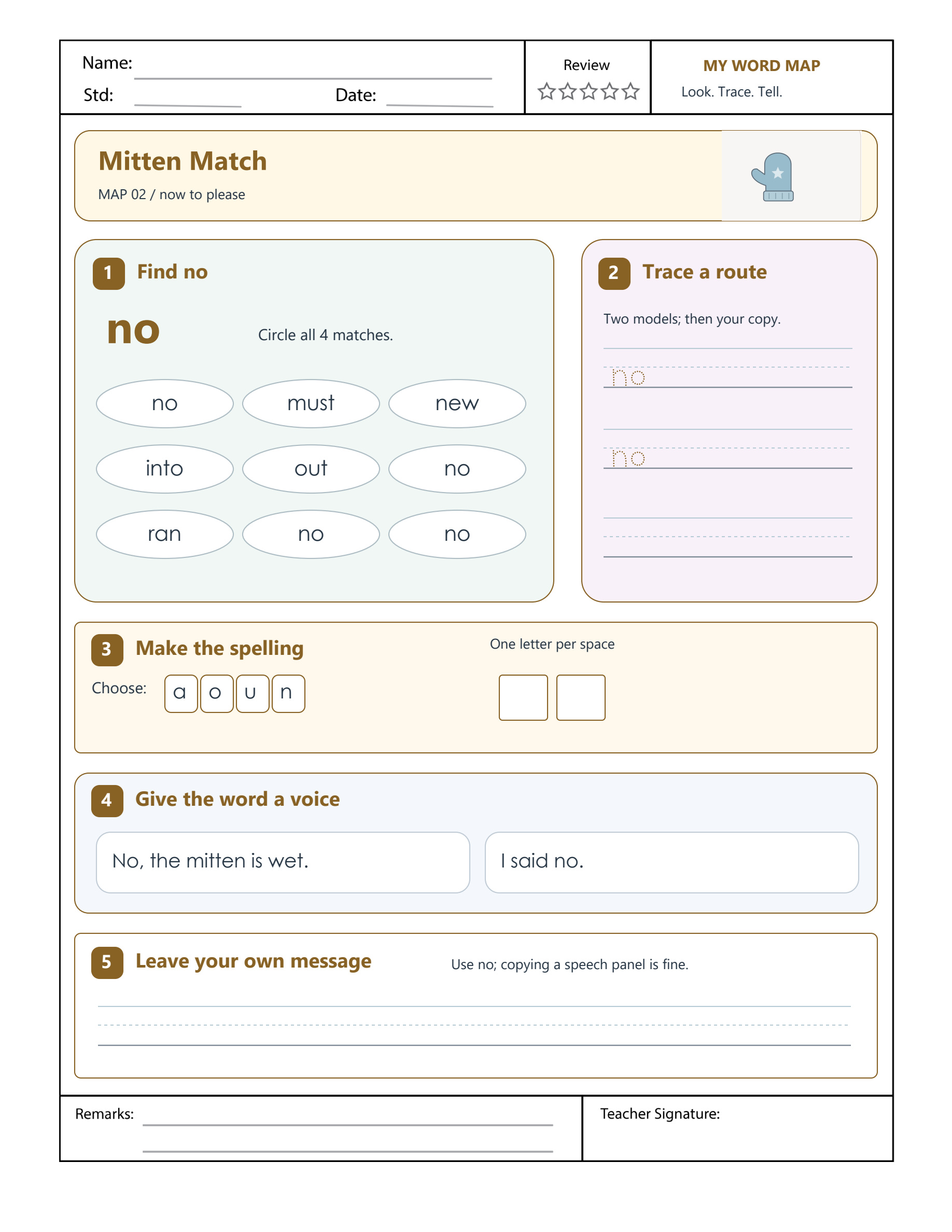
Explore no here, then choose the complete now-to-please Word Maps collection: 26 clean printable sheets together for $5.
The whole no map remains uncropped.
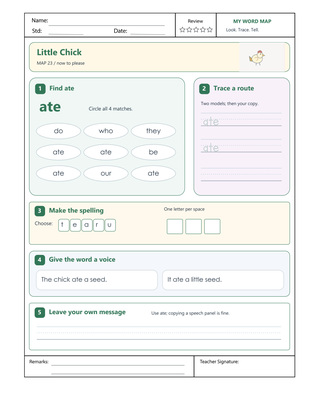
Mitten Match combines its no search hub, tracing side route, spelling rail, speech panels and message strip.
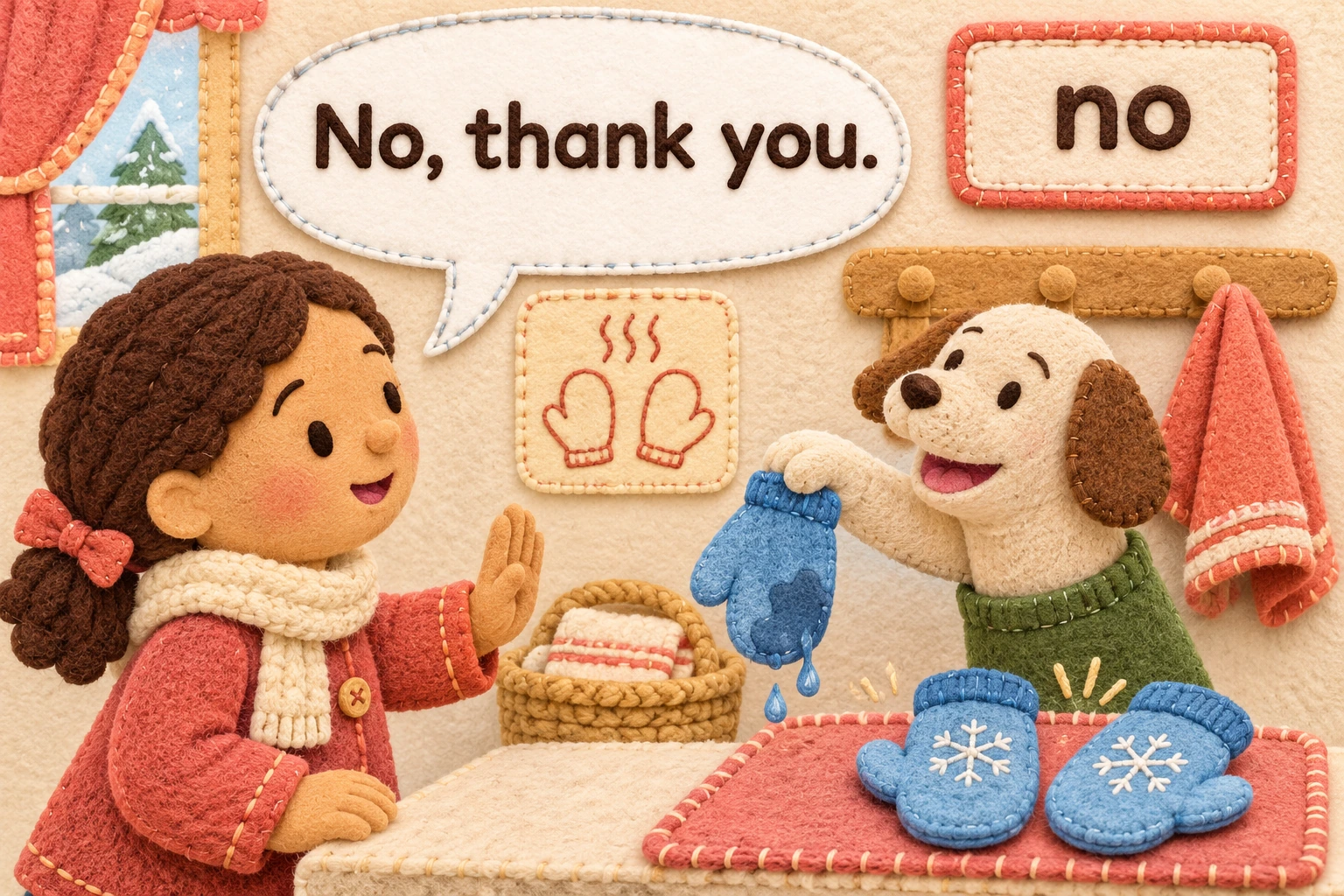
Ben notices that the offered mitten is wet and gives a useful answer: no. A negative response can carry information, protect a choice and open a conversation about what would work instead. The No Sight Word worksheet brings that ordinary exchange into print through a mitten scene, complete sentences and a two-letter spelling. Its clean map keeps five activities inside the established page frame. An adult can begin with the child's answer, then move towards finding and forming the written word without treating agreement as the goal of the lesson.
A negative answer has a meaning to respect
The first printed message explains that the mitten is wet. Read it as an answer to a suitable question, such as whether the mitten is ready to wear. The second reports that the speaker said no. Discuss what was declined and why; neither sentence asks the child to reject everything or to repeat an adult's answer without considering the situation.
No and yes serve different purposes. A learner who automatically agrees with every question may need time to inspect the scene and decide what fits. Present a dry mitten on another turn so the same response is not correct merely because it was practised first. The adult should model listening to both answers calmly.
Capital No at the sentence opening and lowercase no in another position belong to the same word. Show the two forms beside each other if needed. The initial capital is not an extra sound, and the comma in the first message marks its spoken pause rather than a third letter in the target.
Start with a real choice at home
Use two safe clothing items, one ready to use and one needing attention. Ben may decide whether a puppet should wear the offered item. Ask the question once and wait. If the response is no, invite an explanation or accept a pointing gesture that makes the reason clear. The adult can then offer a suitable alternative without insisting on a different answer.
Return to the paper after that exchange. Locate no in one printed message and compare n followed by o with the large model. A child who understands the refusal but cannot yet form n can arrange letter pieces instead. One meaningful answer and one spelling decision make a sensible first session; the remaining map areas can be visited when the mitten story is played again.
Six useful observations during the mitten exchange
- Intentional responding: Ben considers whether the answer fits the offered mitten.
- Reason giving: an explanation connects the negative word with a visible condition.
- Listening: the partner accepts the response and checks what the speaker means.
- Case recognition: sentence-opening No connects with the lowercase search model.
- Ordered letters: n-o remains different from reversing the two selected pieces.
- Written participation: a short response can be traced, copied or dictated without requiring a lengthy original composition.
A puppet conversation for the classroom
Set up a dry-clothes basket and a pretend drying area. One learner offers a mitten to a puppet, while another decides whether it is ready. The teacher can establish the intended question before the response; otherwise a perfectly reasonable no may be marked wrong because the adult had a different question in mind.
After each answer, let the listener retell what was declined. Then inspect the worksheet's reported-speech message together. Ben can point to no while the teacher reads the longer surrounding words. Rotate the offering and answering roles. Children should not have to earn their right to decline by producing a perfect trace or an elaborate explanation.
Assemble n-o on the spelling rail
The no bank presents a, o, u, n. Make 2 positions for n-o; leave a and u unused. Ben selects the no sequence rather than transcribing the mitten match display order. Movable no pieces can reduce Ben's pencil load during this mitten match spelling decision.
Point from no's large model to each n-o position. If Ben misplaces a no letter, move that piece while the mitten match materials remain adjustable. Name n-o for the written sequence; read no naturally within its mitten match message. Check Ben's completed construction, then offer a no pencil copy.

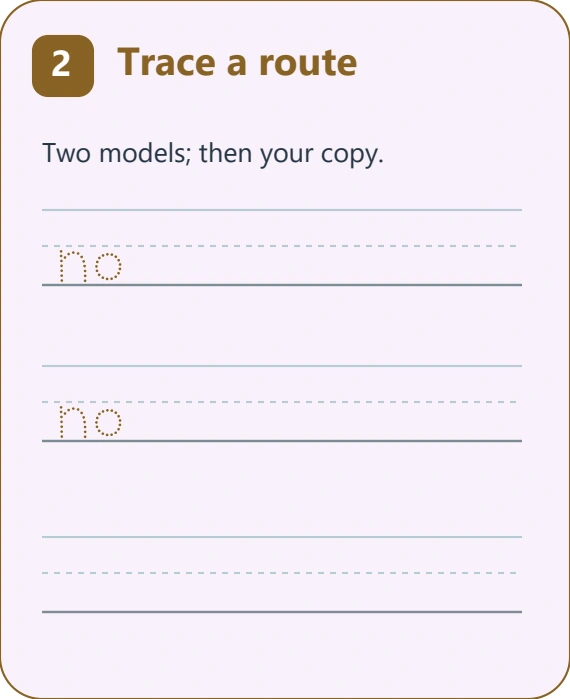
A pencil route for the mitten match word
Two dotted no examples sit on separate mitten match guides. Follow n-o once while Ben watches a useful demonstration. The third no band is for an untraced mitten match attempt. Choose a quantity of no practice that fits Ben's hand control, rather than asking Ben to fill the entire mitten match sidebar.
Understanding the mitten match message and writing no are different questions. Ben may explain no correctly while its no letters still need motor support. Dictating no can preserve a mitten match idea when independent no writing is tiring. Keep no's model visible for Ben; offer formation help on no separately instead of turning mitten match sentence practice into repeated correction.
A mitten match message using no
The no finish accepts a copied mitten match example or a new no sentence. Let Ben speak the mitten match message before writing no. Check how the listener understands Ben's idea. Supply unfamiliar spellings around no if Ben needs them. Preserve this mitten match thought while helping Ben with print. Provide Ben with spelling help that preserves no.
No Sight Word inspection on the mitten match map
The mitten match search contains nine ovals. Begin at no's large model, then compare each no choice. For no, number the top row 1–3; continue the mitten match middle row 4–6, then the no bottom row 7–9. Review these mitten match notes after Ben's own no attempt; reveal answers when that no comparison needs support.
| No cell | Choice | No check |
|---|---|---|
| 1 | no | No is complete at cell 1: n-o. Ben can compare its final o with no's ending before making this mitten match circle. |
| 2 | must | Ben: reject must when searching for no. must has m at position 1; no needs n there. Compare n-o before ruling out must on this mitten match map. |
| 3 | new | Ben: reject new when searching for no. new has e at position 2; no needs o there. Compare n-o before ruling out new on this mitten match map. |
| 4 | into | Ben: reject into when searching for no. into has i at position 1; no needs n there. Compare n-o before ruling out into on this mitten match map. |
| 5 | out | Ben: reject out when searching for no. out has o at position 1; no needs n there. Compare n-o before ruling out out on this mitten match map. |
Finish checking the mitten match choices
| No cell | Choice | No check |
|---|---|---|
| 6 | no | Cell 6 holds another exact no. Let Ben inspect no's neighbours too; one successful no find does not decide adjacent mitten match choices. |
| 7 | ran | Ben: reject ran when searching for no. ran has r at position 1; no needs n there. Compare n-o before ruling out ran on this mitten match map. |
| 8 | no | This n-o matches no. Ask Ben to show each no position before circling the entry on the mitten match map. |
| 9 | no | The fourth matching no occupies cell 9. Its n-o agrees with the model; Ben can point to every no position before including it. |
Four ovals match no. If Ben circles a different quantity, revisit the mitten match choices. Compare each selection against n-o before adding a no circle. Ask Ben to explain a selected no and a rejected mitten match candidate. Listen to Ben's comparison as well as counting no marks.
The no speech windows
Read the first mitten match message: “No, the mitten is wet.” Its no companion says “I said no.” Share the mitten match meaning before asking Ben to locate no in print. An adult may supply other mitten match vocabulary, leaving Ben to inspect the no positions. If Ben guesses no from the picture, cover that mitten match illustration briefly and point back to n-o.

Five gentle ways to practise beyond the mitten
1. Change the puppet's offer
Offer the same puppet a book, then a different book. Let the learner choose whether each suggestion suits the pretend activity. A no answer should remain a valid communication, not an obstacle to overcome. Point to the printed target after the exchange has a clear meaning.
2. Make an answer-and-reason pair
An adult writes no on one card and draws the relevant reason on another. Ben pairs the answer with the picture after a question is asked. Change the reason between turns so the child listens to the actual situation rather than memorising one fixed response.
3. Repair a muddled puppet report
Have a puppet claim that Ben said yes after a clear negative answer. Invite a calm correction: “I said no.” The play creates a purpose for the worksheet's second sentence. Keep the joke kind and stop if the child dislikes being deliberately misunderstood.
4. Sort ready and not-ready props
Use toy items whose pretend conditions are easy to explain, such as an incomplete paper crown and a finished one. Ask a specific readiness question. The labels and answer cards remain visible, allowing the child to connect a meaningful decision with print while the adult handles unfamiliar vocabulary.
5. Give the listener a turn
Swap roles so Ben makes an offer and hears another person's no. Model accepting the answer and asking about an alternative. This makes the target part of a two-way conversation rather than a word children are allowed to use only in the adult's chosen exercise.
Avoid an accidental lesson in compliance
Do not praise yes while correcting no regardless of the question. The language purpose is accurate, intentional responding. Similarly, do not use the worksheet to demand disclosure of personal experiences or reasons a child does not wish to share. The mitten story supplies enough fictional content for a complete reading visit.
For many supported learners around four to six, a two-letter word is a manageable spelling investigation, but spoken confidence and pencil control vary. A reversed letter order needs a model comparison; an automatic answer needs a conversation. Treat those as separate issues. Ben can return another day to a different puppet offer, keeping the amount of writing small and the answer meaningful.
Related practice for a different kind of answer
Compare the negative response with the yes conversation page. An earlier reading route is available in the pre-primer starter pack, and the pencil-control concept collection offers another kind of practice. Broader family activities can be found through NAEYC's shared-play resources and PBS Parents' ideas for learning together.
Open and print the mitten map
The mitten page offers its supplied sample free of charge. Eligible active members have an additional clean-map download, whose PDF excludes website watermarks, domain lettering and advertising blocks. Use the page's account controls for that option. Buying the separate $5 collection provides all twenty-six now-to-please maps together.
Print a single US Letter test and inspect both n-o tracing models plus the entire outer border. Keep the original sample separate from the clean edition so an adult can choose the intended format quickly. There is no need to print a large stack before seeing which part of the mitten conversation interests the learner.
Related Topics
Popular Worksheets
Printable resources families and teachers are downloading now.
 Free
 Free
 Free
 Free