
Want Sight Word: 5 Clever Pencil-Request Tasks
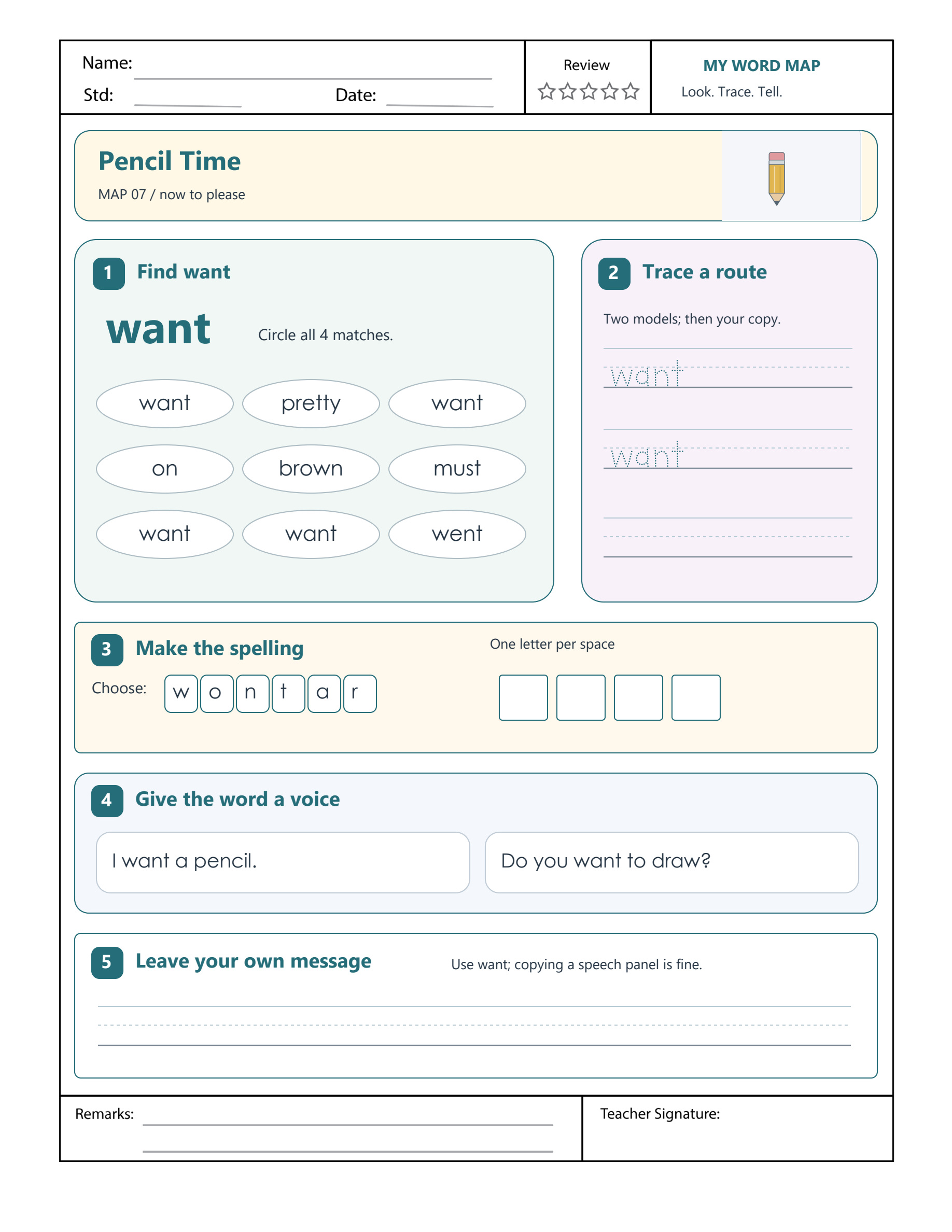
Explore want here, then choose the complete now-to-please Word Maps collection: 26 clean printable sheets together for $5.
The whole want map remains uncropped.
Pencil Time combines its want search hub, tracing side route, spelling rail, speech panels and message strip.
Two drawing tools are available, and Ines has a preference to communicate. Want gives the request a clear focus without deciding what the listener must do next. The Want Sight Word worksheet connects that ordinary art-table conversation with a complete four-letter word, a search and two printed messages. Its clean map retains the source activities while changing their arrangement inside the familiar frame. Begin with choosing and asking, then use the paper to investigate the spelling rather than treating a copied request as proof that the child's own choice has been heard.
Want can state a preference or open a question
The pencil statement describes what the speaker wants. The second source message asks whether the listener wants to draw. Read both and notice whose preference is being discussed. A child who can repeat the first line may still need help listening to the second person's answer. Let the partner give an authentic response instead of scripting automatic agreement.
Want does not mean that every requested object must be supplied immediately. Adults can acknowledge a preference, explain a practical limit and offer another possibility. The reading lesson should not promise that using a particular word guarantees a particular result. Its purpose is clearer communication and attention to the printed sequence w-a-n-t.
In the search, went is a particularly useful contrast. The two words have the same length and similar outer letters, but their second letters differ. Read the actual word before making a circle. Guessing from the opening w or the overall shape misses the distinction this task makes available.
A home art trolley with a choice worth naming
Set out a pencil and a crayon, then ask Ines what would suit the drawing plan. The adult listens to the answer before showing the worksheet's pencil message. If the child wants the crayon instead, keep that preference and explain that the printed character has made another choice. Understanding a sentence does not require adopting its speaker's preference.
Build w-a-n-t using the shuffled bank as a reference, then locate the target in one speech panel. Ines may dictate a fresh pencil request for the adult to record. Follow with one want trace or an explained search decision. Leave space for actual drawing rather than allowing the printable to consume the entire art session.
Six observations at a choice-making table
- Personal expression: Ines names a preference that belongs to the current speaker.
Question understanding: the drawing invitation requests information about another person's wishes. - Respectful listening: the listener can acknowledge a request without promising immediate agreement.
- Middle-letter attention: want is distinguished from the similarly arranged went.
- Spelling sequence: the selected pieces are placed in w-a-n-t order rather than bank order.
- Written purpose: a spoken choice can become a useful message or caption.
A pencil time message using want
The want finish accepts a copied pencil time example or a new want sentence. Let Ines speak the pencil time message before writing want. Check how the listener understands Ines's idea. Supply unfamiliar spellings around want if Ines needs them. Preserve this pencil time thought while helping Ines with print. Provide Ines with spelling help that preserves want.
The want speech windows
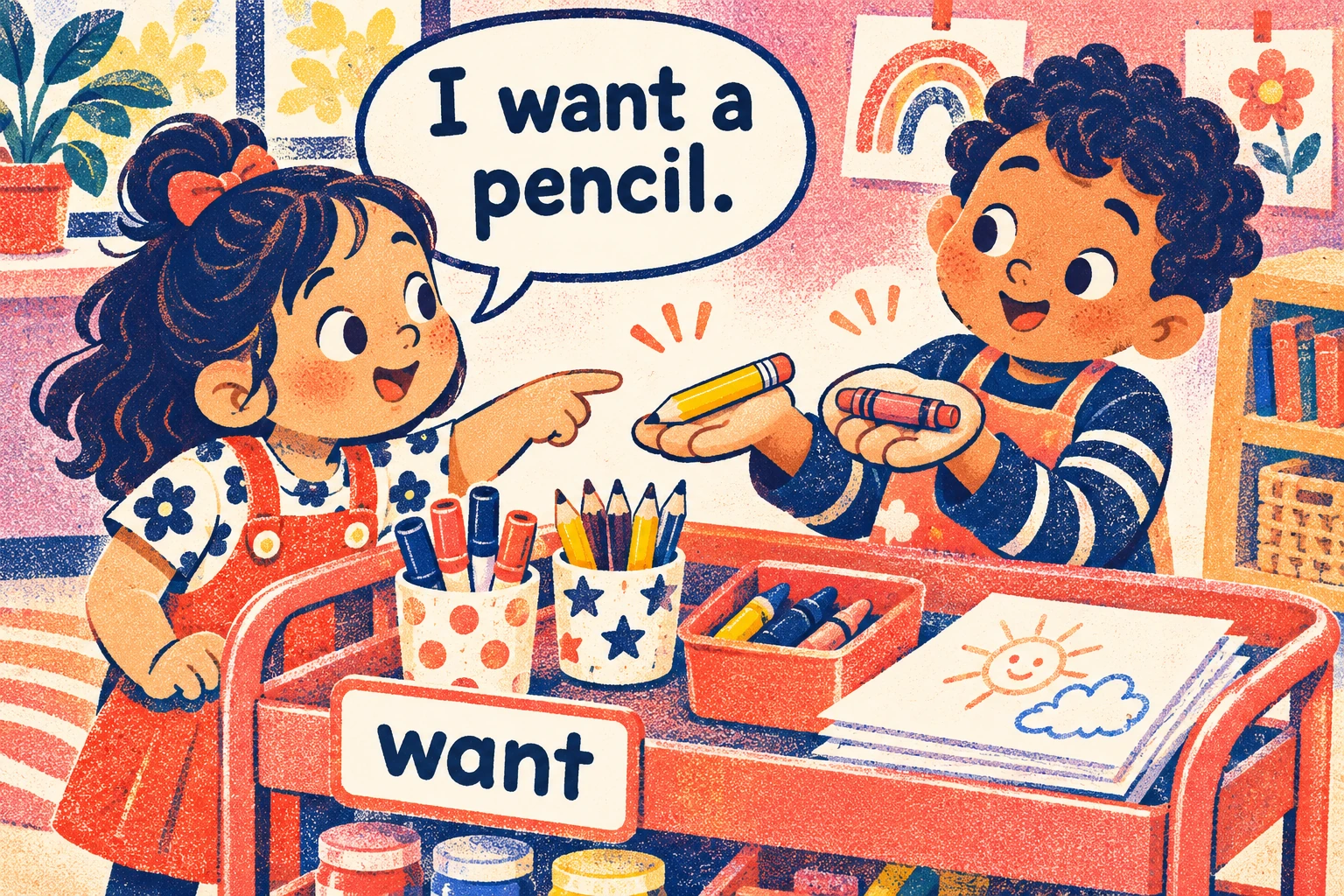
Read the first pencil time message: “I want a pencil.” Its want companion says “Do you want to draw?” Share the pencil time meaning before asking Ines to locate want in print. An adult may supply other pencil time vocabulary, leaving Ines to inspect the want positions. If Ines guesses want from the picture, cover that pencil time illustration briefly and point back to w-a-n-t.

A pencil route for the pencil time word
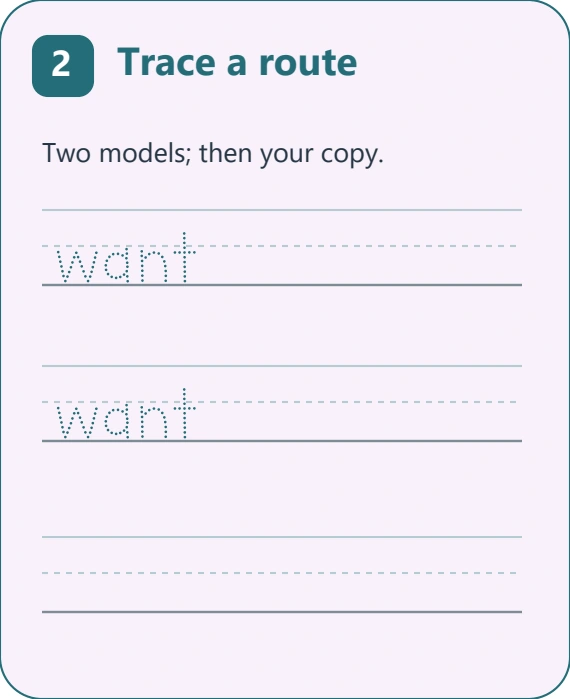
Two dotted want examples sit on separate pencil time guides. Follow w-a-n-t once while Ines watches a useful demonstration. The third want band is for an untraced pencil time attempt. Choose a quantity of want practice that fits Ines's hand control, rather than asking Ines to fill the entire pencil time sidebar.
Understanding the pencil time message and writing want are different questions. Ines may explain want correctly while its want letters still need motor support. Dictating want can preserve a pencil time idea when independent want writing is tiring. Keep want's model visible for Ines; offer formation help on want separately instead of turning pencil time sentence practice into repeated correction.
Assemble w-a-n-t on the spelling rail
The want bank presents w, o, n, t, a, r. Make 4 positions for w-a-n-t; leave o and r unused. Ines selects the want sequence rather than transcribing the pencil time display order. Movable want pieces can reduce Ines's pencil load during this pencil time spelling decision.
Point from want's large model to each w-a-n-t position. If Ines misplaces a want letter, move that piece while the pencil time materials remain adjustable. Name w-a-n-t for the written sequence; read want naturally within its pencil time message. Check Ines's completed construction, then offer a want pencil copy.

Want Sight Word inspection on the pencil time map
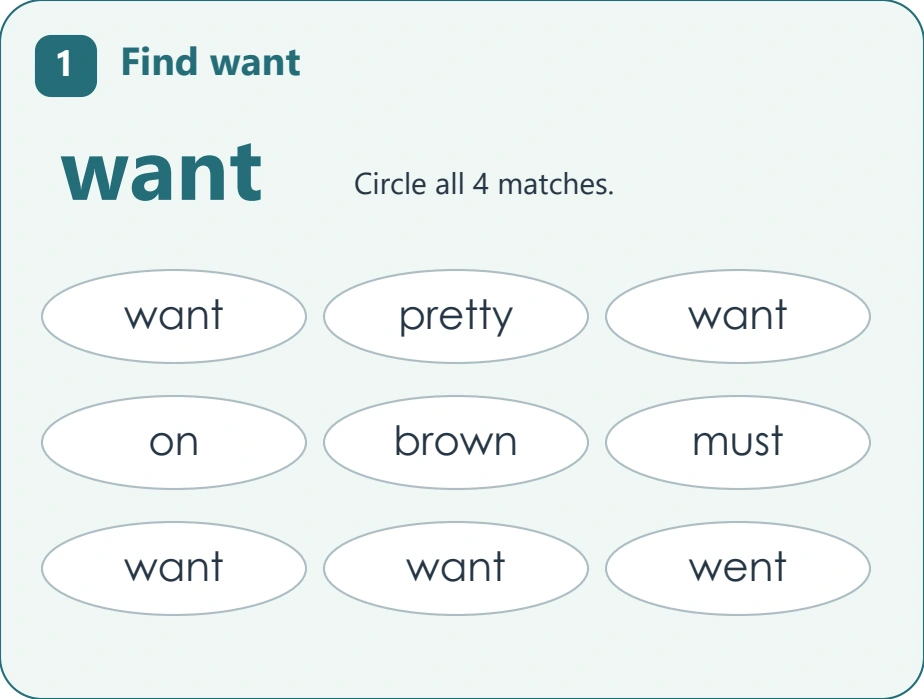
The pencil time search contains nine ovals. Begin at want's large model, then compare each want choice. For want, number the top row 1–3; continue the pencil time middle row 4–6, then the want bottom row 7–9. Review these pencil time notes after Ines's own want attempt; reveal answers when that want comparison needs support.
| Want cell | Choice | Want check |
|---|---|---|
| 1 | want | Want is complete at cell 1: w-a-n-t. Ines can compare its final t with want's ending before making this pencil time circle. |
| 2 | pretty | Ines: reject pretty when searching for want. pretty has p at position 1; want needs w there. Compare w-a-n-t before ruling out pretty on this pencil time map. |
| 3 | want | Cell 3 holds another exact want. Let Ines inspect want's neighbours too; one successful want find does not decide adjacent pencil time choices. |
| 4 | on | Ines: reject on when searching for want. on has o at position 1; want needs w there. Compare w-a-n-t before ruling out on on this pencil time map. |
| 5 | brown | Ines: reject brown when searching for want. brown has b at position 1; want needs w there. Compare w-a-n-t before ruling out brown on this pencil time map. |
Finish checking the pencil time choices
| Want cell | Choice | Want check |
|---|---|---|
| 6 | must | Ines: reject must when searching for want. must has m at position 1; want needs w there. Compare w-a-n-t before ruling out must on this pencil time map. |
| 7 | want | This w-a-n-t matches want. Ask Ines to show each want position before circling the entry on the pencil time map. |
| 8 | want | The fourth matching want occupies cell 8. Its w-a-n-t agrees with the model; Ines can point to every want position before including it. |
| 9 | went | Ines: reject went when searching for want. went has e at position 2; want needs a there. Compare w-a-n-t before ruling out went on this pencil time map. |
Four ovals match want. If Ines circles a different quantity, revisit the pencil time choices. Compare each selection against w-a-n-t before adding a want circle. Ask Ines to explain a selected want and a rejected pencil time candidate. Listen to Ines's comparison as well as counting want marks.
A classroom materials desk with rotating speakers
A teacher can run a small pretend art-supply desk with large safe props or drawings. One learner describes a plan, another asks what is wanted and a third listens for a specific tool. Rotate those jobs. A quiet child may point to a tool first while the adult models a complete request, keeping the learner's intended choice intact.
Return to the printed question after the exchange and ask who is expected to answer. If Ines responds by naming a tool when asked whether she wants to draw, clarify the question rather than marking the response as generally wrong. Then check the target spelling separately. Language interpretation and letter-order knowledge can need different kinds of support in the same visit.
Five ways to extend the request conversation
1. Give two puppets different plans
One puppet wants to draw a house, while another wants to make a pattern. Ines helps each choose a suitable tool. Keep a completed want card nearby and read it when the speaker changes. The word remains stable while its referent and preference change.
2. Make a request that can wait
Stage a shared-tool situation in which the preferred pencil is still being used. Model acknowledging the request and arranging a later turn. A child can hear that want communicates a wish without removing another person's turn or requiring an instant result.
3. Compare the middle vowels
Place want beside went and inspect the second position with the large worksheet model available. The adult supplies pronunciation as needed. Let the learner explain one visible difference before returning to a meaningful sentence; the comparison should not become a rapid guessing race.
4. Write for the materials helper
Ines dictates a short want message for someone who did not hear the original conversation. The helper reads or hears the caption and responds. This creates a reason to make the request clear, while an adult can support unfamiliar spellings around the target.
5. Change the speaker's answer
Ask the drawing question on two different pretend occasions. The child may answer differently each time and explain the changed plan. Revisit the printed question after each turn, showing that a stable sentence can invite more than one reasonable answer.
Notice the preference before correcting the pencil work
For adult-supported readers around four to six, oral confidence may exceed handwriting stamina. Accept a clear spoken request or a movable-letter construction when a long copy would be too much. If a learner writes bank order, compare positions. If the request names the wrong person's wish, return to the speaking roles.
Avoid rewarding only agreement, treating want as a demand that must always succeed or teaching the word solely through a pencil picture. Revisit after a different everyday choice, such as selecting a book for pretend play. Give feedback about a concrete decision, then end while the child still has energy to use the chosen materials.
Related words for asking and choosing
The get block-request lesson offers another action in a practical exchange. The pre-primer reading starter set provides an earlier route, and the prewriting concept workshop offers separate hand-control practice. Explore NAEYC's family play activities or PBS Parents' learning-and-play ideas for other shared conversations.
Download the pencil-request practice map
Pencil Time retains a free original alongside the membership option. An active plan with premium access allows the account holder to download the redesigned want sheet. The child's printable carries the activities without a promotional panel, website mark or domain. The collection card offers a different purchase: all twenty-six clean word maps, combined for $5.
Print one US Letter copy and inspect the frame, the a in the target and both speech messages before preparing more. Keep the file where the adult can find it for another genuine choice, and leave enough of the visit for the child's drawing idea to happen.
Related Topics
Popular Worksheets
Printable resources families and teachers are downloading now.
 Free
 Free
 Free
 Free