
Equal Picnic Sharing: 3 Brilliant Cookie Distributions
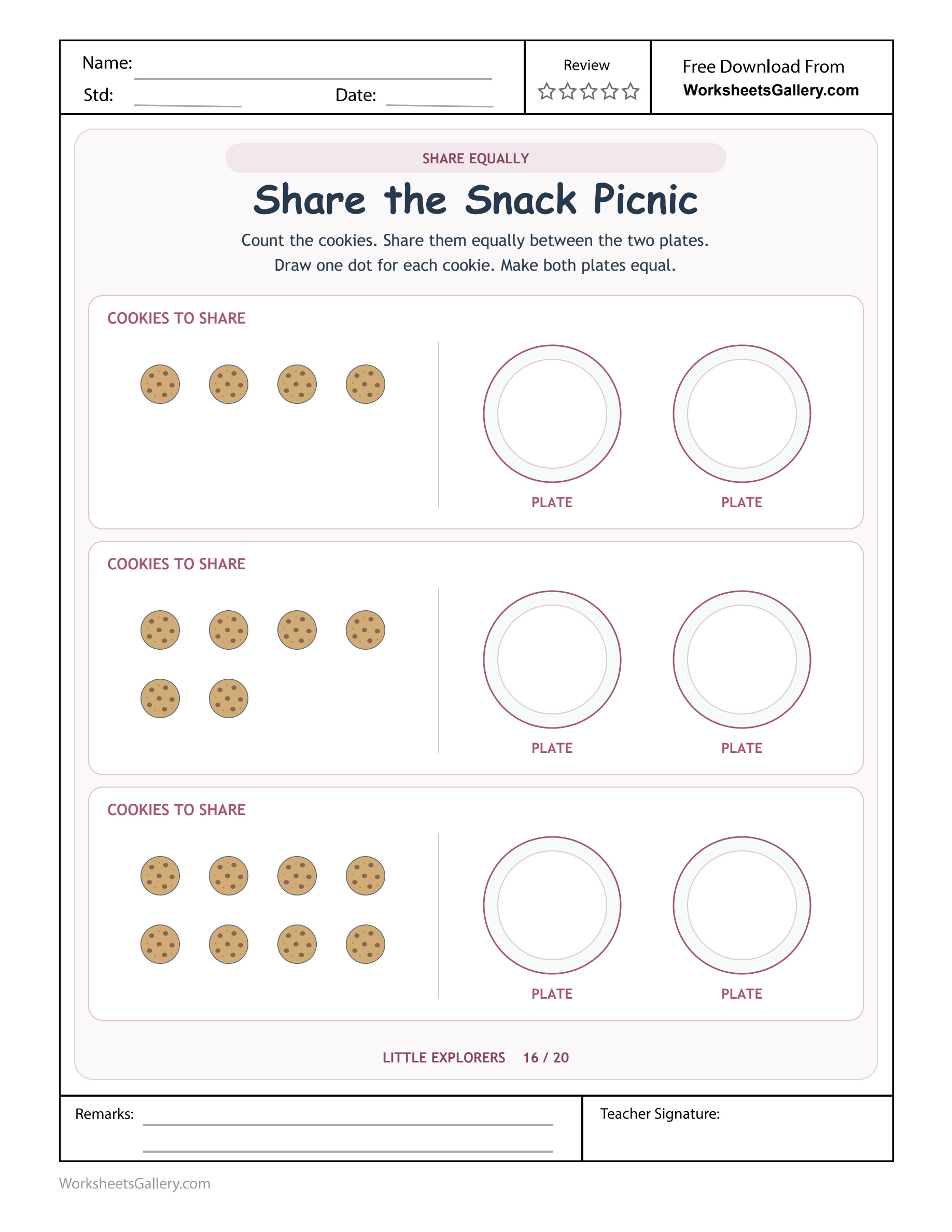
$5 collection companion: Equal Picnic Sharing. Represent four, six and eight cookies as equal dot shares across two plates.
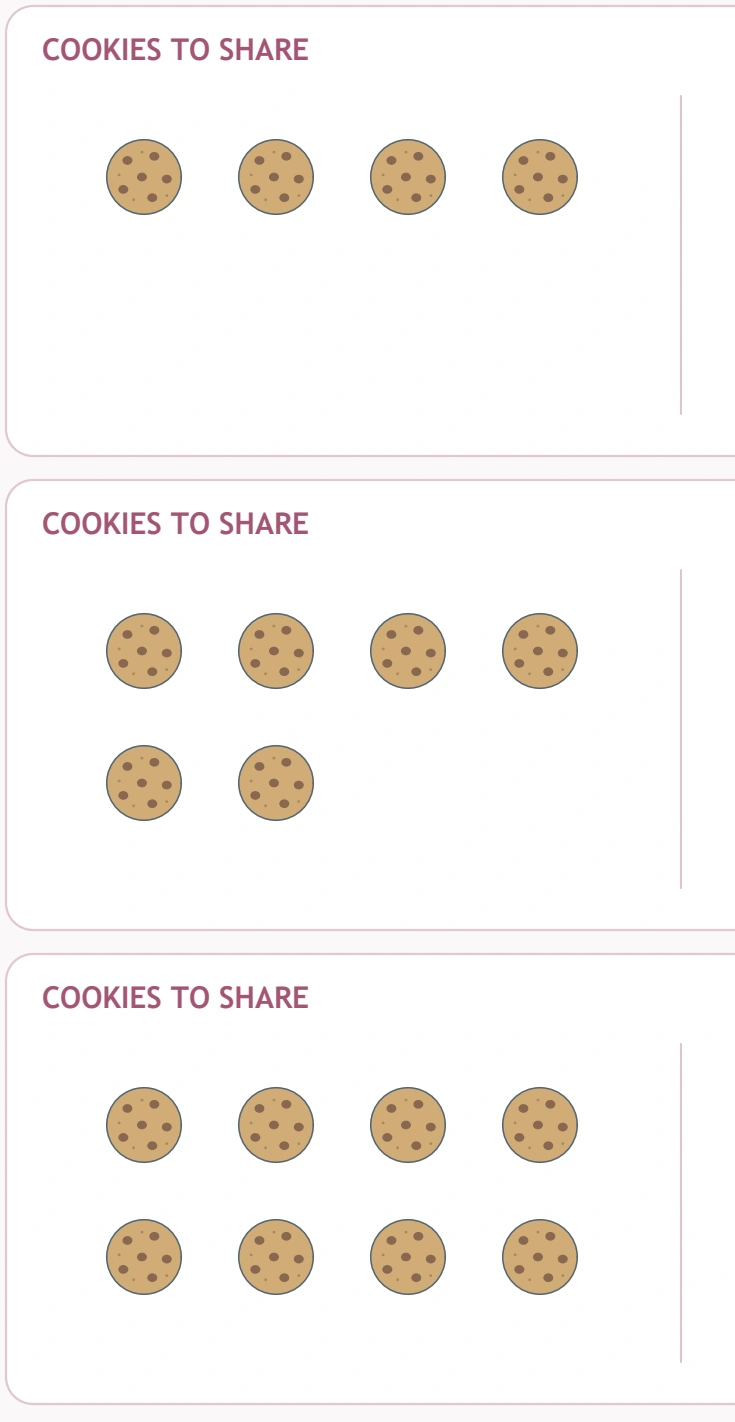
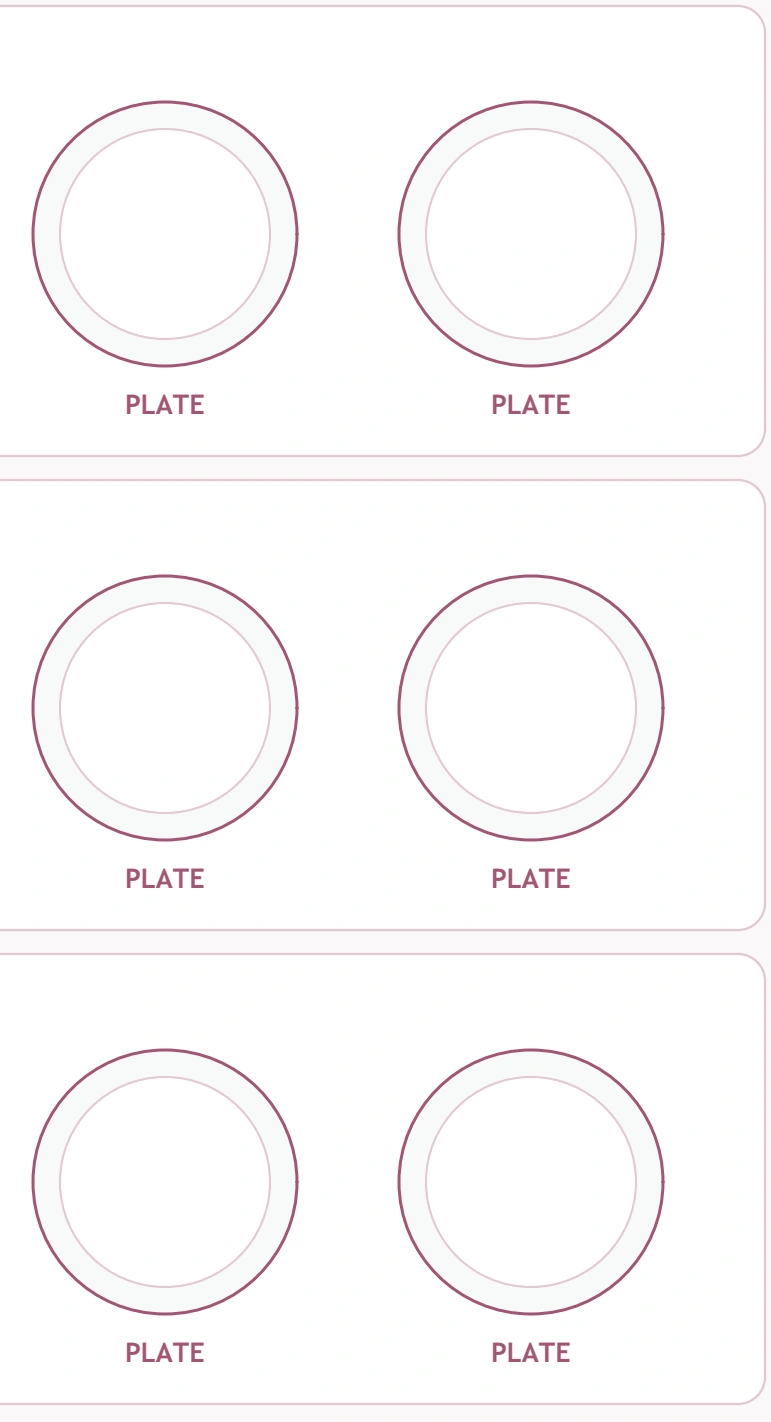
Two empty plates wait beside each group of cookies. In Equal Picnic Sharing, children count the pictured treats and draw dots to share that amount equally between the two plates. The three rows begin with four, six and eight cookies, offering a concrete introduction to fair shares without requiring division symbols. Each dot stands for one whole cookie, not for a chocolate chip. Invite the learner to count the starting group, distribute its amount and then check both plates before moving to the next picnic row.
One cookie becomes one dot in the record — Equal Picnic Sharing
The small marks inside the cookie drawings are decorative chips. They are not the objects being shared in Equal Picnic Sharing. Begin by pointing to the outline of one complete cookie and saying that it will be represented by one dot on a plate. This distinction prevents a busy-looking cookie from becoming several shares accidentally.
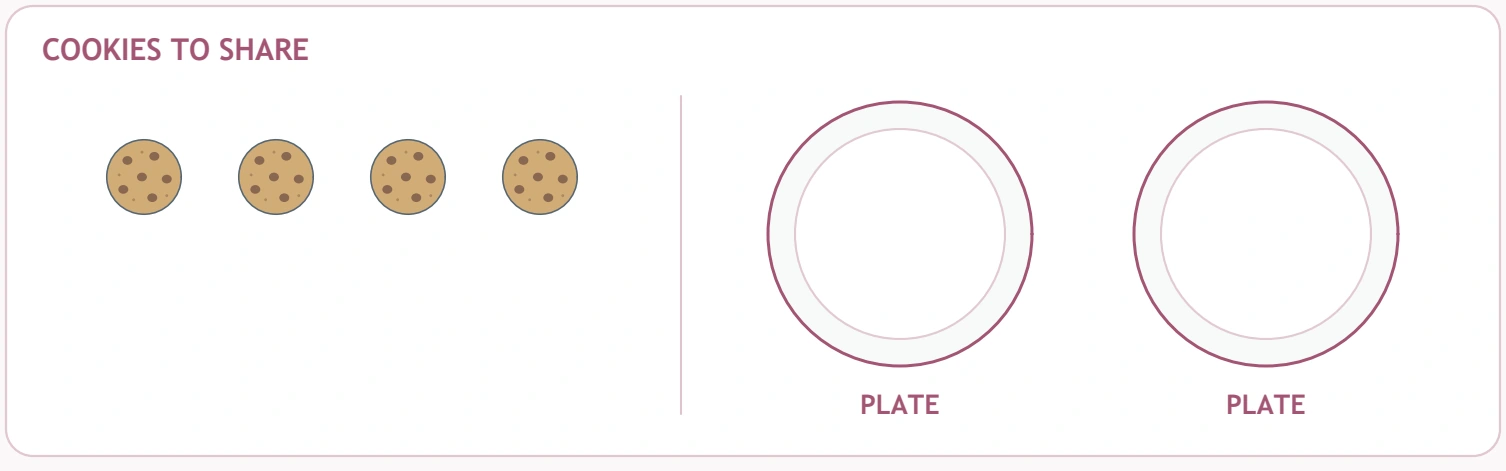
Ask Remy to count the whole cookies in the first group. After agreeing on four, point to the two empty plates and reread the equal-sharing instruction. The total available for this row is fixed. Drawing four dots on both plates would show eight cookies, which is a different amount from the source group.
Deal alternately, then inspect the result
A useful beginning is to represent one cookie on the left plate, the next on the right, and continue until the original amount has been used. Remy can touch a source cookie as each dot is drawn, or use counters beside the sheet first. Choose a method that makes it easy to track which cookies have already been allocated.
For Equal Picnic Sharing, taking turns between the two plates is a practical sharing strategy. The final check still matters: count the dots on each plate and combine those counts to confirm that the original total has been preserved. A method is useful because of the result it produces, rather than because the child copied the adult's hand movements.
Stop when the starting amount has been used
Adding an extra dot to make a plate look full changes the mathematical record. The empty space on the plate is intentional room for the child's response. It does not need to be filled completely. A few clear, countable marks communicate the share more effectively than a dense patch of dots.
Adult reference for the three picnic rows: Equal Picnic Sharing
| Whole cookies pictured | Dots on the first plate | Dots on the second plate | Total checked |
|---|---|---|---|
| 4 | 2 | 2 | 4 |
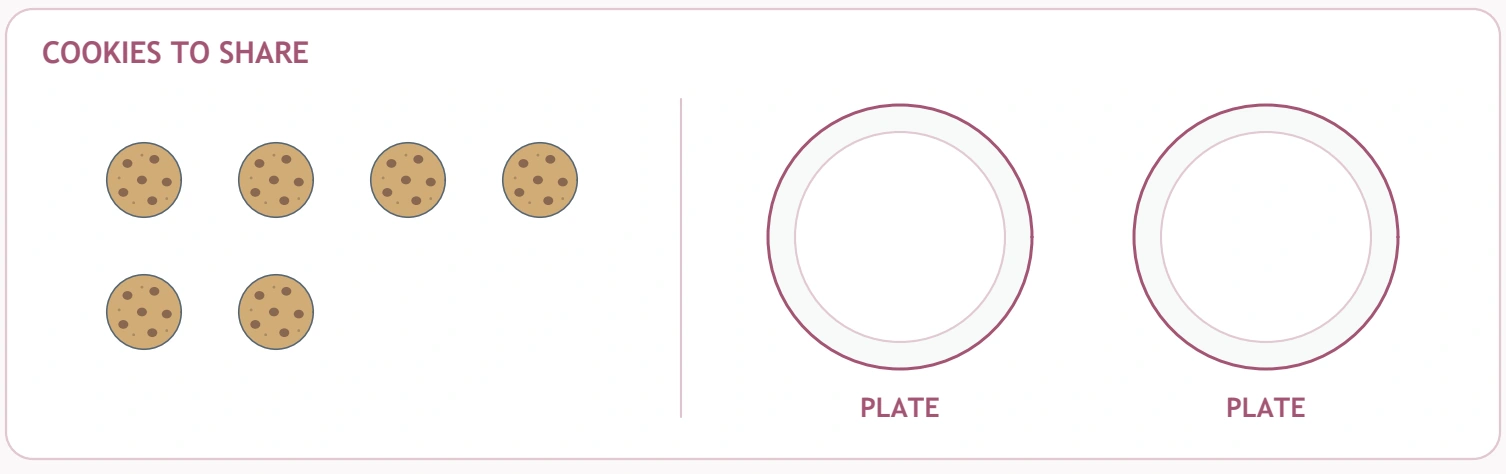
| 6 | 3 | 3 | 6 |
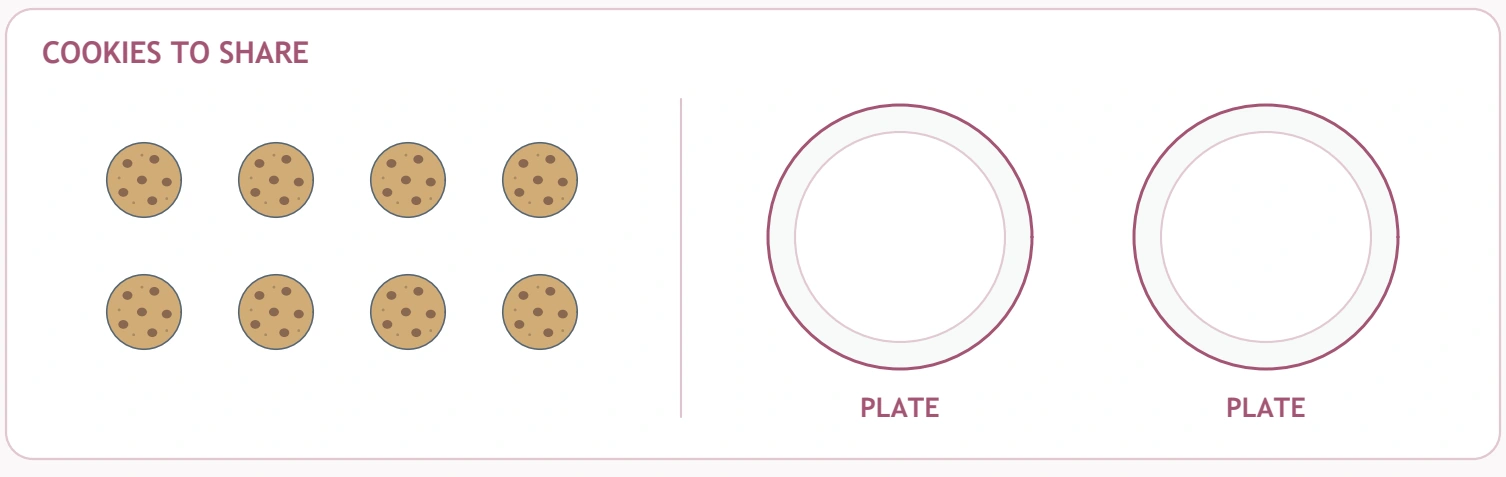
| 8 | 4 | 4 | 8 |
The Equal Picnic Sharing answer pattern increases by one on each plate as the source group increases by two. That is a useful observation after sharing, but it need not replace counting and checking the actual pictures. The worksheet asks for dot shares rather than a written equation or copied numeral.
Fairness has two checks here: Equal Picnic Sharing
First, the two plates must contain equal numbers of dots. Second, their combined number must match the cookies supplied in the row. A result of three dots and three dots is equal, but it cannot represent the first row's four cookies. Both conditions are needed to answer this particular task.
Invite Remy to explain each check separately. He may pair a dot on one plate with a dot on the other to show equality, then count every dot to check the total. Another child may count each plate directly. The useful question is whether the explanation accounts for both the equal groups and the available amount.
Equal does not mean identical dot placement
One plate might show its dots in a line while the other shows a small cluster. If both have the same count, their quantities are equal. Equal Picnic Sharing does not ask the child to copy the same spatial arrangement on both plates. Clear separation between dots helps a listener count them reliably.
A home picnic with six counters
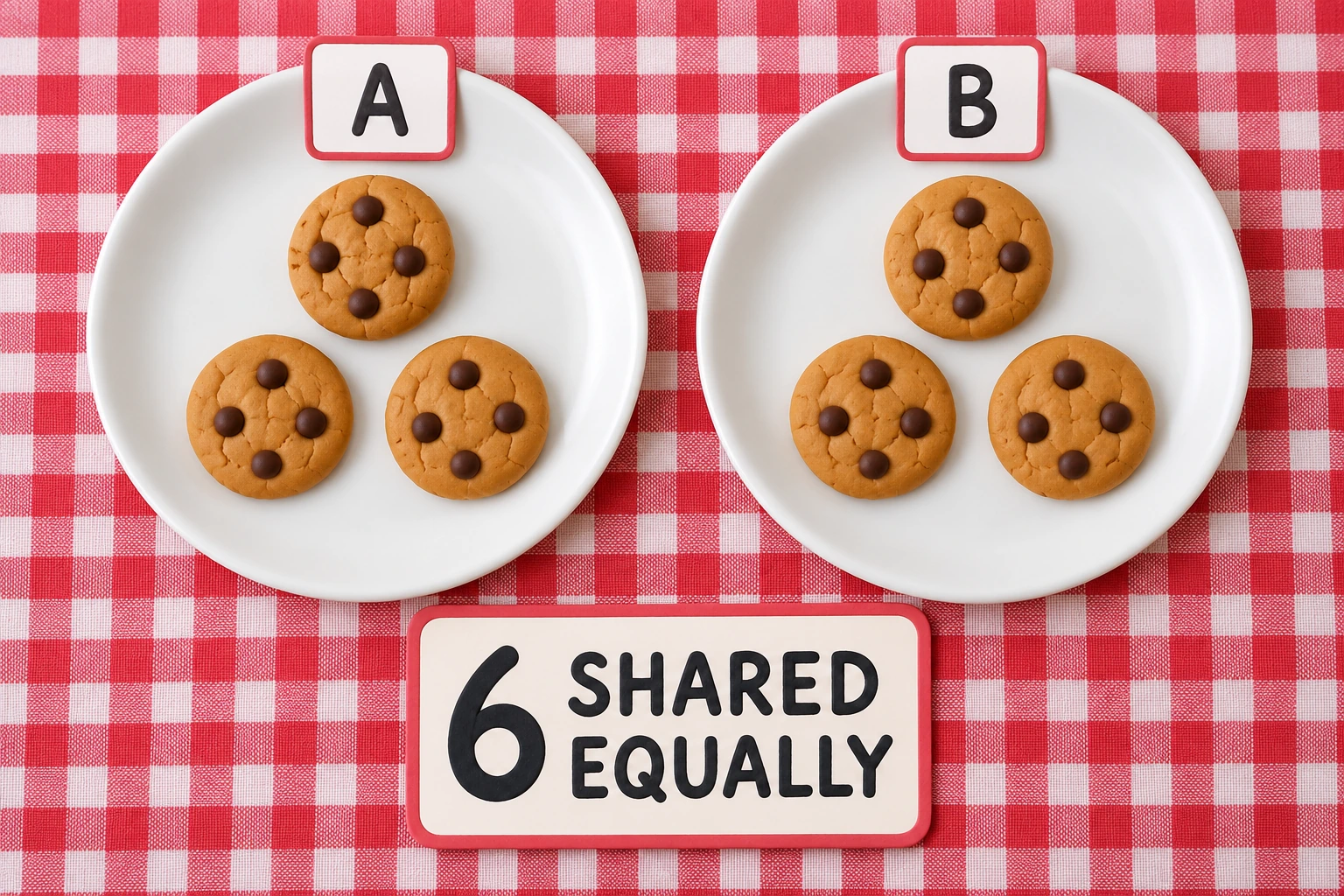
Picture Remy setting out six large counters with his older sister as a pretend picnic. They place two paper circles on the table for plates. Remy distributes the counters one at a time and notices that each plate ends with three.
His sister asks how many counters they used altogether. Remy gathers them back into a single group and counts six again. Returning to Equal Picnic Sharing, he draws three dots in each plate of the six-cookie row and compares the paper record with the counter arrangement.
This example gives a dot a meaning before it becomes a pencil mark. The real counters can be moved and reconsidered, while the source pictures keep the original total visible. There is no need to introduce halves of individual cookies: each pictured cookie remains a whole unit throughout these rows.
Six mathematical ideas the marks can reveal: Equal Picnic Sharing
Counting a collection once: Equal Picnic Sharing
Remy needs to establish the source amount without skipping or recounting a cookie. Touching each whole outline can support this step. An incorrect starting count can affect both plates even when the later dealing is carefully alternated.
Representing a unit with a symbol: Equal Picnic Sharing
In Equal Picnic Sharing, a dot carries the meaning of one cookie. The child does not have to draw a detailed baked treat. Notice whether that one-to-one connection stays consistent when the group becomes larger.
Tracking what has been distributed: Equal Picnic Sharing
Sharing involves remembering how many items remain available. A child may use alternating turns, temporary counters or a deliberate left-to-right source scan. Ask which method helps them avoid representing the same cookie twice.
Comparing two group quantities: Equal Picnic Sharing
Two plates can be checked through counting or pairing. Remy can show that neither has an extra dot. This turns the everyday idea of a fair share into something a partner can inspect on the paper.
Conserving the starting total: Equal Picnic Sharing
The combined plate record must still account for all the source cookies. Equal Picnic Sharing makes this check visible because the starting group remains printed beside the response. Equality alone does not establish that the original amount was shared.
Explaining a repair: Equal Picnic Sharing
If the child spots one extra mark, ask what change would restore the intended amount. A correction can be discussed as a revision to a representation. It does not need to erase the reasoning that led to the discovery.
A classroom conversation about an uneven picnic
For a hypothetical small group, a teacher uses four counters to make plates containing one and three. The class describes what is uneven and suggests moving a counter. They can check that the move changes the two group sizes while leaving the total at four.
After this demonstration, each learner approaches their own Equal Picnic Sharing sheet. The teacher asks for a plate count and a total count, listening for which condition the child checks first. A learner who has two matching groups but the wrong total needs different support from one who preserves the total but makes unequal shares.
Partners can exchange explanations after one row. One child points to the source cookies while the other counts the plate dots. Keep the role meaningful without turning the exchange into a race to finish all three groups. The printed plates are a record to discuss, not a measure of how quickly a child can make marks.
Five ways to extend the picnic idea
Reunite the shares
Use counters to make the two equal groups, then move them back together and count. This gives Remy a direct way to check the combined amount. Keep the count connected to the specific starting collection.
Repair one uneven arrangement: Equal Picnic Sharing
Set out six counters as two and four. Invite the child to move a counter so the groups match, then verify that six counters remain. Ask for the reason the repaired arrangement is fair in this two-plate game.
Match a dot card to a plate
Draw a small card showing three separated dots and ask Remy to make a plate with the same number of counters. A different layout is acceptable. The extension compares quantities rather than requiring a visual copy.
Make an adult's picnic order: Equal Picnic Sharing
Let Remy ask an adult to share four or eight counters across two pretend plates. The child checks the adult's finished result. Giving the checking role to the learner offers another reason to explain both equality and total.
Describe before drawing: Equal Picnic Sharing
On spare paper, plan a six-item sharing picture aloud before making marks. The adult can record the child's explanation in words beside the two groups. This is a separate extension; the source still requests its own dot responses.
Support counting without adding a new task
Many children around four to seven can explore Equal Picnic Sharing with an adult adapting the amount of support. Start with the four-cookie row and use movable counters if keeping track on paper is difficult. The larger rows can wait for another visit.
Common misunderstandings include counting chips, copying every cookie onto both plates, making equal groups with too many dots or treating a plate as space that must be covered. Return to the meaning of one dot and the fixed number of available cookies. Read the original instruction rather than adding formal division notation as a requirement.
A spoken explanation can clarify an unclear mark: Equal Picnic Sharing
Two touching dots may look like one, while a large dot can be mistaken for a coloured patch. Ask Remy what each mark represents before correcting the quantity. A clear counter demonstration can reveal understanding that is harder to see in a developing pencil record.
Revisit one row with a different check: Equal Picnic Sharing
On a later visit, ask Remy to verify a familiar row through pairing instead of recounting each plate separately, or by combining the groups after checking equality. A new explanation gives the repeated picture a purpose. Simply remembering “two, three, four” does not show how the shares relate to the source amounts.
Keep ordinary practice brief enough for the checking conversation to remain clear. The worksheet offers three amounts, so a single completed and explained row can be a useful stopping point. Return when the child is ready to account for another collection.
Choose the clean printable file
A member whose current plan grants eligibility can save the premium Equal Picnic Sharing single-page PDF. Website watermark and domain promotion have been removed, and the clean file carries no embedded advertising. The original supplied sheet remains a distinct sample option.
Check the portrait print preview for both complete plates beside every cookie group. Preserve the bottom row and all its response space. For more varied tasks, buy the $5 Little Explorers collection: its twenty-page clean PDF includes the cookie-sharing sheet among nineteen other concepts.
Follow quantity with another kind of thinking: Equal Picnic Sharing
After Equal Picnic Sharing, explore Garden Group Counting beside Equal Picnic Sharing, Toy Counting Zones after Equal Picnic Sharing, Picnic Group Sorting beyond Equal Picnic Sharing. Keep each new instruction separate from Equal Picnic Sharing.
Families can find conversational learning ideas through PBS Parents' resources for language during shared activities. For ways to give children's marks a meaningful audience, see NAEYC's family article about supporting writing at home. With Equal Picnic Sharing, discuss one dot for one cookie, the matching plate counts and the total that must remain unchanged.
Popular Worksheets
Printable resources families and teachers are downloading now.
 Free
 Free
 Free
 Free