
Size Workshop Choices: 4 Wonderful Comparison Rules
$5 collection companion: Size Workshop Choices. Change the comparison dimension between longest, shortest, tallest and smallest.
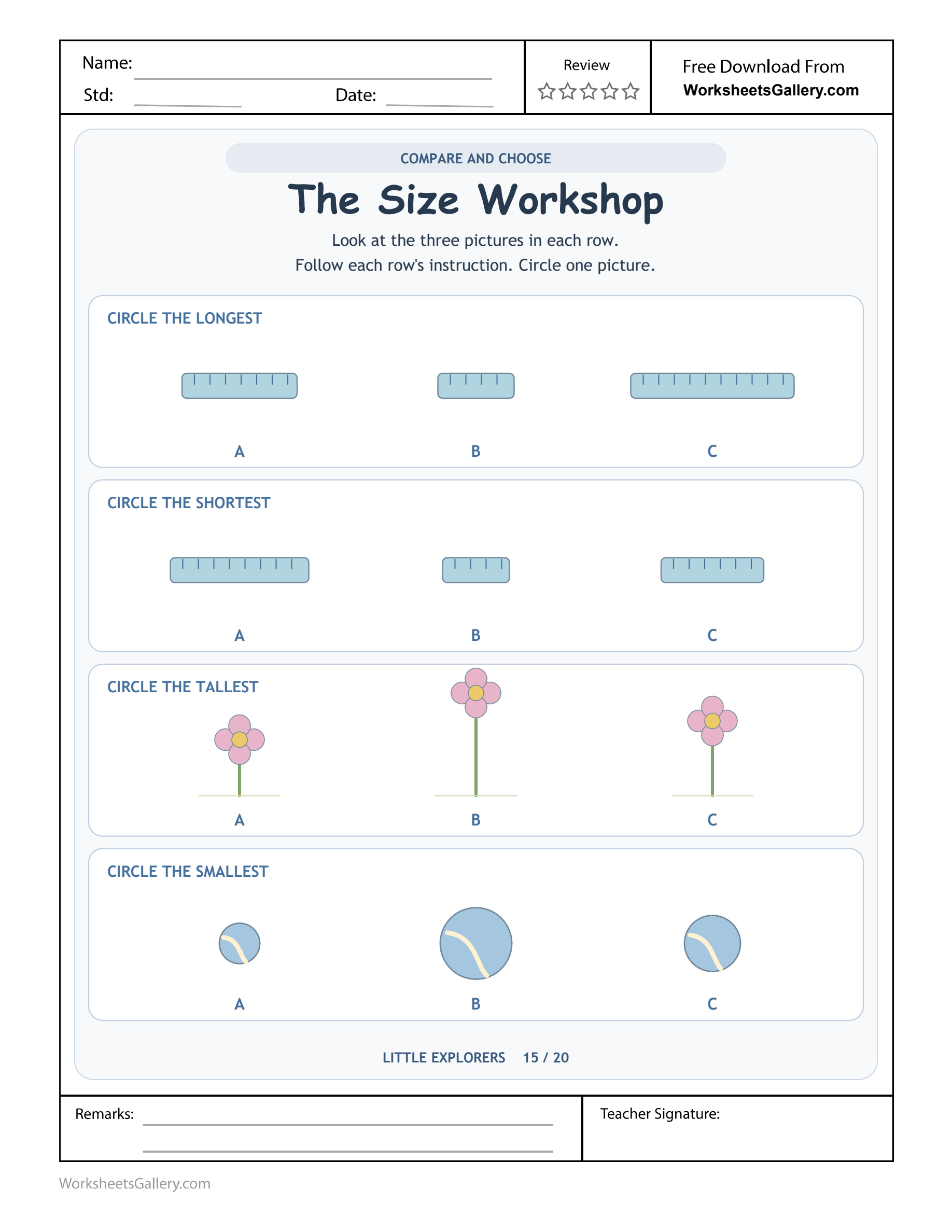
The longest ruler will not answer a question asking for the shortest one. Size Workshop Choices changes the comparison across four rows, using rulers, flowers and balls to explore length, height and overall size. Children inspect three labelled pictures in each group and circle the picture that fits the request. Read the instruction for every row before comparing its objects. This adult-supported activity gives a familiar word such as tall or small a specific visual meaning, while letting the learner explain which feature guided the decision.
Let the question choose what to compare — Size Workshop Choices
At first glance, Oona might treat Size Workshop Choices as a search for the largest picture on every line. That strategy fits neither the shortest-ruler row nor the smallest-ball row. Start by reading one instruction and asking which property it names. The relevant comparison changes even though the response format remains A, B or C.
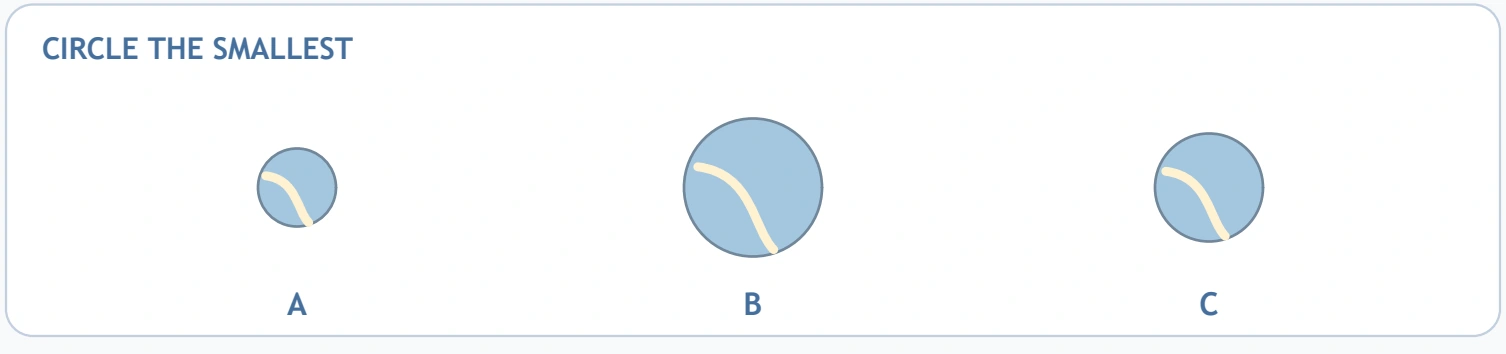
For the rulers, compare their end-to-end lengths. For the flowers, look at how high each reaches from its lower point. For the balls, compare the size of the round pictures. The child does not need to name a measurement unit or calculate a difference to make these visual comparisons.
A printed letter helps identify a picture: Size Workshop Choices
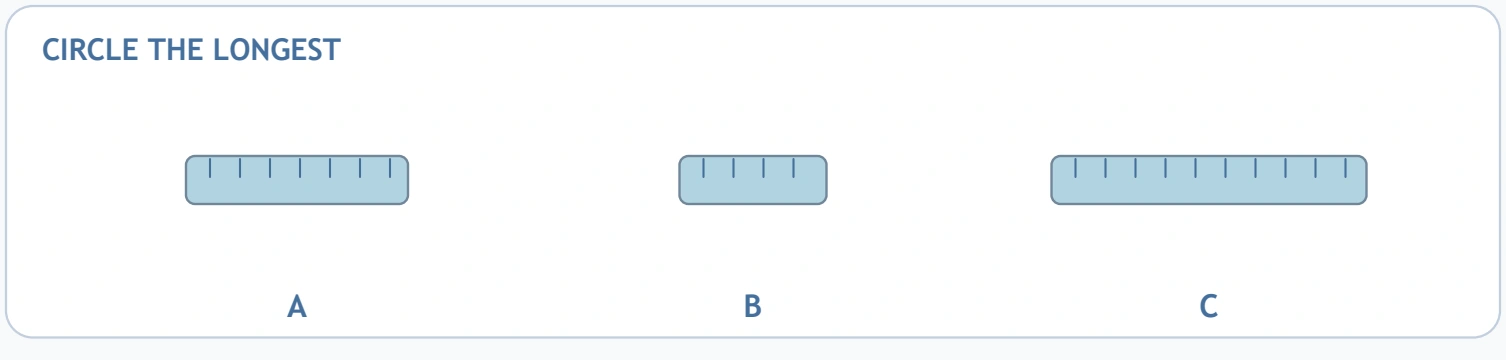
The letters identify positions within the current group. A is not always the smallest, and C is not automatically the correct answer. Ask Oona to point to her chosen object before circling that picture as instructed. The letter beneath it helps an adult identify which object the child's explanation concerns.
A four-row reference for an adult: Size Workshop Choices
| Requested comparison | Picture group | Source response |
|---|---|---|
| Longest | First ruler group | C |
| Shortest | Second ruler group | B |
| Tallest | Three flowers | B |
| Smallest | Three balls | A |
Keep this Size Workshop Choices answer reference for checking an explanation after the child has looked at the pictures. The table's letters identify the pictures to circle; reading C, B, B, A aloud first would remove the comparisons that give those circles a purpose. Each row asks for its own choice.
The ruler markings are not a calculation task: Size Workshop Choices
Although the ruler pictures suggest measuring tools, the instruction concerns their pictured lengths. No particular numeral on the drawing needs to be read as a measurement. Avoid turning a visual comparison into an additional arithmetic question unless that is an explicitly separate extension for a learner who wants it.
Notice the endpoints before deciding: Size Workshop Choices
For a length question in Size Workshop Choices, invite Oona to trace the imagined distance from one end of a ruler to the other with a finger. Compare the whole object rather than a single decorated section. If she points to a long-looking middle area, ask where that ruler actually begins and ends.
The flower row introduces a different direction. Height is judged vertically, with attention to each flower's lower point and top. The source's alignment helps the comparison; a broad blossom is not necessarily the tallest flower. Name the dimension the row asks about before using a general word such as bigger.
Smallest is a question about these balls
The last row compares round objects of visibly different sizes. Ask which ball takes up the least space in its group. Keep the answer anchored to those three pictures, rather than asking whether the child has seen a smaller real ball elsewhere. A relative word needs a comparison set.
A home workshop with ribbon offcuts: Size Workshop Choices
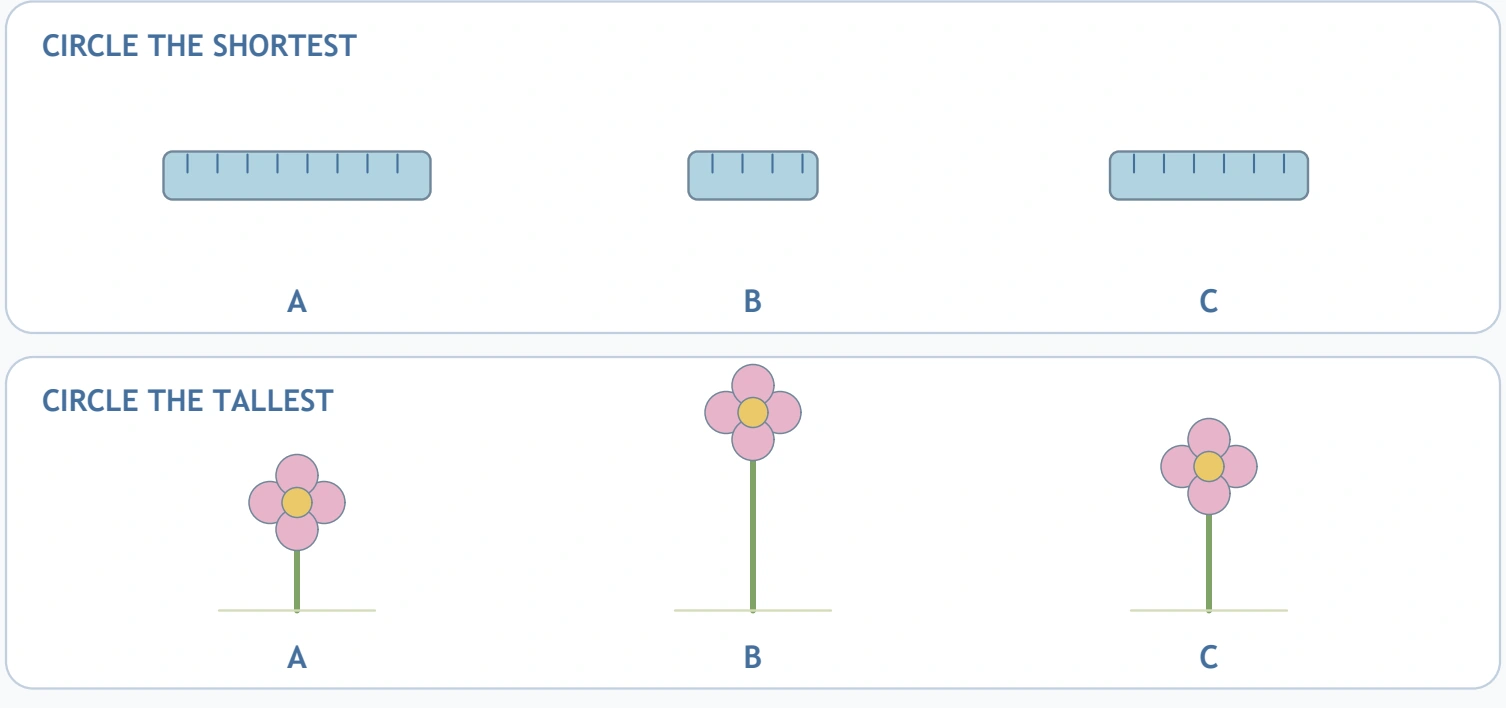
Imagine Oona and her grandfather laying three short ribbons flat on a table beside Size Workshop Choices. They line up one end of each ribbon so that the other ends can be compared. Oona chooses the longest, then listens as the request changes to shortest.
Her grandfather does not move the ribbons when he changes the question. This lets Oona notice that the objects stayed the same while the requested answer changed. They return to the worksheet's two ruler rows and read their separate instructions rather than carrying the first choice down the page.
When Oona later compares the flowers, she explains that they are being judged upwards. The adult can acknowledge this change of dimension without asking her to use a formal definition. Her gesture from the lower stem towards the blossom is meaningful evidence of what she compared.
Six useful observations beyond a selected picture: Size Workshop Choices
Responding to a comparison word
Size Workshop Choices makes it possible to notice whether Oona changes her decision when the request changes. Listening to longest and shortest is central to the two ruler questions. A repeated answer strategy may indicate that the instruction needs another reading.
Identifying the relevant dimension: Size Workshop Choices
Height and length are related everyday ideas, but the pictured task asks the learner to attend to a particular direction. A child who gestures along a ruler and up a stem is making that distinction visible. The explanation can be spoken, pointed or demonstrated.
Comparing a complete set: Size Workshop Choices
Looking at only A and B could miss C, even if one of the first two appears plausible. Encourage a brief inspection of all three candidates. This is an opportunity to discuss the whole group before committing to a letter.
Identifying the intended object clearly: Size Workshop Choices
The chosen picture should be clear within the child's circle. In Size Workshop Choices, neighbouring labels help adults discuss the options, but the source instruction is to circle one picture. Asking for a point can clarify the learner's intention without repeating the comparison for them.
Giving a reason another person can inspect
“Its end reaches farther” tells a listener more than “that one.” Invite an explanation connected to a visible feature. The adult need not insist on a long sentence when a finger movement and a short phrase communicate the same comparison.
Revising after a closer look
A child may change a response after noticing a ruler's full endpoint or rereading shortest. Treat the revision as a response to evidence. A clean final circle is useful, but the conversation about why it changed may be more informative.
Classroom partners compare reasons first
In a hypothetical maths station, one learner explains a Size Workshop Choices choice while a partner locates the object being described. The teacher asks which instruction was read and which part of the picture supports the answer. Partners can disagree about the selected letter while still sharing a way to inspect the row.
If one child chooses the widest flower, the teacher returns to tallest and invites both children to follow the flowers upwards. This gives the dimension a visible reference without simply announcing B. The children then decide whether their original choices still fit the actual request.
For a group that needs a gentler start, discuss one ruler row and the ball row on separate visits. Completing four rows quickly is less useful than understanding one comparison well enough to explain it. Children who find the page straightforward can offer a reason for ruling out each alternative.
Five small comparison activities to try afterwards: Size Workshop Choices
Change the request without moving the objects: Size Workshop Choices
Use three pencils of different lengths and ask first for the shortest, then for the longest. Keep the arrangement fixed so that the spoken request explains the changed answer. Let Oona give the next instruction to an adult.
Build a height display: Size Workshop Choices
Stand three block towers on the same tabletop and compare their tops. Discuss why a shared starting surface helps. A very wide tower can still be shorter than a narrow one, which makes the height question worth stating clearly.
Find a size pair in a drawing
Draw two circles on spare paper and ask the child to add a third that is smaller than both. This extends the comparison into making an example. The new drawing can be discussed separately from the worksheet's fixed answer group.
Be an endpoint reporter: Size Workshop Choices
Lay a strip of paper beside a ribbon and describe where each begins and ends. Oona can point while another person listens. The purpose is to make the comparison understandable, without introducing ruler units or requiring written measurements.
Sort a mixed collection by one rule
Choose safe classroom objects that can be compared for length, then state that rule before arranging them. Afterwards ask whether the order would necessarily be the same for height. It is acceptable to choose a simpler set when the mixed shapes make the new question unclear.
When a plausible answer misses the row's question: Size Workshop Choices
The most common mix-up in Size Workshop Choices is carrying a previous comparison word into a new group. Point back to the current instruction and read it together. A child can have compared the objects carefully while answering the wrong question.
Other difficulties include judging a flower by blossom width, choosing before looking at all three pictures or placing a circle around a neighbouring object. Use the child's explanation to identify which step needs support. Announcing a choice alone will not show whether the underlying comparison became clearer.
Keep the language accessible: Size Workshop Choices
Adult-supported use suits many learners around four to six. Demonstrate long and short with familiar objects if those words are new, then reconnect them to the printed question. A child who understands the spoken comparison can point first and practise a deliberate circle afterwards.
Return with a different comparison in mind: Size Workshop Choices
On another day, invite Oona to explain why the answer to one row would change if its instruction asked for the opposite comparison. Keep this discussion distinct from filling in the original source. The printed task still asks its own four specific questions.
A short return can focus on one dimension, such as flower height, rather than repeating C, B, B, A from memory. Familiarity with the labels should not replace a fresh inspection of the pictures. Ask for the feature that supports the decision on this visit.
Download a complete set of comparison pictures: Size Workshop Choices
Download the clean Size Workshop Choices printable when your active member plan grants access. This premium sheet omits the domain promotion and website watermark; embedded advertising is absent as well. A separate original sample remains available in the file choices.
Print the complete portrait sheet with all three labels visible in every row. Check that the bottom ball group and its instruction have not been clipped by the printer preview. This page is also included in the related Little Explorers twenty-page clean collection, offered as a separate $5 purchase.
Extend the conversation through other tasks: Size Workshop Choices
After Size Workshop Choices, explore Drawing Size Choices beside Size Workshop Choices, Fruit Half Matching after Size Workshop Choices, Patchwork Tile Logic beyond Size Workshop Choices. Keep each new instruction separate from Size Workshop Choices.
For family learning ideas, visit PBS Parents' literacy activities built around everyday conversation. NAEYC's guidance on early expression and writing at home offers another way to give a child's explanation an audience. In Size Workshop Choices, keep the requested dimension, the complete comparison group and the picture-to-letter connection in view.
Popular Worksheets
Printable resources families and teachers are downloading now.
 Free
 Free
 Free
 Free