
Train Pattern Tickets: 4 Amazing Next-Picture Checks
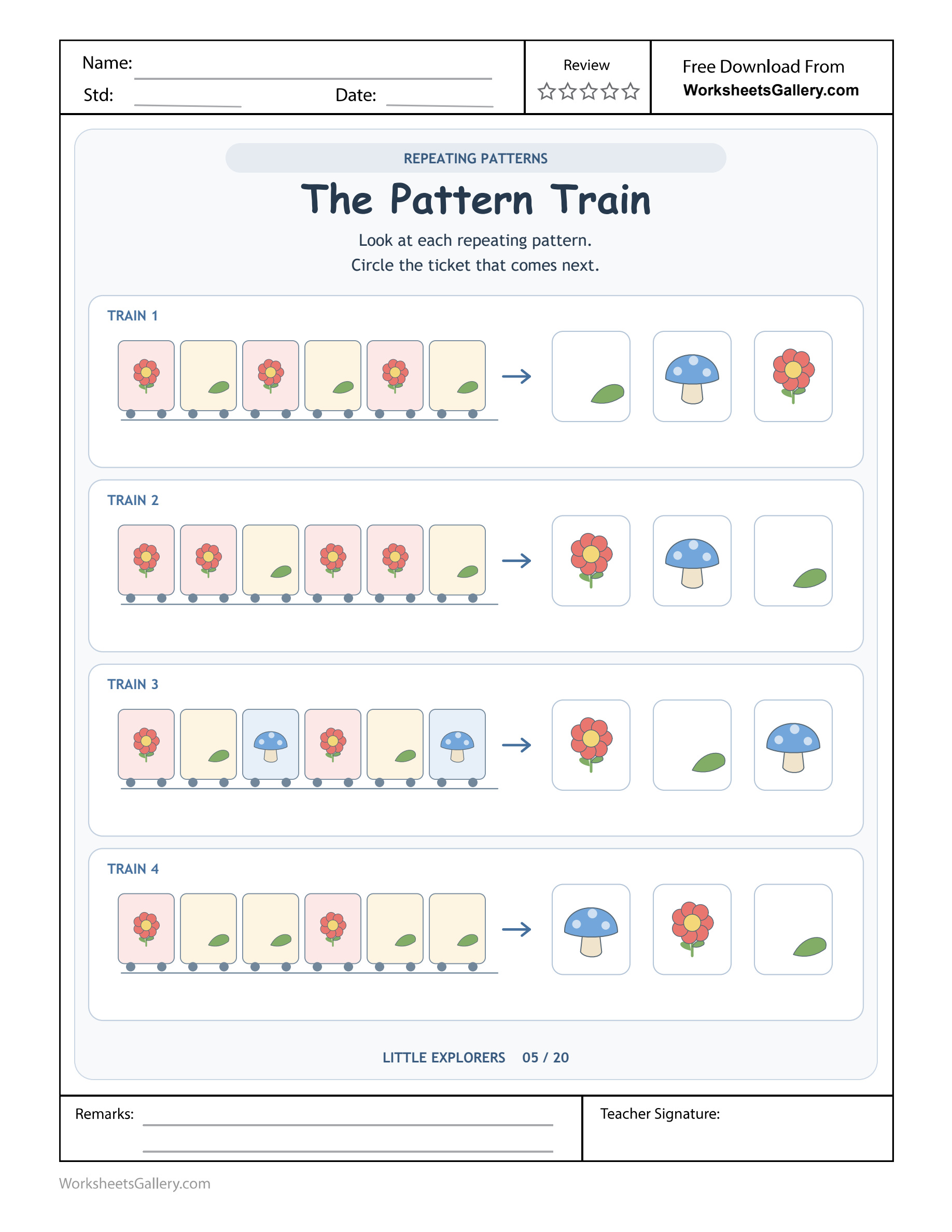
$5 collection companion: Train Pattern Tickets. Explain four different repeating units even though every next picture is a flower.
Every train needs a flower next, yet the reason changes from row to row. That small surprise makes Train Pattern Tickets more interesting than a quick picture guess. Children inspect four repeating arrangements and circle the ticket that continues each one. Flowers, leaves and mushrooms supply familiar visual material, while the repeated unit supplies the evidence. This printable suits adult-supported early maths conversations in preschool or kindergarten. Ask how the pictures repeat before looking at the answer choices, and leave time for a child to explain why two rows can lead to the same next picture.
Ask the question before offering the tickets — Train Pattern Tickets
Cover the three choices at the end of one row temporarily and inspect the six picture cars. In Train Pattern Tickets, the repeated arrangement determines what should follow. An attractive ticket is not evidence by itself. Ask Etta to say the pictures aloud or point to a group that begins again.
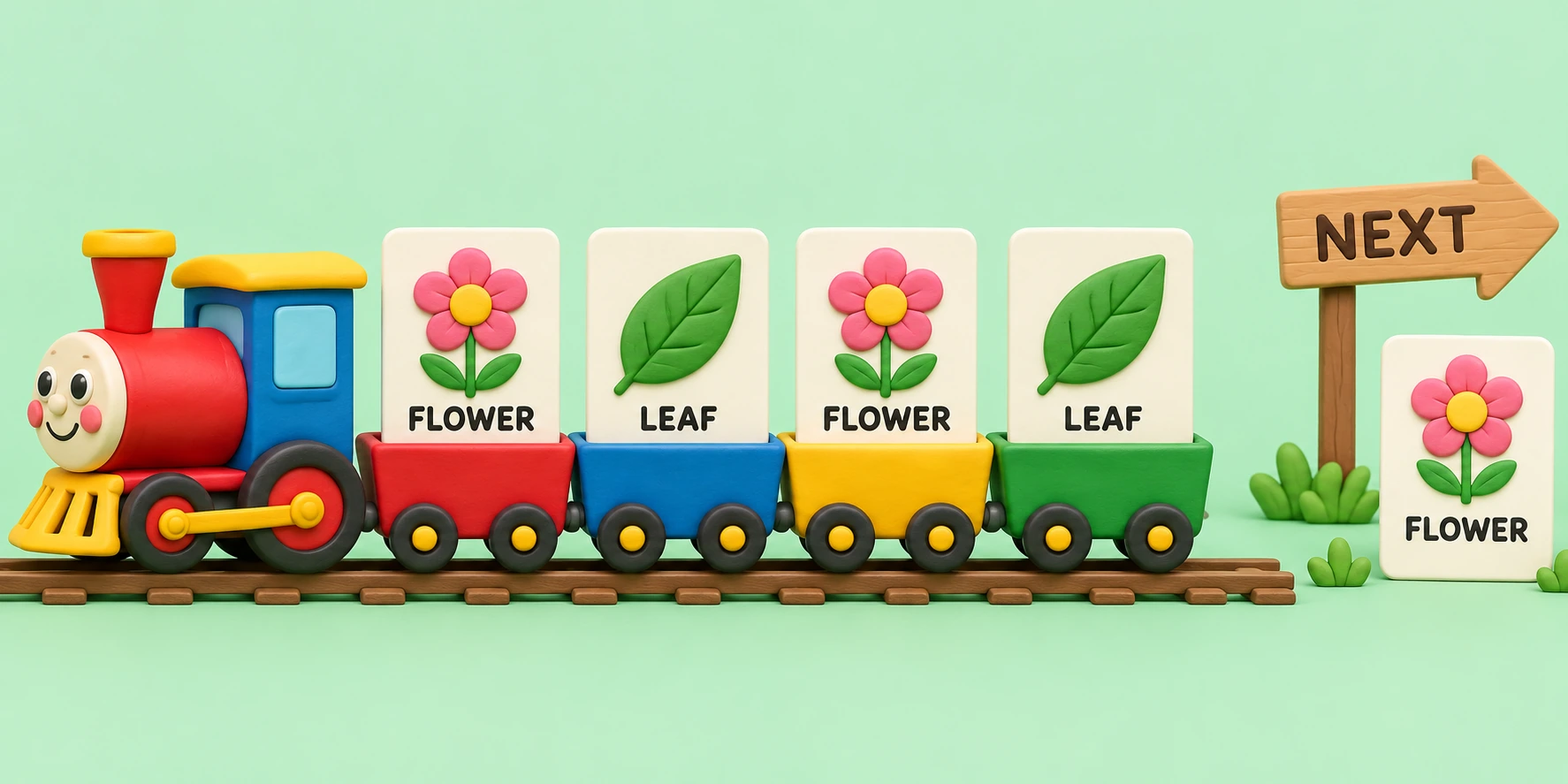
The first row alternates flower and leaf. Its six cars can be heard as flower-leaf, flower-leaf, flower-leaf. Once Etta has identified that unit, the next flower has a reason: another copy of the same pair is beginning. Revealing the three tickets afterwards lets her check a prediction against the available pictures.
This approach also works for the three longer units in Train Pattern Tickets. Keep the task about the pictured sequence rather than the colours of the carriages or which ticket sits nearest the arrow. The source asks for the next picture, and the choice positions vary across its four trains.
Four trains, four explanations
| Source row | Smallest repeating picture group | Next ticket |
|---|---|---|
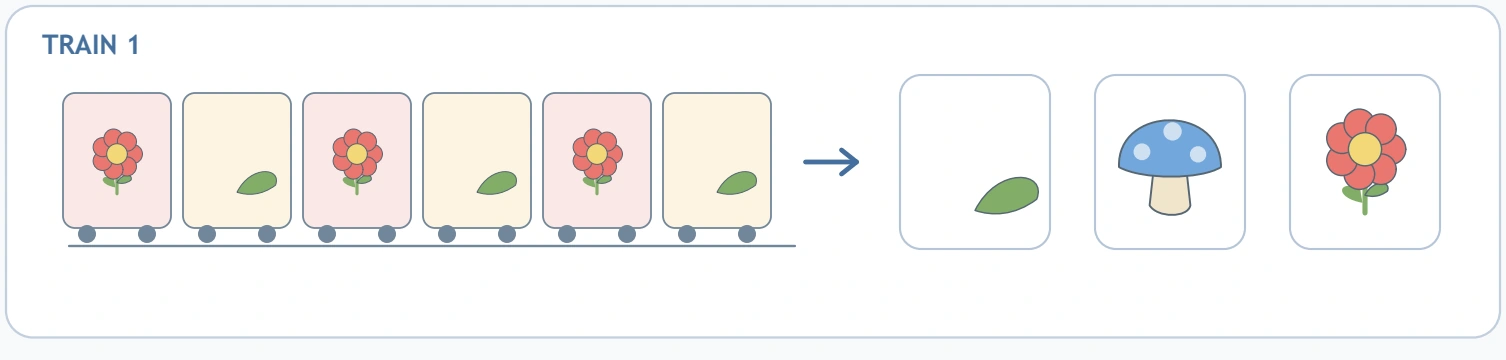
| Train 1 | Flower, leaf | Flower, choice 3 |
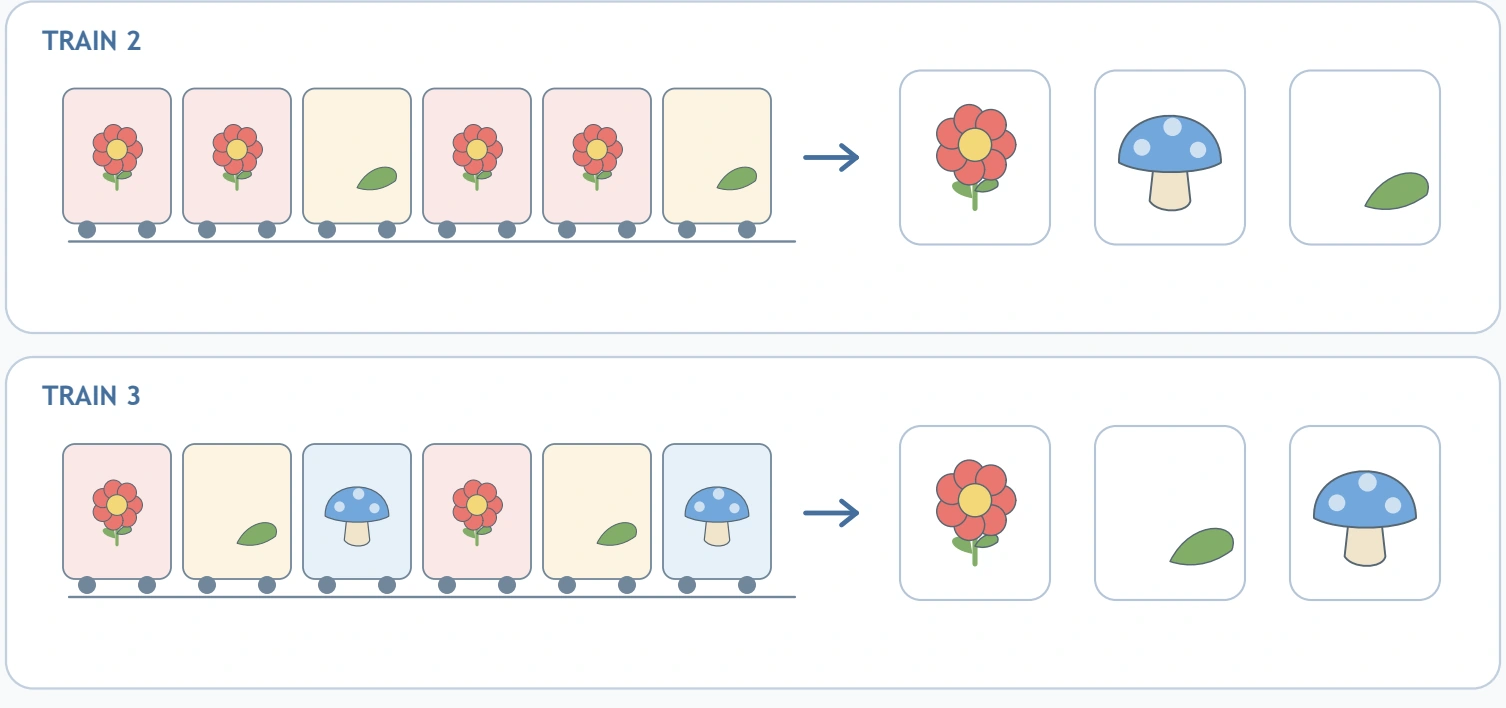
| Train 2 | Flower, flower, leaf | Flower, choice 1 |
| Train 3 | Flower, leaf, mushroom | Flower, choice 1 |
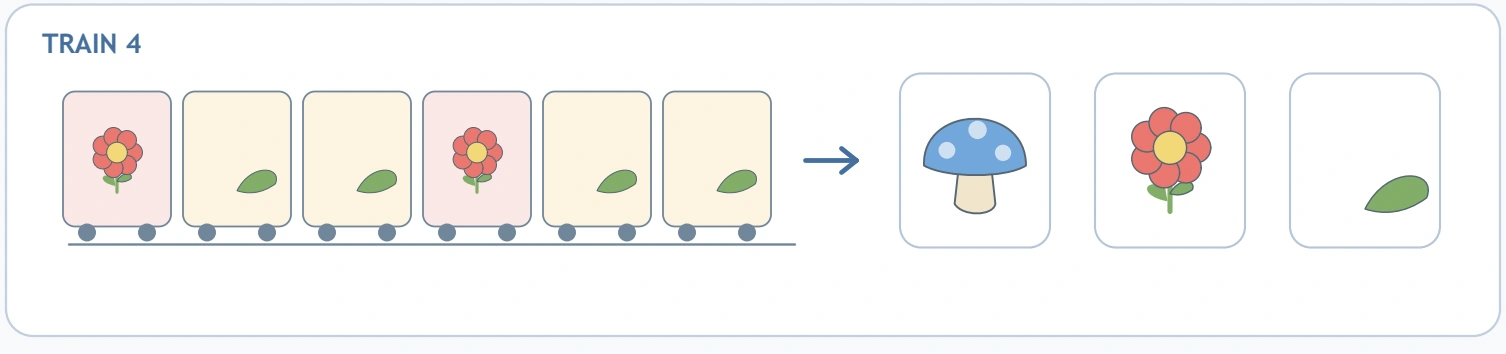
| Train 4 | Flower, leaf, leaf | Flower, choice 2 |
Use this Train Pattern Tickets table as an adult checking reference after the learner has investigated a row. The first train repeats a two-picture unit three times. Each other train repeats a three-picture unit twice. All four displayed arrangements end at a unit boundary, so another flower begins the following unit.
The second flower in Train 2 matters
Flower-flower-leaf is not the same unit as flower-leaf. A child who skips the repeated flower while naming the cars can accidentally impose the first row's rule on the second. Point to each pictured car as it is named. The two adjacent flowers are two sequence positions, even though their identities match.
A mushroom changes the third train's rhythm
Train 3 introduces a third picture type. Compare flower-leaf-mushroom with flower-leaf-leaf in Train 4. The units share their opening pictures but differ at the last position. Train Pattern Tickets is an opportunity to discuss that distinction instead of treating every three-car group as the same pattern.
A home investigation with homemade tickets: Train Pattern Tickets
Imagine Etta laying three quick picture cards beside Train Pattern Tickets: one flower, one leaf and one mushroom. Her parent asks which card would follow the first train before uncovering the printed choices. Etta selects a flower and explains where she hears the pair begin again.
For Train 2, the parent leaves the first row available but asks Etta to inspect the new cars carefully. She notices the adjacent flowers and points through all six positions. If she initially predicts a leaf, the adult asks her to show the unit she is repeating rather than immediately replacing her card.
After checking the printed ticket, Etta can use the homemade cards to extend a new unit. The household cards are additional play material; the source sheet still requires one circled picture per train. A short explanation for two trains can be enough for one visit, leaving a clear reason to return to the remaining rows later.
A classroom station with an explainer and a listener: Train Pattern Tickets
In a hypothetical early maths station, partners take turns choosing a Train Pattern Tickets row. The explainer names its repeating group. The listener points to where a second copy of that group starts and checks that the spoken rule accounts for every displayed car.
Only then do they discuss the next ticket. This gives the listener a concrete checking job rather than a chance to call out the answer first. An adult might notice that a learner can identify flower-leaf-mushroom orally but needs pointing support to keep track of the six printed positions.
Allow different ways to express the same unit. A child can name the pictures, tap once per car or describe “two flowers, then a leaf.” The explanation should remain connected to the sequence. Letter codes such as AB or AAB are optional adult shorthand, not additional symbols the child must write on this page.
Six mathematical habits to watch
Seeing a group instead of isolated pictures: Train Pattern Tickets
Train Pattern Tickets invites a child to regard two or three cars as a unit that can recur. Ask which pictures belong together before the same arrangement starts again. This is a different observation from simply naming all six pictures correctly.
Keeping one position for each item: Train Pattern Tickets
The double flower in Train 2 can reveal whether Etta points once per car. Naming two identical pictures as one would change the unit. Matching a spoken name with each position gives her prediction a more reliable foundation.
Holding a rule long enough to check it: Train Pattern Tickets
A proposed repeat should account for the entire row. Train Pattern Tickets lets the adult ask where the next copy starts, then inspect whether the following pictures agree. A plausible opening alone does not prove that the whole train follows the guessed unit.
Comparing related structures: Train Pattern Tickets
Train 3 and Train 4 both use three positions per unit, but their third pictures differ. A child can explain the shared length and the different content without being required to learn formal pattern notation first.
Giving a reason for an answer
Since every next picture is a flower, Train Pattern Tickets makes it especially useful to hear more than a named ticket. “The group starts again here” connects the answer with the display. A correct guess and a checked continuation are different kinds of evidence.
Recording one intended choice: Train Pattern Tickets
The child circles the next-picture option, not every flower already printed on the train. A loose circle can communicate the choice. Keep the mathematical reasoning separate from the size or smoothness of the pencil mark.
What to do when “flower again” becomes a shortcut: Train Pattern Tickets
If Etta realises that all four answers are flowers, acknowledge the observation. It is true. Then ask a new question: why does a flower belong after each particular sequence? The purpose of Train Pattern Tickets is not to hide a repeated answer through adult tricks, but to inspect the rules that support it.
One useful extension is to ask what would follow that next flower. Train 1 would then need a leaf; Train 2 would need another flower. Those predictions separate the two rules even though their first next answers agree. Label this as an extra spoken investigation beyond the printed single-ticket response.
Avoid copying an answer position
The flower appears in choice positions 3, 1, 1 and 2 across the four rows. A child should inspect the picture choices anew. The earlier ticket's location does not establish where the next row's answer will be.
Four off-page pattern experiments: Train Pattern Tickets
A carriage clap
Use two distinct gentle actions, such as clap and tap, to make a repeating pair. After several copies, pause and ask which action belongs next. Relate the repeating group to the first train only after the child has described the action sequence.
Two kinds of three: Train Pattern Tickets
Arrange block-block-button and block-button-button on separate strips. Invite a partner to extend each strip. Discuss why both groups contain three positions but cannot be substituted for one another without changing the sequence.
A ticket printer's correction
Make a short picture train with one deliberate error. Ask the child whether the proposed repeated unit explains every car. Let them replace one card and demonstrate the repaired arrangement. This shifts the focus from guessing a next item to checking a whole rule.
Start halfway through a unit
With loose cards, show a pattern that begins at a different point in the repeating cycle. Ask what comes next and listen to how the child groups it. Keep this as a separate challenge inspired by Train Pattern Tickets; the printed rows themselves begin with flowers and have their own clear arrangements.
Matching the challenge to the learner: Train Pattern Tickets
Train Pattern Tickets can suit supported children around four to six who are ready to inspect a short pictured sequence. Begin with the alternating pair if three-picture units feel crowded. An adult can name unfamiliar drawings, point once per car or let the child move a counter along the row before choosing a ticket.
Watch for skipping adjacent identical pictures, following carriage colours instead of the pictured objects, circling a train car instead of an option, or carrying Train 1's rule into another row. Return to the particular displayed arrangement. A shorter inspection with a clear explanation can be more useful than finishing all four through guesses.
To encourage another visit, invite Etta to choose which train she wants to explain to a toy passenger. She might remember an answer already, so ask how the cars prove it. Make room for a pause when the explanation stops being playful. Recognising and discussing a repeat is the point, rather than accumulating completed pages.
Download a clear train-and-ticket page: Train Pattern Tickets
An eligible current membership unlocks the clean Train Pattern Tickets PDF through the premium option. This printable retains the four trains without website watermark or domain branding, and advertising is not embedded. The uploaded original has its own separate sample control.
Before printing, examine all six cars and the three options in each portrait row. The rightmost tickets must remain inside the paper boundary. The $5 Little Explorers collection also contains this activity in its twenty-page clean PDF, available from the related purchase page when one combined file is preferred.
Related changes of rule: Train Pattern Tickets
After Train Pattern Tickets, explore Picnic Fruit Patterns beside Train Pattern Tickets, Space Pattern Choices after Train Pattern Tickets, Number Neighbour Trail beyond Train Pattern Tickets. Keep each new instruction separate from Train Pattern Tickets.
For adult-supported conversation alongside picture work, browse NAEYC's family resource on meaningful early marks and PBS Parents suggestions for speaking and reading together. Keep Train Pattern Tickets grounded in a repeated unit, a checked prediction and a reason the child can show with the actual cars.
Popular Worksheets
Printable resources families and teachers are downloading now.
 Free
 Free
 Free
 Free