
Toy Counting Zones: 6 Clever Totals Inside Two Boxes
Save the two toy zones with the rest of the selection. A single clean PDF holds all 25 uploaded puzzles for $5. Keep this boundary-counting page in the collection so another visual or word-based activity is ready when counting is done.
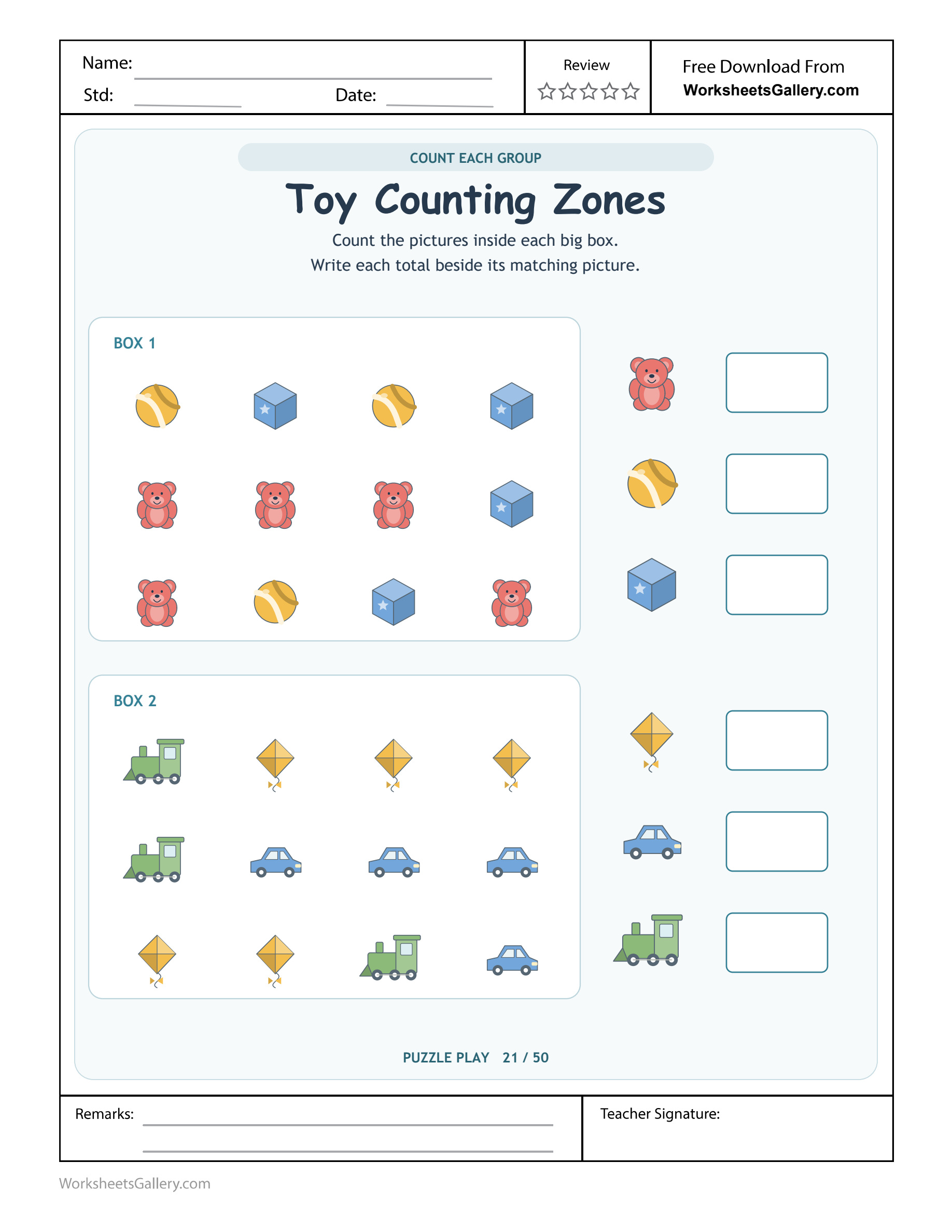
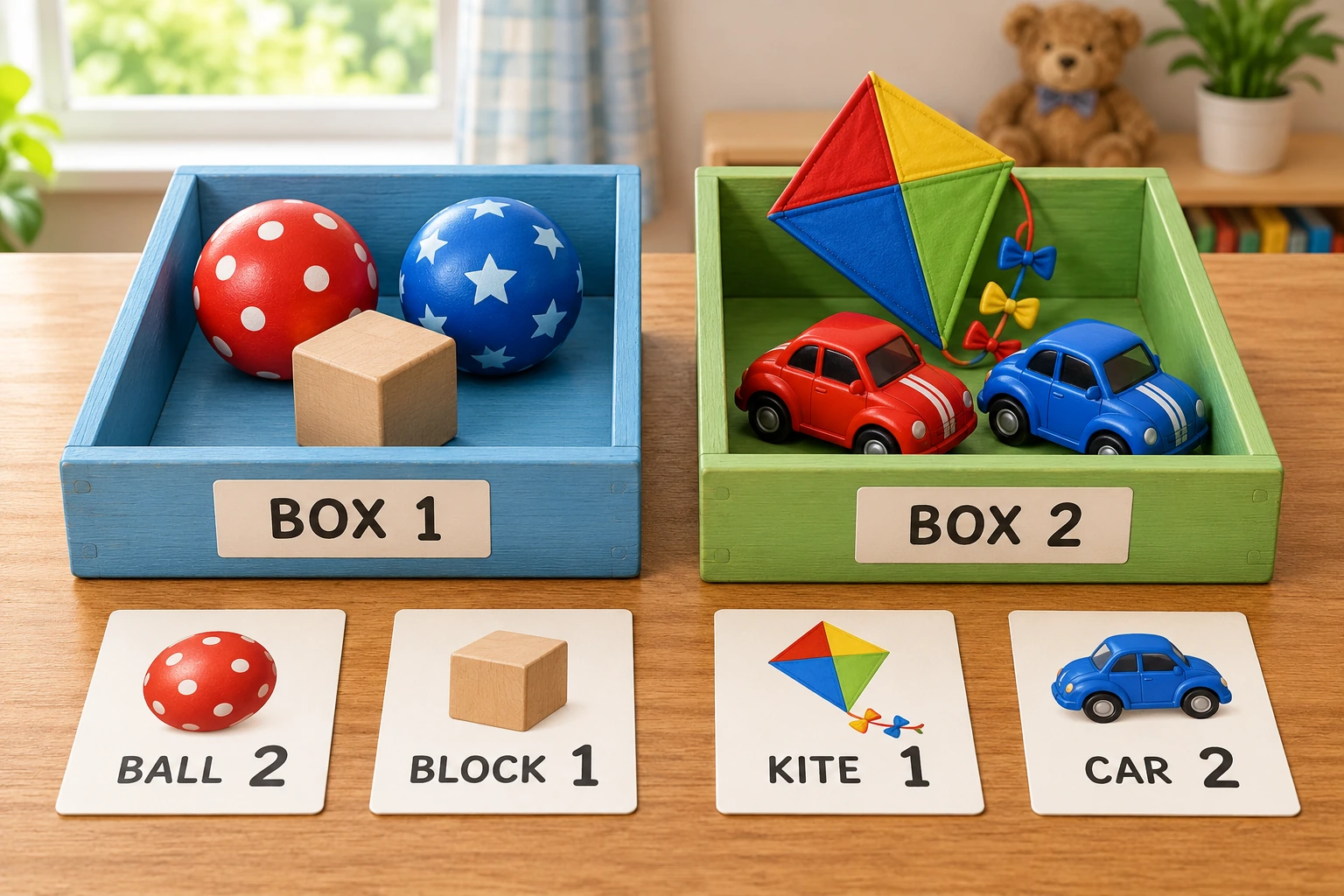
Two big boxes make two separate toy collections, even though all their pictures share one page. Toy Counting Zones asks children to respect those boundaries while counting each toy type and recording six answers. The upper group contains teddy bears, balls and blocks; the lower group uses kites, cars and trains. Reference pictures beside the response slots name the targets without enlarging either collection. Begin by identifying a box and one toy, then keep the count inside that enclosure until its total has been checked.
Toy Counting Zones: the rule on this particular sheet
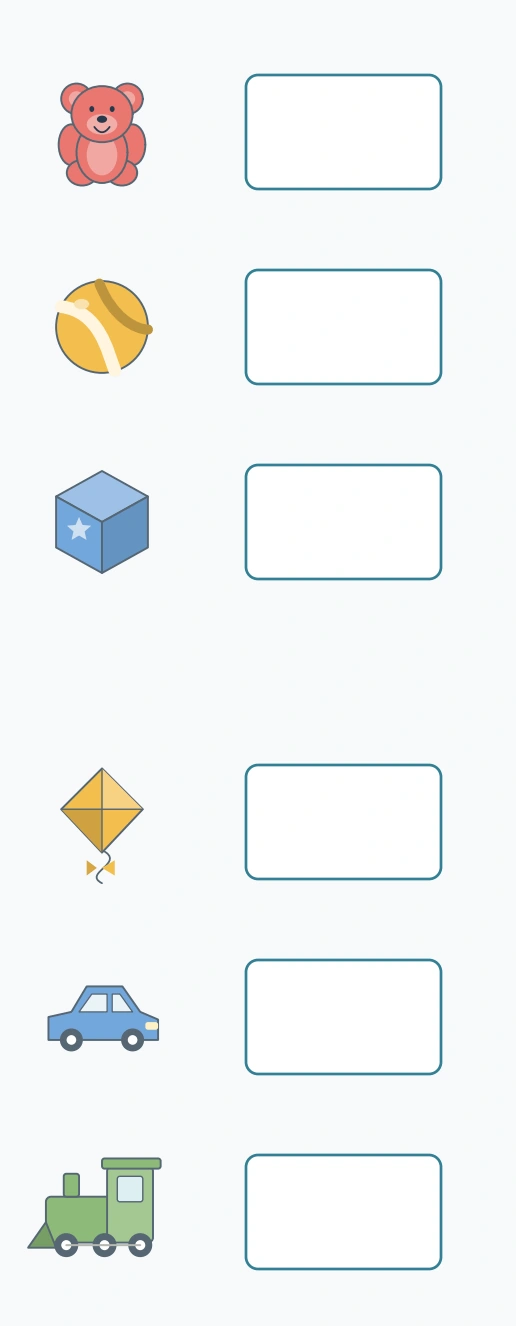
Two separate big boxes each contain twelve toy pictures. Box 1 holds teddy, ball and block; Box 2 holds kite, car and train. Six reference images and answer boxes sit outside the collections.
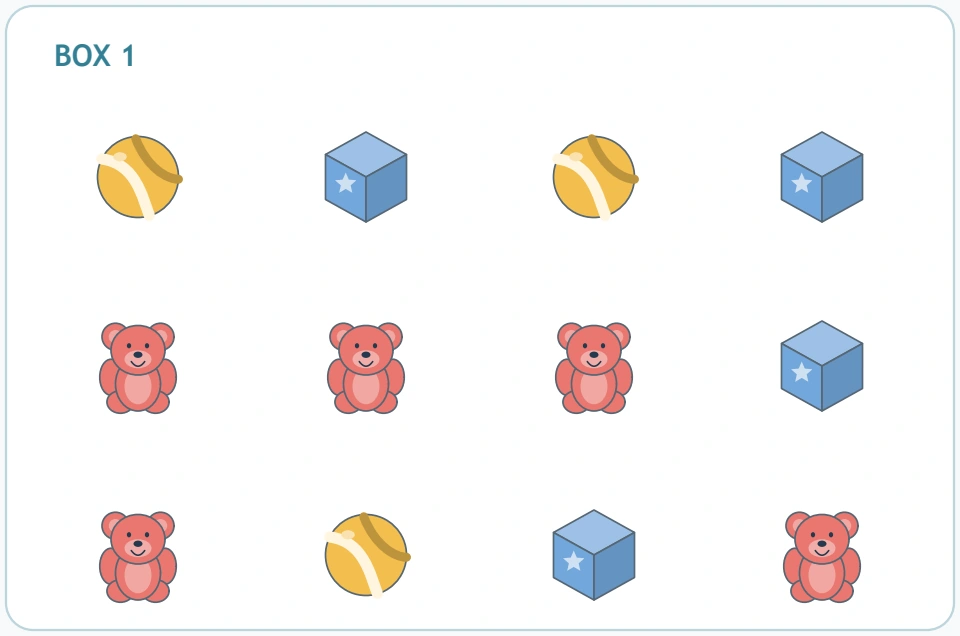
Inside Box 1, count five teddies, three balls and four blocks. Those quantities add to its twelve field objects, but the sheet asks for each toy category separately rather than one undifferentiated total.
What box 2 kite reveals
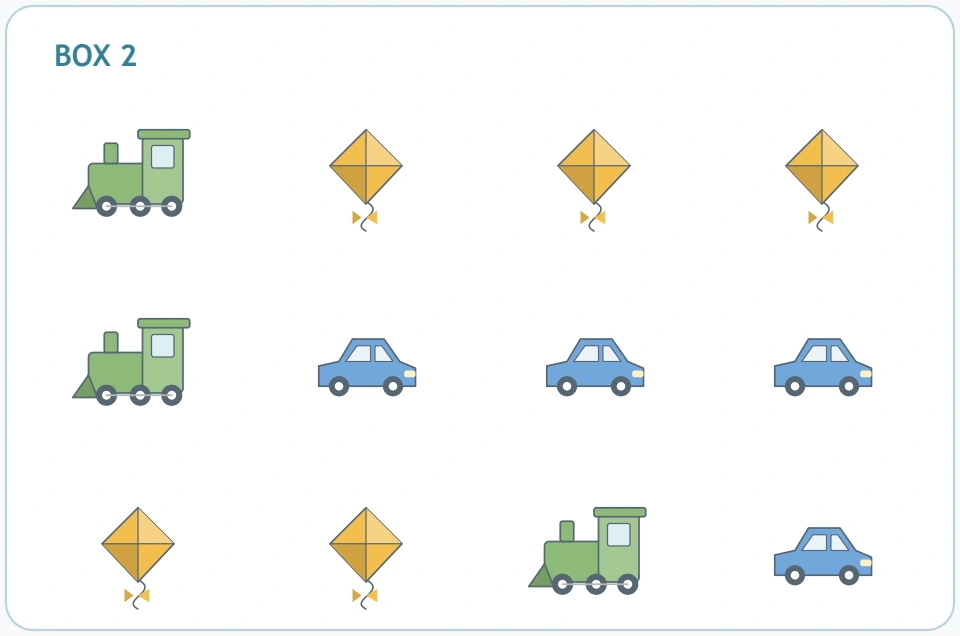
Box 2 contains five kites, four cars and three trains. Keep the count inside that lower boundary and match each result to its own reference picture. A reference toy beside a response box is not another counted object.
The two zones keep different collections separate. Look for the BOX 1 or BOX 2 label before beginning, and name the toy category again when moving from the field to the appropriate answer slot.
A practical Toy Counting Zones sequence
Box 1 teddy with Nia
Begin Toy Counting Zones: box 1 teddy. There are 5 teddies inside the upper collection. Ask Nia, “Is this toy inside our current box?” The father and Nia can inspect box 1 teddy together.
Box 1 others with Nia
Next inspect Toy Counting Zones: box 1 others. The upper box has 3 balls and 4 blocks. Ask Nia, “Which toy are we counting now?” The father and Nia can inspect box 1 others together.
Box 2 kite with Nia
Then confirm Toy Counting Zones: box 2 kite. The lower collection contains 5 kites. Ask Nia, “Where is the kite answer box?” The father and Nia can inspect box 2 kite together.
Box 2 vehicles with Nia
Finally record Toy Counting Zones: box 2 vehicles. Record 4 cars and 3 trains in their own slots. Ask Nia, “Have we moved to BOX 2?” The father and Nia can inspect box 2 vehicles together.
Toy Counting Zones adult reference
| Printed clue | Source check |
|---|---|
| Box 1 teddy | There are 5 teddies inside the upper collection. |
| Box 1 others | The upper box has 3 balls and 4 blocks. |
| Box 2 kite | The lower collection contains 5 kites. |
| Box 2 vehicles | Record 4 cars and 3 trains in their own slots. |
A box edge defines membership
Follow the upper boundary with a fingertip and name the toys enclosed there. Then point to a reference image outside that boundary. The reference identifies an answer slot but is not another member of the toy group. Making that spatial distinction explicit can resolve a count that is consistently one too large without changing the child’s ability to recognise the toys.
Classroom partners inspect box 1 others
One partner counts a category in Box 1 while another identifies its answer key. They change roles for Box 2, announcing the new boundary and target before starting so a previous count does not drift into the next zone. For a Toy Counting Zones partner visit, category counting is this toy counting zones partnership focus.
Keep category and zone together
A useful request names both the target and its location: balls in BOX 1 or cars in BOX 2. The child then knows which collection and which identity control the count. This is more precise than asking how many toys, which could reasonably invite a combined total. Repeat the target-zone pair when partners exchange counting and recording roles.
Toy Counting Zones: box 2 kite mistakes
A child may combine objects across both boxes or add the reference symbol to a zone total. Re-establish the big-box boundary and the current toy category before recounting. A correctly counted numeral still needs the matching reference slot. Invite Nia to discuss box 2 kite with the father.
6 observations in Toy Counting Zones
Set boundaries: Is this toy inside our current box
Here, a visible box defines which objects belong in the collection. The prompt “Is this toy inside our current box?” gives Nia a way to explain set boundaries to the father.
Category counting: Which toy are we counting now
Here, mixed toys still need separate verified totals. The prompt “Which toy are we counting now?” gives Nia a way to explain category counting to the father.
Reference matching: Where is the teddy answer box
Here, a key picture identifies the intended answer slot. The prompt “Where is the teddy answer box?” gives Nia a way to explain reference matching to the father.
Switching zones: Have we moved to BOX 2
Here, a new box begins a separate counting task. The prompt “Have we moved to BOX 2?” gives Nia a way to explain switching zones to the father.
One-to-one attention: Which block is next in our scan
Here, each selected toy receives one count. The prompt “Which block is next in our scan?” gives Nia a way to explain one-to-one attention to the father.
Checking a record: Does this number describe these toys
In Toy Counting Zones, a numeral can be compared with its enclosed group. The prompt “Does this number describe these toys?” gives Nia a way to explain checking a record to the father.
Five play invitations after Toy Counting Zones
Build two labelled toy boxes
Use a small box with two balls and one block, and another with one kite and two cars. Complete the labels before comparing the separate counts. After this Toy Counting Zones play round, ask the father which clue Nia chose to explain.
Trace the collection edge
Place counters inside a shallow tray and a reference picture outside. Follow the tray edge and explain why the key picture does not enlarge the counted set. Let Nia demonstrate this example before another Toy Counting Zones visit; ask the father to listen for Nia’s reasoning.
Send a box-specific order
A partner requests the car count from BOX 2. The counter repeats both the zone and category before inspecting the objects, avoiding a vague request for how many toys. On a later Toy Counting Zones visit, ask Nia what changed; the father can discuss Nia’s evidence.
Move one toy across the border
In a separate physical example, move a counter from one labelled box to another. Recount the affected collections and describe why the boundary change alters their membership. Ask Nia how this example relates to Toy Counting Zones; the father can follow the clue that Nia identifies.
Audit the toy-key delivery
Write a checked ball total on a loose numeral card. Ask a child to place it beside the ball reference rather than the nearest empty answer space. Keep Nia’s own explanation central in this Toy Counting Zones game. Let the father hear what Nia observed.
Check the correct number in the correct slot
After counting five teddies, find the teddy reference and its associated numeral space. For Toy Counting Zones, A correct quantity placed beside the ball image communicates the wrong result. Let the child identify the recording destination before writing, using the picture key as a guide. This separates counting evidence from the later task of representing it in the intended location.
Imagine Nia at a home puzzle table
Nia counts a ball beside an answer box as though it were inside the collection. Her father follows the big-box edge with a finger, then asks which balls are actually enclosed. The boundary gives a concrete reason for excluding the reference picture. Here, Toy Counting Zones gives Nia a reason to discuss set boundaries using the Toy Counting Zones clues.
Physical movement can explain the boundary rule
In a separate two-box example, move one toy from the upper box to the lower one. Ask which collection has changed and recount the affected toy types. The printed worksheet itself remains unaltered, but the physical example makes set membership tangible. Return to its fixed boundaries afterward and count the supplied pictures according to where they actually appear.
A fresh Toy Counting Zones reason to return
Revisit a single box and ask the child to explain what its boundary excludes. Then verify one category, keeping the new visit short and purposeful. Nia can show the father a new box 2 vehicles observation during that short toy counting zones visit.
Readiness for Toy Counting Zones at ages 4–6
Work on one toy type within one box before introducing the next. Pointing and spoken counting can remain independent while an adult helps locate or write in the correct answer slot. Suggested range for Toy Counting Zones: ages 4–6. Begin with set boundaries and adult support.
For a comfortable Toy Counting Zones visit, let Nia show box 1 teddy before the father requests another response. Discuss one-to-one attention using the printed Toy Counting Zones example.
Save a printable Toy Counting Zones copy
For this toy-box activity, a qualifying active membership unlocks the clean Toy Counting Zones premium PDF. Website watermark and domain text have been removed, and the printable contains no embedded advertisements. The original sample remains a separate download. Before using paper, check that BOX 1, BOX 2 and all six picture-key answer slots fit inside the printer preview margins. The same two-zone activity appears within the separately sold $5 twenty-five-worksheet collection.
Toy Counting Zones: another printable to explore
Extend the set boundaries conversation beyond Toy Counting Zones with Box 1 teddy before a road-width task; Reference matching and picture-detail tracing; Switching zones beside a car-and-flag maze.
Explore Toy Counting Zones alongside NAEYC family-writing ideas and Toy Counting Zones with PBS Parents literacy activities. Keep box 1 teddy, switching zones and checking a record connected to the pictured puzzle.
Popular Worksheets
Printable resources families and teachers are downloading now.
 Free
 Free
 Free
 Free