
Mushroom M Moments: 4 Brilliant Letter Discoveries
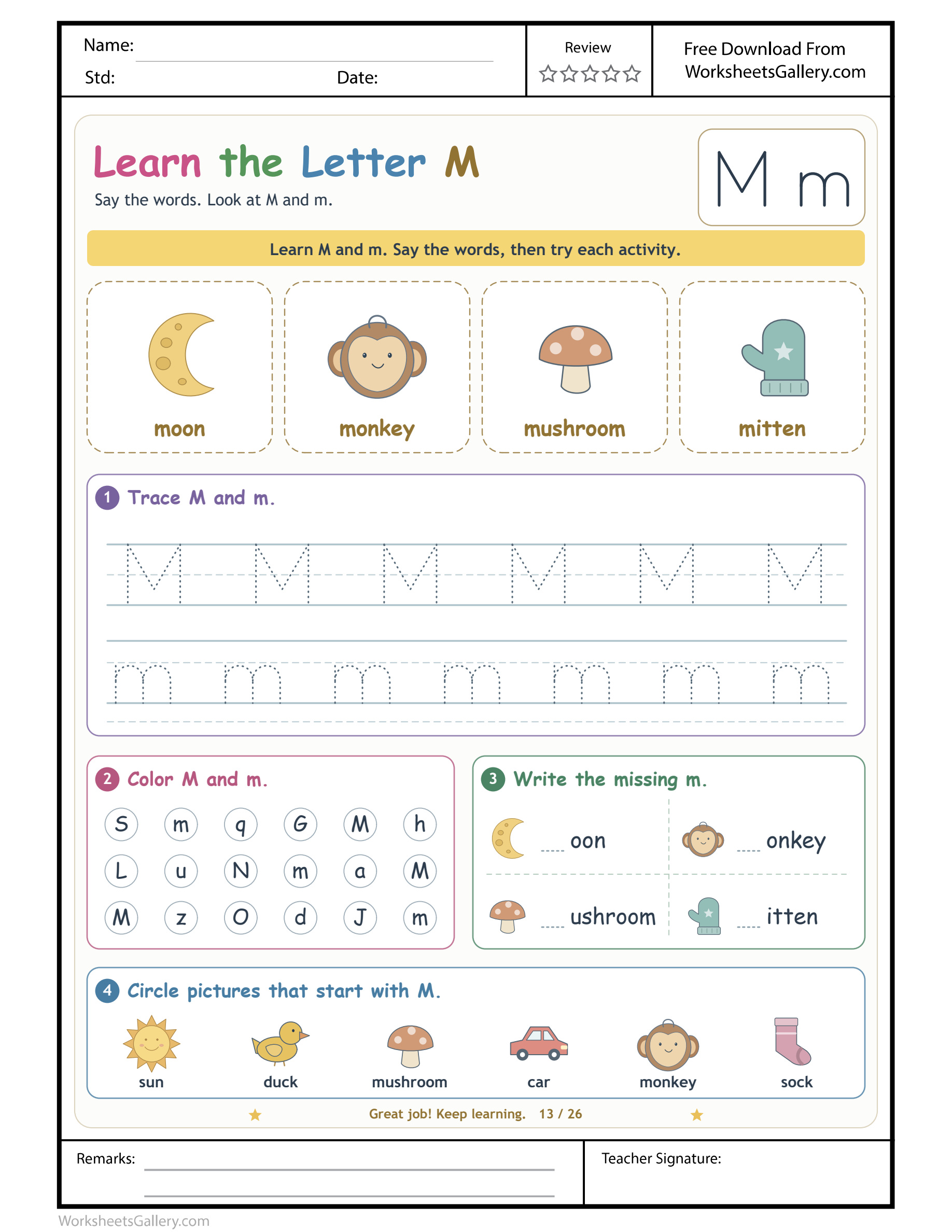
Mushroom M Moments: Notice the difference between uppercase M angles and lowercase m humps before writing initial m.
Moonlight, mushrooms and mittens can share a story even when they belong in different everyday places. Mushroom M Moments brings moon, monkey, mushroom and mitten together through their initial m. The page offers four numbered ways to investigate Mm: tracing, case searching, restoring a lowercase beginning and selecting pictures by their names. Adults can read the labels and welcome the learner's picture talk before a pencil is needed. Let a visible reference support each choice, with a comfortable amount of marking rather than a race through every dotted form and answer space on the sheet.
Open with a moonlit story — Mushroom M Moments
Imagine Mira making a small pretend garden from paper at home. She places a mushroom picture beneath a paper moon, and an adult reads both labels on Mushroom M Moments. They compare the first characters, then let a mitten become an unlikely visitor in the story. Mira can choose one of those names to examine more closely.
This imagined episode offers a way to introduce meaningful print. It is not a claim about a real child's development. The grown-up might write a sentence dictated by Mira and read it back, while leaving a tracing panel for a later moment if the story is holding her attention.
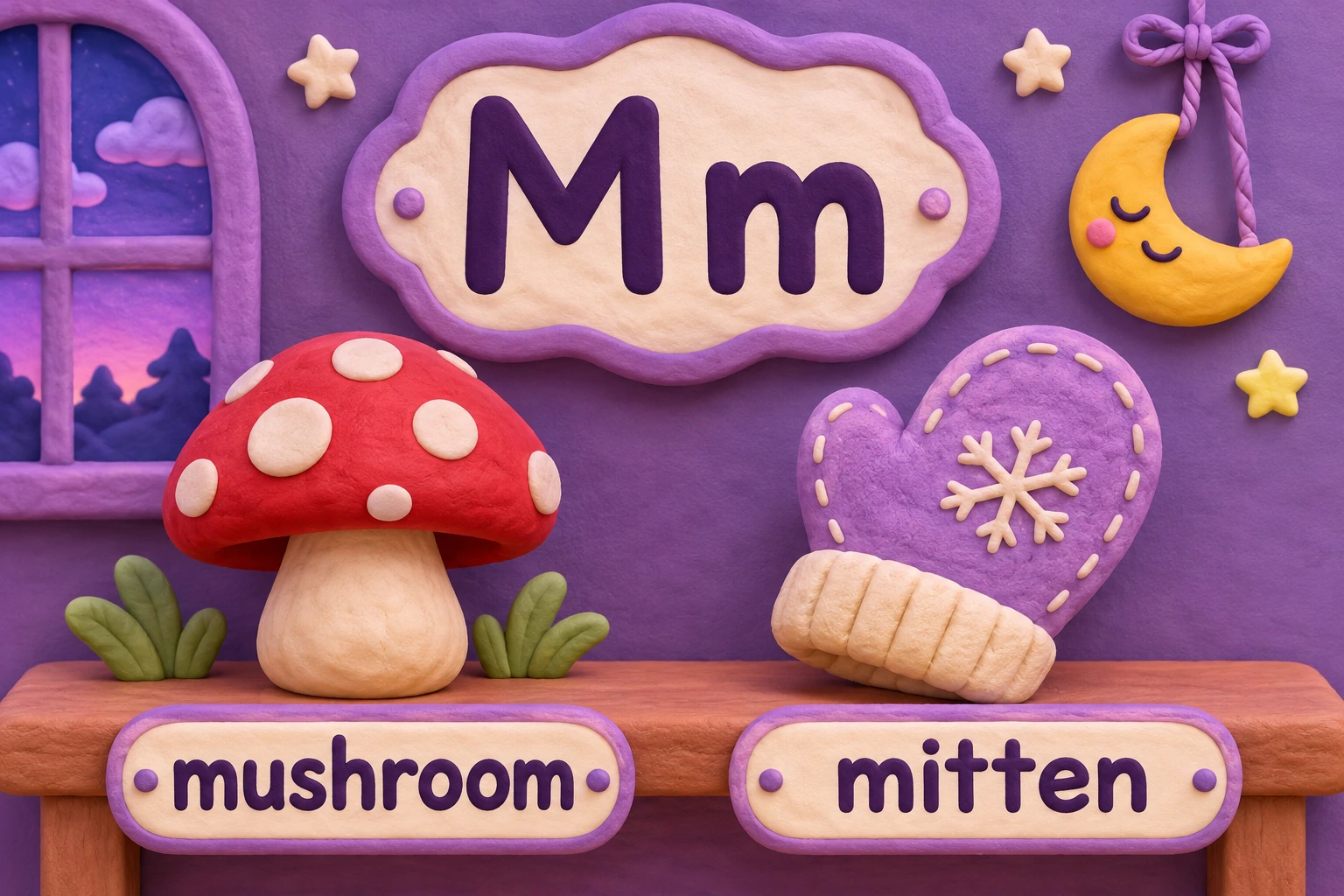
Make the top bank a dependable reference: Mushroom M Moments
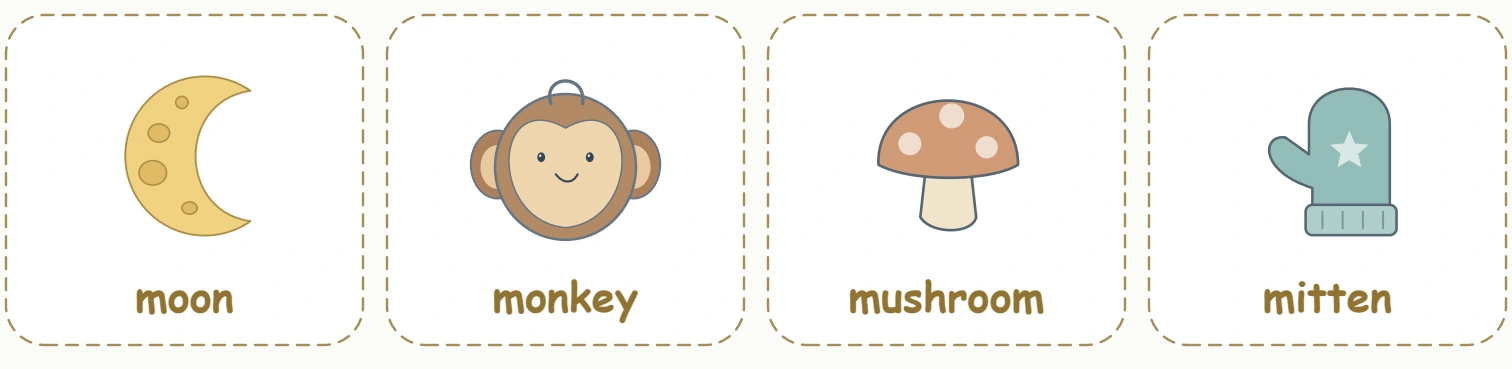
The Mushroom M Moments picture labels are moon, monkey, mushroom and mitten. Say each one clearly and find its first m. A child may know a different specific kind of monkey or describe the mitten as a glove. Listen to that vocabulary, then read the supplied label to establish the word used by the activity.
Mushroom is longer than moon, but recognising its initial is still a one-character comparison. Adult reading can carry the unfamiliar internal spelling. The worksheet does not require every label to be decoded independently, memorised or copied in full before the child can join its letter work.
Keep the angular capital and rounded small form in view: Mushroom M Moments
Capital M and lowercase m on Mushroom M Moments look noticeably different. Compare the capital's angled arrangement with the lowercase model's rounded parts. Count or describe features only if it helps the particular learner see the whole form; a formal drawing vocabulary is unnecessary.
A quick glance at a single hump can be misleading. Return to the complete small model when considering a candidate that seems close. The goal is not to announce a guess quickly, but to locate visible evidence that a printed choice matches one of the two case references.
A checkable route through all four panels: Mushroom M Moments
| Mushroom M Moments activity | Adult quick check | Source detail |
|---|---|---|
| Trace M/m | 6 M models;7 m models | Mushroom M Moments guide rows |
| Find Mm cases | 2, 5, 10, 12, 13, 18 | 6 matches in the Mm circle field |
| Complete moon through mitten | m | Mm: initial m |
| Picture-name check | mushroom, monkey | 2 choices fit Mm |
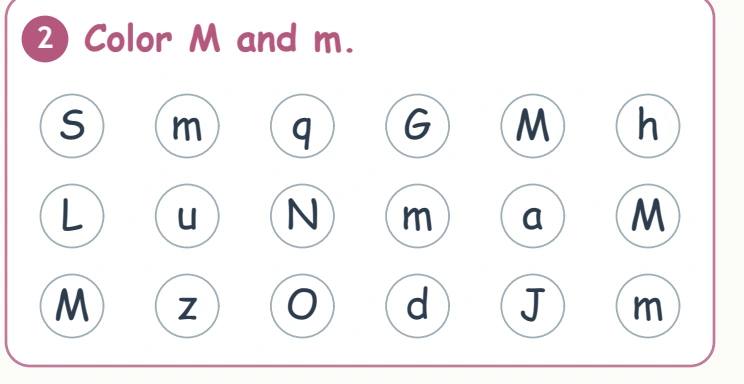
The Mushroom M Moments circle field contains eighteen positions, counted across three rows of six. Three capital M and three lowercase m choices fit. The final strip contains two picture matches, so its answer total is independent of the case-search count. Use the relevant instruction each time you move to another panel.
Choose a trace that allows a useful comparison: Mushroom M Moments
Six capital M models and seven lowercase m models provide the tracing supply in Mushroom M Moments. Look at one example, try a finger movement and offer a short pencil attempt if the learner wants it. Holding the sheet steady with the other hand can keep the task more manageable.
No numbered arrows appear in the source, so any larger demonstration is support provided by an adult rather than a prescribed route printed on the PDF. If the hand tires, switch to a pointing comparison or stop. More dark marks do not necessarily reveal more understanding of the letter's shape.
Six reasons to value a small Mm investigation: Mushroom M Moments
- Case connection. A learner can associate two different outlines with the same letter name.
- Visual precision. Checking the full lowercase form encourages attention beyond a single rounded part.
- Vocabulary grounding. A mitten picture and label make an initial meaningful rather than isolated.
- Reference use. The complete mushroom word can guide a repair without a memory demand.
- Motor control. A chosen trace gives the hand a bounded model to follow.
- Verbal reasoning. Explaining why monkey fits the final group links a spoken name to its printed beginning.
These are opportunities in Mushroom M Moments, not promised achievements on a timetable. Observe what the child actually attempts and explains. Confidence in picture naming can coexist with uncertain handwriting; adjust the amount of pencil work without overlooking the language or comparison skill already demonstrated.
Look through the circles with an explicit target: Mushroom M Moments
During the Mushroom M Moments search, keep both cases visible and ask whether each candidate belongs with either model. A learner can work across one row, with other rows temporarily covered if the field feels busy. Colour follows the letter decision, rather than replacing it.
Finding only capital M may indicate that the small partner needs another introduction. A specific prompt such as comparing the entire rounded form is clearer than announcing that several answers are still missing. The adult can check six matches afterwards without turning the count into pressure to mark doubtful choices.
The fragments need m, not a whole copied word: Mushroom M Moments
The incomplete Mushroom M Moments names are oon, onkey, ushroom and itten. Read their matching complete labels above and add one lowercase m to the beginning of each selected fragment. The remaining printed letters already do their job and do not need rewriting.
If a capital M is suggested, acknowledge the correct letter identity before showing the small form requested. A large movable m can make the answer visible when close writing is difficult. Looking back at the bank is appropriate evidence use, not something the learner must stop doing to prove success.
Mushroom and monkey fit the lower instruction: Mushroom M Moments
Sun, duck, mushroom, car, monkey and sock form the final picture strip. Mushroom and monkey begin with m in their supplied names. Moon and mitten belong to Mushroom M Moments's bank but do not appear as additional bottom answers. Read the actual choices aloud before asking for a decision.
Sun and mushroom could both belong in an outdoor scene, just as duck and monkey could share an animal group. These connections are sensible under other rules. Here the written initial provides the grouping rule, which the adult should state clearly before correcting a selection based on another idea.
A classroom mitten-and-monkey invitation: Mushroom M Moments
For a hypothetical classroom setting, a teacher places a mitten, a monkey picture and completed name cards beside Mushroom M Moments. Pupils hear the names, compare their first characters and choose a case model to discuss. One child may point to the capital's angles while another recognises a small m.
Individual sheets allow different response amounts afterwards. Ask how a learner checked rather than requiring an identical finished row from the group. This proposed use demonstrates a way to connect discussion and print, without reporting results or suggesting that every child will find the same panel equally easy.
Four new jobs for the story's objects: Mushroom M Moments
Dictate a mitten's moon journey: Mushroom M Moments
Invite a short story about a mitten travelling to the moon. An adult writes and reads back a sentence. Find a target initial if it occurs, while leaving the child's story free to use any characters, places or vocabulary.
Give a paper mushroom a label: Mushroom M Moments
Place a completed mushroom card beside a paper model. Read it together and inspect its first m. Return to Mushroom M Moments's fragment only after the full name is meaningful; the long spelling need not become a separate reading test.
Try two different sorting rules: Mushroom M Moments
Group separate pictures by animals and objects, then try an m heading. Discuss what moves when the rule changes. This makes it easier to understand why a familiar outdoor or animal connection does not decide the final worksheet selection.
Move an m into a large gap: Mushroom M Moments
Set an itten fragment next to an intact mitten label and offer a large lowercase m. The learner can place the missing character with a broad movement. This preserves the initial-letter decision while reducing the immediate demand for precise pencil control.
Comfort matters more than an exact completion amount: Mushroom M Moments
Mira’s mushroom scene can introduce Mushroom M Moments to learners of approximately three to six, supported at preschool or kindergarten level. Begin with accessible picture talk or pointing when the narrow tracing guides feel demanding. A steady table, manageable tool and visible model support writing without making it the only acceptable response.
Common slips include accepting only capitals, confusing a partial lowercase outline, using the animal group instead of the initial rule, or supplying M where the gap needs m. Explain the particular comparison the panel needs. When frustration rises, offer a larger example or close the sheet after one clear observation rather than adding repeated erasing.
Return to a different part of the moonlit scene: Mushroom M Moments
Another Mushroom M Moments visit might begin with monkey after an earlier focus on moon. Try one search row or one repaired beginning and let the learner describe what was checked. Regular practice can be brief, with books, pretend play and free drawing supplying other encounters with language and print.
Use specific encouragement, such as “You looked at all of the small letter before deciding.” A learner's willingness to return is worth preserving. The unfinished parts can remain available for another useful invitation rather than becoming a list of obligations attached to the story.
Save an authorised Mm print file: Mushroom M Moments
The supplied Learn the Letter Mm original can be obtained free. A member account with current eligible access can request the clean Mushroom M Moments premium PDF instead. The moon, monkey, mushroom and mitten tasks remain complete. Removed material consists of promotional advertisements, website-domain credits and the source watermark.
A complete clean library is linked as a separate $5 product with twenty-six sheets merged into one PDF. Choose that checkout for the collection. Before printing Mushroom M Moments, save an edition you are authorised to access and review its US Letter layout at original scale. Use the PDF rather than enlarging the moonlit supporting illustration or a source crop.
Continue the picture-and-print conversation: Mushroom M Moments
Mushroom M Moments connections: Mushroom stories can lead toward Mm Letter Mapper. Compare another Mm route through Mm Worksheet. A learner ready to leave the moonlit scene may enjoy the capital-order work in Dino Missing Capitals.
Adults planning related experiences around Mushroom M Moments can visit PBS Parents' area for learning and growth or play material for families published by NAEYC. These independent educational links neither endorse this file nor supply extra pages within its download.
Popular Worksheets
Printable resources families and teachers are downloading now.
 Free
 Free
 Free
 Free