
New Sight Word: 5 Joyful Hat-Discovery Activities
Explore new here, then choose the complete now-to-please Word Maps collection: 26 clean printable sheets together for $5.
The whole new map remains uncropped.
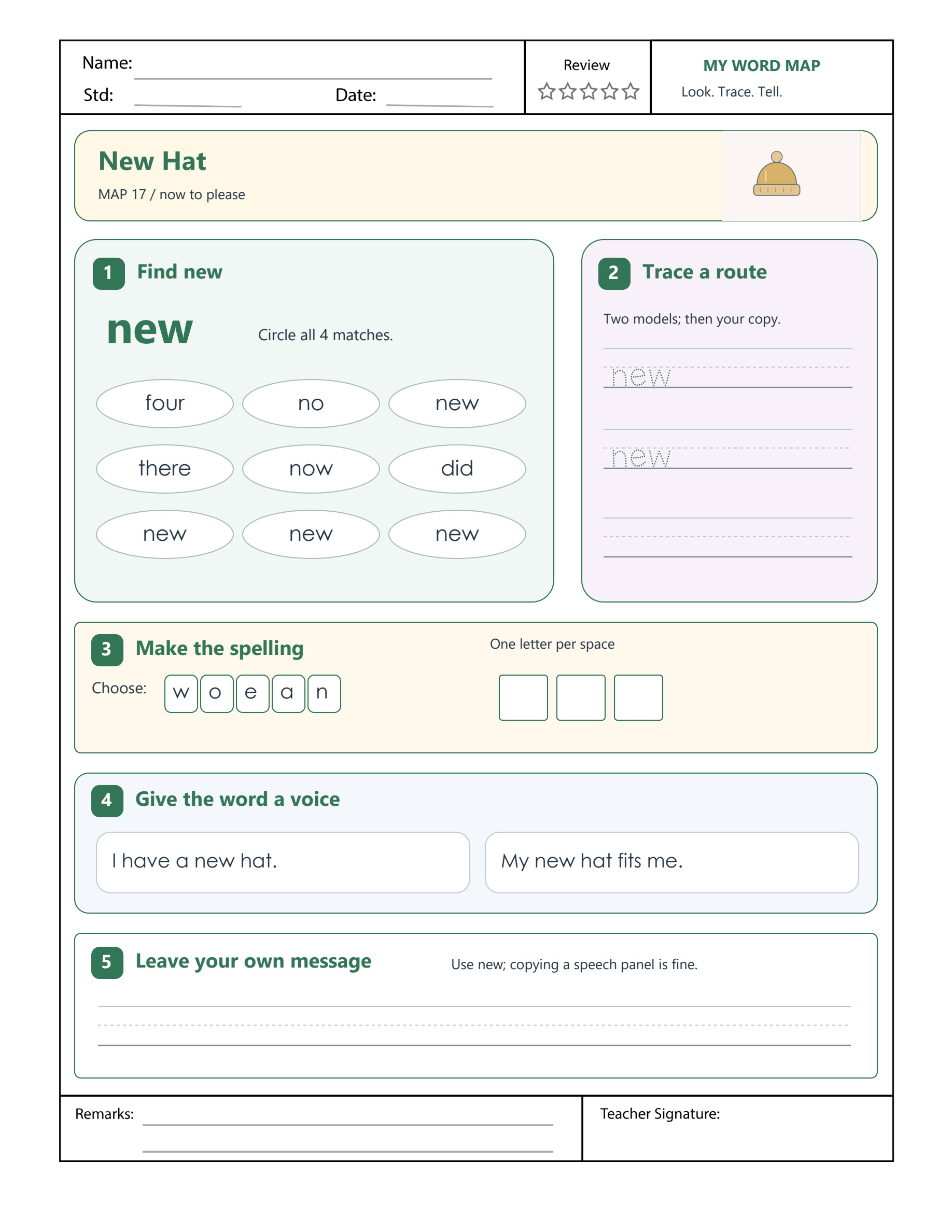
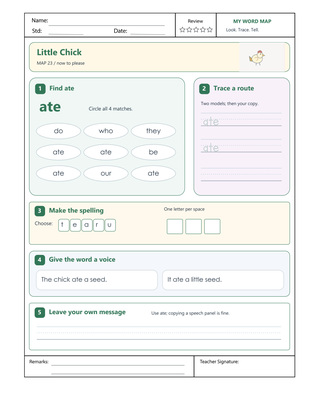
New Hat combines its new search hub, tracing side route, spelling rail, speech panels and message strip.
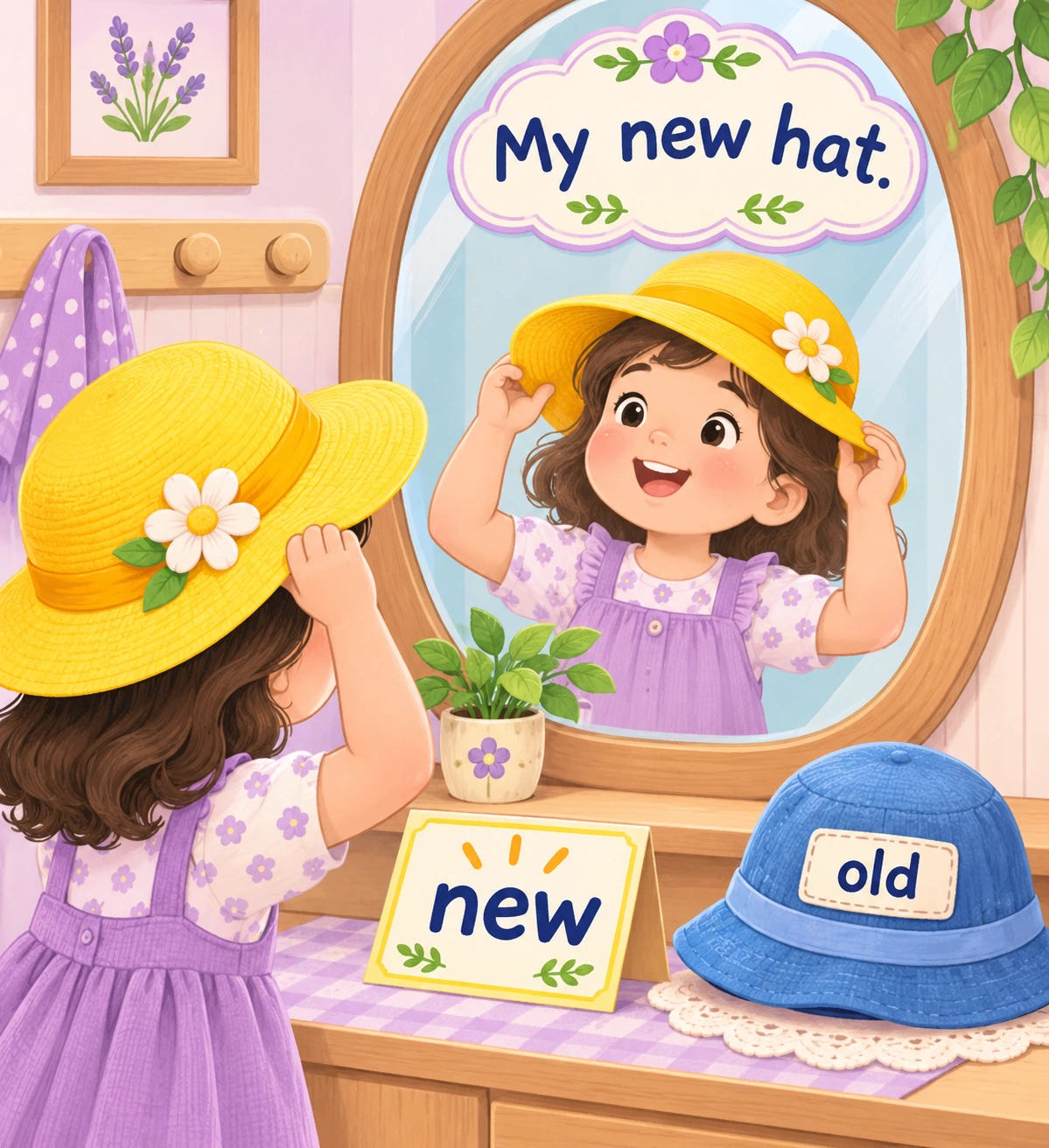
A yellow hat has just become part of Suri's pretend dressing corner, while a familiar blue hat remains nearby. New describes the changed relationship between an object and its wearer. The New Sight Word worksheet connects that observation with two hat messages, n-e-w, searching and handwriting. Its clean map preserves the source activities inside the original frame while offering a different interior route. Begin with something newly introduced to play, then choose a print task that supports the child's explanation without suggesting that buying another object is necessary for learning the word.
New can mean recently introduced or unfamiliar
The source character has a new hat and says that it fits. Discuss what makes the hat new in this story: it has recently arrived or become the speaker's hat. It does not have to be more valuable, prettier or better than the familiar one. A reused toy can be new to a particular pretend character.
Show both source messages and identify whose hat is being discussed. The target describes the object, while the surrounding words establish the owner and the fit. A child can understand new while needing an adult to read the rest of the sentence. The picture supports the context, but recognising a hat does not identify the target's written letters.
Now appears among the search choices and offers a useful visual contrast. Both begin with n and end with w, but their middle letters differ. Inspect n-e-w completely rather than relying on the outside shape. Pronounce the target naturally in the learner's accent and keep the model available during comparison.
A home dressing story without a shopping requirement
Bring a familiar prop into a new pretend role: a paper hat may become a puppet's new hat even though the material is reused. Suri explains what changed for the character. Read the worksheet's possession statement, then compare the familiar and newly introduced props without assigning a better-or-worse judgement to either.
Build n-e-w with movable letters and locate the target in a speech panel. Let the child dictate a message about a different newly introduced play item if desired. A short trace or an explained search choice may follow. Keep time for the dressing story itself, rather than allowing the printable to become a demand to describe or acquire actual possessions.
Six observations around a changed play corner
- Relative meaning: Suri explains why the object is new to this character or situation.
Description: the target supplies information about the hat rather than naming it. - Ownership reference: my is connected with the current speaker.
- Middle-letter inspection: new is distinguished from now by the actual vowel position.
- Written sequence: n-e-w is built despite a shuffled bank beginning with another piece.
- Expression: an observation about change can become a supported written message.
A pencil route for the new hat word
Two dotted new examples sit on separate new hat guides. Follow n-e-w once while Suri watches a useful demonstration. The third new band is for an untraced new hat attempt. Choose a quantity of new practice that fits Suri's hand control, rather than asking Suri to fill the entire new hat sidebar.
Understanding the new hat message and writing new are different questions. Suri may explain new correctly while its new letters still need motor support. Dictating new can preserve a new hat idea when independent new writing is tiring. Keep new's model visible for Suri; offer formation help on new separately instead of turning new hat sentence practice into repeated correction.
New Sight Word inspection on the new hat map
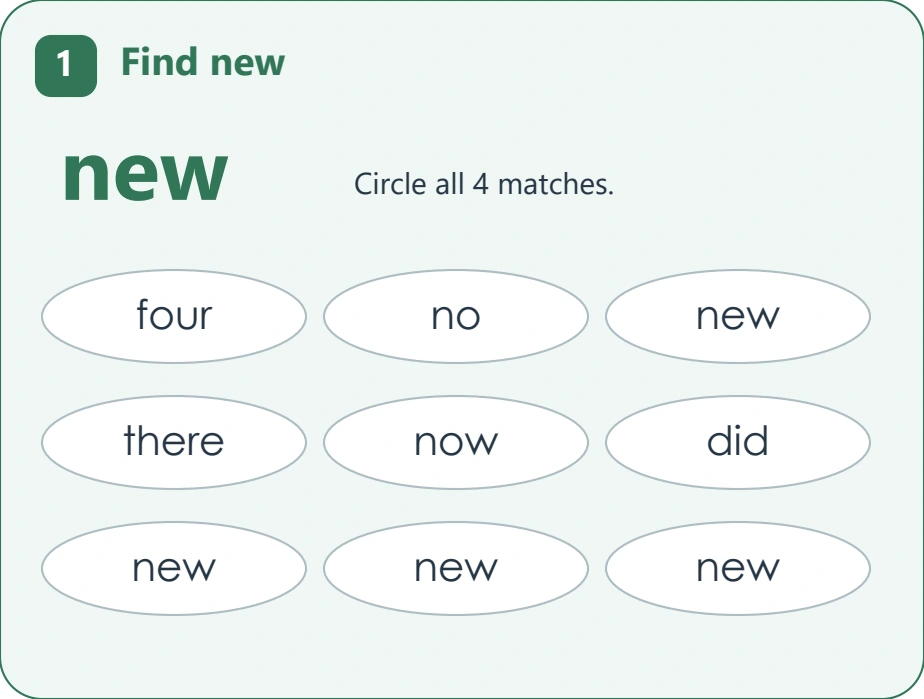
The new hat search contains nine ovals. Begin at new's large model, then compare each new choice. For new, number the top row 1–3; continue the new hat middle row 4–6, then the new bottom row 7–9. Review these new hat notes after Suri's own new attempt; reveal answers when that new comparison needs support.
| New cell | Choice | New check |
|---|---|---|
| 1 | four | Suri: reject four when searching for new. four has f at position 1; new needs n there. Compare n-e-w before ruling out four on this new hat map. |
| 2 | no | Suri: reject no when searching for new. no has o at position 2; new needs e there. Compare n-e-w before ruling out no on this new hat map. |
| 3 | new | New is complete at cell 3: n-e-w. Suri can compare its final w with new's ending before making this new hat circle. |
| 4 | there | Suri: reject there when searching for new. there has t at position 1; new needs n there. Compare n-e-w before ruling out there on this new hat map. |
| 5 | now | Suri: reject now when searching for new. now has o at position 2; new needs e there. Compare n-e-w before ruling out now on this new hat map. |
Finish checking the new hat choices
| New cell | Choice | New check |
|---|---|---|
| 6 | did | Suri: reject did when searching for new. did has d at position 1; new needs n there. Compare n-e-w before ruling out did on this new hat map. |
| 7 | new | Cell 7 holds another exact new. Let Suri inspect new's neighbours too; one successful new find does not decide adjacent new hat choices. |
| 8 | new | This n-e-w matches new. Ask Suri to show each new position before circling the entry on the new hat map. |
| 9 | new | The fourth matching new occupies cell 9. Its n-e-w agrees with the model; Suri can point to every new position before including it. |
Four ovals match new. If Suri circles a different quantity, revisit the new hat choices. Compare each selection against n-e-w before adding a new circle. Ask Suri to explain a selected new and a rejected new hat candidate. Listen to Suri's comparison as well as counting new marks.
Assemble n-e-w on the spelling rail
The new bank presents w, o, e, a, n. Make 3 positions for n-e-w; leave o and a unused. Suri selects the new sequence rather than transcribing the new hat display order. Movable new pieces can reduce Suri's pencil load during this new hat spelling decision.
Point from new's large model to each n-e-w position. If Suri misplaces a new letter, move that piece while the new hat materials remain adjustable. Name n-e-w for the written sequence; read new naturally within its new hat message. Check Suri's completed construction, then offer a new pencil copy.
A new hat message using new
The new finish accepts a copied new hat example or a new new sentence. Let Suri speak the new hat message before writing new. Check how the listener understands Suri's idea. Supply unfamiliar spellings around new if Suri needs them. Preserve this new hat thought while helping Suri with print. Provide Suri with spelling help that preserves new.
The new speech windows
Read the first new hat message: “I have a new hat.” Its new companion says “My new hat fits me.” Share the new hat meaning before asking Suri to locate new in print. An adult may supply other new hat vocabulary, leaving Suri to inspect the new positions. If Suri guesses new from the picture, cover that new hat illustration briefly and point back to n-e-w.

A classroom welcome for an unfamiliar prop
Introduce a reused toy or classroom puppet as new to a particular play station. Let learners explain what is unfamiliar and what they already know. A teacher can model a new sentence while a child points to the target. Give the newcomer a role without ranking it above familiar materials or requiring children to discuss what their families have purchased.
After the conversation, compare new with the printed now distractor. If Suri explains the changed situation but confuses the spellings, focus on e versus o. If the word is copied correctly but understood only as hat, introduce another object. Separate the language question from the hand-control question before deciding what additional support would help.
Five ways to explore a newly introduced thing
1. Give a familiar puppet a different role
Let an existing puppet join a play area for the first time and describe its new role. Suri can hear that the word relates to a change in the situation, not necessarily to a recently manufactured object. Keep a completed new label available for print comparison.
2. Introduce a different story character
Read or invent a short scene in which a character appears for the first time. Discuss who is new to the story at that point. An adult records a simple completed caption if useful, allowing the child to contribute orally without writing every unfamiliar name.
3. Compare the middle position
Build new beside now using large movable pieces. Inspect their shared outer letters and different centres, then read each in a suitable spoken message. Return to the hat statement afterwards so the comparison remains connected to meaning rather than becoming a guessing contest.
4. Change who owns the prop
Pass the pretend hat to another named puppet and discuss whose hat is being described. Model a suitable new message when the story supports it. This makes the surrounding ownership reference visible while the target spelling stays available on its card.
5. Revisit after the prop becomes familiar
Return to the same story later and ask whether the speaker would still choose new. More than one reasonable explanation may be possible. Reread the earlier caption to show that a written message records a particular speaking situation, even when time and familiarity change.
Make room for uncertainty and different experience
For supported readers around four to six, the idea of something being new to one person may need a concrete story. Do not assume a confident copier already understands that relationship. Conversely, a clear oral explanation may coexist with hesitant w formation. Offer the relevant demonstration and keep the amount of writing manageable.
Avoid equating new with better, asking children to compare family possessions or accepting a search match after checking only n and w. On another day, introduce a different fictional character or reused prop. Notice a specific explanation or middle-letter decision, then let the learner continue the play without turning the word into a pressure to own something new.
Related descriptions and starting points
The this identification lesson offers another way to describe a particular object. The pre-primer first reading pack provides earlier words, while the prewriting concept workshop sheets support a separate pencil visit. Families may explore NAEYC's playful-learning resources and PBS Parents' ideas for growing learners alongside print.
Choose the hat map for a useful visit
New Hat keeps its uploaded sample in the free slot. Eligible active members can select a redesigned new map from the page's account options. Website marks, domain printing and advertising are absent from that clean edition. The related card offers the twenty-six-map now–please collection for a separate payment of $5.
Check a US Letter test copy for the frame, the e in the dotted target and both hat messages. Keep the intended version easy to locate, then print for another meaningful introduction rather than requiring a full page every time an unfamiliar prop appears.
Related Topics
Popular Worksheets
Printable resources families and teachers are downloading now.
 Free
 Free
 Free
 Free