
Who Sight Word: 5 Brilliant Sock-Search Questions
Explore who here, then choose the complete now-to-please Word Maps collection: 26 clean printable sheets together for $5.
The whole who map remains uncropped.
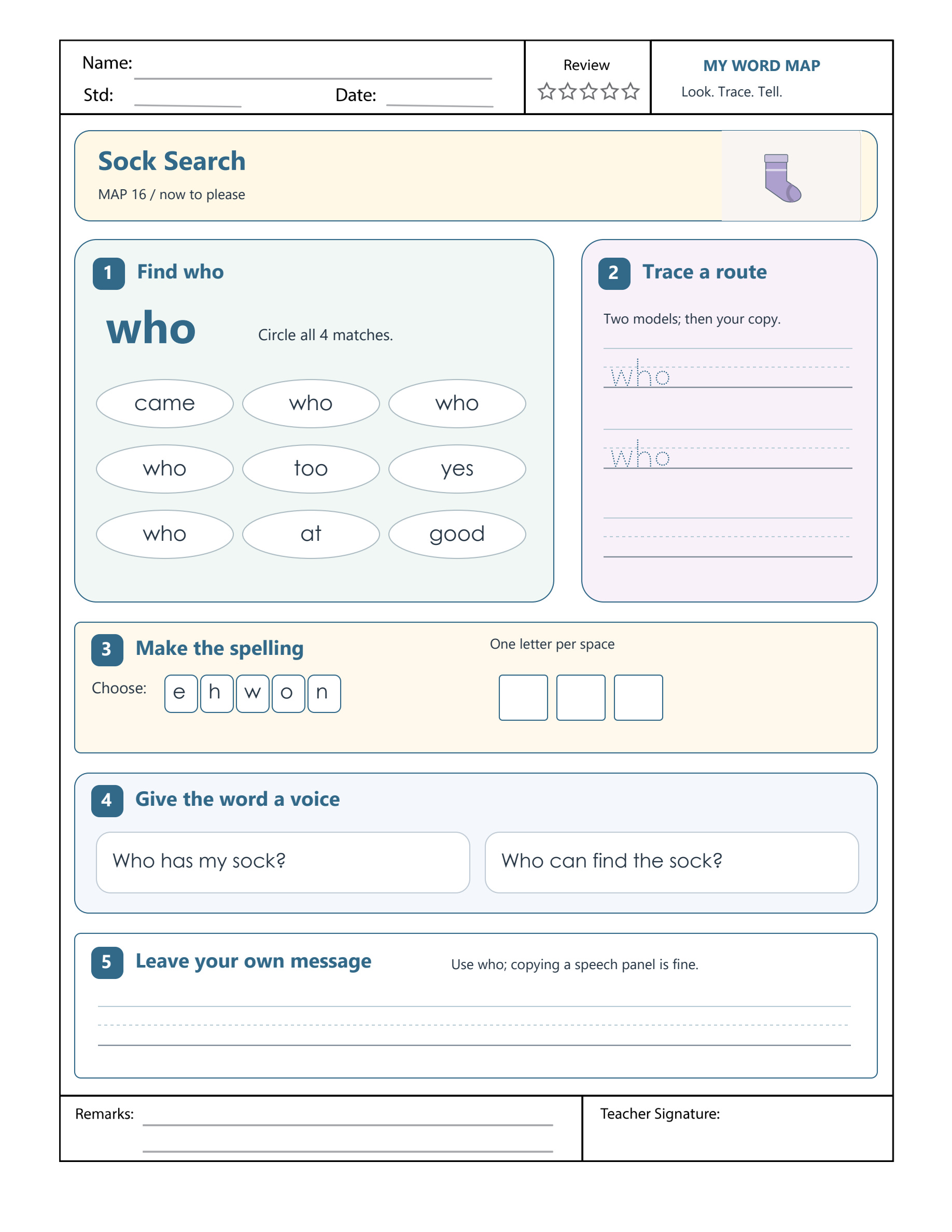
Sock Search combines its who search hub, tracing side route, spelling rail, speech panels and message strip.
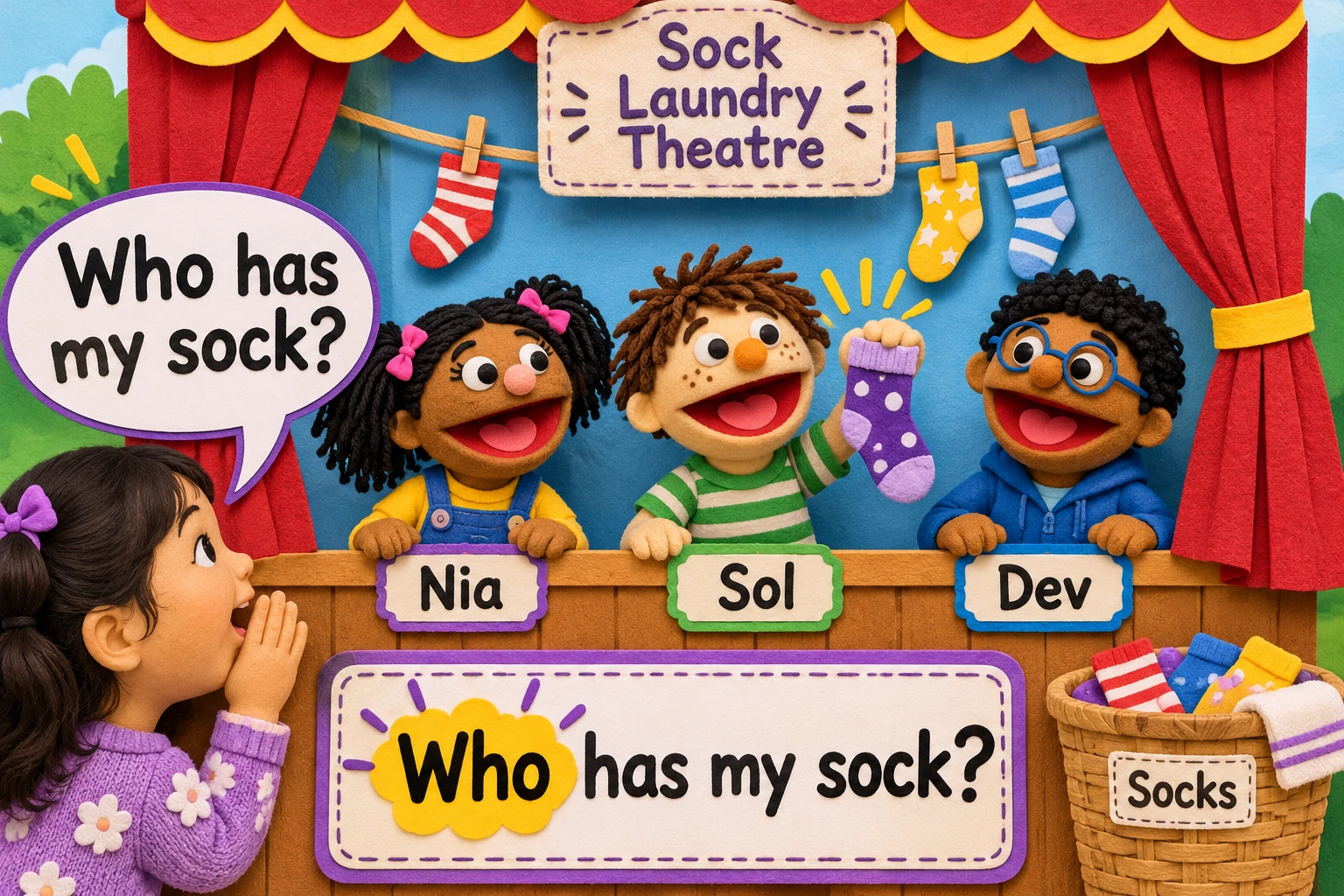
Rosa can see several puppets, but only one is holding the missing sock. Who asks for that person's identity, giving the listener a clear kind of information to supply. The Who Sight Word worksheet uses two sock questions to connect spoken understanding with w-h-o, a search and supported handwriting. The sock map changes the interior arrangement and keeps its established outer border. Begin with named characters and a visible clue, then let the printed question support the exchange without requiring the learner to decode every surrounding word or write a complete answer independently.
A who question needs a person-shaped answer
The first source question asks who has the sock. The second asks who can find it. One concerns possession, while the other concerns a person able to help. Establish which question is being asked before judging the answer. Naming the sock's colour is useful information in another conversation, but it does not identify the person requested here.
Use fictional names and a visible sock so the learner is not being asked to guess private information. A puppet can answer for itself or point to another character. If Rosa initially points, an adult may model the person's name in a fuller response without dismissing the clear nonverbal explanation.
Both printed questions begin with capital Who, while the isolated model and search use lowercase who. Connect those forms explicitly. The same word starts a question with a capital letter; it has not gained another letter or changed into a different spelling to be built.
A laundry puppet game at home
Choose three named puppets or toy people and let one hold a large paper sock openly. Read the possession question and give Rosa time to inspect the scene. After an answer, change the holder and ask again. The changing person prevents one memorised name from standing in for understanding the question.
Next, ask which character can help find another visible sock. Explain the different purpose of the second source message. Locate Who on the page and compare it with w-h-o in the bank. Movable letters can precede a short trace, while an adult writes a dictated answer if the child wants a written record.
Six observations on a tiny laundry stage
- Question type: Rosa looks for a person rather than supplying only an object or colour.
- Evidence: a visible sock holder supports the identity answer.
- Changing reference: the answer changes when another character takes the sock.
- Capital connection: Who at a sentence opening belongs with lowercase who.
- Letter order: w-h-o is built from a shuffled set with spare choices.
- Communication: pointing, naming or a supported sentence can all make the intended answer clear.
Assemble w-h-o on the spelling rail
The who bank presents e, h, w, o, n. Make 3 positions for w-h-o; leave e and n unused. Rosa selects the who sequence rather than transcribing the sock search display order. Movable who pieces can reduce Rosa's pencil load during this sock search spelling decision.
Point from who's large model to each w-h-o position. If Rosa misplaces a who letter, move that piece while the sock search materials remain adjustable. Name w-h-o for the written sequence; read who naturally within its sock search message. Check Rosa's completed construction, then offer a who pencil copy.

A pencil route for the sock search word
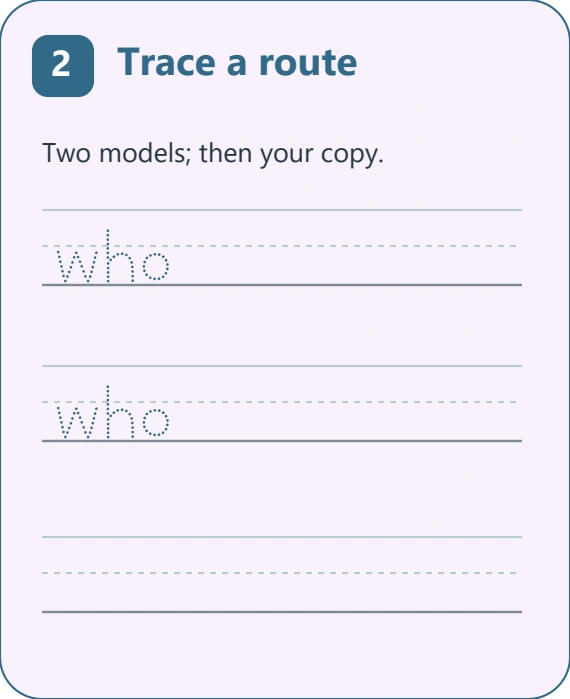
Two dotted who examples sit on separate sock search guides. Follow w-h-o once while Rosa watches a useful demonstration. The third who band is for an untraced sock search attempt. Choose a quantity of who practice that fits Rosa's hand control, rather than asking Rosa to fill the entire sock search sidebar.
Understanding the sock search message and writing who are different questions. Rosa may explain who correctly while its who letters still need motor support. Dictating who can preserve a sock search idea when independent who writing is tiring. Keep who's model visible for Rosa; offer formation help on who separately instead of turning sock search sentence practice into repeated correction.
The who speech windows
Read the first sock search message: “Who has my sock?” Its who companion says “Who can find the sock?” Share the sock search meaning before asking Rosa to locate who in print. An adult may supply other sock search vocabulary, leaving Rosa to inspect the who positions. If Rosa guesses who from the picture, cover that sock search illustration briefly and point back to w-h-o.

Who Sight Word inspection on the sock search map
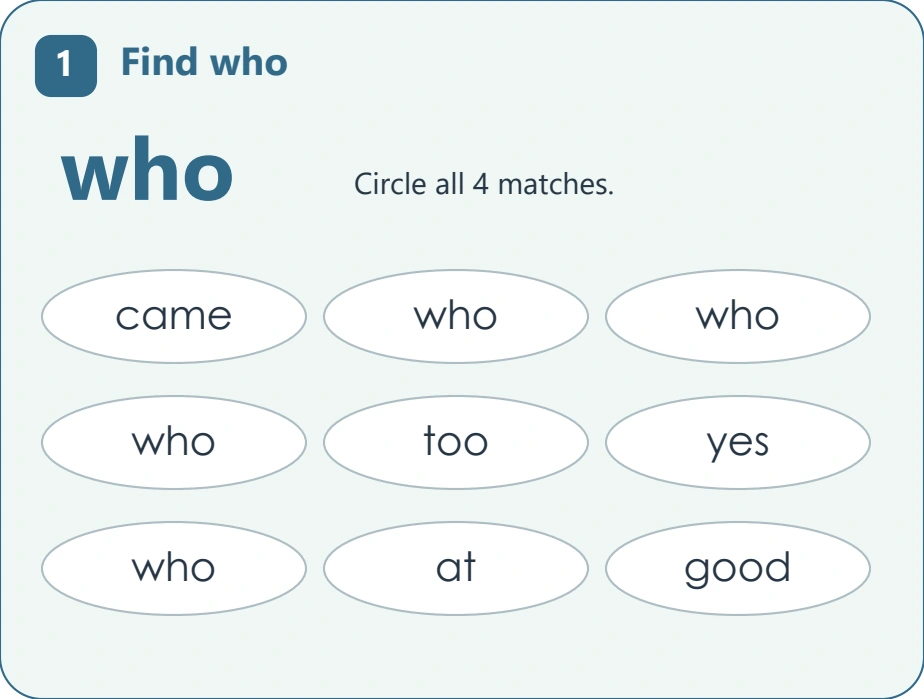
The sock search search contains nine ovals. Begin at who's large model, then compare each who choice. For who, number the top row 1–3; continue the sock search middle row 4–6, then the who bottom row 7–9. Review these sock search notes after Rosa's own who attempt; reveal answers when that who comparison needs support.
| Who cell | Choice | Who check |
|---|---|---|
| 1 | came | Rosa: reject came when searching for who. came has c at position 1; who needs w there. Compare w-h-o before ruling out came on this sock search map. |
| 2 | who | Who is complete at cell 2: w-h-o. Rosa can compare its final o with who's ending before making this sock search circle. |
| 3 | who | Cell 3 holds another exact who. Let Rosa inspect who's neighbours too; one successful who find does not decide adjacent sock search choices. |
| 4 | who | This w-h-o matches who. Ask Rosa to show each who position before circling the entry on the sock search map. |
| 5 | too | Rosa: reject too when searching for who. too has t at position 1; who needs w there. Compare w-h-o before ruling out too on this sock search map. |
Finish checking the sock search choices
| Who cell | Choice | Who check |
|---|---|---|
| 6 | yes | Rosa: reject yes when searching for who. yes has y at position 1; who needs w there. Compare w-h-o before ruling out yes on this sock search map. |
| 7 | who | The fourth matching who occupies cell 7. Its w-h-o agrees with the model; Rosa can point to every who position before including it. |
| 8 | at | Rosa: reject at when searching for who. at has a at position 1; who needs w there. Compare w-h-o before ruling out at on this sock search map. |
| 9 | good | Rosa: reject good when searching for who. good has g at position 1; who needs w there. Compare w-h-o before ruling out good on this sock search map. |
Four ovals match who. If Rosa circles a different quantity, revisit the sock search choices. Compare each selection against w-h-o before adding a who circle. Ask Rosa to explain a selected who and a rejected sock search candidate. Listen to Rosa's comparison as well as counting who marks.
A sock search message using who
The who finish accepts a copied sock search example or a new who sentence. Let Rosa speak the sock search message before writing who. Check how the listener understands Rosa's idea. Supply unfamiliar spellings around who if Rosa needs them. Preserve this sock search thought while helping Rosa with print. Provide Rosa with spelling help that preserves who.

A classroom helper question with fair information
A teacher can name the characters before the game and show who has the relevant prop. Learners take turns asking, holding and answering. Read the longer words aloud where needed so the target remains accessible to a child who cannot yet decode the entire question alone. Keep the activity fictional and cooperative rather than using it to investigate a real missing possession.
If Rosa answers “purple,” acknowledge the colour and clarify that who asks which person. If the question is understood but a search distractor is selected after seeing w, inspect the full spelling. Those responses reveal different needs. A learner should not have to write a long sentence before being allowed to participate in the conversation.
Five person-finding questions beyond the sock
1. Move a clearly visible prop
Let a different named puppet hold a toy book and ask who has it. Rosa can point or name the holder before an adult models a fuller answer. The new object shows that the question word is not simply another label for a sock.
2. Choose a helper for a pretend task
Give one character a visible tool for a fictional job and ask who can help. Ensure that the scene actually supplies enough information. A child should not be marked wrong for lacking knowledge that the adult has kept hidden.
3. Ask the same question after a swap
Exchange the sock between two puppets while the learner watches, then ask again. The printed who card can remain unchanged as the correct identity changes. This helps separate the stable question word from one repeatedly supplied person's name.
4. Pair capital and lowercase forms
Show Who in the source question beside who on a completed word card. Let the learner inspect the same three letter identities across both forms. Return to the puppet question afterwards so the visual comparison remains connected to its communication purpose.
5. Send a question to another listener
Rosa dictates a who question for a puppet that has not yet joined the game. An adult records and rereads it, then provides the visible scene needed to answer. The child can inspect the target while the adult supports the unfamiliar surrounding spellings.
Keep identity questions playful and clear
Supported learners around four to six can approach the page through named toys, gestures, oral questions or print. A child may understand the identity request while needing help with the unfamiliar sound relationships in who. Model pronunciation naturally and teach the spelling at an appropriate level instead of stretching every letter into a separate spoken beat.
Avoid hidden clues, real accusations about missing clothing or assuming that a colour answer proves the child was not listening. Clarify the question and offer another visible example. For a later visit, change the characters and prop, then notice a specific decision such as identifying a new holder or checking the final o before circling.
Compare a different kind of question
The what car-question lesson asks for a different kind of information. The pre-primer early-word lessons offer another print starting point, and the prewriting workshop activities separate pencil movement from oral questioning. Explore NAEYC's suggestions for shared play or PBS Parents' everyday activity ideas for other family exchanges.
Download the sock-question edition
The free option supplies the original sample. Active eligible members can use the account controls for the clean premium map, whose printable page excludes website watermarks, domain lettering and advertising panels. The separate $5 collection purchase contains all twenty-six now-to-please word maps together.
Rosa's first Letter-size print should retain its entire frame, capital Who in both questions and the lowercase dotted models. Keep the chosen file accessible for another named-character game, printing the amount that suits the next visit rather than requiring every response to be written immediately.
Related Topics
Popular Worksheets
Printable resources families and teachers are downloading now.
 Free
 Free
 Free
 Free