
That Sight Word: 6 Clever Berry-Choice Discoveries
Continue beyond that with twenty-six clean reading-first practice sheets in one $5 printable collection.
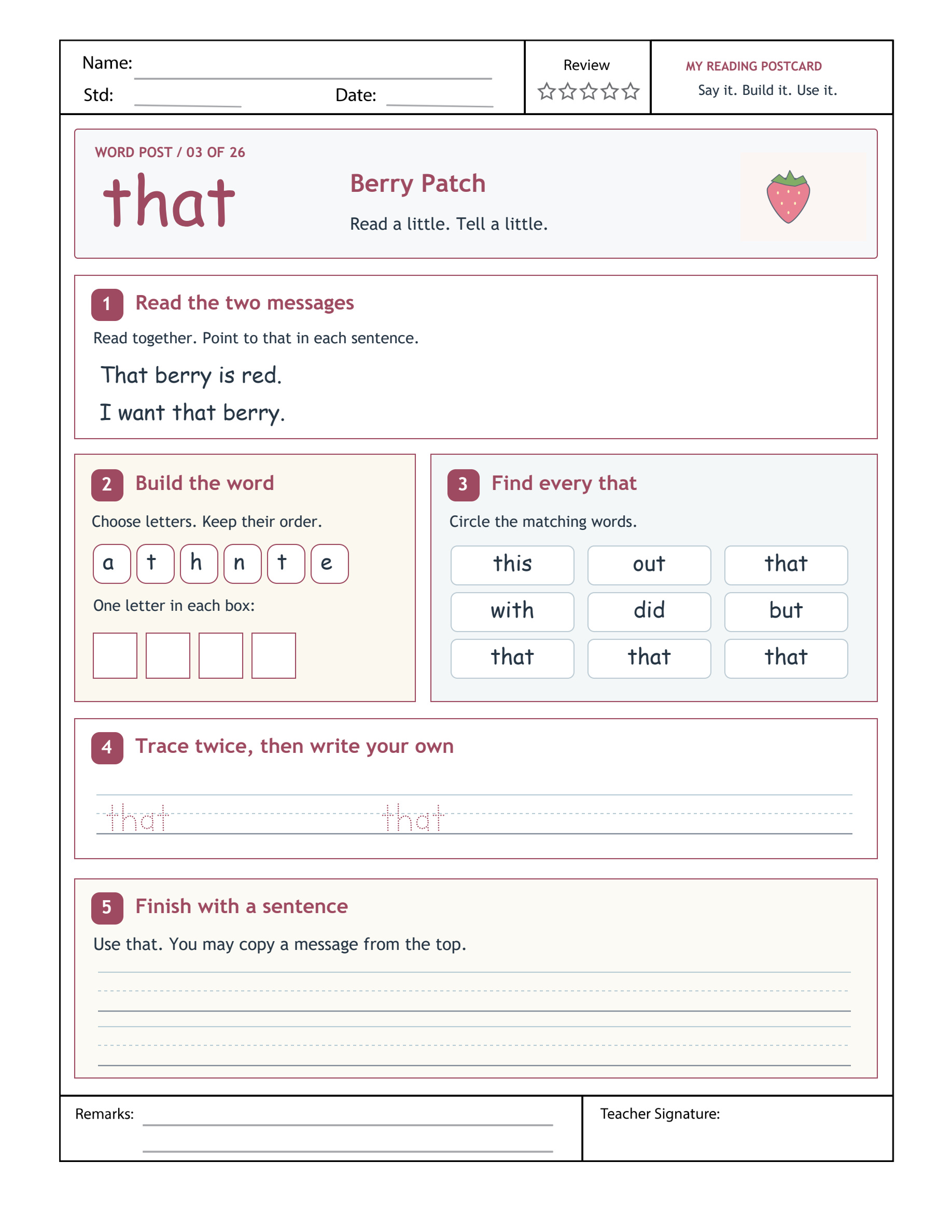
The full that sheet retains its US Letter frame.
Point to one specific berry and keep its identity clear. The complete redesigned page appears without cropping.
Which berry does Noor mean? A pointing finger and the word that can help a listener select one particular fruit from a patch. That Sight Word practice begins with this everyday communication problem, then gives children several ways to examine the spelling. The berry lesson includes reading, letter selection, a word hunt, two dotted copies and sentence writing. Its clean premium layout starts with the messages and finishes with a generous writing area. Share the page with an early reader who is ready to connect a short printed word with a clear spoken intention.
The berry a listener needs to find
Place two pretend berries in view, one near the speaker and one a little farther away. Point towards the farther berry and say, “That berry is red.” A learner can identify the intended object even before attempting the written sentence. The gesture and the conversation supply a context for that.
In these examples, that identifies a particular berry. The second supplied statement, “I want that berry,” makes the choice personal: the speaker selects a specific fruit rather than any available berry. Discuss which one is meant and how the listener knows. Accept a gesture or a brief explanation instead of requiring a formal definition.
Distance is a helpful first demonstration, but it is not the only way English uses that. The word can also connect ideas in other sentences. This sheet concentrates on the pointing and selecting use shown by its two examples. A short lesson does not need to teach every grammatical function a word may have elsewhere.
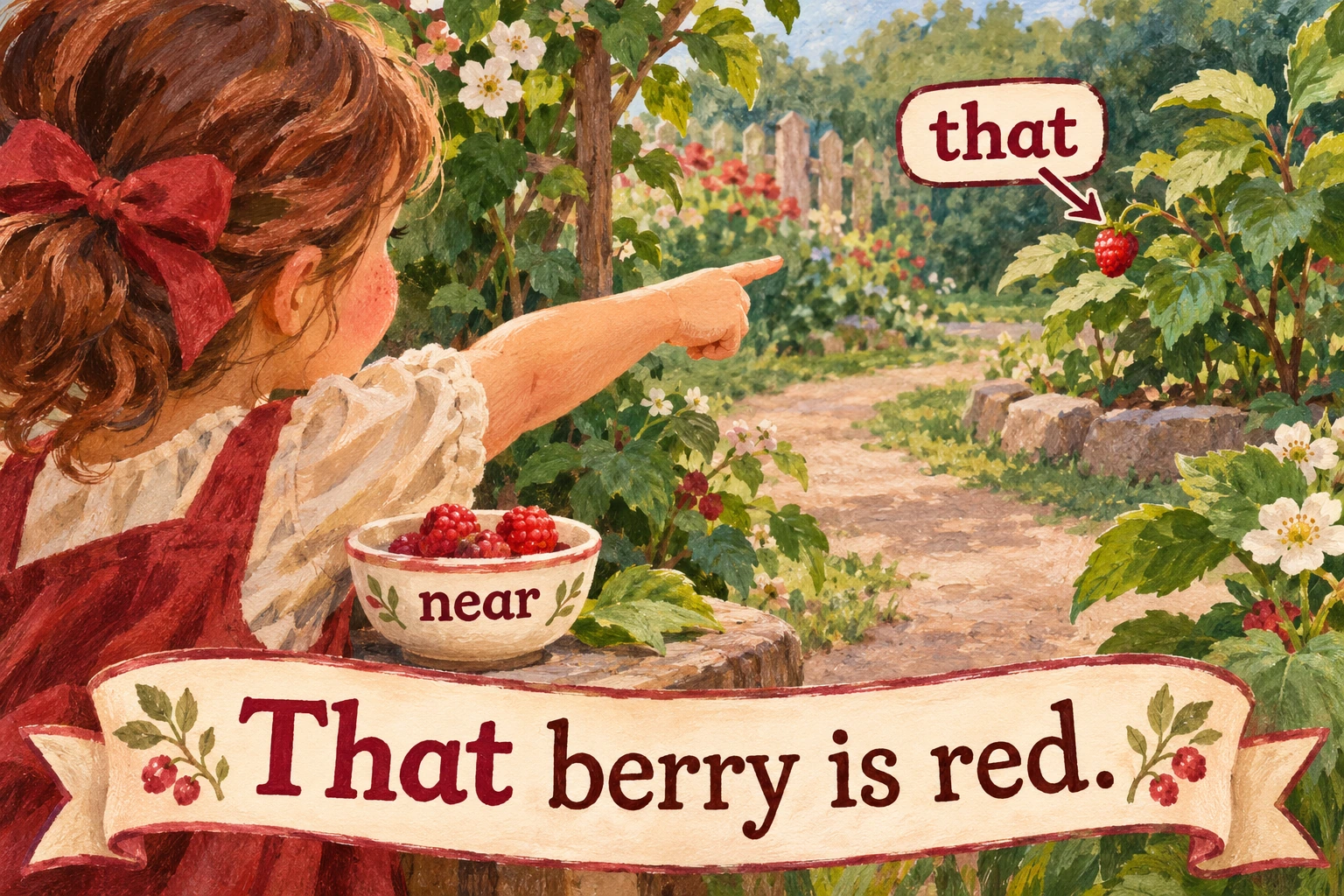
That Sight Word: a statement and a particular choice
The first sentence gives information about a berry's colour. The second tells which berry someone wants. Read both with normal phrasing, then ask the learner to find that. A capital T opens “That berry is red.” A lowercase t appears inside “I want that berry.” Show that the two forms represent the same target.
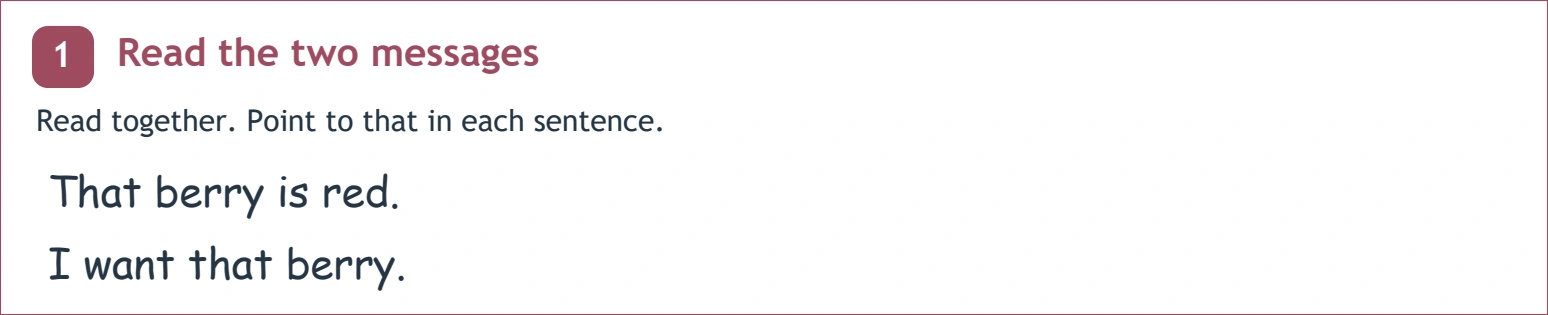
Do not turn the illustration into an answer key for every printed word. A child may correctly identify a red berry while still reading this instead of that. Return to the letters after the meaning conversation. Compare the visible forms rather than assuming that a sensible sentence guess demonstrates accurate word recognition.
You can also move the pretend berry while repeating the original message. If the speaker still points clearly, the listener can follow. If several berries are close together and no gesture or shared context is available, the message may be ambiguous. Invite the child to make the communication clearer; that is a useful language decision, separate from handwriting.
The exact practice choices inside the frame
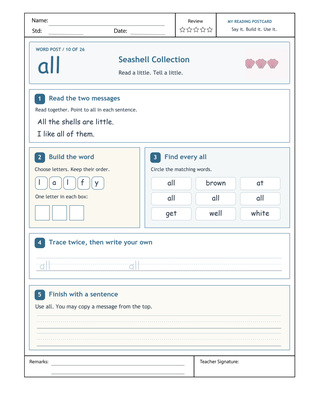
Berry reading leads the clean page, with the four-letter workshop opposite the exact-match grid. The dotted that models and expanded message finish follow those investigations. The retained sample begins with its tracing task instead. Both layouts preserve the five supplied activities and the same established US Letter frame.
There are nine search choices arranged as this, out, that; with, did, but; that, that, that. The bank contains a, t, h, n, t and e. Four response boxes require t-h-a-t. The spelling needs both copies of t, so choosing one t and then treating the other as an accidental duplicate would leave the answer unfinished.
This is a one-page reading and writing resource. Any actual berries, pointing games or loose alphabet pieces come from your own teaching materials. Use pretend fruit if that is easier. The activity does not require tasting, collecting outdoor plants or bringing food into a classroom.
Two t letters do different positional work
The first t begins that and the second t closes it. Between them are h and a. Name the sequence while pointing along the large model. Then find the letters in their shuffled bank and arrange them beside the four boxes before writing.
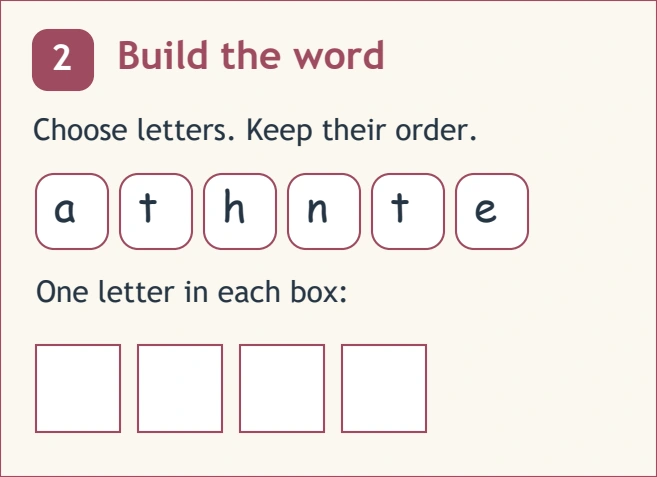
A learner may choose t, h and a and stop because all three different letter names have been found. Ask how many positions the printed word actually occupies. The repeated t is another written position, even though its letter name is familiar. Move a second t into place so that this requirement becomes visible.
The opening th represents a sound combination in this word. Say that naturally and let the child hear it in the sentence. Avoid presenting t and h as two separately pronounced sounds in the completed word. Letter naming can help with spelling, while a natural spoken model supports reading; those tasks need not sound identical.
Compare this and that without guessing
This is the very first distractor in the search. It shares the opening th with that, so a glance at the first two letters is insufficient. Invite the child to inspect the endings: this has i-s, while that has a-t. Keep both spellings available and let the learner point to the difference.
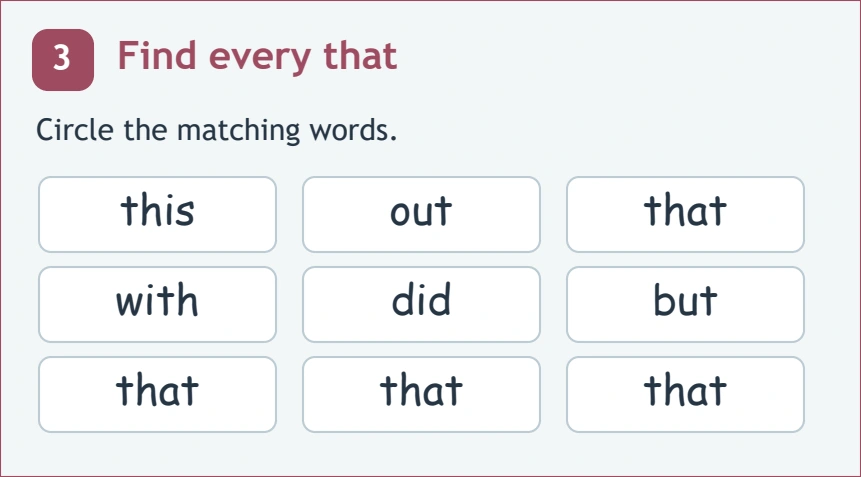
Adult that key: 3, 7, 8, 9. The bottom row contains three matches. A child who assumes that each row must hold just one answer may stop too early. Read the instruction as a request for every match, then inspect each cell on its own evidence.
Other distractors include with, which contains th at the end, and but, which finishes with t. Neither is the target. Ask for a complete comparison instead of a single-letter justification. A circle can be revised after inspection; the correction itself can show more careful attention than an initially lucky choice.
Trace the entire sequence, then say the message
The two dotted models each show the complete spelling. Begin at the left, follow t-h-a-t and say the finished word. The neighbouring space on the guide allows an independent attempt with the model still visible. A four-letter word may need more room and effort than a two-letter target, so keep the pencil demand comfortable.

When letter formation becomes the main difficulty, separate it from the language question. The learner can correctly select a berry while still struggling to make a readable a. An adult may demonstrate that letter on spare paper, then return to a short copy rather than asking for repeated full sentences immediately.
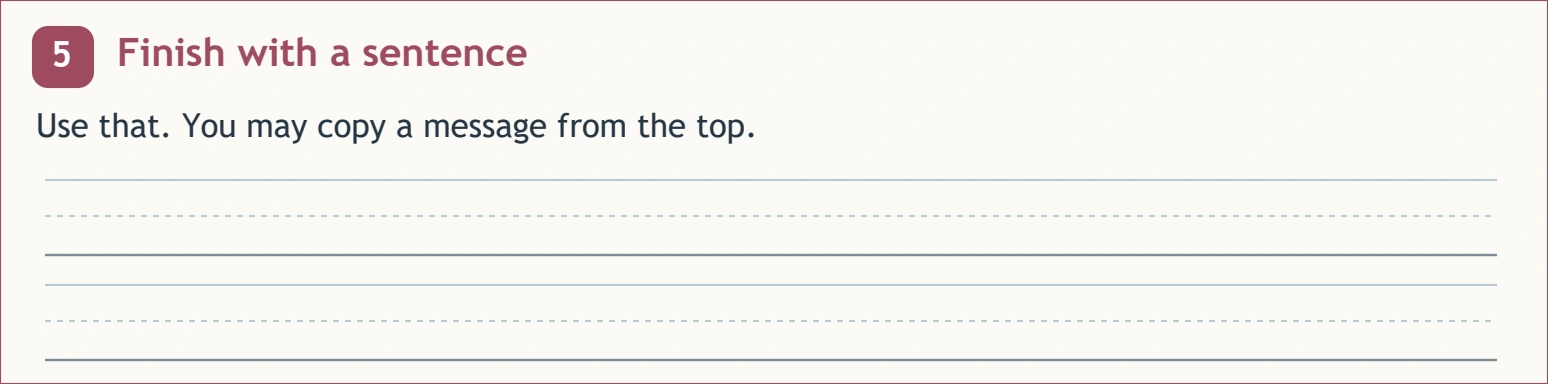
The final area offers two ruled lines for a message containing that. Copying a source sentence is permitted. For a new sentence, let the child say the idea first and make sure the listener can identify the intended object. Keep the selected berry clear while an adult supplies harder spellings around the child's that.
Six benefits to notice in a berry conversation
- Shared reference: a listener identifies the particular berry indicated by the speaker.
- Purposeful speaking: describing a colour and expressing a choice become two distinct message intentions.
- Case awareness: the capitalised sentence opening is connected with the lowercase word model.
- Repeated-letter reasoning: both t positions are preserved when building the four-letter sequence.
- Careful discrimination: the learner checks the endings of this and that rather than relying on th alone.
- Sentence planning: a spoken idea is rehearsed before it reaches the final ruled lines.
Keep a separate note for the berry reference and the repeated t spelling. A child can make a clear choice yet still omit the closing letter.
Noor's home example: choose a pretend fruit
In a possible home session, Noor and an adult set two paper berries on a cloth. Noor points to one and says which berry is wanted. The adult responds with the complete that sentence, then offers Noor a turn to repeat or change the message. The fruit remains pretend, and personal food preferences do not need to enter the activity.
They move to the reading banner, find that in both positions and build its spelling with two t pieces. Noor might circle the top search row before taking a break. The adult saves the remaining rows for later rather than treating an unfinished page as an unsuccessful session.
To finish, Noor dictates a new sentence about a toy across the table. The adult checks that the listener knows which toy is meant, writes the unfamiliar words and invites Noor to add that. This scenario shows a route from an ordinary choice to print without promising that every child will respond in the same way.
A partner game for a small classroom group
Provide a pair of clearly visible classroom objects and establish who is speaking. One child indicates an object with a that message; the partner points to the intended item. Then switch roles. If the partner chooses a different object, pause to improve the gesture or add information rather than simply announcing an error.
After the oral turn, each reader can inspect the printed this distractor beside that. The teacher asks one learner to explain the changed ending and another to identify the second t required by the bank. This creates two separate checks: communication about an object and attention to spelling.
The writing finish can be differentiated quietly. Some children copy the colour statement; others dictate a choice sentence or write a fresh one. Keep each learner's model visible as needed. A confident partner should listen and point, not fill another child's response boxes.
Respond to a particular stumbling point
| A berry-lesson difficulty | Focus your support | Look for this next |
|---|---|---|
| Uses this for both printed forms | Inspect a-t beside i-s after the shared th. | A decision based on the ending. |
| Builds only three letters | Count the four positions and restore the closing t. | Two t pieces in distinct places. |
| Stops after one circle in a row | Check each remaining cell independently. | All three bottom-row matches considered. |
| Listener cannot identify the chosen berry | Clarify pointing and shared context. | A message the partner can act on. |
Five ways to keep that useful beyond the grid
1. Create a pointing gallery with two completed picture captions. The child selects a picture and explains which caption fits, using that to identify the chosen one.
2. Set out duplicate t tiles deliberately. Ask a puppet to build the word while omitting the final tile, then invite the learner to repair the unfinished spelling.
3. Play near-and-far shopping with safe toy objects. Take turns requesting a particular item across the counter, always making the intended reference understandable.
4. Write this and that on separate completed cards. Sort a few spoken examples by checking the printed ending rather than memorising card colour or location.
5. Dictate a caption for a family drawing. An adult supplies the longer words while the child contributes that and reads the finished statement to someone who can see the drawing.
Suitable readers and a steady practice rhythm
Around ages 4–6, the berry choice can be discussed orally while letter formation is still developing; the four-letter copy should reflect actual readiness. Children need opportunities to understand the spoken example before being expected to explain a grammar term. The pencil section can be shortened when letter formation is still developing.
Return to the target through a real choice rather than starting every visit with a spelling demand. A brief pointing game can reveal whether the word's purpose remains clear. Later, show a different completed sentence containing that and invite a careful read. Praise a specific contribution such as retaining the second t or making the selected object clear.
For earlier short-word lessons, browse the starter reading routes. The pencil discovery activities provide another route when motor demands need attention. A separate eat worksheet can extend a pretend fruit conversation without adding more words to today's search task.
Adults can find shared-play prompts through NAEYC's resources for families and explore additional everyday learning ideas at PBS Parents. Choose one idea with a clear communication purpose rather than trying to fit every extension into a single visit.
Print the berry lesson or continue into the collection
Choose the berry sample for the original supplied arrangement. A member whose plan includes this option can unlock the clean berry PDF using the premium control. The clean edition retains each source task while introducing reading first. Website branding and the domain have been removed, and the printable worksheet includes neither watermark overlays nor advertising panels.
Check one US Letter berry print for an intact frame and four usable response boxes. The optional loose-letter set needs two t pieces, not just one. A pencil is otherwise sufficient. The collection card provides a $5 route to all twenty-six clean primer pages in one ordered download when you want to continue beyond this particular pointing word.
Popular Worksheets
Printable resources families and teachers are downloading now.
 Free
 Free
 Free
 Free