
She Sight Word: 5 Wonderful Pear Practice Activities
Continue beyond she with twenty-six clean reading-first practice sheets in one $5 printable collection.
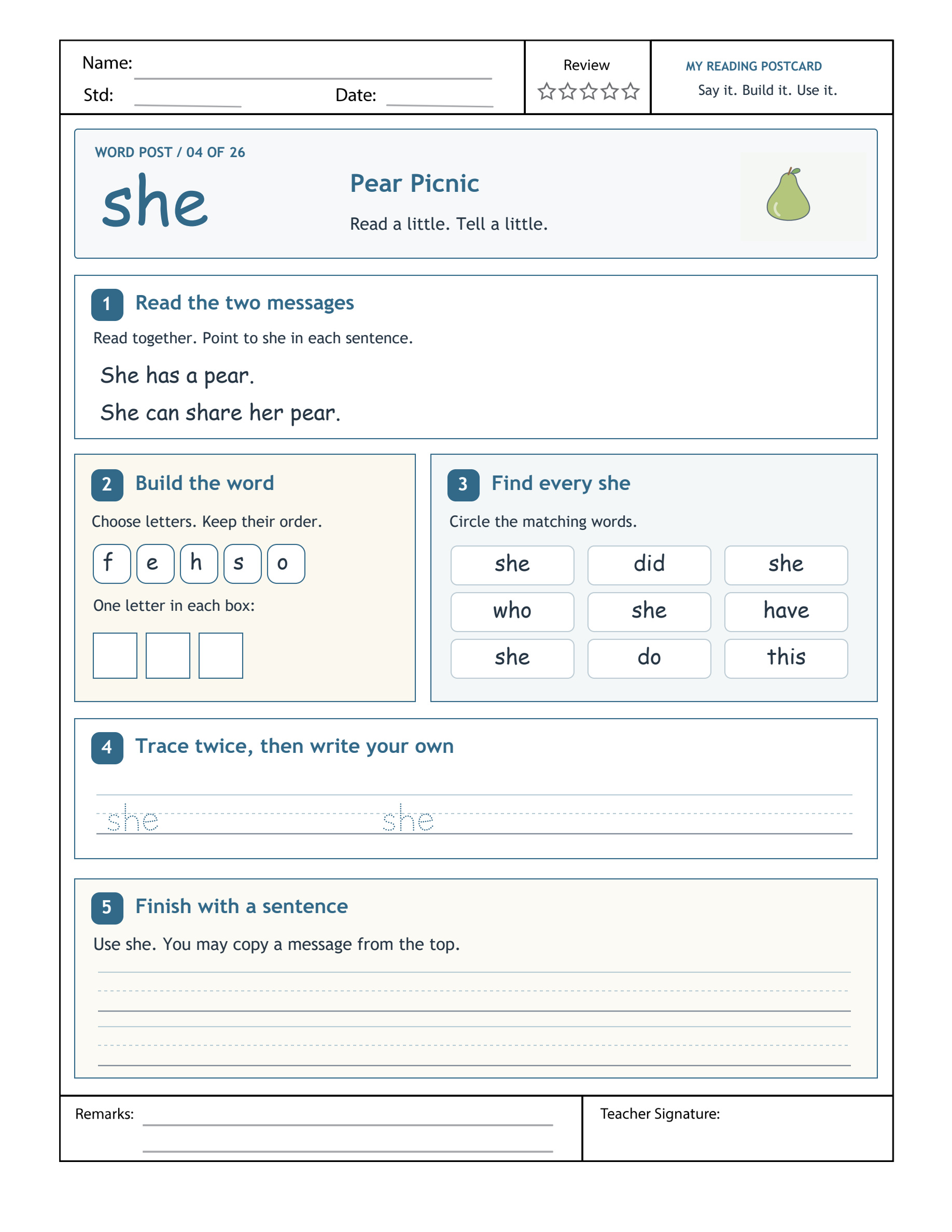
The full she sheet retains its US Letter frame.
Refer back to a named pear-sharing character without repeating her name. The complete redesigned page appears without cropping.
Sharing a pear gives Lena something to do and a listener something to describe. In this She Sight Word activity, children first meet a named character, then use she to keep talking about that character without repeating the name. Two pear sentences accompany a spelling bank, a matching search and guided handwriting. The resource is designed for a conversation as well as a pencil: adults can model the reference, hear the child's idea and choose a manageable amount of writing. A clean reading-first version accompanies the retained original sample through the membership download option.
Begin with the person behind the pronoun
Introduce Lena as a character who uses she. Place her name beside a picture or a toy and describe the pear she holds. Then replace Lena with she in a second statement. The listener should still know whom the sentence concerns. A pronoun is useful because the conversation has already supplied its reference.
Keep this introduction explicit. Clothes, hair and favourite colours do not establish a person's pronouns. The illustrated Lena has a name and a she label so that the intended reference is available to both speaker and listener. Children can use a different familiar character if that reference is equally clear.
The target does not mean pear or sharing. Those details belong to the sentence around it. You might introduce Lena holding a book instead, say a new she sentence and show that the pronoun can remain useful when the object changes. This small variation prevents the worksheet picture from becoming the child's only cue.
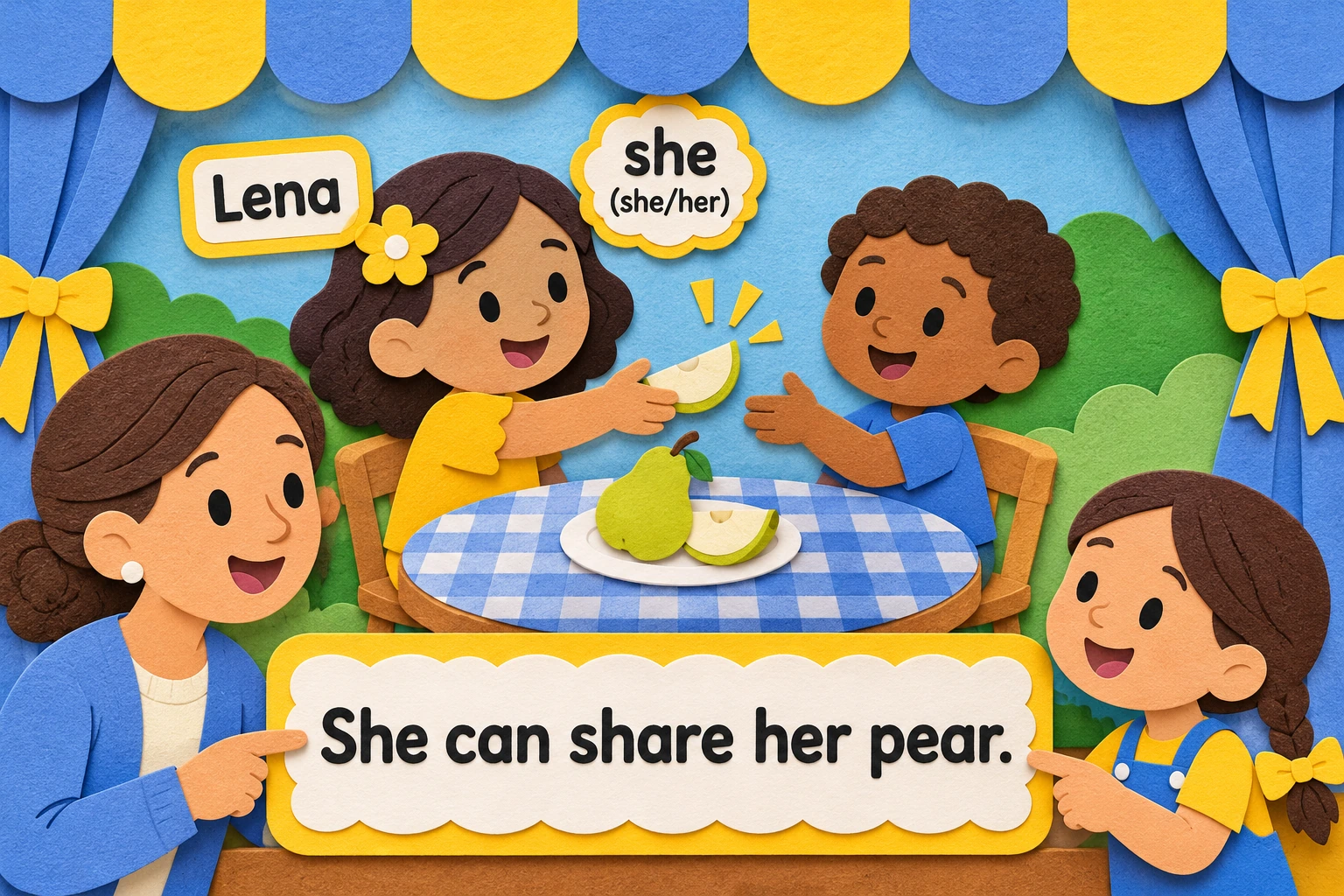
Two messages about Lena's pear
“She has a pear.” tells what the character has. “She can share her pear.” adds a possibility involving someone else. Speak each sentence as a complete thought, then invite the learner to point towards she. Adult help with has, share or the other surrounding vocabulary is appropriate during this guided activity.

Both examples use capital She at the beginning. The separate model shows lowercase she. Compare S with s and connect the two appearances through their common h-e ending and spoken word. A child should not have to guess whether capitalisation has created another pronoun.
The second sentence also contains her. Explain its role only as much as the child's question requires: the pear belongs to the character being discussed. Her is not an additional target to circle in this lesson. Read the complete source message accurately while keeping the spelling investigation centred on s-h-e.
Decide what sort of help is needed today
Before choosing a pencil task, listen to one oral response. Can the child identify Lena when you say she? Can the child point to the written word when it is spoken? Can the child name some of its letters? These are related but distinguishable observations.
| Starting observation | A pear-lesson response | What can wait |
|---|---|---|
| Knows Lena but not the print | Pair one spoken she sentence with its visible spelling. | An independent search of all nine cells. |
| Recognises she by its beginning | Compare the complete s-h-e sequence with each choice. | Reading every distractor aloud without support. |
| Can explain the pronoun orally | Build the spelling and prepare one sentence to copy. | A demand for several original written sentences. |
| Writes comfortably and reads the model | Compose another clear message about the named character. | Extra repetition solely to fill the page. |
An adult can keep the large word model visible throughout. Support is part of using the resource, not something to remove as soon as a child makes one correct response. A useful challenge is one the learner can understand and attempt with confidence.
She Sight Word choices inside the search
The nine cells read she, did, she; who, she, have; she, do, this. Matching requires all three letters in the right sequence. Four entries qualify. Adult she key: 1, 3, 5, 7.
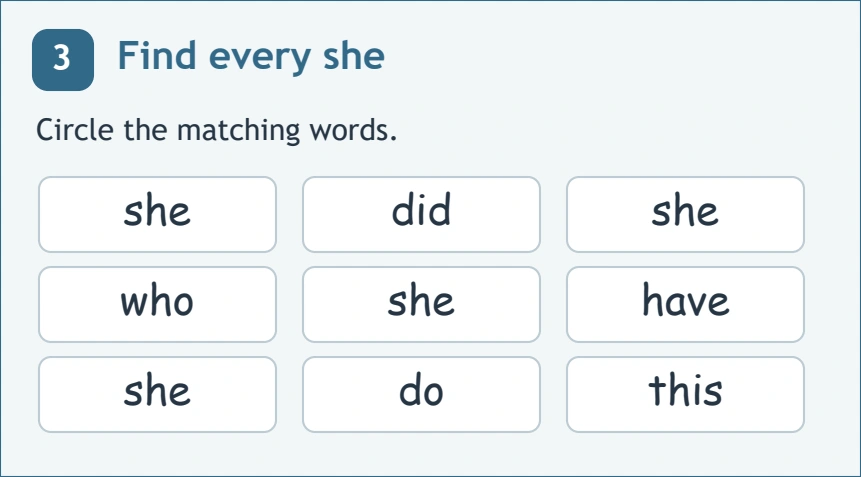
Who contains h, and this contains s, but those shared letters do not make either spelling she. Have also begins with a letter present in the target, yet it is a different whole word. Encourage the reader to compare beginnings, middles and endings before making a circle.
Use a small counter to hold a search position if the learner skips around. The counter can move from cell to cell while the child decides. Do not ask for speed. Accurate inspection and the ability to explain a decision are better guides to the next teaching step than the number of seconds spent completing the grid.
A bank that has the right letters in the wrong arrangement
The printed bank contains f, e, h, s and o. Select s, then h, then e to fill the three response boxes. The spare f and o remain unused. A child who copies the first three bank letters has followed the display order rather than the target spelling; that is an understandable misunderstanding to correct directly.
Point to the large she model and let the learner locate each required letter. Saying the letter names helps establish the sequence. For the spoken word, read she naturally rather than pronouncing s and h as separate beginning sounds. The sh opening works together in this word, followed by the long e sound.
Loose letters can make the distinction easier to see. The child moves the selected pieces into order, checks them against the print and writes the same sequence. Keep that rehearsal short enough that there is still energy for a sentence about Lena rather than turning the bank into a long alphabet-naming exercise.
What the pencil stations ask for
Use the two she guides to practise the s curve before a separate three-letter attempt. The remaining guide offers space to try the complete word. A learner may need a demonstration of the curved s, the tall h or the smaller e. Show the specific movement on spare paper, then let the child attempt the target without expecting adult-like uniformity.
The closing task requests a sentence using she and permits copying a source example. Say the intended message before writing it. If the child wants to describe Lena sharing a book, an adult can supply the unfamiliar spelling of book while the child contributes she and the words already within reach.
Lena's clean pear sheet begins with her two messages, then offers the letter bank alongside its matching choices. Guided she copies and the final sentence area come afterwards. The supplied sample uses tracing as its opening task. The reorganisation preserves five activities, the established border and the original US Letter size.
Six signs of purposeful practice
- A stable referent: the child can show which introduced character she concerns.
- A changed object: the same pronoun remains meaningful when Lena holds something other than a pear.
- A joined beginning: the spoken sh opening is connected with its two written letters.
- A full spelling check: shared individual letters do not cause unrelated search choices to be circled.
- A planned copy: s-h-e is rehearsed before the pencil follows or writes it.
- A listener's understanding: the final sentence gives someone else a clear idea about Lena.
Observe whether Lena remains the understood subject when the pear changes to another object. Note s-h-e formation separately from that reference decision.
At home, give a puppet a helpful introduction
A possible family session uses a puppet called Lena and a paper pear. The adult says Lena uses she and describes what she has. The child passes the pear to another puppet while the adult reads the sharing sentence. If the child wants to keep the pear in the story, accept that choice; understanding a printed possibility does not require acting it out.
Next, the learner points to She in the reading banner and finds s-h-e in the bank. One or two search decisions may be enough before the pair returns to the puppet. The adult asks for another statement that a listener could understand, with Lena still clearly established as the subject.
The family can finish with a dictated caption. The child supplies she, and the adult helps record the rest. This imagined visit demonstrates how the page might join shared play. It is not a testimonial, a measured classroom result or a promise that one character game will produce fluent reading.
A classroom caption desk with shared references
Set up a small caption desk with a clearly named story character and two object pictures. Tell the group which pronoun the character uses. One learner chooses an object, another says a she statement, and a partner identifies the character concerned. The teacher listens for a reference that remains clear across the exchange.
Move into the worksheet after the oral message has a purpose. Some readers can inspect the four search matches, while another learner benefits from an adult pointing under s-h-e. For writers who are ready, replace pear in a new dictated sentence with the selected object. Explain that this extension is separate from the unchanged printed examples.
Close the station by rereading a child's caption to the group. Ask whether listeners can tell who she means. If a new listener has not met the character, introduce Lena before repeating the caption. That small repair shows why pronouns rely on shared knowledge instead of functioning as stand-alone names.
Five extensions for reference and spelling
1. Make a character greeting card with a completed name label and a clear pronoun statement. The child introduces the character to a visitor before reading a she message.
2. Use a puppet to select f-e-h from the bank deliberately. Let the learner compare it with she, choose s and restore the proper reading order.
3. Draw Lena with a different familiar object and dictate a fresh caption. Point out that the object changes while the established subject can still be described with she.
4. Place she beside two unrelated words on completed cards. Ask the reader to explain the choice using all three letters rather than card colour or position.
5. Practise a speaker-and-listener turn. One partner introduces a character and adds a pronoun sentence; the other names the intended person. Change roles after a clear response.
A comfortable pace for young readers
Lena's pear lesson suits adult-supported reading near ages 4–6, with the amount written chosen after hearing how clearly the learner identifies the character. The pronoun discussion can be entirely oral at first. Someone who understands the reference may still need help forming s or reading the surrounding sentence vocabulary.
Avoid using the same pear picture as the only recognition cue on every visit. After a familiar reread, try a new completed sentence about Lena and check the actual letters. Also avoid correcting every unknown spelling in an original sentence at once. Select the target and one manageable writing goal so that the message remains worth telling.
For related preparation, the earlier short-word collection offers a separate starting route. The prewriting workshop pack can support a learner whose pencil effort is the immediate challenge. A snack-themed conversation may continue through the eat word activity when the child is ready for another focus.
For play-based conversation ideas, consult NAEYC's family materials on play. The activities at PBS Parents' learning hub can also inspire a character story away from the worksheet.
Obtain and print the pear practice page
The free pear download preserves the source page. Eligible members have a clean premium alternative whose new interior starts with reading and keeps every source activity. The website name, domain and watermark are absent from that PDF; it also has no advertising within the worksheet. Select this edition before preparing a clean class or home copy.
Use a single US Letter trial to check Lena's frame and dotted she models. Keep the print large enough for comfortable letters rather than shrinking several lessons onto one sheet. A pencil is enough, with a named puppet as optional support. The $5 companion collection links the twenty-six clean primer lessons in one file for adults planning further word visits.
Popular Worksheets
Printable resources families and teachers are downloading now.
 Free
 Free
 Free
 Free