
Violin V Visit: 4 Clever Letter Practice Encounters
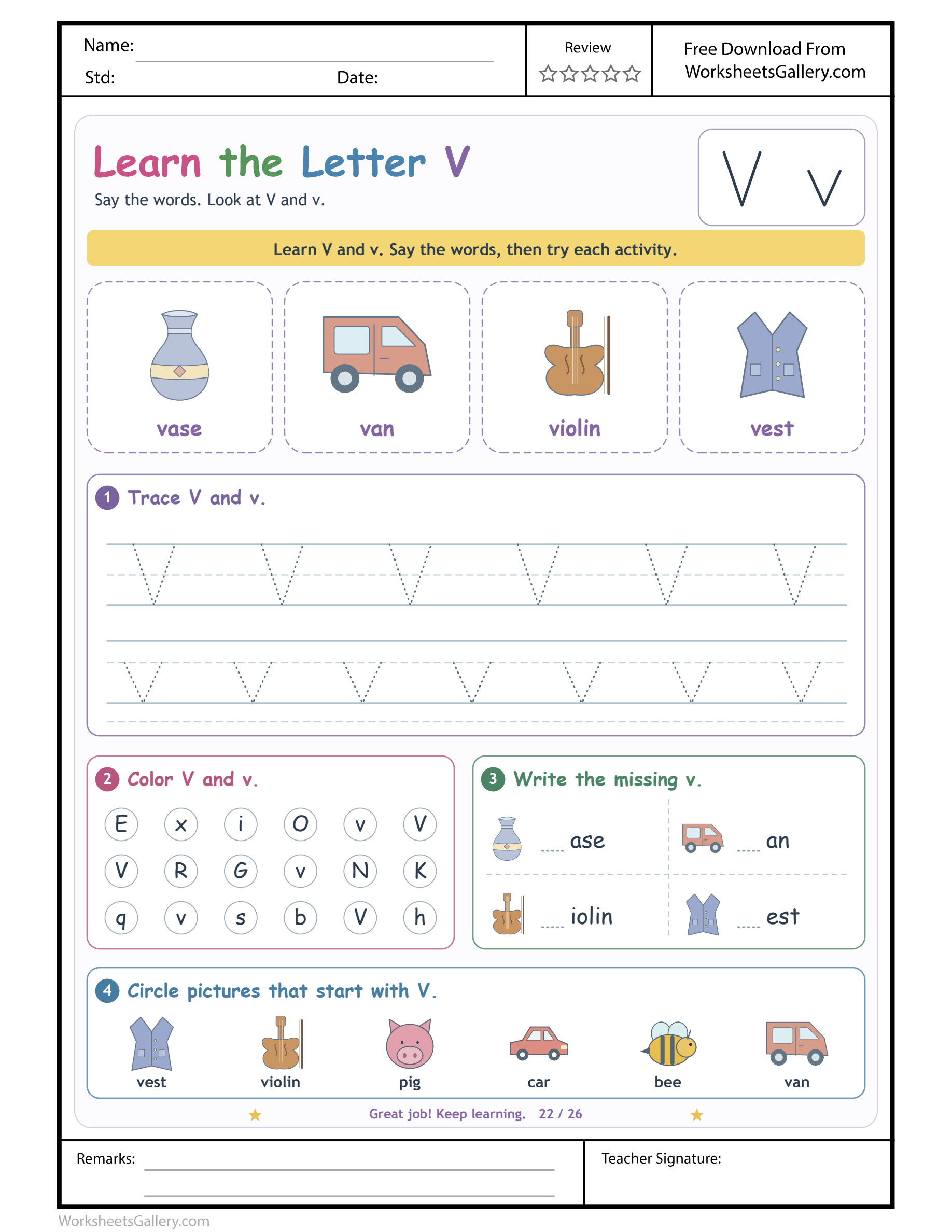
Violin V Visit: Compare the two sloping strokes in V and v while using the printed vase name rather than a naming guess.
Violins can visit a pretend shop alongside a vest, a van and a vase, giving four names a shared printed beginning. Violin V Visit invites children to explore Vv through named-picture decisions, Vv case matching, tracing and initial repairs. Adult reading gives those names a voice while the learner inspects a visible v. Playing an instrument or reading every label independently is unnecessary before joining in. Keep the complete references nearby, welcome questions about the drawings and choose a short response that suits the child's interest and hand comfort today.
Four labels make a small shop window — Violin V Visit
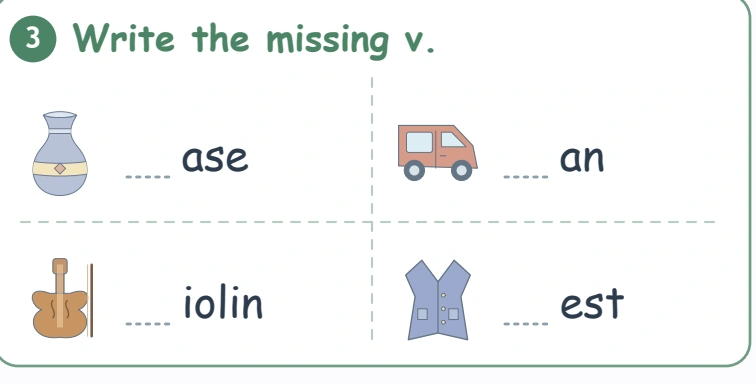
The upper Violin V Visit bank contains vase, van, violin and vest. Read those exact names with the learner, then inspect their first v. A child can describe where a vase belongs or what a van carries without having to understand every internal spelling in violin.
Alternative names may arise. A vase could be called a pot, or a vest might be described by another familiar clothing term. Acknowledge the description and read the supplied label before making an initial-letter judgement. The worksheet compares its chosen written names, rather than testing whether only one everyday word can name a drawing.
Similar outlines still deserve a case comparison: Violin V Visit
Capital V and lowercase v on Violin V Visit have related slanting forms. Look at their printed sizes and placements rather than assuming the case distinction needs no introduction. A learner can recognise the relationship while still needing guidance about which form belongs in a writing gap.
Compare the full pair of slants and their meeting point. A single diagonal by itself is not enough evidence to accept another letter as V. Pointing to a visible feature can communicate a sound decision without requiring the child to use a formal vocabulary for letter parts.
Vera's imagined music-shop visit: Violin V Visit
Picture Vera arranging a toy van and a paper vest beside a pretend violin display at home. A grown-up reads the labels on Violin V Visit, then asks which first written character they share. Vera chooses one small model to inspect before returning to the shop story.
This invented example offers a way to give print a purpose. It does not describe a documented learning result. An adult might write a dictated shop sign on spare paper while Vera supplies the words, letting a brief comparison accompany imaginative play rather than requiring every worksheet panel to be finished first.
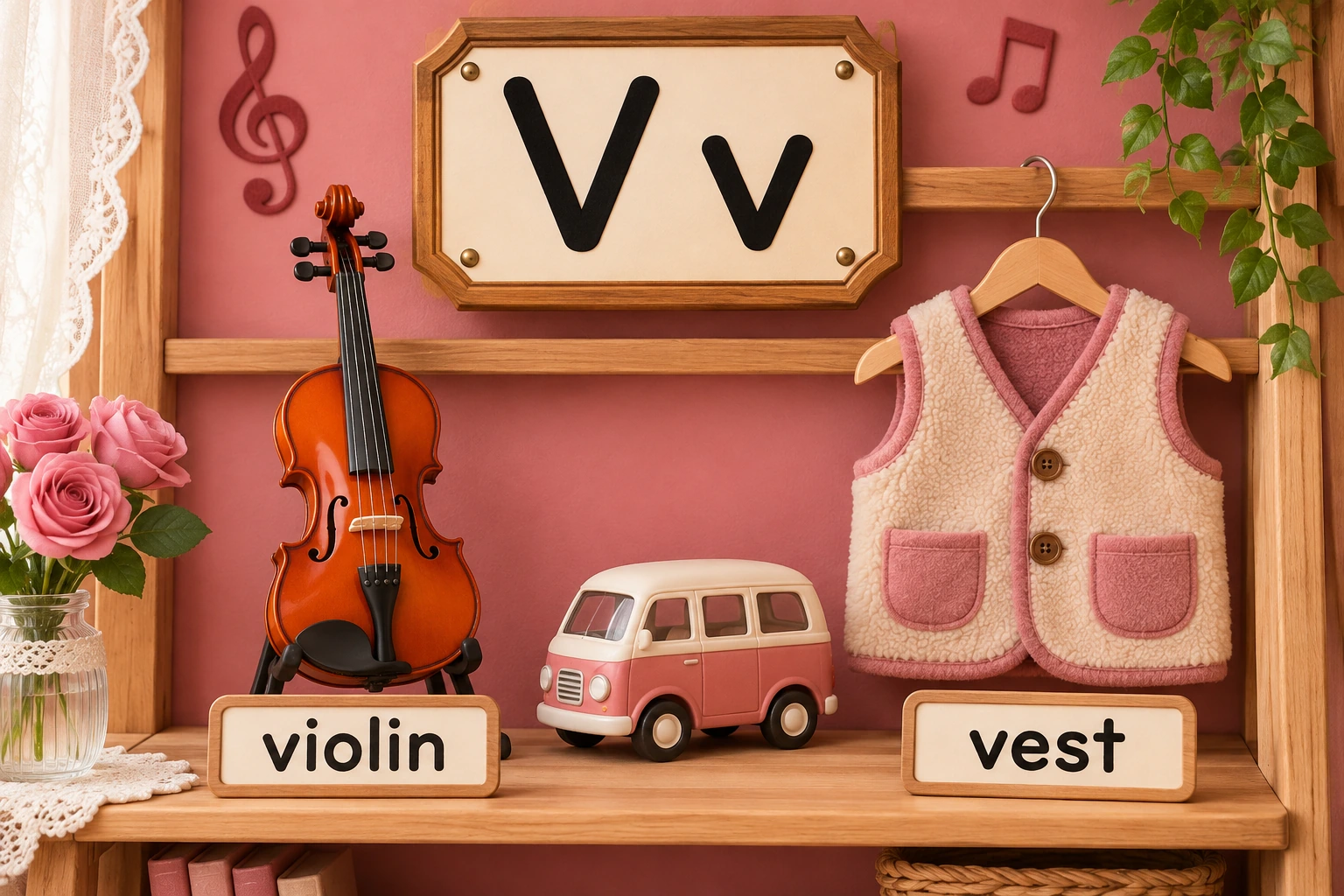
Check the printed tasks with an adult map: Violin V Visit
| Violin V Visit activity | Adult quick check | Source detail |
|---|---|---|
| Trace V/v | 6 V models;7 v models | Violin V Visit guide rows |
| Find Vv cases | 5, 6, 7, 10, 14, 17 | 6 matches in the Vv circle field |
| Complete vase through vest | v | Vv: initial v |
| Picture-name check | vest, violin, van | 3 choices fit Vv |
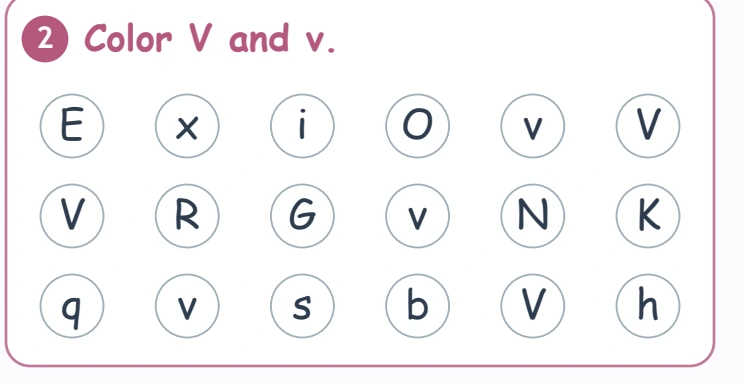
The Violin V Visit case field contains eighteen circles across three six-choice rows. Six match Vv, with three capitals and three lowercase forms. Three names qualify in the final picture strip under a different rule. For the Vv table, read locations row by row from the left edge; picture-name selection remains a separate instruction.
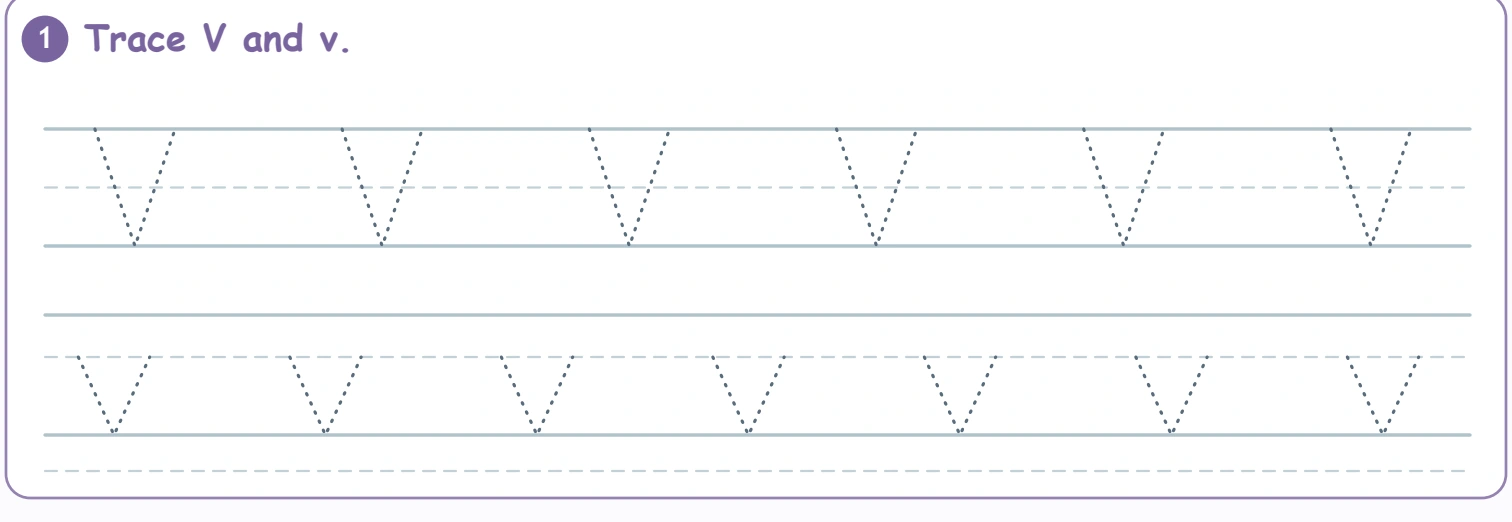
Trace slants with enough room to notice them: Violin V Visit
Six capital V dotted guides and seven lowercase v guides appear on Violin V Visit. Inspect one model before tracing it with a finger or pencil. A larger adult example on separate paper can make the meeting point clearer when the narrow Vv guide makes the slant hard to inspect.
There are no numbered formation arrows in the source. Any extra adult demonstration should stay distinct from what the PDF actually prescribes. Hold the sheet steady, choose a manageable tool and pause if the hand tires. A small deliberate sample can provide enough movement to discuss without completing every available guide.
Search for complete matches in either case: Violin V Visit
Leave V and v visible during the Violin V Visit recognition task. One row can be an accessible starting amount, keeping unchosen Vv rows under another sheet when fewer choices are helpful. Decide whether a candidate matches before adding colour.
Ask the learner to show the supporting feature. The adult can check six targets after the decisions, without turning that total into a reason to mark doubtful circles. Finding only capitals may call for a renewed small-case comparison. Naming every distractor is unnecessary when a direct target-to-candidate look will answer the question.
Five opportunities to notice thoughtful work: Violin V Visit
- Whole-form attention. Comparing both slants and their meeting point encourages more than a partial glance.
- Case understanding. Related large and small forms can be identified while the requested writing case stays clear.
- Vocabulary clarification. A supplied vase label establishes which word is being judged.
- Reference-guided repair. The full violin name makes its missing initial visible.
- Directed hand movement. A v traced once provides an example of the hand following a visible angle before another task is chosen.
These possibilities around Violin V Visit are not guaranteed changes after printing. Observe the actual explanation and movement separately. A child can understand a picture name's initial while preferring to point rather than write; preserving that answer method can keep the comparison useful and comfortable.
Four initial gaps need a lowercase v: Violin V Visit
The Violin V Visit fragments are ase, an, iolin and est. Compare them with vase, van, violin and vest above, then add one small v at the beginning of each selected name. An is already a useful word elsewhere, but the van picture and its full label clarify the intended completion here.
Leave the existing letters unchanged. If capital V is offered, recognise the correct letter identity while showing the small form requested. A movable lowercase card can make the answer visible before the learner chooses whether to use the narrow pencil space.
Vest, violin and van fit the final instruction: Violin V Visit
The bottom Violin V Visit strip names vest, violin, pig, car, bee and van. Vest, violin and van are the initial-V answers. Vase belongs in the upper word bank but is absent from the lower choices, so it should not be treated as an extra picture to find below.
A van and car could form a vehicle group, and pig and bee could form an animal group. Those are meaningful rules for other games. This panel instead compares the supplied written beginnings. State that current rule before asking a learner to reconsider another sensible way of grouping.

A possible classroom instrument-and-clothing table: Violin V Visit
For a hypothetical group activity, a teacher displays a violin picture and a vest with completed name cards near Violin V Visit. Pupils hear the labels, describe the items and inspect the shared first character. A larger case pair can introduce both targets before individual responses begin.
One learner might point at a search circle while another adds a small v to a fragment. Ask which reference helped rather than comparing speed or finished marks. This proposed scene supports different ways to participate and makes no claim about a class having trialled the download.
Four extensions for the Vv shop
Give the van a delivery note: Violin V Visit
Invite a sentence about what a toy van brings to the shop. An adult writes the child's dictation on spare paper and reads it back. If van appears in the message, inspect its opening v after the delivery has been described. Other words belong freely in the customer’s story.
Clarify a vase's particular label: Violin V Visit
Place a complete vase card beside a toy container. Discuss other names a child knows, then return to vase for its initial v. This extends Violin V Visit's label-based decision without suggesting that familiar alternative words are unacceptable in everyday talk.
Repair an instrument's beginning at a larger size: Violin V Visit
Offer an iolin fragment, a complete violin reference and a large lowercase v. Moving the missing character into place repeats the print choice with a broader hand action. Narrow handwriting can wait until the learner wants to try it.
Change the shop's grouping instruction: Violin V Visit
Use separate vest, van and car cards. First group by vehicles, then by initial v. Talk about what changes. The rule determines which connection matters now, allowing another sensible grouping to remain valid in a different game.
Let readiness guide the response method: Violin V Visit
Vera’s music-shop invitation is aimed at preschool and kindergarten exploration, commonly ages three to six, with Violin V Visit supported by an adult. Spoken naming and visual pointing can be comfortable before small slanting traces. Provide a stable surface, a manageable tool and larger references as needed, choosing an amount the learner approaches willingly.
Common slips include accepting a partial diagonal, finding only one case, substituting an everyday object name without checking the printed label, or putting V where v belongs. Return to the particular model or label that supplies useful evidence. When correction becomes frustrating, finish with a clear oral comparison rather than repeated erasing.
Reopen the shop with a different small question: Violin V Visit
A later Violin V Visit visit could begin with vest after an earlier violin conversation. One circle row or one restored initial can provide a fresh focus. Combine these brief encounters with books, pretend deliveries and drawing with the shop’s chosen label providing a fresh question for each encounter.
Offer concrete language, for instance “You checked the label before choosing its first letter.” Let Vera nominate the next shop label and end the visit when attention wanes. Remaining panels can serve as future invitations, while the observation already made receives attention now.
Save a Vv edition for printing: Violin V Visit
The uploaded Learn the Letter Vv original remains free to download. The clean Violin V Visit edition is a separate premium PDF for an active eligible member account. It keeps the violin, vest and other exercises, removing domain promotion, website watermark and worksheet advertising from the printable content.
For every letter together, follow the native library link to a separate $5 product containing twenty-six clean sheets. Save an authorised Violin V Visit edition and check US Letter settings before printing, keeping the source size where possible. Use the PDF with its intact case guides; a shop illustration or panel close-up is intended for viewing alongside the explanation.
Other print experiences for a curious visitor: Violin V Visit
Violin V Visit connections: Violin labels can lead to Vv Letter Viewer. Revisit the Vv pair through Vv Worksheet; for a different kind of print check after the shop visit, consider Picnic Letter Order.
Adults extending Violin V Visit may find NAEYC's pages about family play and learning-and-growth resources from PBS Parents useful for broader planning. These external sources remain independent and do not endorse or add files to this download.
Popular Worksheets
Printable resources families and teachers are downloading now.
 Free
 Free
 Free
 Free