
Watch W Wordwork: 4 Wonderful Letter Discoveries
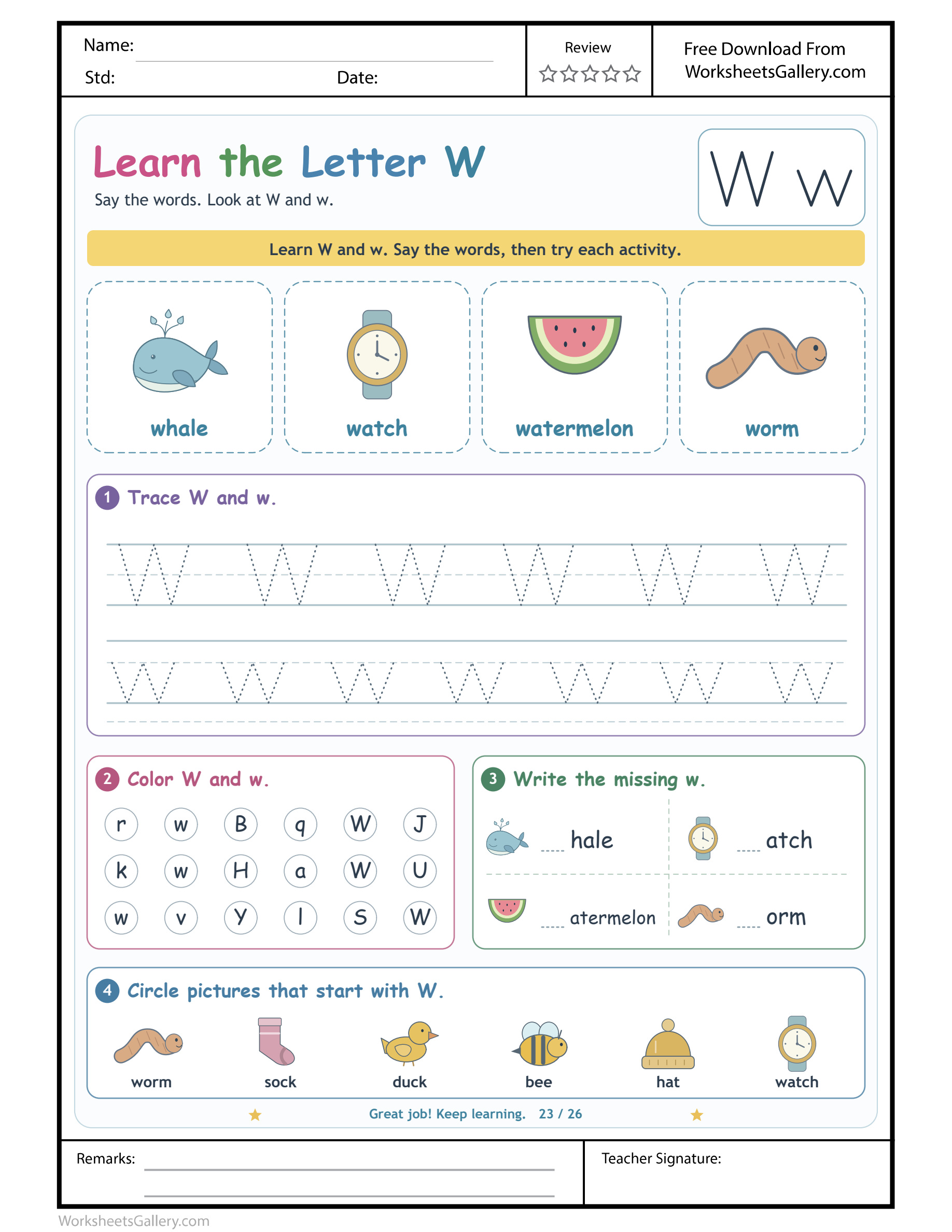
Watch W Wordwork: Keep both dips in W and w visible, then identify worm and watch among unrelated picture choices.
Watches and worms can share a pretend picnic even though their real-world jobs are very different. Watch W Wordwork brings whale, watch, watermelon and worm together through their written initial w. Four numbered panels offer tracing, case recognition, lowercase word repair and picture selection. Adults can read the names while learners inspect one visible letter at a time. The watch picture does not require telling time, and whale's longer spelling need not become an independent reading test. Begin with a picture that invites conversation, then choose a comfortable small observation or mark to make.
A shared written w is the immediate connection — Watch W Wordwork
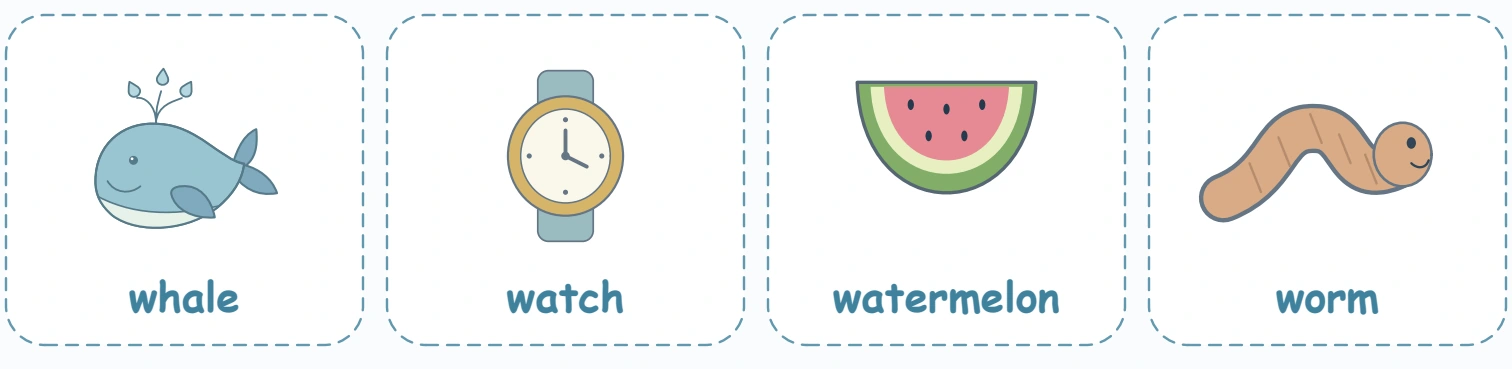
Read whale, watch, watermelon and worm from the upper Watch W Wordwork bank. Say the words naturally and point to their first written characters. Whale begins with the spelling wh, so do not present the initial w by itself as an explanation of the whole word's opening sound.
An adult can supply watermelon without expecting the child to decode its internal letters. The picture vocabulary gives print a meaning, while the worksheet's target remains a case or initial comparison. Familiarity with an object and independent reading of its full label are different demands that can be supported separately.
One watch, without a time-reading task: Watch W Wordwork
The Watch W Wordwork watch drawing is a named picture. A learner can choose it for its label's first w without reading the hands on its face. If time becomes an interesting side conversation, enjoy it separately rather than making clock knowledge a condition for joining this letter activity.
Similarly, a whale can invite talk about size or the sea while its complete written name stays available as a reference. The page's print task does not ask children to know facts about every pictured thing. Naming with adult help is enough to establish the word being compared.
Wrenna's imagined worm picnic: Watch W Wordwork
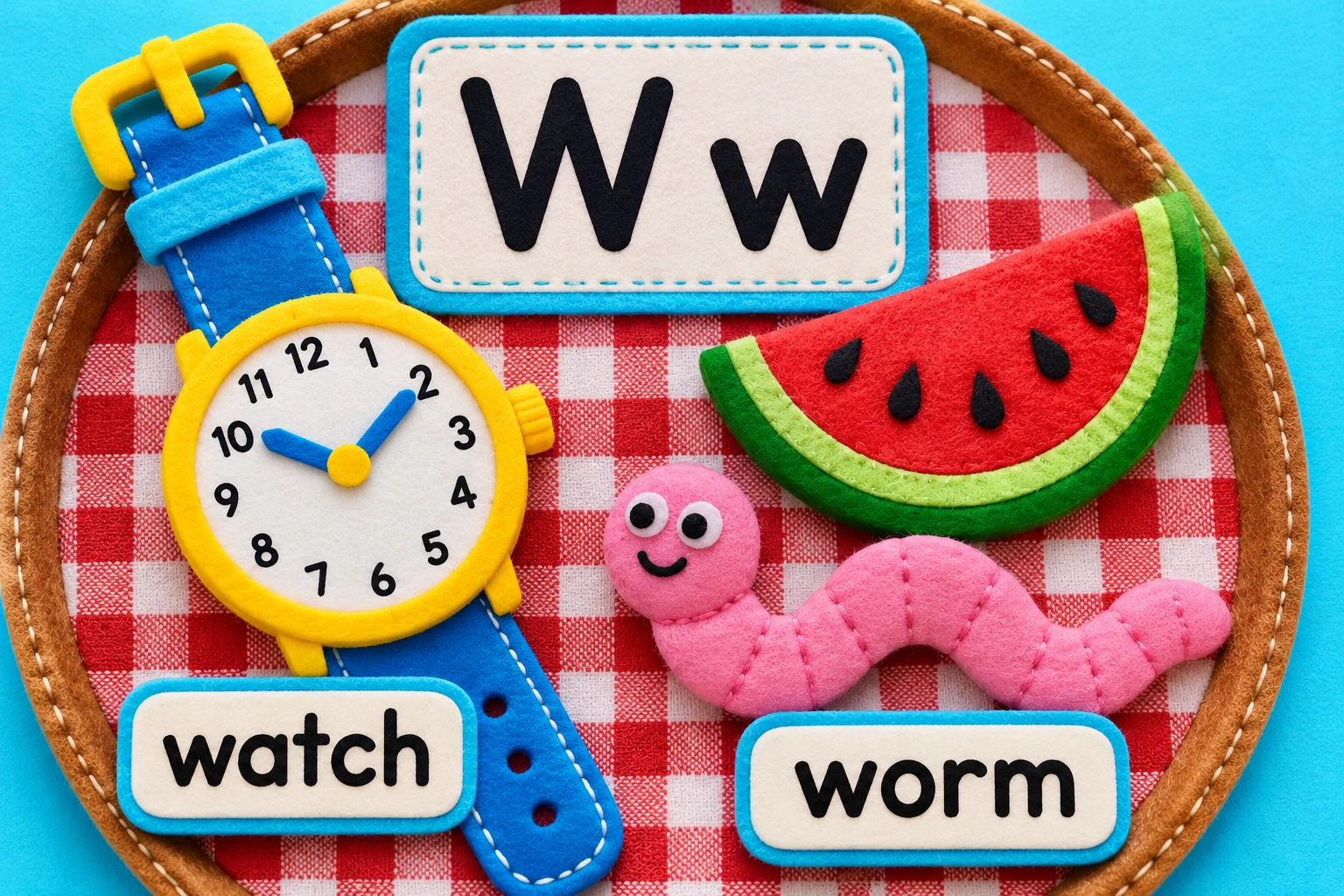
Picture Wrenna placing a paper worm beside pretend watermelon at home. A grown-up reads both labels on Watch W Wordwork and lets a toy watch become part of the picnic story. Wrenna points at the first characters and chooses one lowercase model to inspect before trying a word gap.
This fictional scene offers an activity idea rather than a recorded learning result. The adult can write a dictated picnic message on spare paper and read it back. A single clear comparison can accompany the play even if the remaining printed panels wait for another willing visit.
Keep four source checks within reach: Watch W Wordwork
| Watch W Wordwork activity | Adult quick check | Source detail |
|---|---|---|
| Trace W/w | 6 W models;7 w models | Watch W Wordwork guide rows |
| Find Ww cases | 2, 5, 8, 11, 13, 18 | 6 matches in the Ww circle field |
| Complete whale through worm | w | Ww: initial w |
| Picture-name check | worm, watch | 2 choices fit Ww |
The recognition panel on Watch W Wordwork arranges its eighteen choices as three six-circle rows. Six match Ww, divided into three capital and three lowercase forms. Two picture names qualify below. Count circle positions across rows when checking, keeping the picture total separate from the letter-search count.
Inspect the full set of slants: Watch W Wordwork
Capital W and lowercase w on Watch W Wordwork have related shapes, but both need to be introduced as the supplied targets. Look across the complete outline, including its two lower meeting points. A partial diagonal alone cannot decide whether another printed letter belongs.
The learner can show a feature with a finger rather than naming it formally. Leave the references visible while comparing candidates. If another font elsewhere looks different, discuss it as an additional example and return to this sheet's models for its immediate recognition task.
Trace a sample that leaves room for thought: Watch W Wordwork
The PDF supplies six capital W guides and seven lowercase w guides. Choose one Watch W Wordwork model, inspect it and try a finger trace before offering a pencil. A larger demonstration on spare paper may make the changes of direction easier to see.
No numbered formation arrows prescribe a route in the source. Keep any adult instruction distinct from the printed content. A stable page and manageable tool support the physical response, while a pause prevents fatigue from taking over. Thirteen examples are available, but a useful comparison does not require all thirteen to be completed at once.
Five ways to recognise thoughtful participation: Watch W Wordwork
- Whole-outline checking. Looking across the complete W or w encourages more than a quick glance at one slant.
- Case association. Related large and small forms can be recognised under one letter name.
- Meaningful vocabulary. An adult-read watermelon label gives a longer word a clear picture reference.
- Reference-guided repair. The intact watch name can guide the missing beginning below.
- Controlled movement. One traced form gives the hand a bounded path with an accessible stopping point.
These are opportunities around Watch W Wordwork, not guaranteed improvements. Observe the learner's actual explanation, attention and movement. A sound print decision may be expressed orally when close writing is uncomfortable, and a neat line by itself does not establish understanding of the separate picture rule.
Compare a circle before choosing a colour: Watch W Wordwork
During the Watch W Wordwork case search, leave both models in view. A single row can be a manageable starting area; separate covering paper can temporarily hide the others. Ask whether a candidate's entire form matches W or w before adding colour.
At the end, use the adult reference to verify all six Ww targets. Avoid using the total as pressure to mark doubtful shapes. Introduce the second Ww case explicitly when the child has noticed only capital targets. A direct target comparison can answer the question without requiring the learner to name every unrelated letter in the field.
Four fragments ask for one lowercase beginning: Watch W Wordwork
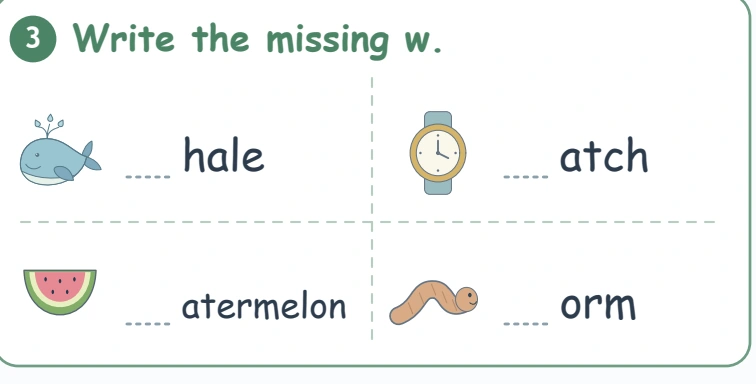
The Watch W Wordwork unfinished labels are hale, atch, atermelon and orm. Consult whale, watch, watermelon and worm above, then add one lowercase w at the opening. In whale, h is already printed after the gap; it is not another missing letter to insert.
Keep the remaining spelling unchanged, even when a word is long. If capital W is offered, recognise W as a sensible letter choice, then place its lowercase w reference beside the gap. A movable w can make the repair visible before the learner tries a narrow written space.
Worm and watch fit the final picture rule: Watch W Wordwork
The lower strip reads worm, sock, duck, bee, hat and watch. Worm and watch meet the Watch W Wordwork initial-W instruction. Whale and watermelon are upper-bank examples but are absent from this bottom set. Read the six actual names before deciding what to mark.
Worm, duck and bee could form an animal group in another game. Sock, hat and watch might belong together as things to wear. Those are sensible connections, but the worksheet uses the printed initial instead. Explain the current rule respectfully before correcting a different meaningful grouping.

A hypothetical classroom picnic-label table: Watch W Wordwork
For a possible class invitation, a teacher displays paper watermelon, a worm picture and completed labels near Watch W Wordwork. Pupils describe them, hear the names and find the shared first character. A watch picture can join without asking anyone to tell the time.
Children then choose a circle, gap or spoken comparison on their own copies. Invite pupils to describe the label or model that supported a particular Ww answer. This proposed routine accommodates different handwriting amounts and does not claim results from a classroom trial or a common pace for all learners.
Four extensions from the Ww picnic: Watch W Wordwork
Dictate a worm's invitation: Watch W Wordwork
Ask whom a pretend worm would invite to a picnic. Write the child's dictated sentence and read it back. Find a target word if it appears, while allowing any other language needed for the story rather than forcing an all-W message.
Read a watch label without its clock face: Watch W Wordwork
Place a complete watch card beside a toy watch. Locate w and compare it with worm. The initial decision can be made without reading the hands, keeping this print activity distinct from any later time-learning game.
Repair a long label at a larger size: Watch W Wordwork
Offer an atermelon fragment, a complete watermelon reference and a large lowercase w. Sliding the character into place repeats Watch W Wordwork's one-letter decision with a broader hand action. Length of the remaining word does not change the size of the answer.
Change the picnic's sorting heading: Watch W Wordwork
Use separate worm, duck and watch cards. Group animals first, then try w. Describe what moves when the instruction changes. Different rules can reveal different connections, while the final worksheet panel keeps its specific printed-initial requirement.
Match the response to current readiness: Watch W Wordwork
Wrenna’s picnic can introduce Watch W Wordwork for a learner near three to six years, using adult help at the relevant preschool or kindergarten level. Naming pictures and pointing can be comfortable before narrow tracing. Use a steady surface, a manageable tool and larger references when needed, letting willingness guide the amount of marking.
Common mix-ups include checking only one slant, searching only capitals, inserting another h into whale or selecting by a wearables theme. Show the exact model or existing print that resolves the particular uncertainty. If correction becomes frustrating, finish with an oral answer rather than repeated erasing.
Keep a return visit connected to curiosity: Watch W Wordwork
A later Watch W Wordwork encounter might begin with whale after an earlier worm story. One search row or one repaired beginning can provide a fresh focus. Books, pretend picnics and everyday labels can supply other print experiences between short worksheet visits.
Specific encouragement could be “You noticed the h was already printed before adding w.” Wrenna can select the next picnic picture while the visit ends at a comfortable moment. A partly marked sheet can still preserve a useful observation, with unused panels available when another reason to look appears.
Obtain a Ww edition for the printer: Watch W Wordwork
The free Ww control supplies the original Learn the Letter Ww upload. To obtain the clean Watch W Wordwork premium file, use a member account with current eligible access. Its watch, worm and vocabulary panels are retained without website watermark, promotional ads or domain branding on the worksheet.
The linked full library is purchased separately for $5 and contains twenty-six clean letter sheets merged into one PDF. Select its product page for that collection. Save Watch W Wordwork through your authorised route and inspect the US Letter preview at source scale. The saved PDF preserves the fine W/w guides for printing; the picnic illustration is supporting artwork.
Other invitations to talk about written names: Watch W Wordwork
Watch W Wordwork connections: Watch and worm talk gives Ww Letter Wanderer a place beside this page. Another Ww route appears in Ww Worksheet. If the picnic moves toward alphabet order, explore Dino Missing Capitals as a separate task.
Adults planning beyond Watch W Wordwork can read PBS Parents' resources for everyday learning and the NAEYC family collection on play. These external organisations remain independent and do not endorse this worksheet or add material to its download.
Popular Worksheets
Printable resources families and teachers are downloading now.
 Free
 Free
 Free
 Free