
Butterfly Mirror Drawing: 2 Wonderful Matching Wings
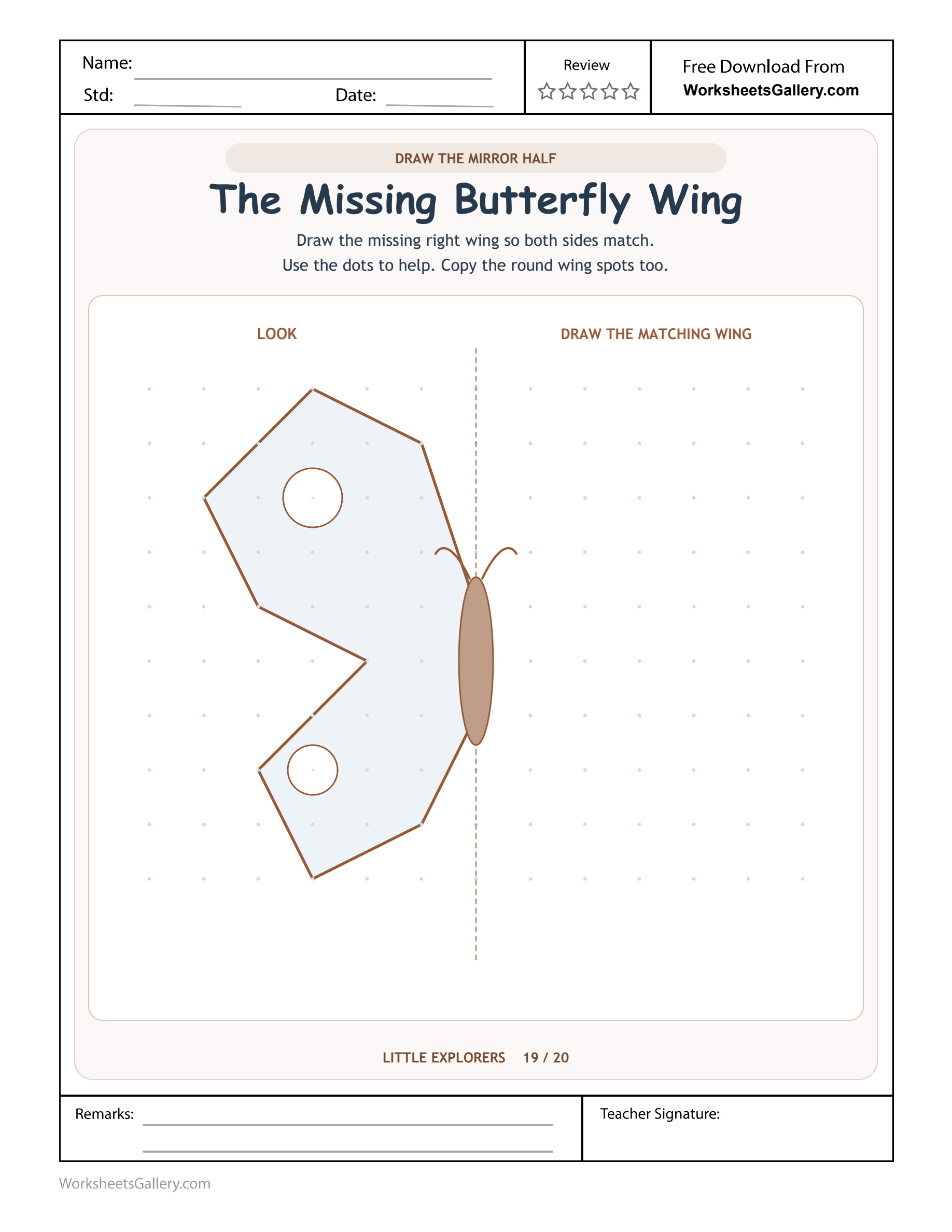
$5 collection companion: Butterfly Mirror Drawing. Reflect outline points and round spots across a vertical middle line without translating them.
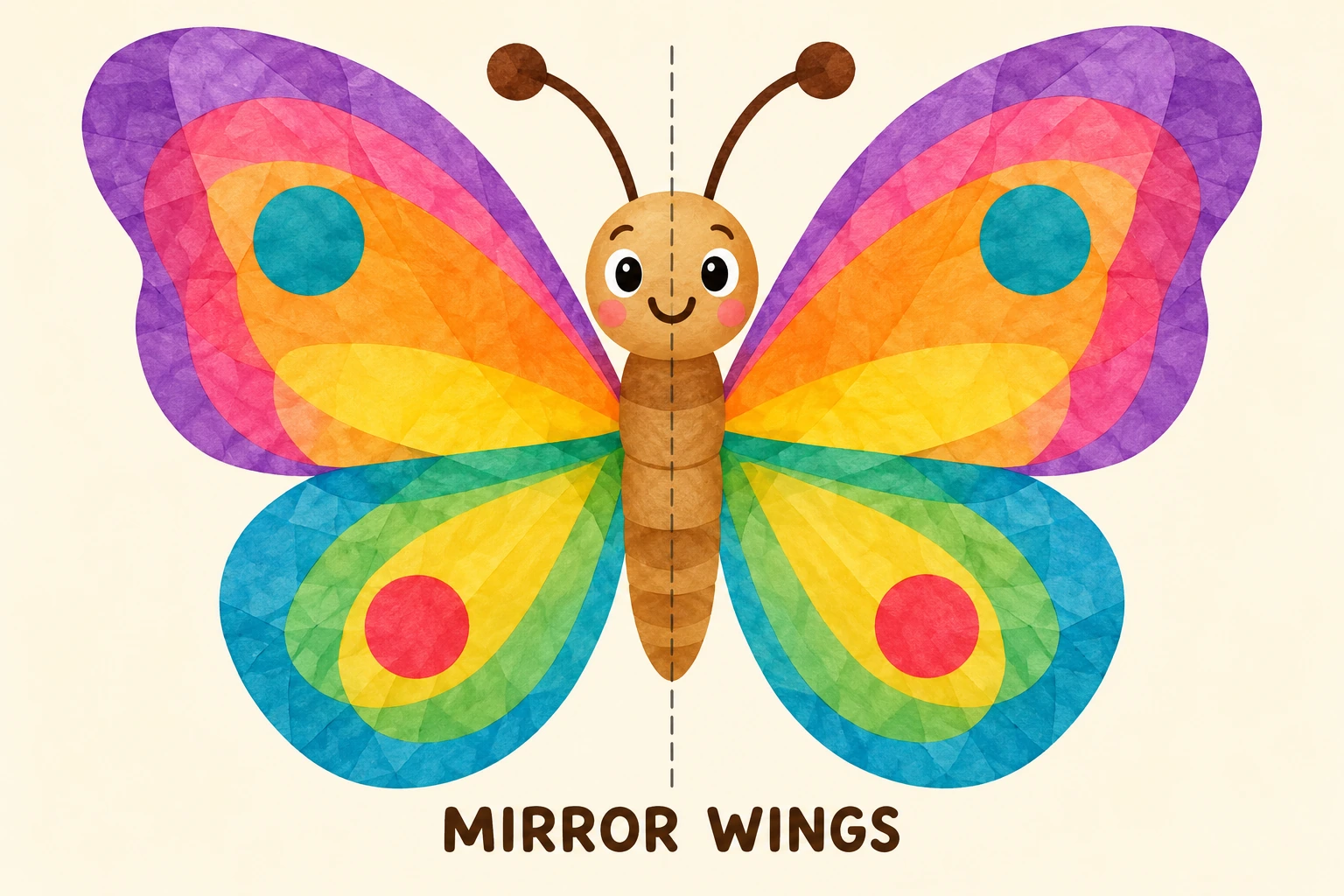
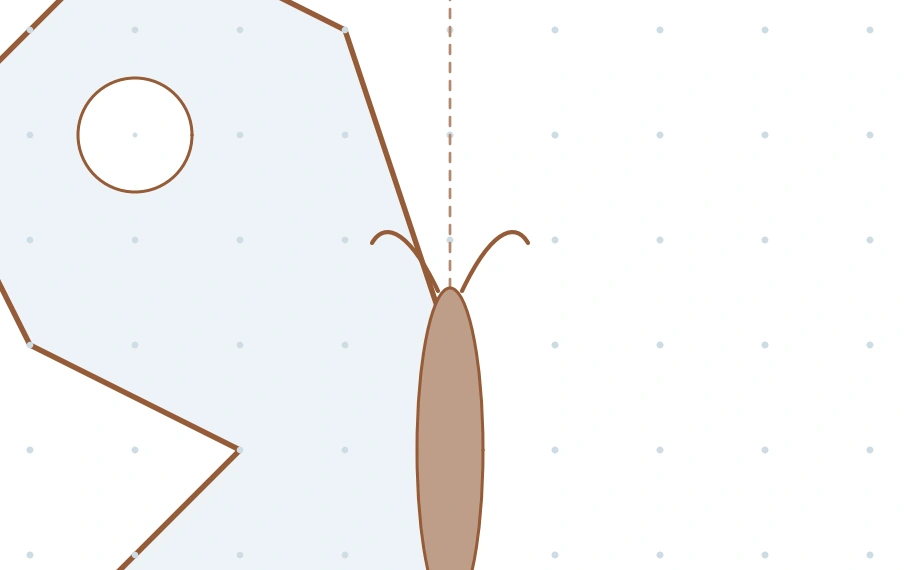
One butterfly wing is drawn, while the other side waits beside a vertical centre line. Butterfly Mirror Drawing invites children to complete the missing wing as a reflection, using the dot grid to compare corresponding positions. The supplied side includes an angular outline and two round spots, giving the learner more than an outer shape to consider. Begin with the middle line as a reference and inspect one point at a time. The goal is a mirrored partner, with matching heights and distances on opposite sides of that line.
The middle line changes how copying works — Butterfly Mirror Drawing
Moving the supplied wing sideways without reversing it would make a second copy facing the same direction. Butterfly Mirror Drawing asks for a reflected partner instead. The dashed vertical line through the butterfly gives each point a reference: a feature on the left belongs at the same height and an equal distance to the right.
Invite Una to find the centre before drawing. She can point to the butterfly's body and then follow the dashed reference through the grid. The body and antennae are already supplied. The open response area is for completing the missing side rather than inventing a second body.
Begin with a point that is easy to describe: Butterfly Mirror Drawing
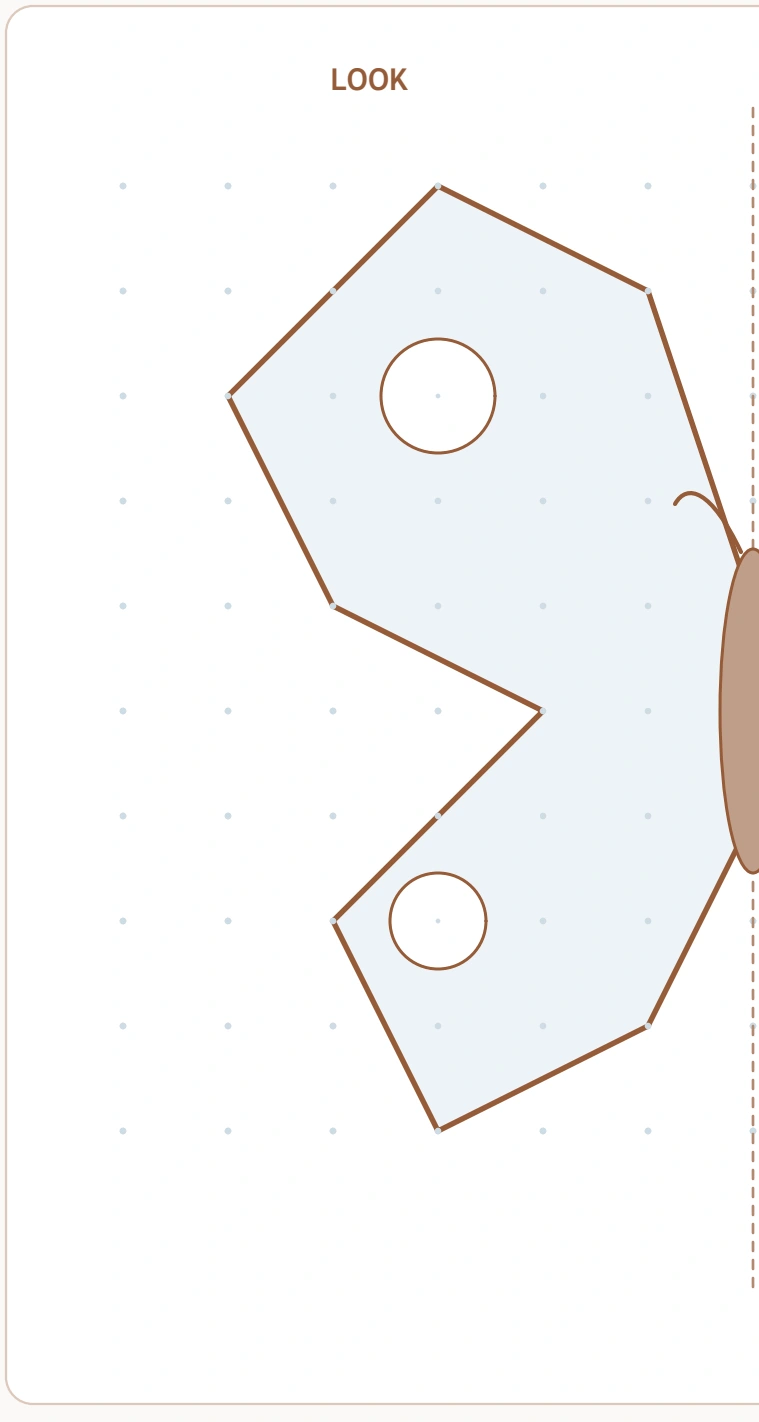
Choose a clear corner on the drawn outline and compare its position with the nearest grid dots. Point to the same horizontal level on the empty side. Then consider how far that point sits from the centre line. A small, inspectable decision is easier to discuss than an instruction to make the whole butterfly symmetrical at once.
Two relationships locate a reflected feature: Butterfly Mirror Drawing
| What stays related | What to inspect | What would change the intended reflection |
|---|---|---|
| Height | A feature and its partner share a horizontal level | Placing the partner noticeably higher or lower |
| Distance from the centre | Equal spacing on opposite sides of the dashed line | Moving the partner closer to the body or farther away |
| Outline sequence | Matching corners connect in reflected order | Copying the original orientation without reversing it |
| Wing details | Two round spots gain matching positions | Completing only the border while omitting its details |
Use this Butterfly Mirror Drawing reference as a way to ask a more precise question. “Which point needs to move?” is more useful when the child knows whether height or distance is being checked. The dot grid provides visible landmarks for those comparisons without requiring a formal coordinate system.
Plan several landmarks before connecting the outline: Butterfly Mirror Drawing
Una can indicate a few corresponding corners with light marks, then compare them with the supplied wing. Connecting those landmarks gradually gives her a chance to revise a point before a long outline is complete. There is no requirement to produce the entire partner wing in one continuous pencil stroke.
For Butterfly Mirror Drawing, keep checking against the original side rather than the most recently drawn segment alone. A small shift repeated from point to point can pull the new outline away from its intended reflection. Returning to the middle reference helps the child compare each landmark with its actual partner.
The dots guide positions, rather than every movement
Some parts of the source include straight edges and some include round details. The learner need not connect every nearby dot simply because it is printed. Ask which dot helps locate the intended corner or spot, then follow the shape the source provides.
A folded-paper comparison at home: Butterfly Mirror Drawing
Imagine Una and her grandmother folding spare paper along a vertical crease. They draw a simple mark on one side and discuss where its partner would appear across the fold. When the paper lies open, the crease supplies a clear centre reference for comparing the two sides.
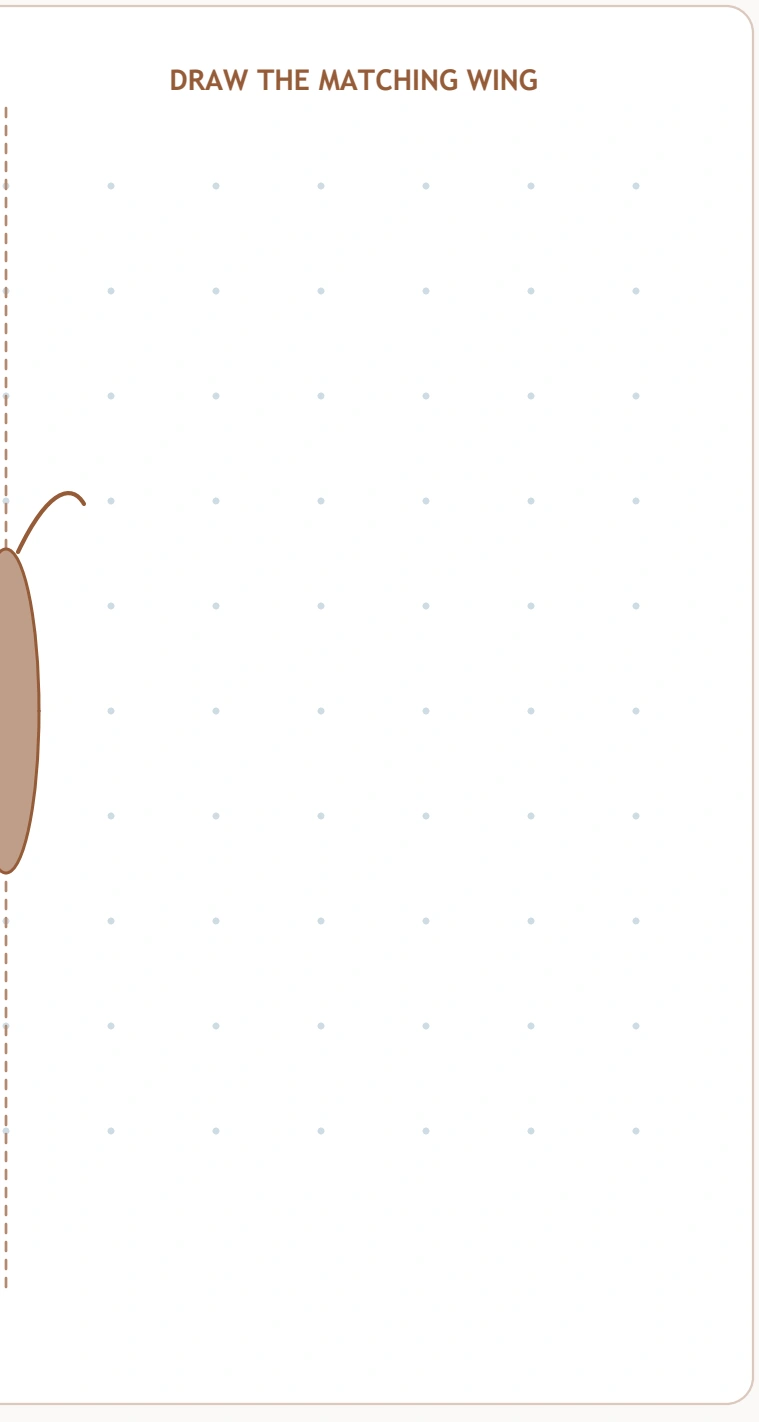
They return to Butterfly Mirror Drawing and locate the dashed line in the same role. Una points to a corner on the given wing, then to a proposed partner point. Her grandmother asks about its height and distance rather than drawing the missing outline for her.
The extension does not require folding or altering the printed worksheet. It offers another way to talk about the relationship before making a mark. A learner who can point to a suitable partner position may still need time to draw the connecting line with a pencil.
Six things a mirrored wing can make visible: Butterfly Mirror Drawing
Establishing a reference axis: Butterfly Mirror Drawing
The centre line anchors every comparison in Butterfly Mirror Drawing. Notice whether Una returns to it when a point is uncertain. Without that shared reference, “the other side” may become a vague place rather than a position that can be checked.
Matching a horizontal level: Butterfly Mirror Drawing
A reflected point across a vertical line stays at the same height. A child can demonstrate this by following a row of grid dots with a finger. This makes one part of the comparison visible before discussing the sideways distance.
Comparing distance from the middle
An outer corner needs a partner equally far from the centre. Una can compare the intervening grid spacing on each side. The aim is a paired relationship, rather than simply placing the new point somewhere to the right of the butterfly.
Organising connected segments: Butterfly Mirror Drawing
The angular border contains several changes of direction. Deciding which corners connect can support deliberate planning of the outline. A child may understand individual reflected points while needing help keeping their connection order clear.
Including interior details: Butterfly Mirror Drawing
The two round spots belong to the wing design as well as its border. Butterfly Mirror Drawing gives a reason to revisit the inside of the supplied shape after completing the outline. Their positions should be compared across the same middle line.
Describing a specific revision: Butterfly Mirror Drawing
“This corner needs to come closer to the middle” identifies a change more clearly than “my wing looks wrong.” Encourage a manageable observation about one feature. The explanation can guide a revision without requiring the adult to replace the child's drawing.
Add the spots after locating their partners: Butterfly Mirror Drawing
The source wing contains two round spots at different places within the outline. Once the missing border is planned, invite Una to point to where each spot's partner should go. Compare height and distance just as with an outline corner.
A spot does not become a suitable mirror partner merely because it fits inside the new wing. Its relationship to the centre matters. Likewise, changing a round spot into an unrelated decoration would create a different design rather than complete the supplied reflection. Save free decoration for a separate butterfly drawing after the source task.
A classroom discussion built around one corner
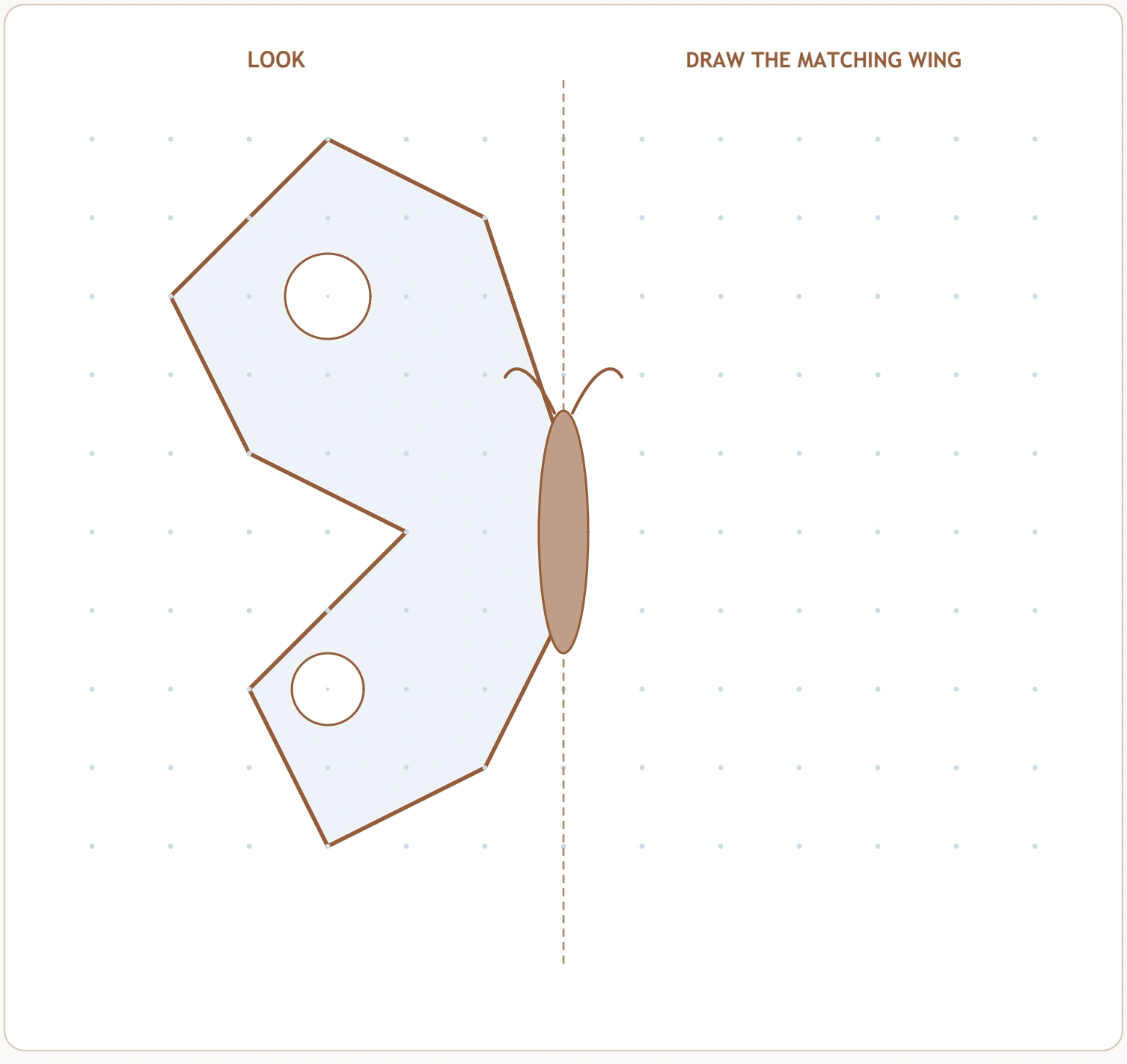
For a hypothetical paired session, the teacher selects a single corner from Butterfly Mirror Drawing and asks each child to point to a possible partner. The children compare their proposals with the dot grid. They discuss whether the two locations share a height and match their distance from the centre.
This small focus lets a learner participate without drawing a complete wing immediately. One child might identify the correct row but choose a point too close to the middle. Another may choose the right spacing at a different height. Those observations suggest different next prompts.
After a few landmarks are understood, learners can work on their own outlines and explain a chosen segment to a partner. The teacher keeps the printed source as the reference, while recognising that pencil control affects how precisely a planned segment is recorded. Comparing intention and mark can make the feedback more useful.
Five reflection activities on spare materials
Pair two counters across a crease
Use a folded-paper line as a middle reference and place a counter on one side. Ask Una to position a second at the same height and distance on the other side. Move the first counter and discuss how its partner must change.
Draw one simple reflected mark: Butterfly Mirror Drawing
Make a short line on one half of a fresh grid and invite a matching reflected line on the other. Keep the example simpler than the full butterfly. The extension lets the learner explain the relation without managing many corners at once.
Check a deliberately shifted point: Butterfly Mirror Drawing
An adult places a proposed partner higher than the original feature. Una inspects the shared horizontal level and explains the mismatch. Afterwards try a point at the correct height but a different distance, so the two checks can be discussed separately.
Plan a new symmetrical creature: Butterfly Mirror Drawing
On separate paper, invent a simple creature around a drawn centre line and discuss pairs of features. This is an open creative extension, so it can include the child's own shapes. The worksheet's original wing remains a fixed reflection task.
Explain a spot to a listening partner: Butterfly Mirror Drawing
One person describes a feature's place relative to the middle and its height, while the other points to its partner position. Swap roles. This gives spatial language a practical audience and can expose which part of the description needs clarification.
Support precision in manageable pieces: Butterfly Mirror Drawing
For ages four to seven, an adult can adapt Butterfly Mirror Drawing to the learner's current spatial and drawing confidence. A first visit might focus on the reference line and one or two corners. Pointing, light planning marks and a larger spare-paper example can help separate the reflection idea from fine pencil demands.
Common mix-ups include drawing a translated copy, rotating the wing, following every printed dot regardless of the outline, changing a point's height or forgetting the two spots. Choose one feature to inspect rather than labelling the whole response incorrect. Return to its partner on the supplied side and check the two relationships again.
Compare the intended point with the actual mark: Butterfly Mirror Drawing
If Una points accurately but draws slightly beside the position, acknowledge what she planned. The pencil record can be refined without suggesting that she did not understand the comparison. A short pause may help more than asking for several full-wing repetitions.
Revisit a detail instead of redrawing everything: Butterfly Mirror Drawing
On another day, ask the child to choose one reflected corner or spot and explain why it belongs there. This makes the return a check of a relationship. A familiar butterfly can still offer a fresh question when the explanation becomes more precise.
For a learner ready for an extension, a new spare-paper shape can use a different outline around the same kind of vertical reference. State that it is a new drawing task. The source page's completed response should continue to match its supplied wing and interior details.
Keep the full dot grid in the printable view: Butterfly Mirror Drawing
The premium Butterfly Mirror Drawing single-sheet PDF is available through an active membership plan that qualifies for access. The butterfly premium edition has no website watermark, domain promotion or embedded advertisements. The unchanged original remains a separate sample option.
Inspect the portrait print preview for both outer grid edges, the complete given wing and the dashed centre reference. Cropping an outer point would remove information needed for the comparison. The clean butterfly sheet also belongs to the twenty-page Little Explorers PDF collection, sold separately for $5.
Another reason to explain a visible relationship: Butterfly Mirror Drawing
After Butterfly Mirror Drawing, explore Robot Mirror Grids beside Butterfly Mirror Drawing, Castle Mirror Puzzle after Butterfly Mirror Drawing, Mirror Half Drawing beyond Butterfly Mirror Drawing. Keep each new instruction separate from Butterfly Mirror Drawing.
For ideas about children's marks and explanations, read NAEYC's family resource on supporting writing at home. PBS Parents' conversation and literacy ideas for age four can support the language around shared activities. With Butterfly Mirror Drawing, compare the middle reference, each paired position and the outline and spots together.
Popular Worksheets
Printable resources families and teachers are downloading now.
 Free
 Free
 Free
 Free