
Ice Cream Color Stack: 4 Brilliant Flavor-Story Games
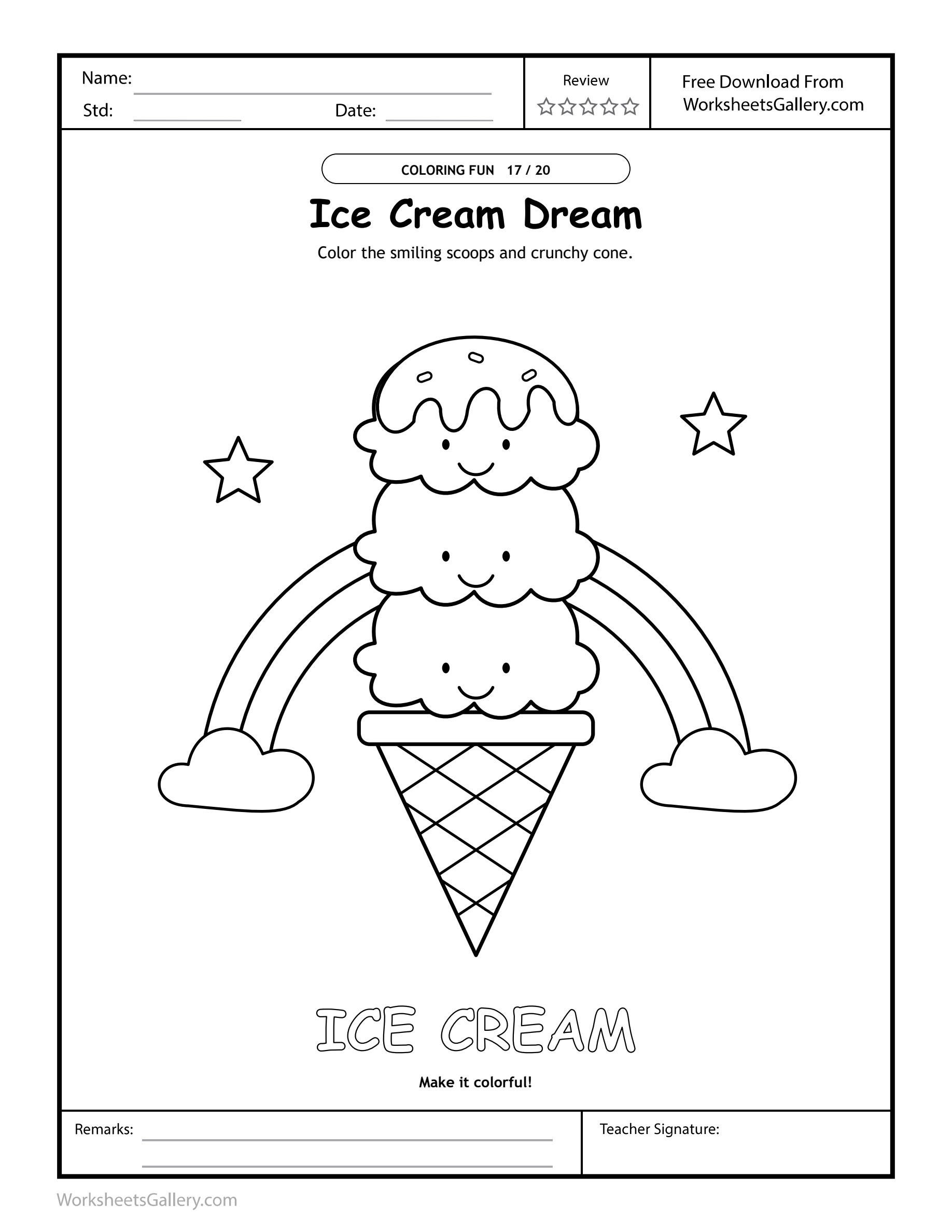
What color would a scoop of moonbeam be? Ice Cream Color Stack begins with invented flavors and three smiling layers, giving a child a reason to choose a palette rather than copy one. The Ice Cream Dream sheet pairs broad rounded scoops with a pointed lattice cone and a flowing topping outline. Its direction invites coloring without assigning flavors or hues. A learner can make one layer minty, another fantastical and another simply a favorite color. Ask which scoop has a story today, then offer room to test that idea before filling a smaller region.
Mahi opens an Ice Cream Color Stack pretend menu
Mahi wants her top scoop to taste like a dream. Her father asks what that would look like, and she chooses lavender with a pale topping. The lower scoops receive other imagined names. He writes her words on a separate menu card while she makes a filled color sample beside each.
Their Ice Cream Color Stack conversation stays in pretend play. The palette does not identify real ingredients, allergies or nutritional properties. Her father follows the visual story and helps locate a scoop boundary when she asks, leaving the color decisions to her.
Ice Cream Color Stack can be equally satisfying without named flavors. A child might prefer three repeated hues or a single layer today. The menu story offers a social purpose for a picture, rather than a requirement to invent unusual vocabulary.
Ice Cream Color Stack studies the smiling layers
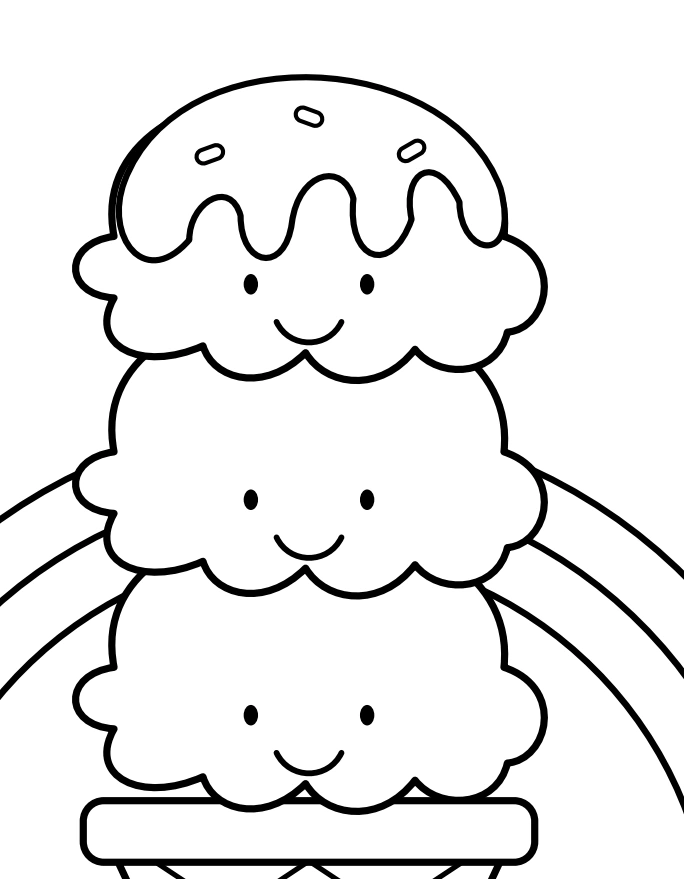
Three rounded scoop shapes sit above one another, with small facial details and a flowing outline on the top layer. Invite the learner to indicate where one scoop ends and the next begins. This slow look supports a chosen color change without adding extra adult lines.
Ice Cream Color Stack can use shorter marks near a smile and broader movements farther from the face. Suggest that adjustment only if the child wants the expression clearly visible. Loose filling may still convey a deliberate flavor or color story.
The Ice Cream Color Stack source includes the outlined words ICE CREAM beneath the picture. An adult can read them aloud. Letter filling, independent menu writing or tracing flavor names are optional extensions of interest, not tasks demanded by the original printable.
Four Ice Cream Color Stack games for imaginary flavors
Offer a game on separate paper so new ideas have enough space. The learner can keep the experiment as the main artwork or transfer a useful choice to the supplied sheet. There is no requirement to finish every layer first.
1. Ice Cream Color Stack writes a swatch menu through dictation
Make a few large filled patches using chosen colors, then invite names for the imagined flavors. An adult writes each dictated name beside its patch. Ice Cream Color Stack menus allow the child to connect a visual choice with language while the adult handles the lettering.
Read the Ice Cream Color Stack menu back and ask which item the maker would like a listener to find in the drawing. The receiver can point to the corresponding scoop. An invented name needs no real food equivalent to support the exchange.
2. Ice Cream Color Stack compares neighboring layers
Draw two large touching scoop-like shapes on a scrap. Test a pair of hues and inspect the shared edge. Ice Cream Color Stack comparisons can explore contrast, similarity or repeated color with different textures, depending on what the maker wants viewers to notice.
The Ice Cream Color Stack artist may reject a pair after seeing it. Keep the first trial and try another only if interest remains. Revision supplies evidence for a choice, rather than proving that the first experiment was wrong.
3. Ice Cream Color Stack invents a topping announcement
On a larger scoop study, add a flowing topping outline and invite a separate palette choice for that region. Dictate a short announcement from the topping if the learner enjoys character play. Ice Cream Color Stack stories can give the smallest region an intentional role.
For Ice Cream Color Stack, a topping can blend quietly or stand out strongly. Ask which effect fits the invented flavor. Keep the activity about the picture; do not infer real ingredients from the hue or turn the imaginary menu into a factual food chart.
4. Ice Cream Color Stack tests the cone's mark scale
Draw a large crossed-line cone study on another sheet. Explore a few cells with short marks, then compare that movement with a broad scoop patch. Ice Cream Color Stack scale trials make the different space demands easier to feel without crowding the small source cone.
The Ice Cream Color Stack maker can choose selected cells, a light overall treatment or another personal arrangement. A checkerboard pattern is optional. Stop once the comparison becomes clear, even if much of the larger study remains available for later.
Ice Cream Color Stack offers six useful art opportunities
- Layer awareness: locate shared scoop boundaries before choosing a region for the next mark.
- Imaginative language: invent a flavor name and explain its relationship to a chosen hue.
- Material comparison: test neighboring marks before deciding whether their difference is strong enough.
- Movement adjustment: change from broad scoop areas to compact cone cells or facial details.
- Authorship: revise an imaginary menu without having to preserve an adult's first suggestion.
- Shared attention: guide a listener to the intended layer through a swatch, gesture or spoken clue.
Ice Cream Color Stack joins thinking, hand coordination and communication in a flexible way. A learner may dictate an elaborate menu while preferring broad strokes. Another may make careful color distinctions through pointing without wanting to speak in front of others.
Ice Cream Color Stack changes pace in the pointed cone

Diagonal crossing lines create a texture unlike the rounded stack. Many small sections sit inside the tapering outline, and a long mark may cross several at once. Before proposing a smaller movement, ask whether the child wants individual cells to remain distinct.
Ice Cream Color Stack can treat the cone as one lightly marked region or give only a few cells attention. It does not require every crossing space to be filled. If the child wants precision but feels frustrated, a larger grid study can preserve the idea at a more comfortable scale.
Ice Cream Color Stack at home becomes a brief menu conversation
Prepare a reachable workspace, familiar coloring tools and a scrap for flavor swatches. Read the page direction, locate one scoop and invite a choice. The adult can offer to write a dictated name if a pretend menu appeals, or simply give quiet working time.
During Ice Cream Color Stack, help with paper movement or locating a small boundary when requested. Avoid asking for a new flavor explanation after every stroke. A short conversation before or after coloring is enough to connect the palette with the child's intention.
Close the Ice Cream Color Stack visit with a visible observation: “Your pale topping leaves that smile easy to see.” A child may confirm the plan or explain something different. Listening to the response is more useful than assuming what each color means.
A classroom Ice Cream Color Stack gallery of invented menus
Provide individual sheets and large sample cards. Each child chooses a layer to explore and dictates a short menu item. The teacher reads the notes during a partner exchange, and viewers locate the intended scoop through its sample or description.
Ice Cream Color Stack partners can ask one interested question about a visible feature. The exchange need not involve pretend buying, prices or choosing the “best” flavor. Keep it an art-and-language invitation in which very different pictures can make sense.
Offer a quiet Ice Cream Color Stack route for learners who prefer individual sharing. The child points to a swatch while the adult speaks, or shows a single scoop study rather than the whole page. Participation does not depend on public performance or independent reading.
Ice Cream Color Stack keeps an example separate from an answer

The companion paper menu displays three scoops in lavender, peach and mint, with DREAM, PEACH and MINT labels beneath MY FLAVOR STORY wording. Its materials and palette offer one imaginative treatment. They do not assign mandatory colors to the printable's layers.
Ice Cream Color Stack can look entirely unlike the example. A repeated hue, unexpected topping or mostly open cone may be deliberate. Ask about the intended story before deciding a region needs more work. The child remains the maker of the picture.
Ice Cream Color Stack support when a plan gets tangled
| What happened? | What can the maker try? |
|---|---|
| Two scoops look alike. | Keep the match or test another neighbor. |
| A face line becomes hard to see. | Try a lighter mark on a larger study. |
| Cone cells feel crowded. | Choose fewer cells or increase the scale. |
Common Ice Cream Color Stack support mistakes include correcting fantasy flavors, demanding a brown cone or turning the menu into compulsory handwriting. Another is using color to claim that an imaginary scoop contains a particular ingredient. Keep the invented story separate from real food information.
Ice Cream Color Stack also works when the child changes the menu midway. Ask whether a new name or swatch would help explain the change. A separate note can preserve the earlier experiment while making the current intention clear to a viewer.
Ice Cream Color Stack fits a range of preschool starting points
Children roughly three to six years old often meet this kind of coloring scene in preschool and early kindergarten. Adjust support to the individual rather than using age as a precision target. Selecting a hue, making one sample or pointing to a layer can begin the activity.
Ice Cream Color Stack can offer broad regions before compact facial details. A comfortable tool, a larger sample or an adult's spoken label may reduce one demand while leaving the child's interesting choice intact. Exact edge control is not the only evidence of engagement.
Invite Ice Cream Color Stack back through a single new flavor, another topping relationship or a small cone study. Do not require a fresh complete page on a schedule. Stop for tired hands or fading interest, and let a return visit follow a specific appealing question.
Print Ice Cream Color Stack and keep the next activity optional
Sign into an account with an eligible active membership to obtain the clean Ice Cream Color Stack premium attachment. Save its PDF as a separate edition from the original sample. The clean document contains no watermark, website/domain branding or embedded ads. Before printing, inspect the US Letter layout and retain the topping, cone tip and lower words within your printer's available area. Advertising around a website page is outside this member file.
For a single food shape, explore the carrot coloring picture. A different kind of support appears in the giraffe's guided palette. Scoop and Swoop curves is a separate movement exercise. Adults can find more ideas at PBS Parents' creative activity pages and NAEYC's family art resource, alongside opportunities for children to draw their own imaginary foods from the beginning.
Popular Worksheets
Printable resources families and teachers are downloading now.
 Free
 Free
 Free
 Free