
Parade Pattern Lines: 4 Clever Mixed-Texture Routes
Finish the parade with the complete $3 picture-key set. All 25 clean activity pages share one PDF, including this mixed-pattern route sheet and the other supplied object, colour and geometry destinations.
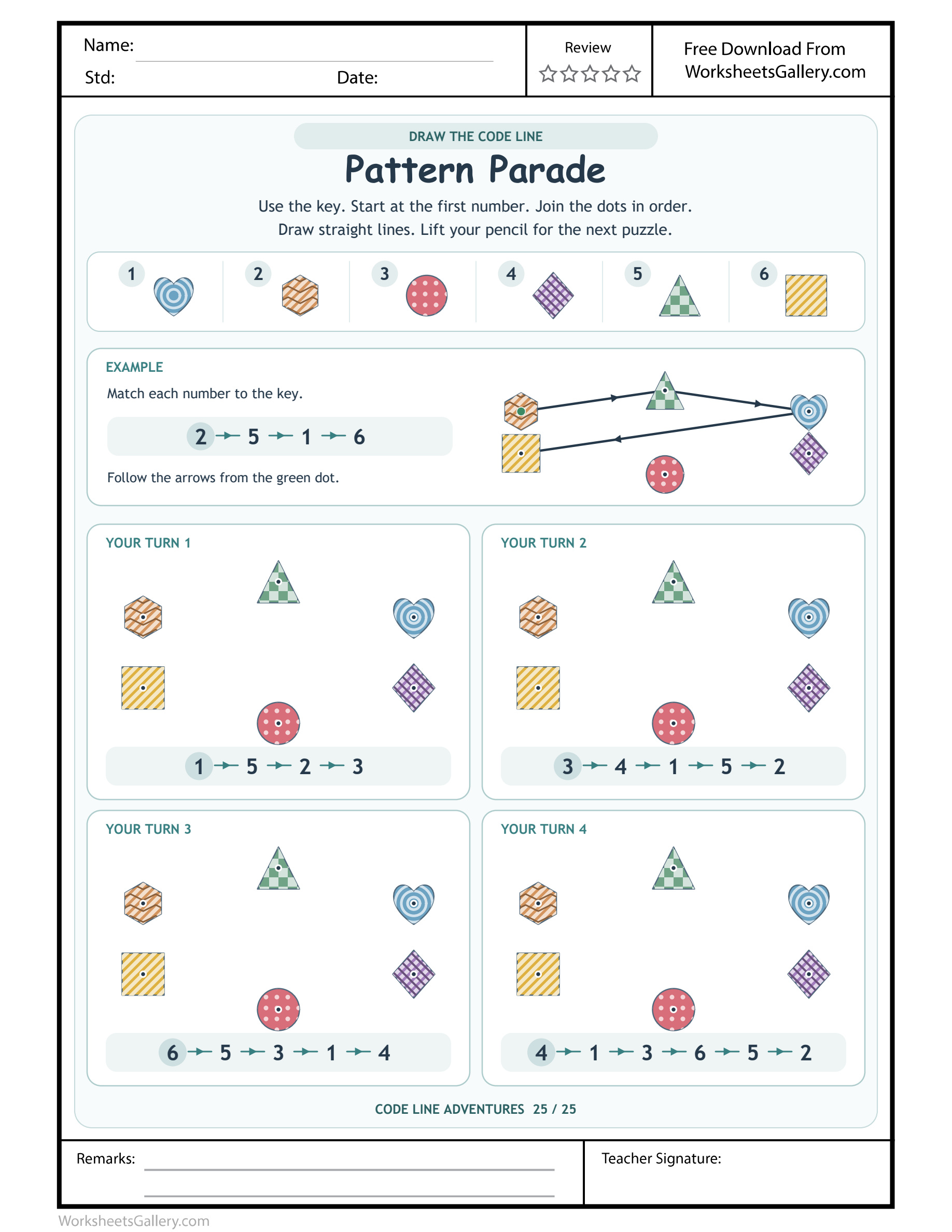
A parade of patterns does not always ask you to continue a repeat. Parade Pattern Lines uses six differently shaped and decorated symbols as numbered destinations, then gives children four route codes to interpret. A wide worked example shows how to connect the selected centre dots with straight segments. Heart, hexagon, circle, diamond, triangle and square each have a distinctive interior, making both outline and texture useful clues. The actual task is to follow the printed itinerary, including its changing starts and endings, rather than guess which decoration should come next in a growing series.
Inspect the parade's actual instruction — Parade Pattern Lines
The Parade Pattern Lines key includes a ringed heart, zigzag hexagon, dotted circle, crosshatched diamond, checked triangle and striped square. Name one or two visible features before starting. Everyday descriptions can identify a figure accurately while more precise shape words are still being learned.
In Parade Pattern Lines, the patterns distinguish entries; they do not supply a rule for extending a sequence. The numeral strip chooses the next symbol. A child who notices a decorative similarity can discuss it, then return to the printed code before choosing where the pencil should travel.
Parade Pattern Lines legend at a glance
| Pattern Parade numeral | Keyed picture |
|---|---|
| 1 | heart (rings) |
| 2 | hexagon (zigzag) |
| 3 | circle (dots) |
| 4 | diamond (cross) |
| 5 | triangle (checker) |
| 6 | square (stripes) |

Parade Pattern Lines example before independent drawing
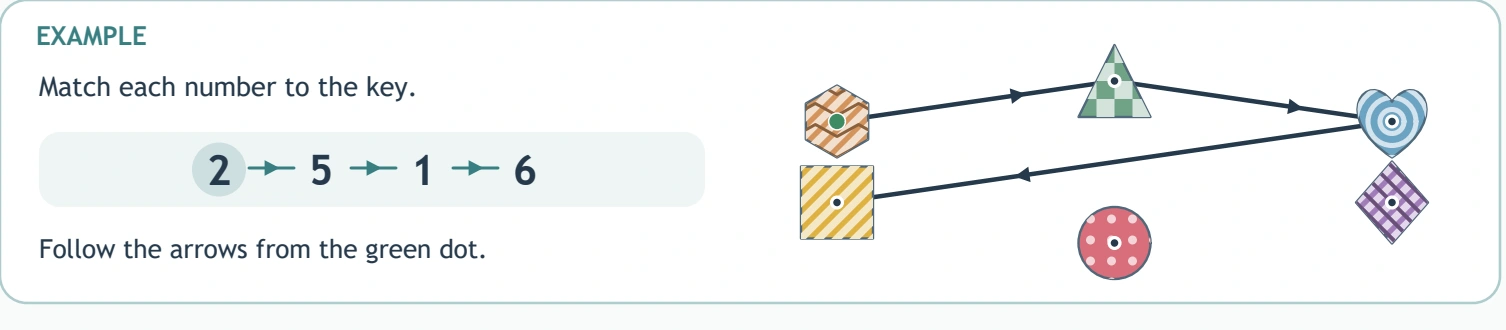
Pattern Parade demonstrates 2 → 5 → 1 → 6. The Pattern Parade itinerary is hexagon (zigzag) → triangle (checker) → heart (rings) → square (stripes). In Pattern Parade, the green start selects hexagon (zigzag). Pattern Parade arrows lead to square (stripes). Pattern Parade has 3 worked segments. The Parade Pattern Lines example supports finger rehearsal. Inspect the Pattern Parade practice strip separately.
Pattern Parade — practice 1
Practice 1 on Pattern Parade: 1 → 5 → 2 → 3. Translate those Parade Pattern Lines destinations as heart (rings) → triangle (checker) → hexagon (zigzag) → circle (dots). Begin on heart (rings) for Pattern Parade; next locate triangle (checker). The Pattern Parade centre-to-centre connections are heart (rings) → triangle (checker); triangle (checker) → hexagon (zigzag); hexagon (zigzag) → circle (dots). Segment count for Parade Pattern Lines: 3, from 4 listed stops. The Pattern Parade endpoint is circle (dots). Against the Pattern Parade strip, verify final 3.
Parade Pattern Lines leaves diamond (cross), square (stripes) outside practice 1. Leave these Pattern Parade alternatives unvisited. Practice 1 for Pattern Parade requests 1 → 5 → 2 → 3.
Pattern Parade — practice 2
Practice 2 on Pattern Parade: 3 → 4 → 1 → 5 → 2. Translate those Parade Pattern Lines destinations as circle (dots) → diamond (cross) → heart (rings) → triangle (checker) → hexagon (zigzag). Begin on circle (dots) for Pattern Parade; next locate diamond (cross). The Pattern Parade centre-to-centre connections are circle (dots) → diamond (cross); diamond (cross) → heart (rings); heart (rings) → triangle (checker); triangle (checker) → hexagon (zigzag). Segment count for Parade Pattern Lines: 4, from 5 listed stops. The Pattern Parade endpoint is hexagon (zigzag). Against the Pattern Parade strip, verify final 2.
Parade Pattern Lines leaves square (stripes) outside practice 2. Leave these Pattern Parade alternatives unvisited. Practice 2 for Pattern Parade requests 3 → 4 → 1 → 5 → 2.
Pattern Parade — practice 3
Practice 3 on Pattern Parade: 6 → 5 → 3 → 1 → 4. Translate those Parade Pattern Lines destinations as square (stripes) → triangle (checker) → circle (dots) → heart (rings) → diamond (cross). Begin on square (stripes) for Pattern Parade; next locate triangle (checker). The Pattern Parade centre-to-centre connections are square (stripes) → triangle (checker); triangle (checker) → circle (dots); circle (dots) → heart (rings); heart (rings) → diamond (cross). Segment count for Parade Pattern Lines: 4, from 5 listed stops. The Pattern Parade endpoint is diamond (cross). Against the Pattern Parade strip, verify final 4.
Parade Pattern Lines leaves hexagon (zigzag) outside practice 3. Leave these Pattern Parade alternatives unvisited. Practice 3 for Pattern Parade requests 6 → 5 → 3 → 1 → 4.
Pattern Parade — practice 4
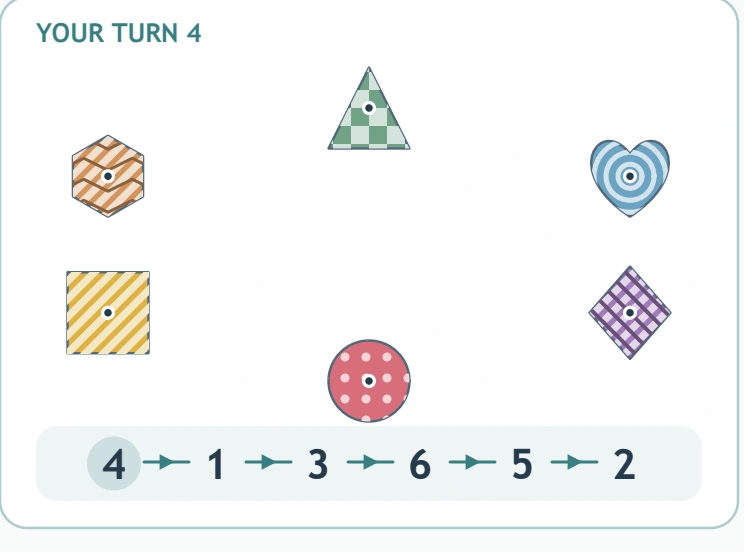
Practice 4 on Pattern Parade: 4 → 1 → 3 → 6 → 5 → 2. Translate those Parade Pattern Lines destinations as diamond (cross) → heart (rings) → circle (dots) → square (stripes) → triangle (checker) → hexagon (zigzag). Begin on diamond (cross) for Pattern Parade; next locate heart (rings). The Pattern Parade centre-to-centre connections are diamond (cross) → heart (rings); heart (rings) → circle (dots); circle (dots) → square (stripes); square (stripes) → triangle (checker); triangle (checker) → hexagon (zigzag). Segment count for Parade Pattern Lines: 5, from 6 listed stops. The Pattern Parade endpoint is hexagon (zigzag). Against the Pattern Parade strip, verify final 2.
Pattern Parade uses every Parade Pattern Lines entry in practice 4 of Pattern Parade: 4 → 1 → 3 → 6 → 5 → 2. First Pattern Parade selection: diamond (cross); final selection: hexagon (zigzag).
Bela's imagined parade planning at home
Imagine Bela looking at Parade Pattern Lines after a pattern-making game. She expects to alternate two decorations and begins inventing a repeat. Her caregiver points to the route strip and asks which numeral follows the first. Bela finds the corresponding key entry, shifting from open pattern invention to the supplied drawing instruction.
They finger-follow one Parade Pattern Lines pair before making a pencil line. The adult accepts Bela's description of the hexagon as the zigzag shape and adds its outline name naturally. They finish a short itinerary, then return to free pattern-making on separate paper if she wants a different kind of play.
Six useful gains from a mixed-symbol field
Distinguish an activity type
The Parade Pattern Lines decorations can resemble material for a repeating-pattern task, but its code asks for a route. Reading the actual instruction helps a child choose the appropriate response. An adult can name that difference without discouraging the pattern observation itself.
Combine outline and interior evidence
During Parade Pattern Lines, checked triangle identifies both a shape and its fill. Either feature may help locate the symbol, and together they can confirm it. Accept a clear everyday description while adding formal terminology only where it assists communication.
Use a numbered reference
Each Parade Pattern Lines numeral selects an assigned picture in the legend. Returning to that visible match is a useful strategy, especially when similar shapes appear with different labels on other worksheets. The assignment belongs to this sheet, not to the shape everywhere.
Prepare a deliberate connection
The Parade Pattern Lines pencil aims at small centre dots. Locate the next target first, move comfortably and slow near arrival. A slightly uneven segment can preserve the correct visiting order, so recognise sound decoding separately from line smoothness.
Keep the present step available
A finger can track the Parade Pattern Lines strip as the eyes consult the Pattern Parade reference and its panel. The aid supports place-keeping without requiring the entire itinerary to be memorised. The child can gradually manage that reference aid themselves as the routine becomes familiar.
Check and repair a local mismatch
Compare one Parade Pattern Lines segment with its adjacent numeral entries. If they disagree, identify the first wrong pair and repair it. A small correction leaves the child's successful decisions intact and makes the feedback easier to understand.
Readiness and a practical first parade
Children approximately four to seven may enjoy Parade Pattern Lines with support for numeral recognition, shape vocabulary or hand control. A child can correctly point through an itinerary before being comfortable drawing every small stroke. Adults may read the code aloud while leaving the symbol matching to the learner.
Set Parade Pattern Lines flat, keep the legend uncovered and follow the example's arrows with a finger. Choose one practice field and identify its initial pair. Draw that link, inspect the next Pattern Parade entry before lifting for a different panel. A single understood route is a reasonable session when interest in the parade fades or drawing becomes uncomfortable.
A classroom discussion of two different rules, imagined
Picture a teacher using Parade Pattern Lines after children have made decorative repeats with large cards. She asks what this sheet's instruction now requests. The group compares continuing a pattern with following a numeral itinerary, using the printed strip as evidence for the drawing response.
Each child then uses an individual Parade Pattern Lines copy, explaining one pair to a partner before drawing. The teacher watches for pattern invention, legend confusion or aiming difficulty and supplies the corresponding clue. Children share a checked decision, with no race to finish all four parade routes.
Four extensions beyond the printed parade
Make two clearly named games
Use large labelled shapes inspired by Parade Pattern Lines. First invent a decorative repeat as an open activity, then announce a short spoken route through the same cards. Discuss how the materials can stay similar while the instruction changes what a player should do.
Give a two-feature parade clue
After Parade Pattern Lines, describe a symbol through its outline and interior together, such as ringed heart. A partner consults the Pattern Parade legend for its number. Try one clue alone and decide whether a second detail makes the choice clearer.
Narrate the printed procession
Choose a completed Parade Pattern Lines itinerary and invent a tiny parade story with its symbols visiting in the drawn order. The child may add characters and a reason for travelling. Keep the supplied sequence intact while imaginative details grow around it.
Help a puppet predict the wrong next decoration
A puppet guesses a repeating pattern instead of reading a Parade Pattern Lines numeral. The child consults the Pattern Parade strip to locate the actual next entry. The puppet changes its plan, modelling a recoverable mistake and a useful return to the visible instruction.
Keep a mistaken rule from spoiling the parade
Common Parade Pattern Lines slips include extending an invented repeat, copying the worked path or tracing decorative outlines. Return to the selected numeral and central target. If the correct picture was chosen, rehearse the movement separately rather than repeating all six legend assignments.
Offer brief Parade Pattern Lines returns around a story or shape conversation. Let the child choose one panel, request a clue and stop comfortably. Noticing which rule applies is a meaningful success. Specific encouragement can make another invitation welcome without requiring a perfectly completed sheet every time.
Download the mixed-pattern route printable
The original Parade Pattern Lines worksheet is offered as a sample. Signed-in users with eligible active membership access can obtain the cleaned premium PDF, with no watermark or advertisements on Pattern Parade, and no website branding. A separate $3 purchase supplies the collection of all twenty-five provided code-line themes.
Save Parade Pattern Lines and inspect portrait print preview for every border, legend entry and code strip. Clear colour is useful for confirming the patterned symbols. Test one copy and change the scaling if the Pattern Parade frame is trimmed before producing more pages.
Continue with another stated rule
Compare Parade Pattern Lines with Castle Color Codes. After Pattern Parade, try Number Letter Switching. For Pattern Parade, consider Exact Path Detective.
Adults extending Parade Pattern Lines may browse NAEYC's shared-learning family resources or PBS Parents' general activity ideas. Choose optional play that fits the child, using this worksheet's own six-symbol legend when returning to its four printed parade routes.
Popular Worksheets
Printable resources families and teachers are downloading now.
 Free
 Free
 Free
 Free