
Flower Route Mapper: 5 Delightful Petal-Picture Trips
The flower patch is included in 25 clean sheets for $3. Choose the complete PDF to keep these bloom-centre routes with the other supplied settings, rather than downloading each theme as a separate file.
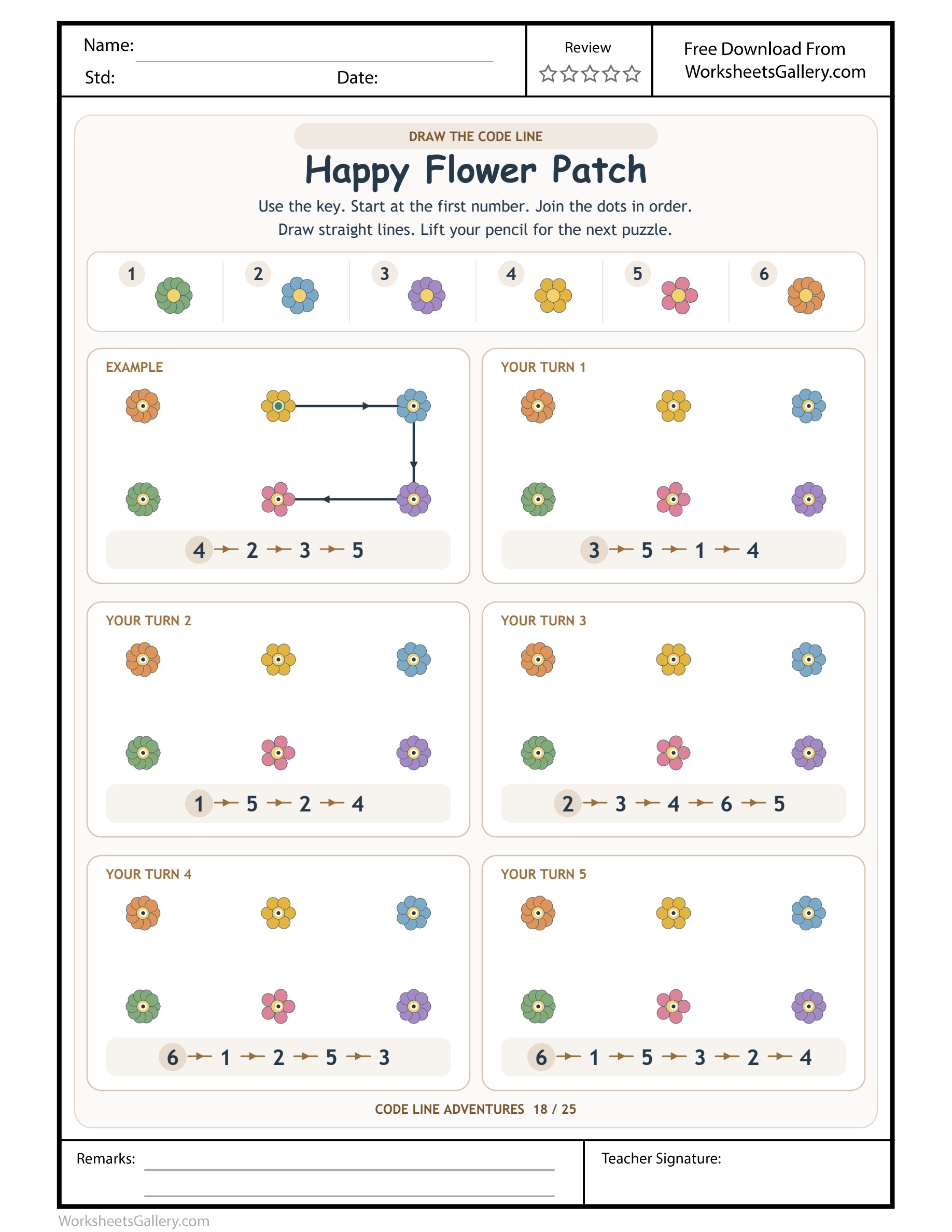
The flowers look inviting to colour, but their centres have another purpose here. Flower Route Mapper uses six flower pictures as numbered destinations and gives children five independent routes to connect with straight lines. A compact worked example shows how a code becomes a path through the blooms. Children inspect the legend, locate the requested flower and aim for its little centre dot. Colour can help them describe a choice, while the key supplies its numeral. There is no need to count petals or draw around their edges to follow these particular garden instructions.
From a petal picture to a centre target — Flower Route Mapper
In Flower Route Mapper, green, blue, purple, yellow, pink and orange flowers occupy the six key entries. Introduce them through the actual legend, pointing to each numeral and matching bloom. Avoid assuming that the numeral represents a petal count; it is the flower's reference label for this page.
The Flower Route Mapper pencil should join central dots rather than travel around petal outlines. Show both actions with a finger and ask which matches the example. Choose the bloom through the key, then land at its centre. This separates colour identification from the smaller drawing movement.
Flower Route Mapper legend at a glance
| Happy Flower Patch numeral | Keyed picture |
|---|---|
| 1 | green flower |
| 2 | blue flower |
| 3 | purple flower |
| 4 | yellow flower |
| 5 | pink flower |
| 6 | orange flower |

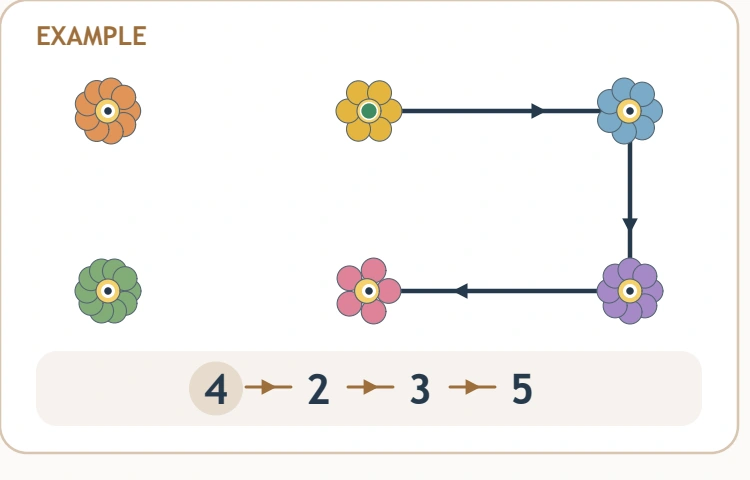
Flower Route Mapper example before independent drawing
Happy Flower Patch demonstrates 4 → 2 → 3 → 5. The Happy Flower Patch itinerary is yellow flower → blue flower → purple flower → pink flower. In Happy Flower Patch, the green start selects yellow flower. Happy Flower Patch arrows lead to pink flower. Happy Flower Patch has 3 worked segments. The Flower Route Mapper example supports finger rehearsal. Inspect the Happy Flower Patch practice strip separately.
Flower Route Mapper — practice 1
Practice 1 on Happy Flower Patch: 3 → 5 → 1 → 4. Translate those Flower Route Mapper destinations as purple flower → pink flower → green flower → yellow flower. Begin on purple flower for Happy Flower Patch; next locate pink flower. The Happy Flower Patch centre-to-centre connections are purple flower followed by pink flower; pink flower followed by green flower; green flower followed by yellow flower. Segment count for Flower Route Mapper: 3, from 4 listed stops. The Happy Flower Patch endpoint is yellow flower. Against the Happy Flower Patch strip, verify final 4.
Flower Route Mapper leaves blue flower, orange flower outside practice 1. Leave these Happy Flower Patch alternatives unvisited. Practice 1 for Happy Flower Patch requests 3 → 5 → 1 → 4.
Flower Route Mapper — practice 2
Practice 2 on Happy Flower Patch: 1 → 5 → 2 → 4. Translate those Flower Route Mapper destinations as green flower → pink flower → blue flower → yellow flower. Begin on green flower for Happy Flower Patch; next locate pink flower. The Happy Flower Patch centre-to-centre connections are green flower followed by pink flower; pink flower followed by blue flower; blue flower followed by yellow flower. Segment count for Flower Route Mapper: 3, from 4 listed stops. The Happy Flower Patch endpoint is yellow flower. Against the Happy Flower Patch strip, verify final 4.
Flower Route Mapper leaves purple flower, orange flower outside practice 2. Leave these Happy Flower Patch alternatives unvisited. Practice 2 for Happy Flower Patch requests 1 → 5 → 2 → 4.
Happy Flower Patch — practice 3
Practice 3 on Happy Flower Patch: 2 → 3 → 4 → 6 → 5. Translate those Flower Route Mapper destinations as blue flower → purple flower → yellow flower → orange flower → pink flower. Begin on blue flower for Happy Flower Patch; next locate purple flower. The Happy Flower Patch centre-to-centre connections are blue flower followed by purple flower; purple flower followed by yellow flower; yellow flower followed by orange flower; orange flower followed by pink flower. Segment count for Flower Route Mapper: 4, from 5 listed stops. The Happy Flower Patch endpoint is pink flower. Against the Happy Flower Patch strip, verify final 5.
Flower Route Mapper leaves green flower outside practice 3. Leave these Happy Flower Patch alternatives unvisited. Practice 3 for Happy Flower Patch requests 2 → 3 → 4 → 6 → 5.
Happy Flower Patch — practice 4
Practice 4 on Happy Flower Patch: 6 → 1 → 2 → 5 → 3. Translate those Flower Route Mapper destinations as orange flower → green flower → blue flower → pink flower → purple flower. Begin on orange flower for Happy Flower Patch; next locate green flower. The Happy Flower Patch centre-to-centre connections are orange flower followed by green flower; green flower followed by blue flower; blue flower followed by pink flower; pink flower followed by purple flower. Segment count for Flower Route Mapper: 4, from 5 listed stops. The Happy Flower Patch endpoint is purple flower. Against the Happy Flower Patch strip, verify final 3.
Flower Route Mapper leaves yellow flower outside practice 4. Leave these Happy Flower Patch alternatives unvisited. Practice 4 for Happy Flower Patch requests 6 → 1 → 2 → 5 → 3.
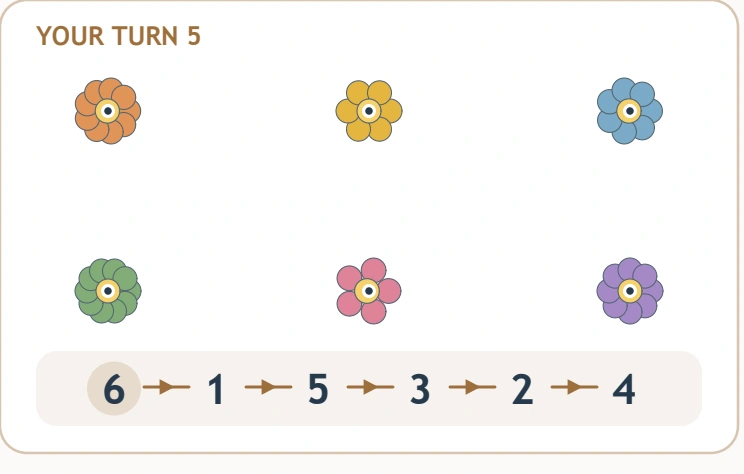
Happy Flower Patch — practice 5
Practice 5 on Happy Flower Patch: 6 → 1 → 5 → 3 → 2 → 4. Translate those Flower Route Mapper destinations as orange flower → green flower → pink flower → purple flower → blue flower → yellow flower. Begin on orange flower for Happy Flower Patch; next locate green flower. The Happy Flower Patch centre-to-centre connections are orange flower followed by green flower; green flower followed by pink flower; pink flower followed by purple flower; purple flower followed by blue flower; blue flower followed by yellow flower. Segment count for Flower Route Mapper: 5, from 6 listed stops. The Happy Flower Patch endpoint is yellow flower. Against the Happy Flower Patch strip, verify final 4.
Happy Flower Patch uses every Flower Route Mapper entry in practice 5 of Happy Flower Patch: 6 → 1 → 5 → 3 → 2 → 4. First Happy Flower Patch selection: orange flower; final selection: yellow flower.
Soren's imagined windowsill map
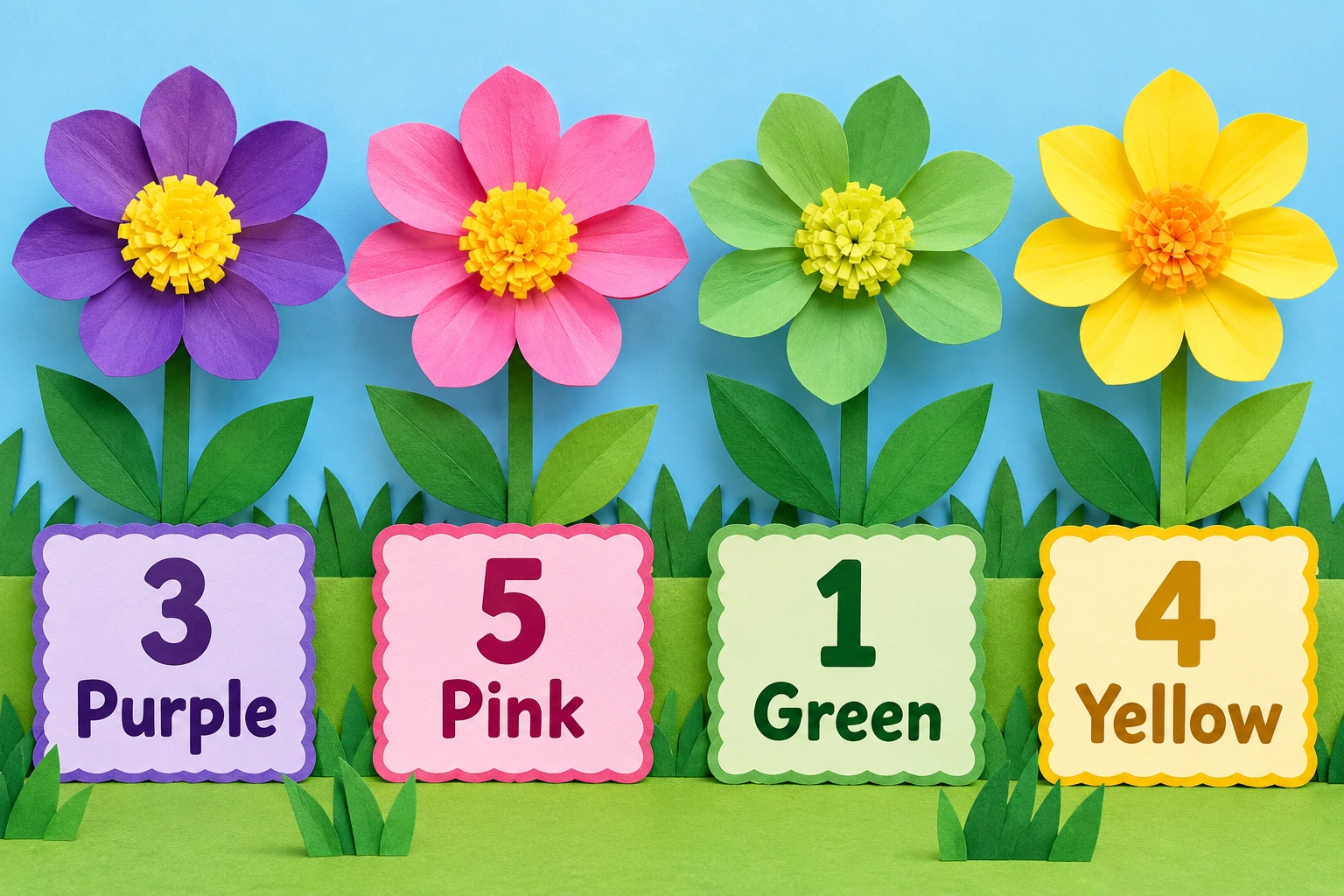
Imagine Soren trying Flower Route Mapper at a home table near a flowering plant. He begins counting petals to decide a numeral. His caregiver points to the printed legend and explains that its assignments already name the destinations. Soren finds purple at three and identifies the first practice start without recounting the flower.
When Soren outlines that Flower Route Mapper bloom, the caregiver invites a finger landing on its centre. They practise one straight connection and keep the rest of the panel for later. The adult praises the useful shift from inspecting the whole flower to finding the intended target.
Six things to observe among the blooms
A label is used as a label
The numeral beside a Flower Route Mapper flower identifies that symbol. A child can match the entry without calculating a quantity inside the picture. This distinction keeps the task focused on reference use rather than introducing an unrequested counting problem.
Colour supports a precise description
During Flower Route Mapper, purple flower is more informative than flower alone. Accept the child's familiar colour words and point together when a distinction is uncertain. The visible legend remains useful; accurate naming need not depend on memorising all six assignments.
A centre guides a deliberate stroke
Each Flower Route Mapper bloom contains a small landing place for the pencil. Find the next centre before moving and encourage a controlled arrival. A slightly uneven connection can still show the correct route, so separate movement feedback from the success of choosing the right flower.
An order survives changing scenery
The Flower Route Mapper flowers repeat across panels, but their requested visiting order changes. A child can practise rereading a new strip instead of assuming the model's route applies everywhere. A finger can mark the present numeral while the eyes return to the key.
Some flowers can stay outside a route
Not every Flower Route Mapper strip requests all six entries. Leaving an omitted bloom unconnected can reflect careful attention. Ask which numeral would have selected it, without adding that extra visit to the printed itinerary.
A repair can refer to one pair
When a Flower Route Mapper line reaches the wrong flower, compare the adjacent numerals with the two selected blooms. The child can point to the correction before drawing again. This keeps a mistake understandable rather than making the whole page feel wrong.
Print clearly and begin briefly
For children around four to seven, Flower Route Mapper can be adapted to numeral knowledge, colour matching and hand comfort. Read a code aloud when numbers are unfamiliar. A child may understand the route through pointing before being comfortable drawing several small segments.
Use a clear colour print of Flower Route Mapper, with the key uncovered and the paper stable. Rehearse the Happy Flower Patch example with a finger, then select a practice field and identify its opening pair. Draw between centres, check the next entry and lift before a fresh box. Stop when the flower session starts feeling tiring or attention begins to wander.
A classroom flower guide, imagined
Picture a teacher using Flower Route Mapper at a small-group garden table. Children describe a flower by colour, then show the legend numeral selecting it. The teacher makes room for a correct point when a spoken colour name is uncertain. Each child uses an individual copy for the actual drawing.
During Flower Route Mapper, the teacher notices whether difficulty lies in finding the keyed bloom or aiming inside it. She offers a focused legend comparison or a slow finger rehearsal accordingly. Children share one checked connection at the end, with no need for everyone to finish all five routes.
Four flower activities with different purposes
Send a toy to two blooms
Use large labelled flower cards inspired by Flower Route Mapper. Give a toy a short spoken itinerary and let the child locate both destinations before moving. Then trade direction-giving roles, keeping the cards' clear words or numerals complete and readable.
Compare an edge with a centre
On a separate large flower picture after Flower Route Mapper, point to a petal edge and a central target. Discuss where a connecting route would land. This rehearses the intended movement without covering the worksheet's unanswered panels with extra demonstration marks.
Narrate a bee's printed itinerary
Choose a completed Flower Route Mapper route and tell a pretend bee story that visits those blooms in order. The child may decide why the bee travels, while the strip keeps the sequence fixed. Follow the Happy Flower Patch drawing during its retelling.
Help a puppet counting petals unnecessarily
A puppet tries to decode Flower Route Mapper by counting a flower's petals. The child shows the already supplied legend assignment instead. The puppet can use the simpler reference, giving the child a playful reason to explain what the numeral means in this activity.
Keep a garden error small enough to fix
Common Flower Route Mapper slips include treating key numerals as petal counts, outlining blooms or copying the sample's path. Return to the actual entry and centre dot involved. If the match was right, rehearse the stroke; if the symbol was wrong, compare the relevant legend pictures before drawing again.
Bring Flower Route Mapper back for a short visit after a flower story or colour game. Let one panel be sufficient and invite the child to ask for a clue. Finding the intended centre is worth noticing. A specific encouraging comment can make a later return more welcome than a demand to complete every bloom journey immediately.
Download the flower-code printable
Choose the supplied Flower Route Mapper original through its sample control, or use a qualifying active membership to obtain the clean Happy Flower Patch PDF after sign-in. The premium activity has neither watermark nor domain branding and includes no printed-page ads. The separate $3 collection places all twenty-five supplied themes in one file.
Save Flower Route Mapper and check the portrait print preview for its entire frame and legend. Colour printing helps preserve the bloom distinctions. Test one page, change the print scale if the Happy Flower Patch frame is trimmed and keep the centres large enough for a comfortable drawing target.
Broader play with visible instructions
Compare Flower Route Mapper with Exact Path Detective. After Happy Flower Patch, try Castle Color Codes. For Happy Flower Patch, consider Number Letter Switching.
Adults extending Flower Route Mapper may explore NAEYC's family learning library and PBS Parents' resources for shared play. Choose optional ideas that fit the child's interests, using this sheet's actual flower key when returning to its five printed itineraries.
Popular Worksheets
Printable resources families and teachers are downloading now.
 Free
 Free
 Free
 Free