
Star Code Party: 4 Wonderful Five-Symbol Adventures
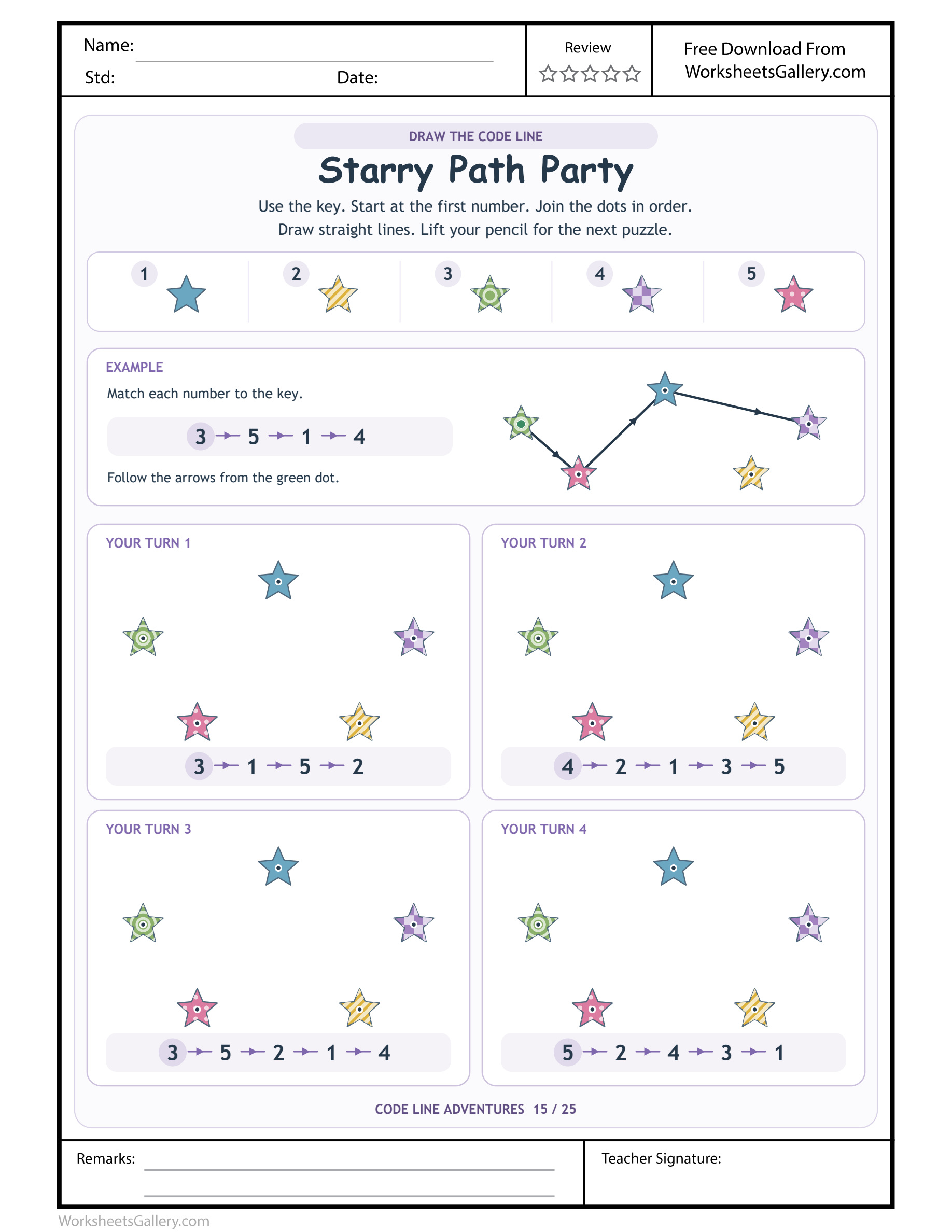
Five stars are one stop in a 25-page collection costing $3. The clean combined file includes this smaller star key without inventing a sixth entry, together with the other supplied symbol-route activities.
Five patterned stars are enough for a complete little route. Star Code Party uses a five-entry legend and four independent drawing puzzles, inviting children to translate the printed numerals before joining the selected centre dots. A wide worked example provides a starting demonstration. Plain, striped, ringed, checked and dotted stars offer different visual clues within the same outline. The activity rewards noticing the actual choices on this page: there is no sixth star to invent, and finishing a code does not require returning to its beginning or closing a decorative shape around the whole party.
Count the available entries, then read the request — Star Code Party
The Star Code Party legend ends at five. A child used to six-picture keys may expect another symbol, so inspect this page together before drawing. Name one visible difference between two stars and locate the corresponding numeral. Pattern details can supplement colour when describing a choice.
In Star Code Party, four listed stops need three connecting strokes. A five-stop route needs four. The dots represent places visited, while segments connect adjacent visits. Do not add a closing line unless the code asks for another stop. These instructions end at their printed final entries, leaving an open journey.
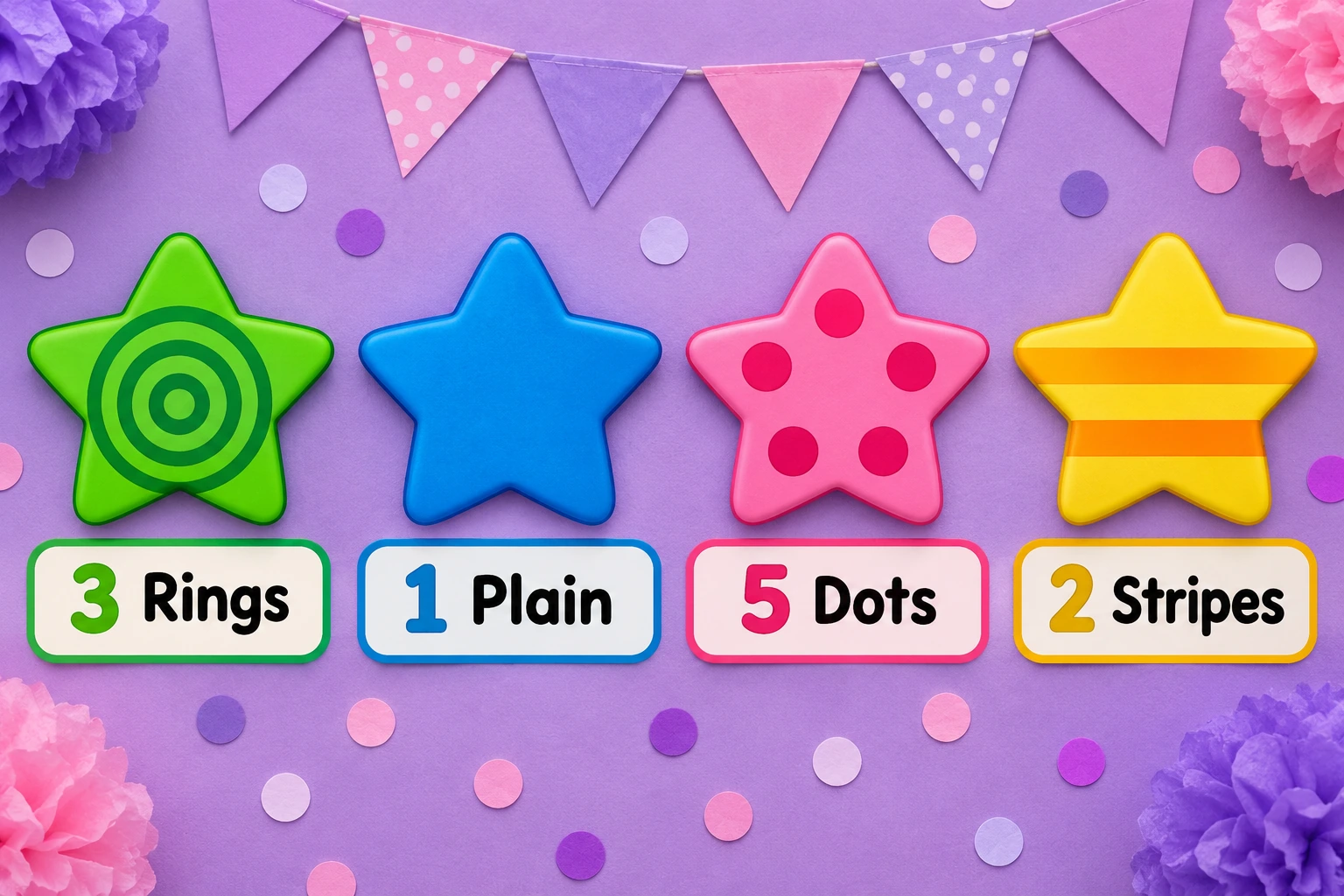
Star Code Party legend at a glance
| Starry Path Party numeral | Keyed picture |
|---|---|
| 1 | star |
| 2 | star (stripes) |
| 3 | star (rings) |
| 4 | star (checker) |
| 5 | star (dots) |

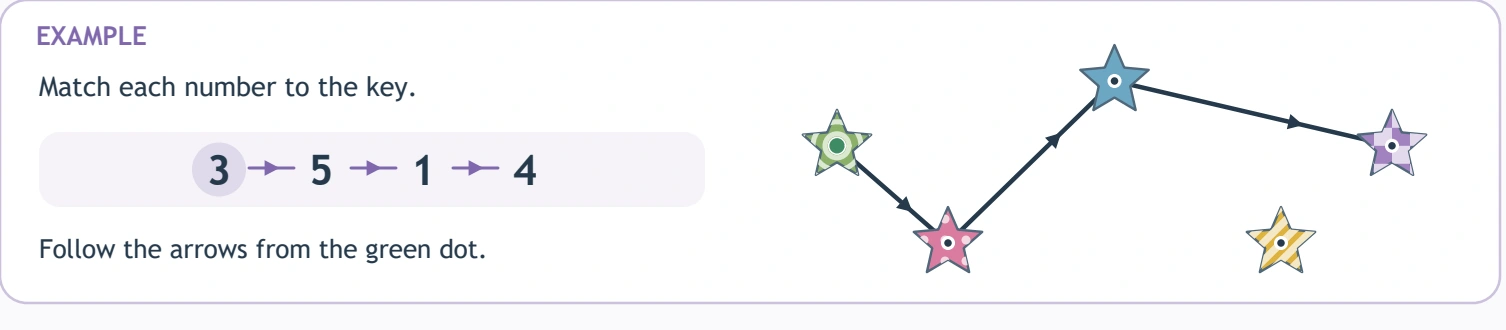
Star Code Party example before independent drawing
Starry Path Party demonstrates 3 → 5 → 1 → 4. The Starry Path Party itinerary is star (rings) → star (dots) → star → star (checker). In Starry Path Party, the green start selects star (rings). Starry Path Party arrows lead to star (checker). Starry Path Party has 3 worked segments. The Star Code Party example supports finger rehearsal. Inspect the Starry Path Party practice strip separately.
Star Code Party — practice 1
Practice 1 on Starry Path Party: 3 → 1 → 5 → 2. Translate those Star Code Party destinations as star (rings) → star → star (dots) → star (stripes). Begin on star (rings) for Starry Path Party; next locate star. The Starry Path Party centre-to-centre connections are star (rings) → star; star → star (dots); star (dots) → star (stripes). Segment count for Star Code Party: 3, from 4 listed stops. The Starry Path Party endpoint is star (stripes). Against the Starry Path Party strip, verify final 2.
Star Code Party leaves star (checker) outside practice 1. Leave these Starry Path Party alternatives unvisited. Practice 1 for Starry Path Party requests 3 → 1 → 5 → 2.
Starry Path Party — practice 2
Practice 2 on Starry Path Party: 4 → 2 → 1 → 3 → 5. Translate those Star Code Party destinations as star (checker) → star (stripes) → star → star (rings) → star (dots). Begin on star (checker) for Starry Path Party; next locate star (stripes). The Starry Path Party centre-to-centre connections are star (checker) → star (stripes); star (stripes) → star; star → star (rings); star (rings) → star (dots). Segment count for Star Code Party: 4, from 5 listed stops. The Starry Path Party endpoint is star (dots). Against the Starry Path Party strip, verify final 5.
Starry Path Party uses every Star Code Party entry in practice 2 of Starry Path Party: 4 → 2 → 1 → 3 → 5. First Starry Path Party selection: star (checker); final selection: star (dots).
Starry Path Party — practice 3
Practice 3 on Starry Path Party: 3 → 5 → 2 → 1 → 4. Translate those Star Code Party destinations as star (rings) → star (dots) → star (stripes) → star → star (checker). Begin on star (rings) for Starry Path Party; next locate star (dots). The Starry Path Party centre-to-centre connections are star (rings) → star (dots); star (dots) → star (stripes); star (stripes) → star; star → star (checker). Segment count for Star Code Party: 4, from 5 listed stops. The Starry Path Party endpoint is star (checker). Against the Starry Path Party strip, verify final 4.
Starry Path Party uses every Star Code Party entry in practice 3 of Starry Path Party: 3 → 5 → 2 → 1 → 4. First Starry Path Party selection: star (rings); final selection: star (checker).
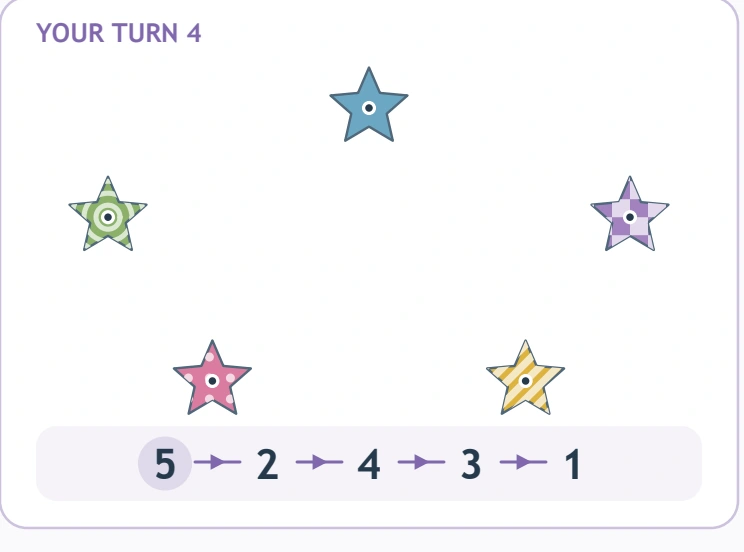
Starry Path Party — practice 4
Practice 4 on Starry Path Party: 5 → 2 → 4 → 3 → 1. Translate those Star Code Party destinations as star (dots) → star (stripes) → star (checker) → star (rings) → star. Begin on star (dots) for Starry Path Party; next locate star (stripes). The Starry Path Party centre-to-centre connections are star (dots) → star (stripes); star (stripes) → star (checker); star (checker) → star (rings); star (rings) → star. Segment count for Star Code Party: 4, from 5 listed stops. The Starry Path Party endpoint is star. Against the Starry Path Party strip, verify final 1.
Starry Path Party uses every Star Code Party entry in practice 4 of Starry Path Party: 5 → 2 → 4 → 3 → 1. First Starry Path Party selection: star (dots); final selection: star.
Oona's imagined star-party plan
Imagine Oona studying Star Code Party at home. She finds all five legend entries and asks where six is. Her caregiver confirms that this page's key contains five stars, then helps her inspect the first route. Oona identifies the four selected symbols and notices that one star is not invited to that particular journey.
After drawing, Oona wants to close the Star Code Party route into a party shape. The adult asks whether another numeral follows the endpoint. They keep the printed route open and draw an imaginative closed shape on separate paper afterwards, giving each activity its own clear instruction.
Six things a five-star key can reveal
Inspecting the supplied set
Looking at Star Code Party before acting can show whether the child notices the actual number of entries. No previous worksheet's key needs to be imported. Ask what is visible here, then let the child use this particular reference for the task.
Discriminating a repeated silhouette
The Star Code Party stars share an outline, so their interiors and colours carry useful information. A child can name dots or rings in their own words. The adult adds terminology while keeping the focus on distinguishing the requested figure.
Separating stops from links
A Star Code Party route begins at a star before any line has been drawn. Connecting the next star creates the first segment. Finger-rehearsing this distinction can clarify why four destinations do not require four strokes or an extra return to the beginning.
Moving toward a small centre
The Star Code Party target is the little dot within the star, not a point on its outer edge. Look ahead to the intended centre and allow a comfortable deliberate movement. A small wobble can preserve the itinerary without needing repeated erasure.
Explaining why a star remains untouched
Some Star Code Party routes omit a legend entry. The child can inspect the current Starry Path Party instruction for the missing entry. This links selective action with evidence and makes an unconnected symbol a possible correct decision rather than automatically unfinished work.
Ending at the final requested visit
Stopping a Star Code Party line at the last symbol is a meaningful act of following instructions. Ask the child to find the final numeral before deciding whether another connection is needed. A visually satisfying closed figure is not the criterion for completion here.
Set a welcoming pace
An approximate age guide for Star Code Party is four to seven, adjusted to numeral recognition, visual comparison and drawing comfort. A child may identify every patterned star while needing numbers read aloud. Another may read the code but benefit from a larger Starry Path Party copy or finger rehearsal before pencil work.
To start Star Code Party, keep the legend uncovered, follow the example's arrows and choose one unanswered panel. Read its initial pair and draw that connection. Review the next numeral before moving again, then lift after the endpoint. Stop after one journey if the hand or attention needs rest.
A classroom party with evidence, imagined
Picture a teacher offering Star Code Party at a small table. Children describe a star to a partner, who finds its key entry. The teacher asks how many destinations the selected strip lists and how many connections that requires. A finger demonstration keeps the discussion visible rather than abstract.
Each child then completes a Star Code Party panel on their own copy. If someone closes a route, the teacher compares the final entry with the new line and asks what requested that return. Children can repair one connection while retaining successful choices elsewhere, with no race to finish all four puzzles.
Four star-party games away from the sheet
Invite only the named guests
Use large labelled star cards inspired by Star Code Party. Give a short spoken invitation list and let a toy visit only those cards. Discuss which guest waits outside that particular journey, then switch who gives the instructions.
Describe a star without pointing
After Star Code Party, describe one visible interior pattern and let a partner find the matching key entry. Add colour as a confirming clue if needed. Accept a child's everyday description, such as circles inside, while modelling ringed as another useful word.
Count moves after a finger journey
Finger-follow a short Star Code Party route, counting each move between symbols separately from the visited stars. Compare the two totals. Keep this an optional concrete conversation, not a written arithmetic demand or a prerequisite for enjoying the page.
Ask a puppet whether the party is over
A puppet finishes a Star Code Party code and wants to return to its start. The child checks whether another numeral is printed. The puppet can stop happily at the correct endpoint, making restraint part of the pretend party rather than a scolding interruption.
Keep a missing sixth star from becoming a problem
Typical Star Code Party errors include inventing a sixth entry, following ascending numbers automatically or closing the line at the end. Inspect the actual five-entry key and the selected strip. If the correct stars are chosen but the pencil misses their centres, offer movement rehearsal instead of more numeral explanation.
For regular Star Code Party use, choose one panel after a night-sky story or pattern game. Let the child request help and decide on a comfortable stop. A checked endpoint is worth celebrating. Returning to a partly finished page can be a fresh invitation without turning the collection into a daily completion requirement.
Download a clean star-route printable
Use the original Star Code Party sample option for the supplied sheet. The cleaned premium PDF is available after sign-in through eligible active membership access; its printable page has no ads, domain branding or watermark. The separate $3 collection contains this theme plus the other supplied code-line worksheets.
Save Star Code Party and inspect the portrait print preview for every border and legend entry. Clear colour printing supports the small pattern distinctions. Test one copy before making more, adjusting fitting if the printer clips an edge and keeping the stars large enough for close comparison.
Other invitations to inspect an instruction
Compare Star Code Party with Castle Color Codes. After Starry Path Party, try Number Letter Switching. For Starry Path Party, consider Exact Path Detective.
For shared play alongside Star Code Party, adults can browse NAEYC resources on early learning and PBS Parents' family activity ideas. Choose optional extensions that suit the child while retaining this page's five-star legend for its printed drawing routes.
Popular Worksheets
Printable resources families and teachers are downloading now.
 Free
 Free
 Free
 Free