
School Supply Codes: 4 Brilliant Pencil-Palette Trips
Pack this classroom key with 24 more sheets for $3. The clean collection preserves the pencil, crayon and palette distinctions and adds the other supplied number-key drawing pages in one downloadable file.
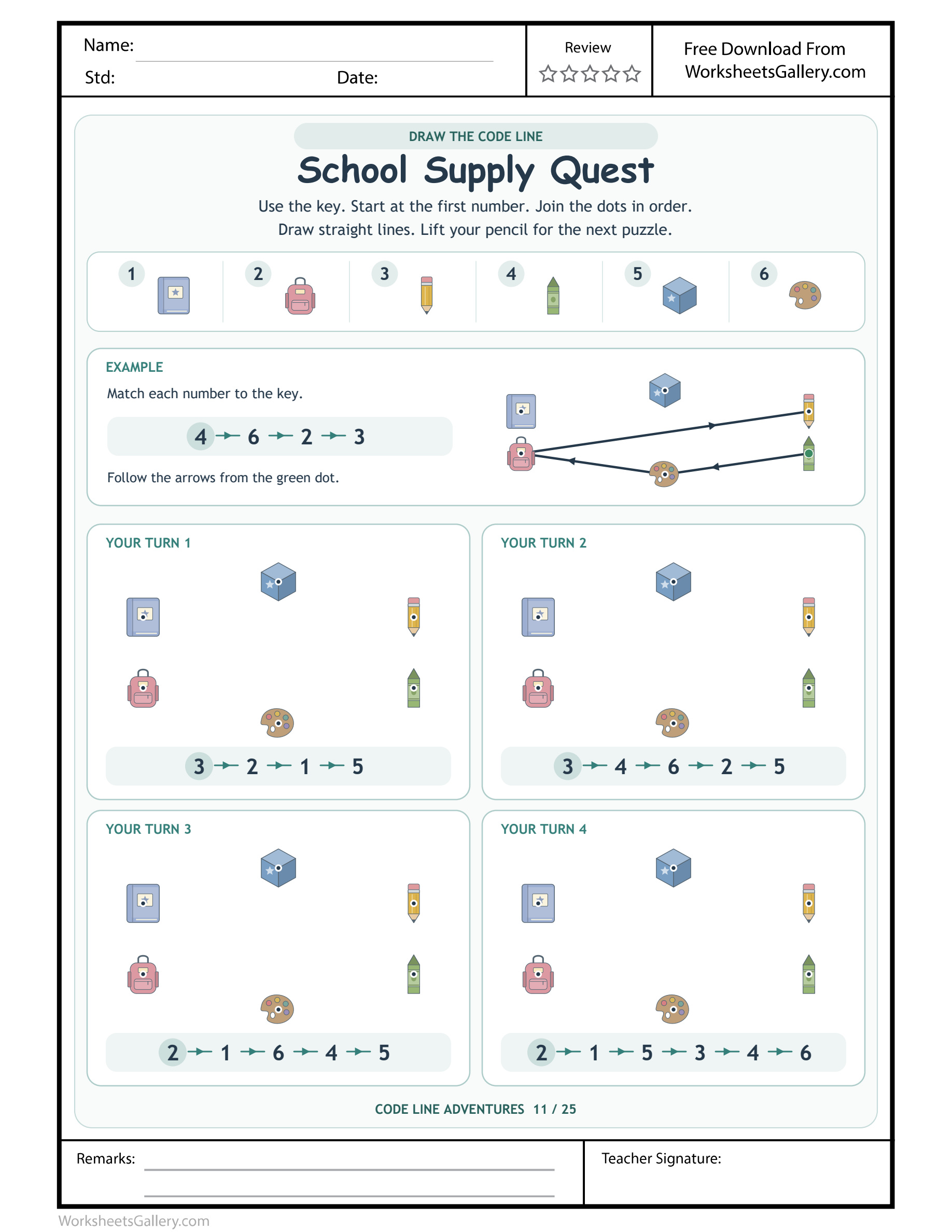
A pencil and a crayon may share a classroom pot, but they have different jobs in this picture key. School Supply Codes invites children to identify six familiar supplies, translate a numeral strip into named destinations and draw straight lines between their centre dots. Four practice routes follow a wide example. Looking closely at book, backpack, pencil, crayon, block and palette gives the conversation a concrete focus. The child need not read the object words independently: pointing, naming and checking the printed legend can work together before the pencil makes its next deliberate connection.
Begin at a classroom table, imagined — School Supply Codes
Imagine Kira using School Supply Codes in a small group. She calls both slender drawing tools pencil. Her teacher points to the separate legend entries and describes the crayon's shape, accepting Kira's correct pointing while adding the more precise word. They compare three with four before drawing, so the vocabulary distinction serves an immediate purpose.
Kira then explains one School Supply Codes connection to a partner using numeral and picture together. The teacher listens for the selected entry, rather than requiring a long sentence. Each child draws on their own copy. A brief spoken check supports the task without giving one child's handwork to another.
What the supply pictures are asking
The School Supply Codes page is a code-to-picture drawing exercise, not a request to colour with each pictured tool or count classroom equipment. A numeral selects one key entry. The centre dots inside the matching panel are the places where the straight lines should meet.
Keep School Supply Codes language specific enough to distinguish similar objects. “Drawing thing” could describe pencil, crayon or palette, whereas “three, pencil” singles out one entry. Check the picture assignment when a word could mean several things. An adult can supply the name while leaving the actual selection to the child.
School Supply Quest legend at a glance
| School Supply Quest numeral | Keyed picture |
|---|---|
| 1 | book |
| 2 | backpack |
| 3 | pencil |
| 4 | crayon |
| 5 | block |
| 6 | palette |

School Supply Quest example before independent drawing
School Supply Quest demonstrates 4 → 6 → 2 → 3. The School Supply Quest itinerary is crayon → palette → backpack → pencil. In School Supply Quest, the green start selects crayon. School Supply Quest arrows lead to pencil. School Supply Quest has 3 worked segments. The School Supply Codes example supports finger rehearsal. Inspect the School Supply Quest practice strip separately.
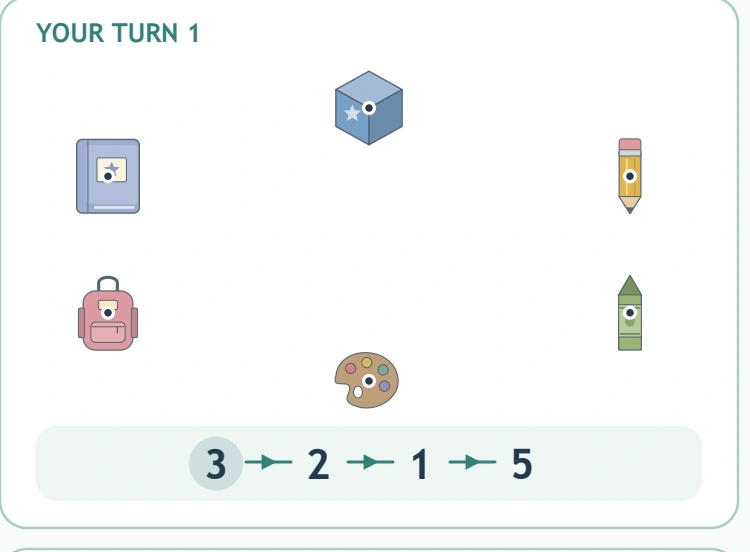
School Supply Quest — practice 1
Practice 1 on School Supply Quest: 3 → 2 → 1 → 5. Translate those School Supply Codes destinations as pencil → backpack → book → block. Begin on pencil for School Supply Quest; next locate backpack. The School Supply Quest centre-to-centre connections are pencil to backpack; backpack to book; book to block. Segment count for School Supply Codes: 3, from 4 listed stops. The School Supply Quest endpoint is block. Against the School Supply Quest strip, verify final 5.
School Supply Codes leaves crayon, palette outside practice 1. Leave these School Supply Quest alternatives unvisited. Practice 1 for School Supply Quest requests 3 → 2 → 1 → 5.
School Supply Quest — practice 2
Practice 2 on School Supply Quest: 3 → 4 → 6 → 2 → 5. Translate those School Supply Codes destinations as pencil → crayon → palette → backpack → block. Begin on pencil for School Supply Quest; next locate crayon. The School Supply Quest centre-to-centre connections are pencil to crayon; crayon to palette; palette to backpack; backpack to block. Segment count for School Supply Codes: 4, from 5 listed stops. The School Supply Quest endpoint is block. Against the School Supply Quest strip, verify final 5.
School Supply Codes leaves book outside practice 2. Leave these School Supply Quest alternatives unvisited. Practice 2 for School Supply Quest requests 3 → 4 → 6 → 2 → 5.
School Supply Quest — practice 3
Practice 3 on School Supply Quest: 2 → 1 → 6 → 4 → 5. Translate those School Supply Codes destinations as backpack → book → palette → crayon → block. Begin on backpack for School Supply Quest; next locate book. The School Supply Quest centre-to-centre connections are backpack to book; book to palette; palette to crayon; crayon to block. Segment count for School Supply Codes: 4, from 5 listed stops. The School Supply Quest endpoint is block. Against the School Supply Quest strip, verify final 5.
School Supply Codes leaves pencil outside practice 3. Leave these School Supply Quest alternatives unvisited. Practice 3 for School Supply Quest requests 2 → 1 → 6 → 4 → 5.
School Supply Quest — practice 4
Practice 4 on School Supply Quest: 2 → 1 → 5 → 3 → 4 → 6. Translate those School Supply Codes destinations as backpack → book → block → pencil → crayon → palette. Begin on backpack for School Supply Quest; next locate book. The School Supply Quest centre-to-centre connections are backpack to book; book to block; block to pencil; pencil to crayon; crayon to palette. Segment count for School Supply Codes: 5, from 6 listed stops. The School Supply Quest endpoint is palette. Against the School Supply Quest strip, verify final 6.
School Supply Quest uses every School Supply Codes entry in practice 4 of School Supply Quest: 2 → 1 → 5 → 3 → 4 → 6. First School Supply Quest selection: backpack; final selection: palette.
Six useful outcomes from a supply conversation
- More precise naming. School Supply Codes offers a practical reason to distinguish pencil from crayon. A clearer word lets a partner identify the intended stop, while a point remains a valid response when the vocabulary is still developing.
- Reference use. Returning to the School Supply Codes legend models checking available information. Children do not need to remember every assignment; finding the relevant numeral and picture is part of the work.
- Ordered explanation. Saying two School Supply Codes destinations in sequence can guide a real action. Listen for the order, rather than the length of the child's sentence, and compare it with the current strip.
- Planned movement. A School Supply Codes centre supplies a visible landing target. Locating it before moving gives the hand a definite goal and makes a controlled arrival easier to notice.
- Selective attention. The School Supply Codes strip may omit some available supplies. Leaving them untouched shows attention to the instruction, even when those pictures look interesting or easy to reach.
- Evidence-based repair. Comparing one School Supply Codes pair with its numerals identifies a local disagreement. A small correction can restore the route without erasing every successful connection already made.
Prepare the paper and choose the support
For children roughly four to seven, School Supply Codes can be adapted around numeral familiarity, object vocabulary and fine motor comfort. Read a code aloud for a child who recognises the pictures but not the number names. Offer a finger route when the lookup is understood but drawing remains tiring.
At home, introduce School Supply Codes with the key visible and the paper steady. Follow the wide demonstration with a finger, identify the chosen practice panel and read its initial pair. Draw one centre-to-centre link, then find the next numeral. Lift before another box. One panel is an appropriate amount when interest begins to fade.
An imagined desk drawer at home
Picture Kira trying School Supply Codes with a caregiver near a drawer of art supplies. They compare a real pencil with the printed pencil and name the palette picture together. The real objects begin the conversation, but they return to the worksheet legend before deciding which numeral identifies each stop.
When Kira wants to colour the School Supply Codes crayon instead of joining its centre, the adult acknowledges the idea and explains the current drawing request. They can colour a separate picture later. Keeping those activities distinct lets Kira enjoy the object while understanding what this particular code asks her pencil to show.
Four ways to keep the supply theme playful
Give the classroom helper a clear request
Use large labelled supply pictures after School Supply Codes. Ask a toy helper to visit a named School Supply Quest pair before inviting the child to direct. Compare whether pencil and crayon were described precisely enough for the listener to choose without guessing.
Find the clue that narrows a name
Offer two descriptions inspired by School Supply Codes: “something used for art” and “the palette with paint spots.” Discuss which selects one picture more clearly. The child can invent another clue, using visible details rather than needing to know specialist art vocabulary.
Retell a desk-clearing trip
Choose a completed School Supply Codes itinerary and invent a brief classroom-helper story using its stops in order. Add a reason for visiting the backpack or book, while preserving the printed sequence. A listener can point through the drawing as the story is told.
Check a puppet's tool mix-up
Let a puppet point to crayon when a School Supply Codes numeral requests pencil. The child refers to the key and supplies a clue or correction. The puppet tries again, giving precise naming a friendly audience without revisiting a learner's mistake as a joke.
When a familiar object becomes a confusing symbol
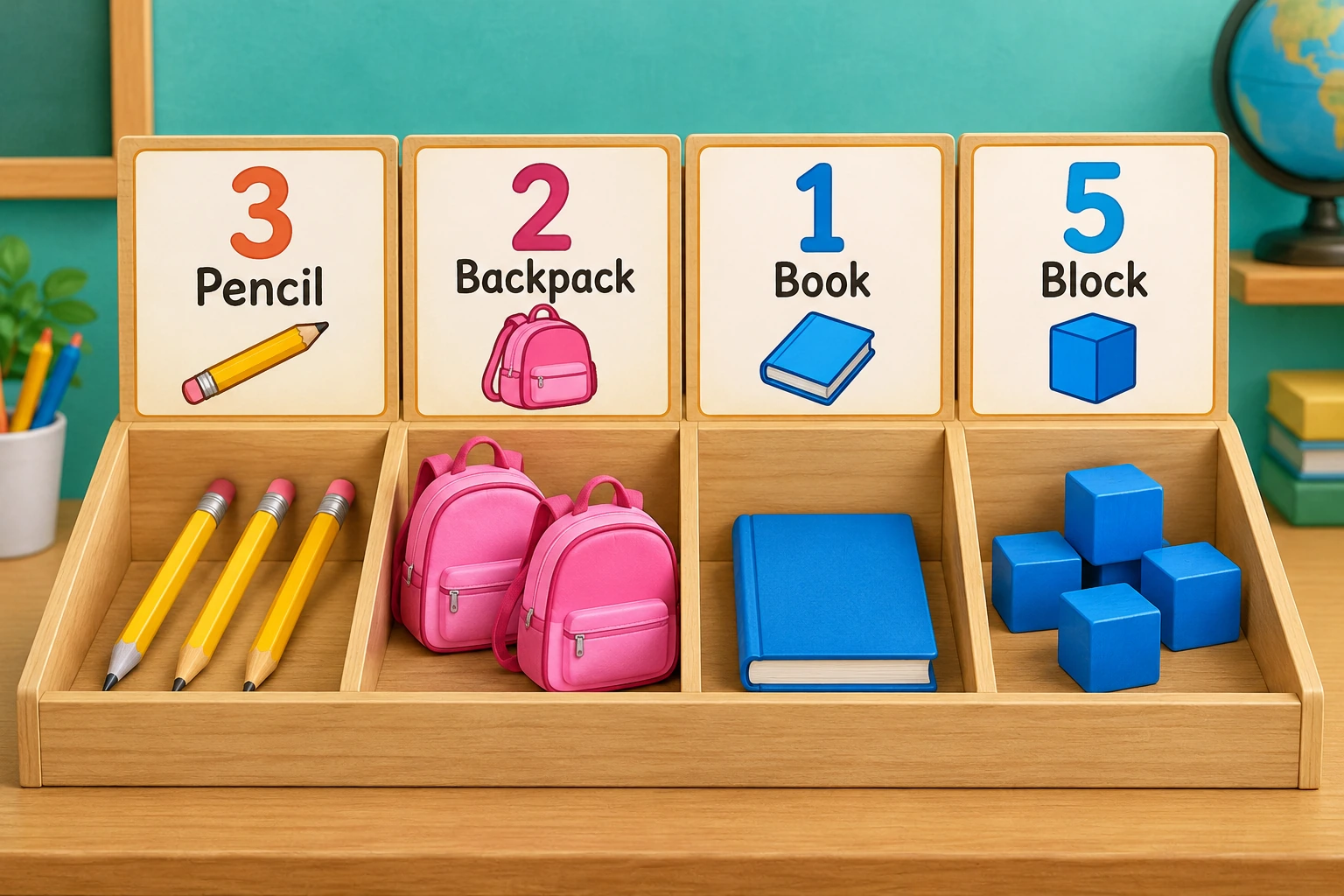
Common School Supply Codes slips include treating pencil and crayon as interchangeable, following the example inside a new field or tracing an object's outline. Compare the specific key entries or centre targets involved. Re-explain only the part causing difficulty; a correct numeral match should not be overlooked because the line is uneven.
Make repeat School Supply Codes practice a short desk-helper invitation after a story or art session. Allow a child to select one field and ask for a word they do not know. Clear communication is a worthwhile success. End with a specific observation about a checked picture or controlled landing, leaving other panels for a later visit.
Choose a printable supply route
The sample download offers the original School Supply Codes sheet. Through an eligible active membership, a signed-in user can obtain its cleaned premium PDF. The premium page removes the domain and watermark and includes no advertisements. The $3 School Supply Quest collection option combines the full set of twenty-five supplied sheets.
Before printing School Supply Codes, open the saved file and inspect its full portrait preview. Keep every border, code strip and legend entry inside the printable margins. A colour copy supports picture discrimination; use a test page to check scaling before preparing a classroom set.
Explore other forms of using a key
Compare School Supply Codes with Castle Color Codes. After School Supply Quest, try Number Letter Switching. For School Supply Quest, consider Exact Path Detective.
For wider play around School Supply Codes, adults may consult NAEYC's resources for shared learning and PBS Parents' activity library. These optional sources can inspire conversation and classroom pretend play while the supplied legend continues to decide the worksheet's requested destinations.
Popular Worksheets
Printable resources families and teachers are downloading now.
 Free
 Free
 Free
 Free