
Travel Picture Tracks: 5 Clever Vehicle Connections
Park all 25 themes in one clean file for $3. The vehicle itineraries remain intact within the collection, giving families a single PDF from which to choose a transport trip or another picture-route setting.
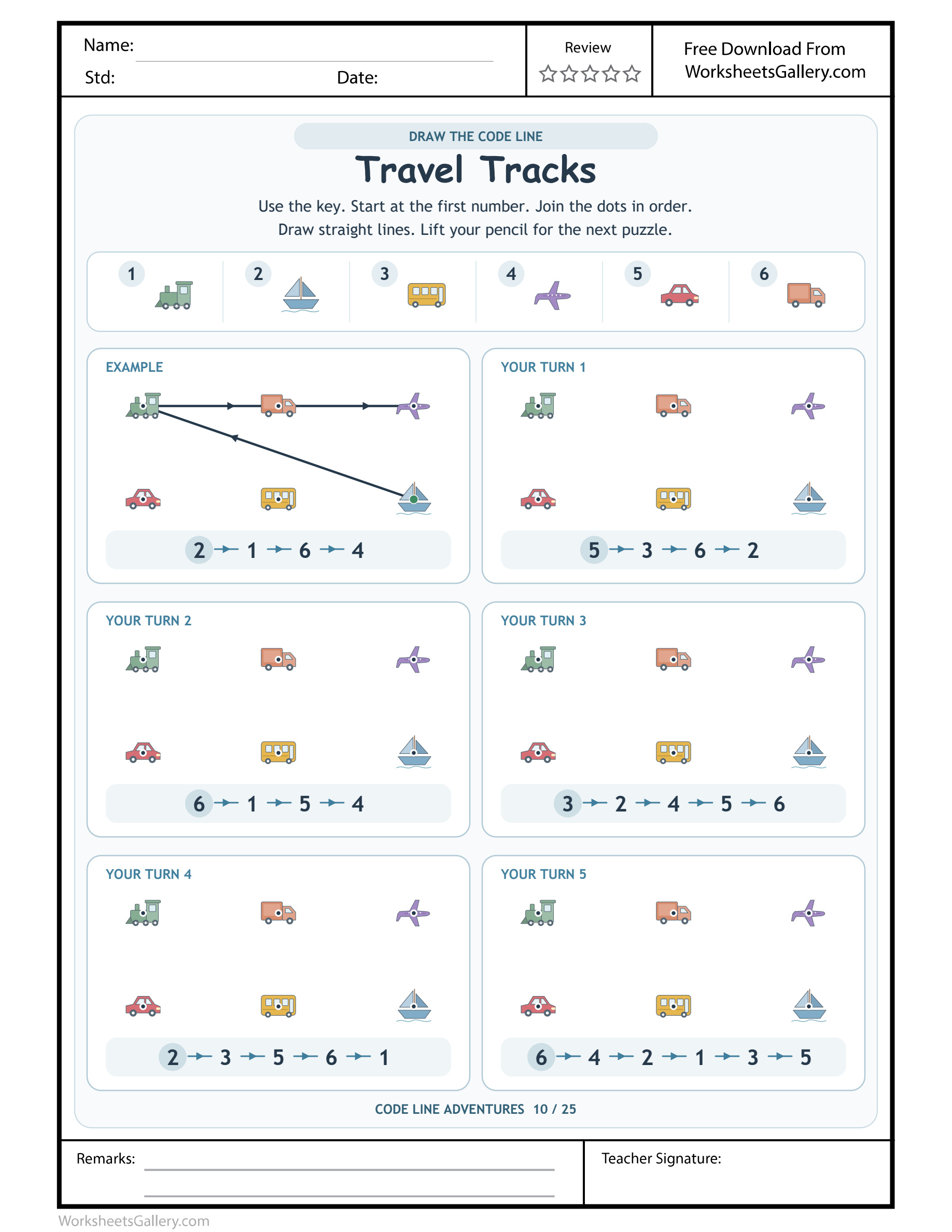
Where should the vehicle journey finish? Checking that question before drawing can make Travel Picture Tracks feel like planning a trip rather than filling a box with lines. Six transport pictures are assigned numerals in a legend, and five separate route strips choose their visiting order. Children connect the matching centre dots, using a finished example as a guide to the method. The first independent trip ends at a sailboat, even though the legend continues beyond its number. The instruction's final entry, rather than the largest numeral or nearest vehicle, decides arrival.
Name the arrival before starting the engine — Travel Picture Tracks
The Travel Picture Tracks legend identifies train, sailboat, bus, plane, car and truck with one through six. Ask the child to locate the last numeral in a chosen strip and show its vehicle. This preview gives the route a clear stopping place, while the intervening entries still need to be followed in their printed order.
For Travel Picture Tracks, checking the endpoint is not a shortcut around the middle. A line that starts and ends correctly can still visit the wrong places between. Plan the arrival, then inspect each requested connection. The route strip remains available throughout the trip.
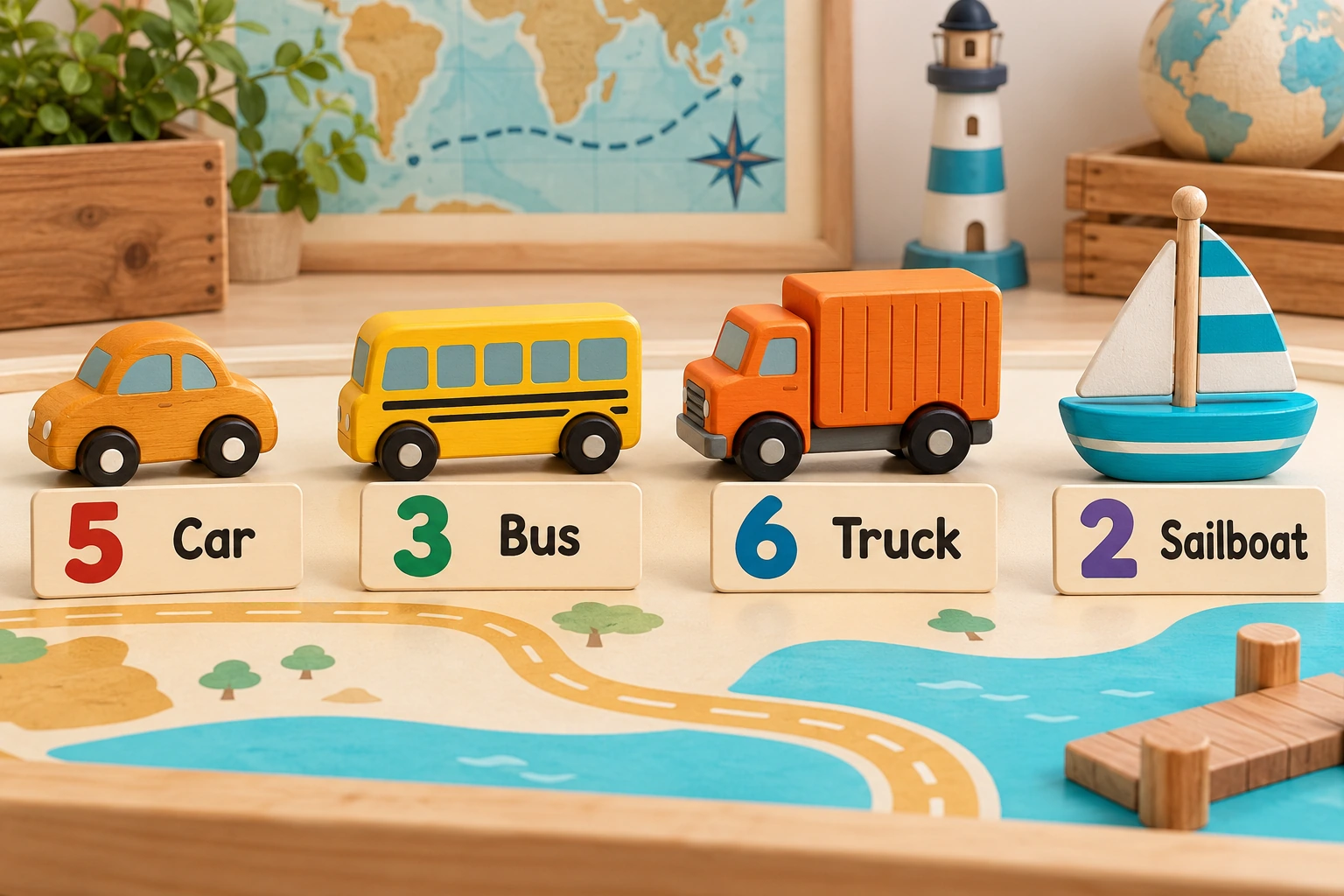
Travel Tracks legend at a glance
| Travel Tracks numeral | Keyed picture |
|---|---|
| 1 | train |
| 2 | sailboat |
| 3 | bus |
| 4 | plane |
| 5 | car |
| 6 | truck |

Travel Tracks example before independent drawing
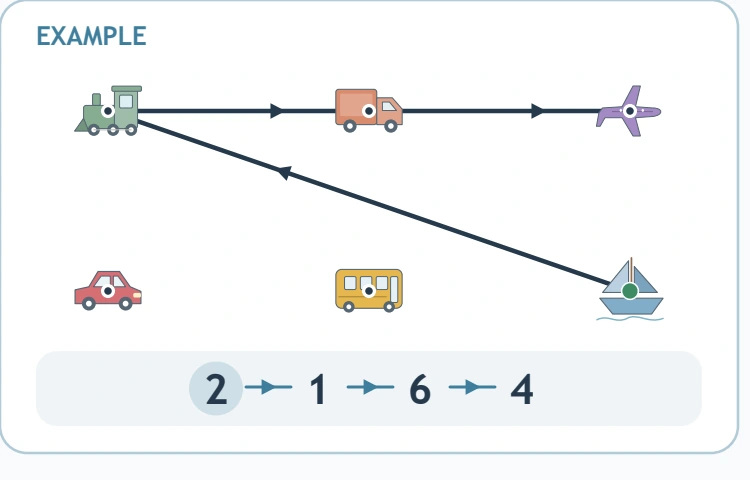
Travel Tracks demonstrates 2 → 1 → 6 → 4. The Travel Tracks itinerary is sailboat → train → truck → plane. In Travel Tracks, the green start selects sailboat. Travel Tracks arrows lead to plane. Travel Tracks has 3 worked segments. The Travel Picture Tracks example supports finger rehearsal. Inspect the Travel Tracks practice strip separately.
Travel Tracks — practice 1
Practice 1 on Travel Tracks: 5 → 3 → 6 → 2. Translate those Travel Picture Tracks destinations as car → bus → truck → sailboat. Begin on car for Travel Tracks; next locate bus. The Travel Tracks centre-to-centre connections are car → bus; bus → truck; truck → sailboat. Segment count for Travel Picture Tracks: 3, from 4 listed stops. The Travel Tracks endpoint is sailboat. Against the Travel Tracks strip, verify final 2.
Travel Picture Tracks leaves train, plane outside practice 1. Leave these Travel Tracks alternatives unvisited. Practice 1 for Travel Tracks requests 5 → 3 → 6 → 2.
Travel Tracks — practice 2
Practice 2 on Travel Tracks: 6 → 1 → 5 → 4. Translate those Travel Picture Tracks destinations as truck → train → car → plane. Begin on truck for Travel Tracks; next locate train. The Travel Tracks centre-to-centre connections are truck → train; train → car; car → plane. Segment count for Travel Picture Tracks: 3, from 4 listed stops. The Travel Tracks endpoint is plane. Against the Travel Tracks strip, verify final 4.
Travel Picture Tracks leaves sailboat, bus outside practice 2. Leave these Travel Tracks alternatives unvisited. Practice 2 for Travel Tracks requests 6 → 1 → 5 → 4.
Travel Tracks — practice 3
Practice 3 on Travel Tracks: 3 → 2 → 4 → 5 → 6. Translate those Travel Picture Tracks destinations as bus → sailboat → plane → car → truck. Begin on bus for Travel Tracks; next locate sailboat. The Travel Tracks centre-to-centre connections are bus → sailboat; sailboat → plane; plane → car; car → truck. Segment count for Travel Picture Tracks: 4, from 5 listed stops. The Travel Tracks endpoint is truck. Against the Travel Tracks strip, verify final 6.
Travel Picture Tracks leaves train outside practice 3. Leave these Travel Tracks alternatives unvisited. Practice 3 for Travel Tracks requests 3 → 2 → 4 → 5 → 6.
Travel Tracks — practice 4
Practice 4 on Travel Tracks: 2 → 3 → 5 → 6 → 1. Translate those Travel Picture Tracks destinations as sailboat → bus → car → truck → train. Begin on sailboat for Travel Tracks; next locate bus. The Travel Tracks centre-to-centre connections are sailboat → bus; bus → car; car → truck; truck → train. Segment count for Travel Picture Tracks: 4, from 5 listed stops. The Travel Tracks endpoint is train. Against the Travel Tracks strip, verify final 1.
Travel Picture Tracks leaves plane outside practice 4. Leave these Travel Tracks alternatives unvisited. Practice 4 for Travel Tracks requests 2 → 3 → 5 → 6 → 1.
Travel Tracks — practice 5
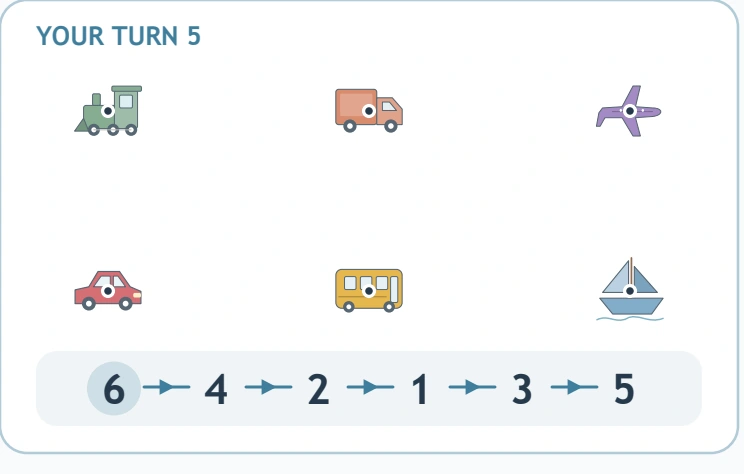
Practice 5 on Travel Tracks: 6 → 4 → 2 → 1 → 3 → 5. Translate those Travel Picture Tracks destinations as truck → plane → sailboat → train → bus → car. Begin on truck for Travel Tracks; next locate plane. The Travel Tracks centre-to-centre connections are truck → plane; plane → sailboat; sailboat → train; train → bus; bus → car. Segment count for Travel Picture Tracks: 5, from 6 listed stops. The Travel Tracks endpoint is car. Against the Travel Tracks strip, verify final 5.
Travel Tracks uses every Travel Picture Tracks entry in practice 5 of Travel Tracks: 6 → 4 → 2 → 1 → 3 → 5. First Travel Tracks selection: truck; final selection: car.
Six useful checks along a vehicle route
Recognise a meaningful endpoint
The last Travel Picture Tracks numeral selects a particular picture, even when it is not six. A child can practise stopping because an instruction has ended. Ask what evidence makes sailboat the arrival point in the first independent trip rather than relying on the drawing's appearance.
Preserve the middle of an instruction
Within Travel Picture Tracks, a correct final vehicle does not excuse skipped stops. Review consecutive pairs so the child can see how the middle contributes to the itinerary. This makes checking more informative than comparing only the first and last symbols.
Match a reference to a drawing field
The legend and panel in Travel Picture Tracks display the same vehicles in different arrangements. Moving between them practises locating a repeated symbol without assuming a reading-row order. An adult can read numeral names while the child performs the picture search.
Control an approach to a target
Each Travel Picture Tracks vehicle includes a small centre dot. Look at the next target, move the pencil deliberately and stop there. Encourage a comfortable stroke rather than a perfectly ruled line; choosing the intended vehicle is a separate success from geometric neatness.
Explain a planned journey
Inviting a short Travel Picture Tracks report can develop useful language: car to bus, then truck to sailboat. A partner can check those words against the key. Accept familiar names such as boat when the picture is clear, adding sailboat as vocabulary support.
Restart without extending the old road
The five Travel Picture Tracks panels describe independent trips. Lift the pencil after arrival and read the next strip from its own beginning. That transition prevents a child from treating the whole page as one continuous vehicle route.
Jules's imagined journey planning at home
Imagine Jules inspecting Travel Picture Tracks with a caregiver. He expects every route to finish at truck because truck is six. They check the first practice strip's last entry, two, and find sailboat in the legend. Jules now knows where this particular journey should end before he draws.
Midway through Travel Picture Tracks, Jules wants to head straight for the sailboat. The caregiver asks which vehicle the next numeral requests. They keep the planned arrival in mind but follow the remaining stops one pair at a time. The finished trip demonstrates why an endpoint and a complete itinerary are different pieces of information.
Set an appropriate distance for a young traveller
Children approximately four to seven can approach Travel Picture Tracks with support adjusted to numeral recognition, picture vocabulary and hand control. Read the strip aloud if numbers are unfamiliar. A child who understands the itinerary but finds the small movement tiring can point through the route instead of drawing another panel.
Prepare Travel Picture Tracks on a clear, stable surface. Follow the example's arrows, then choose one short practice trip. Keep the top legend visible and inspect the present code between strokes. A single route may provide enough practice for the day; five available panels need not mean five immediate completions.
A classroom arrival board, imagined
Picture a teacher using Travel Picture Tracks at a small-group transport table. Each child chooses a panel and announces its final vehicle before beginning. Partners point to the strip's last numeral to check the claim. The teacher then asks for the first pair, ensuring the endpoint discussion has not replaced the journey itself.
Children work on separate Travel Picture Tracks copies while the teacher watches for skipped middle entries, numeral confusion or aiming difficulties. Support follows the observed need. The group ends by explaining one successful check, with no comparison of how quickly the individual trips were completed.
Five travel games for another setting
Give a toy a named terminus
Use labelled vehicle stations after Travel Picture Tracks. State a short itinerary and ask the child to identify the final station before moving a toy. Then follow every requested stop. Trade roles so the adult must also check an arrival instead of assuming the trip ends at the largest label.
Compare journeys sharing an arrival
Invent two short spoken lists inspired by Travel Picture Tracks that finish at the same vehicle but visit different middle stops. Discuss why matching endpoints do not make the journeys identical. Keep the lists brief enough for the child to compare comfortably.
Describe a vehicle through visible clues
Give a Travel Picture Tracks picture clue, such as sails or wings, and find its key entry together. The child can make the next clue for an adult. This supports vocabulary without introducing transport facts or written answers that the worksheet does not request.
Be a road-trip narrator
Tell a small story using a completed Travel Picture Tracks route's destinations in order. Let the child choose passengers and a reason for travelling. Check the itinerary first, then add imaginative details around it rather than changing the printed visiting sequence.
Catch a driver's early stop
Let a puppet stop at the wrong vehicle during a Travel Picture Tracks finger route. Ask the child to inspect the remaining strip and show whether the trip is complete. The puppet can thank the reviewer and continue to the actual endpoint.
Make arrival feel satisfying
Common Travel Picture Tracks misunderstandings include finishing at six automatically, jumping directly to the last symbol or joining all pictures regardless of the code. Examine the relevant pair or endpoint with the legend. If the child understands the choice, practise the movement separately rather than repeating the whole explanation.
Return to Travel Picture Tracks in short, relaxed sessions around transport play. Offer a choice of panel, recognise a careful stopping decision and allow unfinished trips to wait. A well-planned arrival is worth enjoying. Repeated practice should leave space for curiosity, help requests and comfortable hands.
Save a printable vehicle trip
The original Travel Picture Tracks sample is available through its sample option. After signing in, eligible members obtain the cleaned Travel Tracks PDF: its activity sheet has no ads or watermark, and domain branding is removed. The complete twenty-five-theme collection is a separate $3 product.
Save Travel Picture Tracks and review portrait printing before using paper. Preserve the full border, upper legend and code strips in the preview; fit scaling may help on printers with wider margins. A clear colour test copy can confirm the vehicles remain easy to distinguish.
Further practice with chosen directions
Compare Travel Picture Tracks with Exact Path Detective. After Travel Tracks, try Castle Color Codes. For Travel Tracks, consider Number Letter Switching.
To extend discussion around Travel Picture Tracks, adults can explore NAEYC's family activity reading or PBS Parents learning ideas. Choose shared play that suits the child, keeping the worksheet's specific transport legend as the authority for its five drawn itineraries.
Popular Worksheets
Printable resources families and teachers are downloading now.
 Free
 Free
 Free
 Free