
Robot Clue Decisions: 3 Brilliant Features to Check
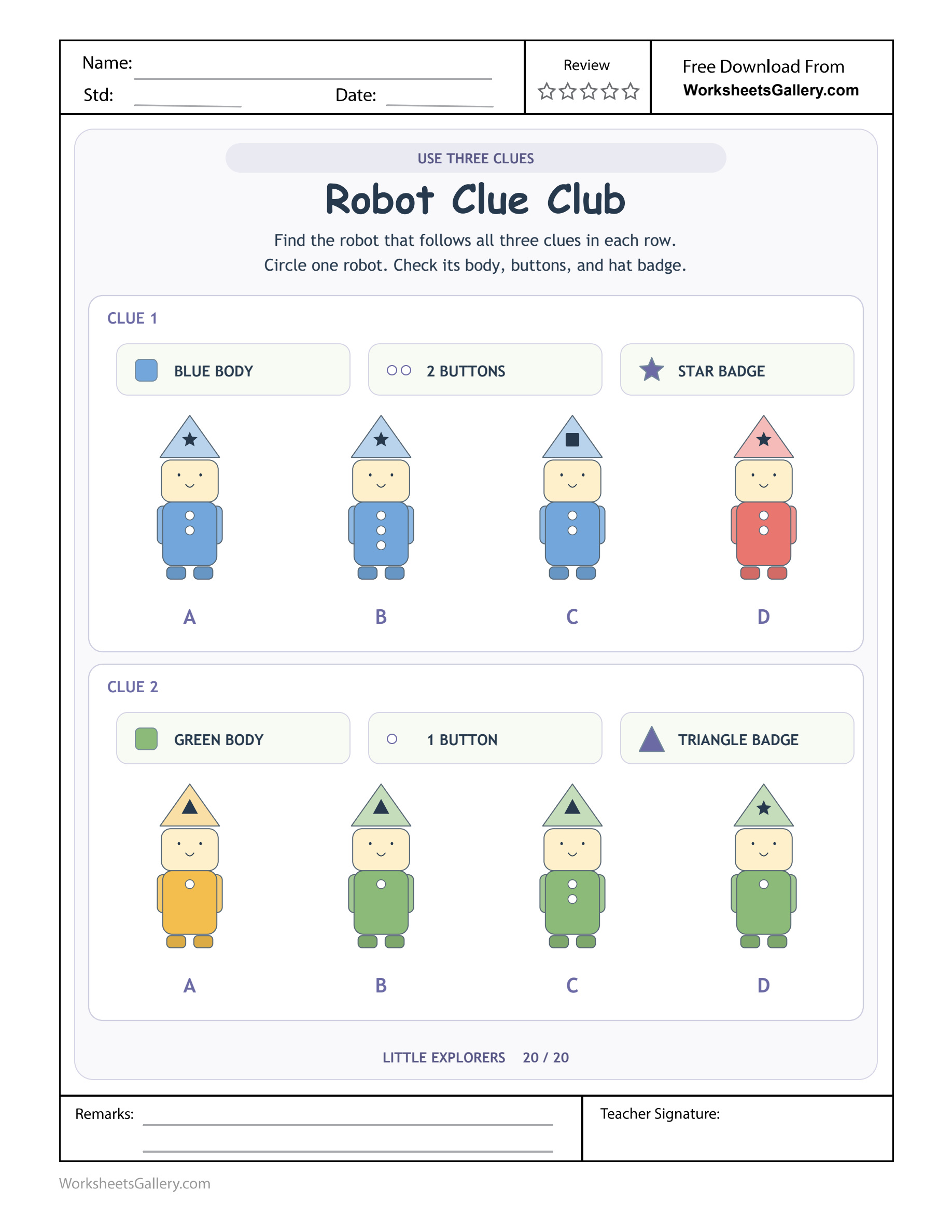
$5 collection companion: Robot Clue Decisions. Intersect body colour, button count and hat badge before choosing one robot per row.
A matching body colour is only one part of the decision. Robot Clue Decisions presents two robot line-ups, each with three clues about colour, button count and a badge shape. Children inspect candidates A to D and circle the robot that satisfies the whole clue set in that row. Several alternatives look close, making a careful final check useful. Read the clues together before searching, then invite the learner to explain how the selected robot meets every condition rather than stopping at the first familiar feature.
Build one complete description from three clues — Robot Clue Decisions
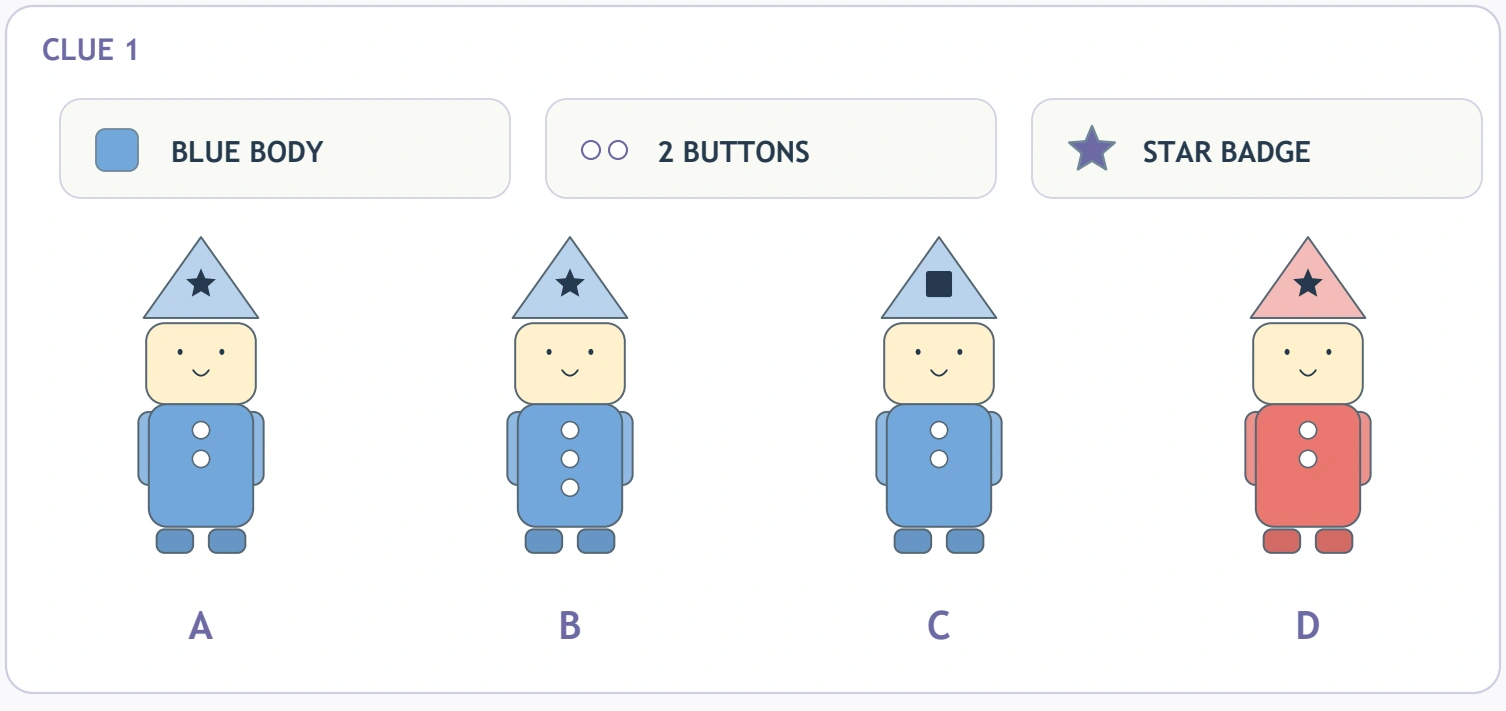
The first Robot Clue Decisions line-up requests a blue body, two buttons and a star badge. Read these as properties that must belong to one robot together. Wren can point to the body, the buttons and the badge location on a candidate while an adult repeats the clue set.
A child who finds a blue robot has begun the search, but has not yet answered the whole question. Ask which other clues still need checking. This gives the next inspection a clear purpose without naming the answer. The activity involves combining evidence, rather than finding any robot with one acceptable feature.
Count the buttons on the body: Robot Clue Decisions
The robot faces also contain repeated round features, but eyes are not the buttons specified in the clue. Establish which body marks are being counted before deciding between two and three. Similarly, inspect the badge drawn on the hat rather than treating the hat's general silhouette as the badge shape.
An adult reference for both line-ups
| Line-up | All required clues | Source choice |
|---|---|---|
| First | Blue body, two buttons, star badge | A |
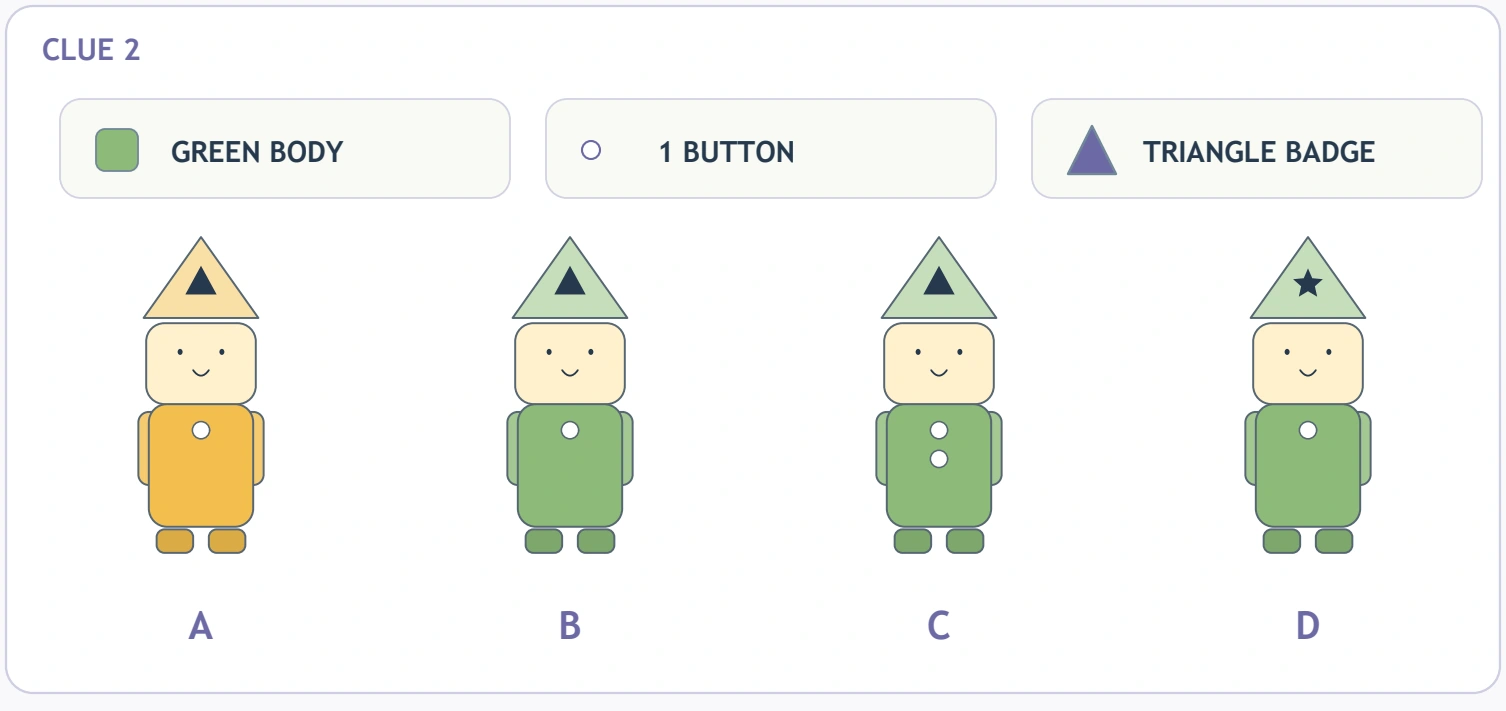
| Second | Green body, one button, triangle badge | B |
In the first Robot Clue Decisions group, B has the wrong button count, C has a square badge and D has a red body. These alternatives show why checking only colour or only two buttons is insufficient. A matches the three conditions together.
The second group changes all three requested properties. A has a yellow body, C has two buttons and D has a star badge. B satisfies the green, one-button and triangle combination. Read the new clues explicitly rather than carrying the first row's description into the next search.
Use elimination as a reasoned conversation: Robot Clue Decisions
Wren might start with body colour, setting aside a candidate whose body is clearly wrong. Another learner may begin by counting buttons. Either route can work if every remaining condition is eventually checked. Ask why a robot is being ruled out, so the decision remains connected to a visible mismatch.
For Robot Clue Decisions, a candidate with two matching features still fails a third incompatible clue. An adult can acknowledge the matches while asking what happens at the remaining check. That response is more informative than calling the candidate nearly correct without identifying the actual conflict.
Keep the two searches separate: Robot Clue Decisions
After completing the first line-up, point to the second clue strip and read it from the beginning. Wren should not assume that a star badge is always desirable. A feature's usefulness depends on the row's current instruction, which gives the same kind of picture detail a different role in the next group.
A home clue board with a patient listener
Imagine Wren reading the first clue set with her uncle. She points to a blue candidate and says that its colour fits. Her uncle asks what the clue says about buttons. Wren counts the body buttons and decides whether to continue inspecting that robot.
When she finds a candidate satisfying the colour and count, they look for the badge. Wren points to its shape and repeats the complete description. Her uncle can follow the evidence without supplying A as a shortcut.
At the second Robot Clue Decisions line-up, Wren notices a familiar star badge but rereads the new triangle request. The previous answer's feature no longer settles the question. The home discussion gives her a reason to update the search when the instructions change.
Six reasoning opportunities in two short rows: Robot Clue Decisions
Attending to a complete instruction set: Robot Clue Decisions
Robot Clue Decisions keeps three requirements visible for each search. Notice whether Wren consults the whole strip or remembers only its first item. Rereading the clues can be part of a successful strategy throughout the activity.
Identifying the relevant picture feature: Robot Clue Decisions
Body colour, body buttons and hat badge occupy different places. A child needs to inspect the feature named by the clue. Pointing can show whether an unexpected answer reflects a misidentified detail rather than a difficulty combining the conditions.
Counting a small set accurately: Robot Clue Decisions
The button clue distinguishes candidates with similar colours. Invite one touch or point per body button. A quick guess from the overall robot appearance may overlook the difference that matters for this condition.
Comparing shape identity: Robot Clue Decisions
A star, square and triangle provide separate badge options. The relevant question is the printed badge shape, not whether the child likes its decoration. Robot Clue Decisions lets an adult hear which visible feature the learner uses to name the shape.
Rejecting a candidate for a specific reason: Robot Clue Decisions
Saying “this one has three buttons” explains why a blue robot fails a two-button clue. Encourage a short reason for one rejected alternative. This makes the filtering process available for another person to inspect.
Verifying a chosen candidate completely: Robot Clue Decisions
Before circling, Wren can perform a final colour-count-badge check. The last review catches a choice made after only two matches. It also gives the learner a routine for checking their own evidence rather than waiting for approval.
A classroom team with three checking roles: Robot Clue Decisions
In a hypothetical small group, one child reads or identifies the colour clue, another counts buttons and a third inspects the badge. They discuss a candidate together, then switch roles for another example. The teacher keeps the full clue strip visible so that no role becomes an isolated guessing game.
When learners complete their own Robot Clue Decisions sheet, each child still chooses one robot per line-up. The group conversation supports the inspection process while preserving individual decisions. Ask a child to explain a match and a mismatch rather than merely repeat a partner's chosen letter.
For a learner who finds three clues demanding, discuss one candidate slowly and check the conditions one at a time. The aim is to combine them by the end of the inspection. Quietly removing a condition would change which candidates qualify, so make any separate simplified practice explicit before returning to the source.
Five clue games on spare cards: Robot Clue Decisions
Describe a robot for an adult to find
Draw a few simple robots with different colours, counts and badges on separate paper. Wren gives a full description for an adult to follow. If more than one fits, discuss what additional feature would distinguish them in that new set.
Repair one incompatible feature: Robot Clue Decisions
On a spare drawing, make a blue robot with three buttons and a star badge. Ask what would need changing to fit the first source description. The extension invites a precise revision while leaving the original worksheet unchanged.
Keep a visible three-part checklist: Robot Clue Decisions
Create small colour, count and shape cards and place them beside a new line-up. Turn attention to each card in sequence while inspecting one candidate. Ask which checks have been completed and which remain before making the final choice.
Change the clue, then reconsider: Robot Clue Decisions
Use a fresh set of robot drawings and alter only the requested badge shape. The child checks whether the previous candidate still fits. This makes the current instruction, rather than familiarity with an earlier answer, the reason for a new decision.
Explain why a near-match fails: Robot Clue Decisions
Choose a spare candidate that satisfies two conditions but misses one. Invite Wren to name its successful matches and its conflict. The game gives a useful role to careful rejection, rather than rewarding only the final selected picture.
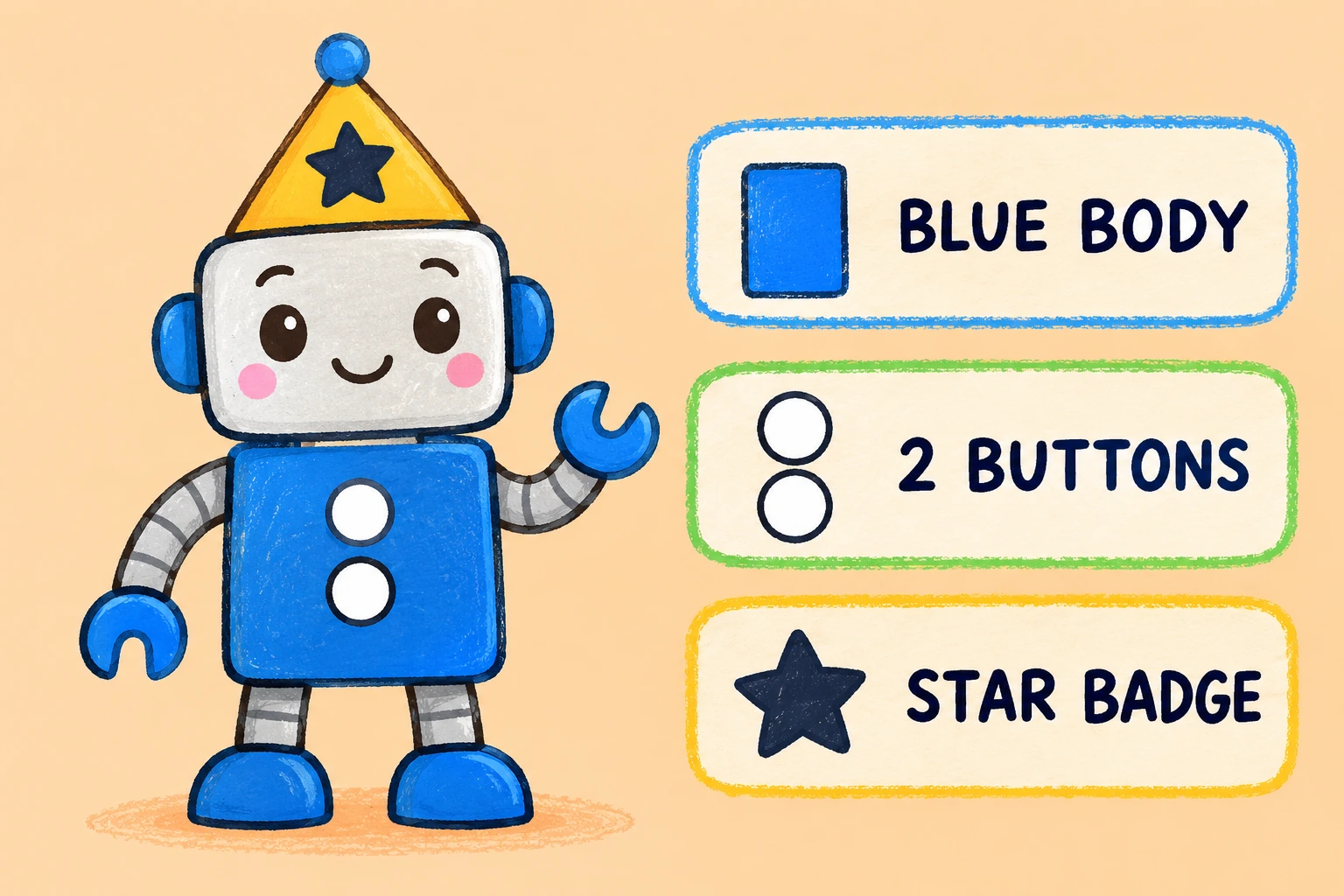
Similar robots can invite different kinds of mistakes: Robot Clue Decisions
An unexpected Robot Clue Decisions choice may come from stopping after the colour match, counting facial features as buttons, looking at the wrong badge location or carrying the previous row's clues forward. Ask the child to demonstrate each check on the chosen robot. This helps locate the specific step that needs another look.
If the body colour fits and the count fits, read the badge requirement again while pointing to the badge. If all three descriptions sound accurate but the child circled a neighbouring letter, clarify the intended selection. A marking slip and a missed clue do not call for the same explanation.
Use the letter to discuss the robot being circled
The A-to-D labels distinguish choices within each line-up. They are not secret codes for body colours or badge shapes. Wren can point to her candidate first, then circle that robot as the source requests. Its letter helps an adult follow the explanation of the selected picture.
Support a deliberate pace across the clue set: Robot Clue Decisions
Read the clues aloud and adapt the pace when introducing Robot Clue Decisions to learners aged four to seven. Start with one line-up and let the learner point through each feature. A single well-explained decision can be a useful first session.
For later practice, ask the child to begin with a different clue while keeping the same three requirements. Starting with buttons rather than colour can reveal whether the checking process is understood. The correct source choice stays the same because all conditions still apply together.
On another visit, a new off-page line-up can prevent the activity becoming a memory test for A and B. Keep the source answers available for checking, while giving the reasoning a fresh set of pictures in the extension. The useful habit is explaining how a candidate satisfies a stated combination.
Download both complete robot line-ups: Robot Clue Decisions
The premium Robot Clue Decisions single-sheet PDF is available with an eligible active membership. In the clean robot-clue printable, website watermark, domain promotion and embedded ads are absent. The original supplied page remains separately available as a sample.
Check the portrait print preview for the full clue strips and all A-to-D candidates in both groups. A cropped badge or missing letter would remove evidence needed to decide. A separate $5 purchase of the twenty-page clean Little Explorers PDF collection also includes this robot-clue activity.
Give another explanation a clear audience
After Robot Clue Decisions, explore Animal Letter Sudoku beside Robot Clue Decisions, Shape Code Sudoku after Robot Clue Decisions, Robot Grid Repair beyond Robot Clue Decisions. Keep each new instruction separate from Robot Clue Decisions.
For further ideas about talking through shared activities, visit PBS Parents' family resource for early literacy conversations. NAEYC's article on supporting children's writing and expression at home offers another perspective on meaningful records. With Robot Clue Decisions, inspect the whole clue combination, the specific body and badge features and the final candidate's complete match.
Popular Worksheets
Printable resources families and teachers are downloading now.
 Free
 Free
 Free
 Free