
Ball Position Words: 5 Clever Reference-Object Checks
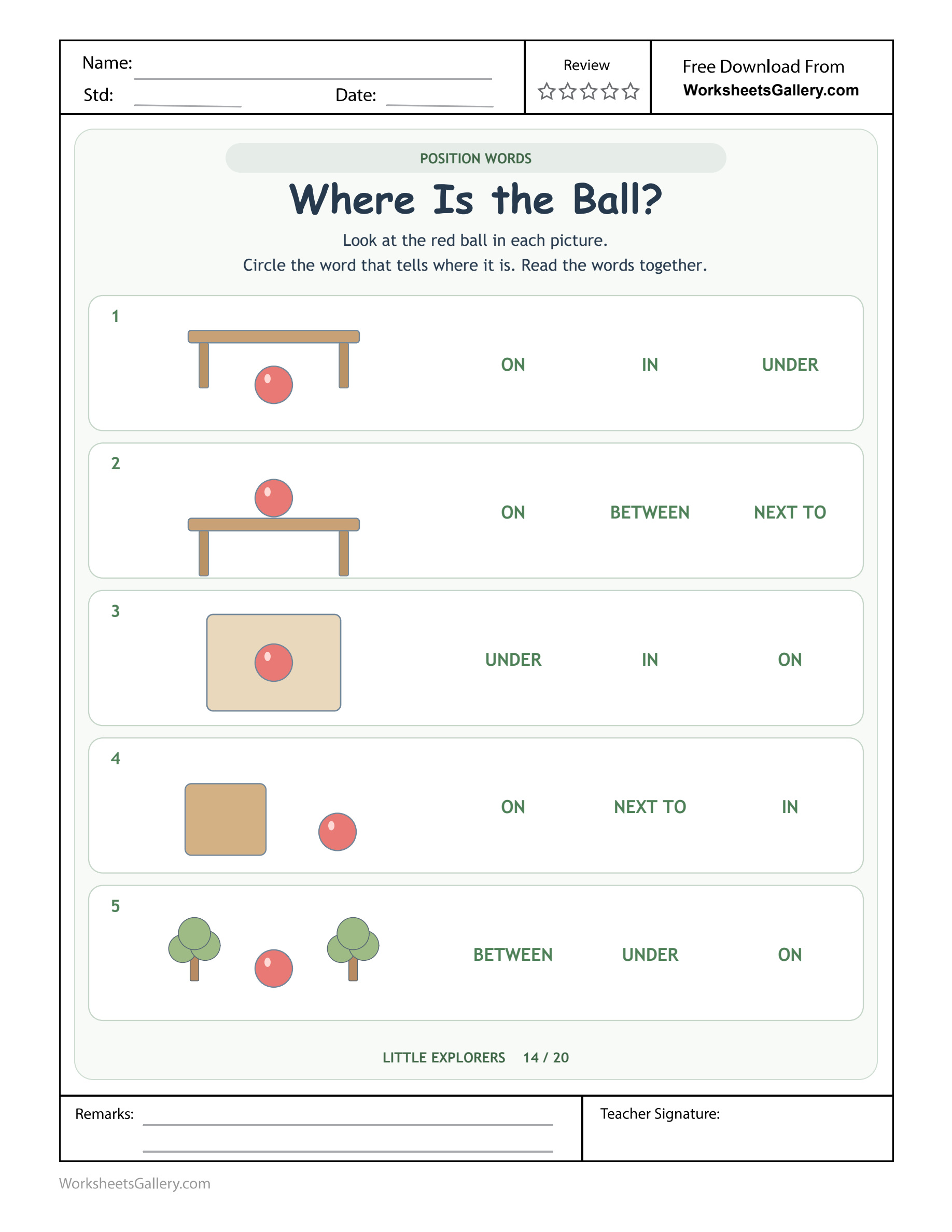
$5 collection companion: Ball Position Words. Describe a red ball relative to a table, box or pair of trees while an adult reads the choices.
The ball stays red, but its relationship to the other objects changes. Ball Position Words presents five pictures and asks children to circle the position word or phrase that describes each one. A table, a box and two trees provide different references for UNDER, ON, IN, NEXT TO and BETWEEN. The source explicitly welcomes reading the options together, so a child can explore the spatial meanings before reading every printed word independently. Begin by identifying both the ball and its reference object, then listen to the available descriptions before making a mark.
A position needs something to relate to — Ball Position Words
Saying that the red ball is “there” may be enough when an adult can see a pointing finger, but it does not explain its relationship to the pictured table or box. Ball Position Words gives that explanation a concrete purpose. Ask Nico which object helps describe the ball's place in the current row.
In the first picture, the ball is beneath the tabletop. In the next, it rests above the tabletop on its upper surface. The reference object stays recognisable while the relationship changes. This pair offers a clear starting point for discussing UNDER and ON without introducing every position word at once.
Read the row's actual choices aloud. Nico does not need to guess which written shape represents the word the adult has in mind. The source's reading support lets the decision remain about the pictured position rather than silently turning the activity into an independent word-reading test.
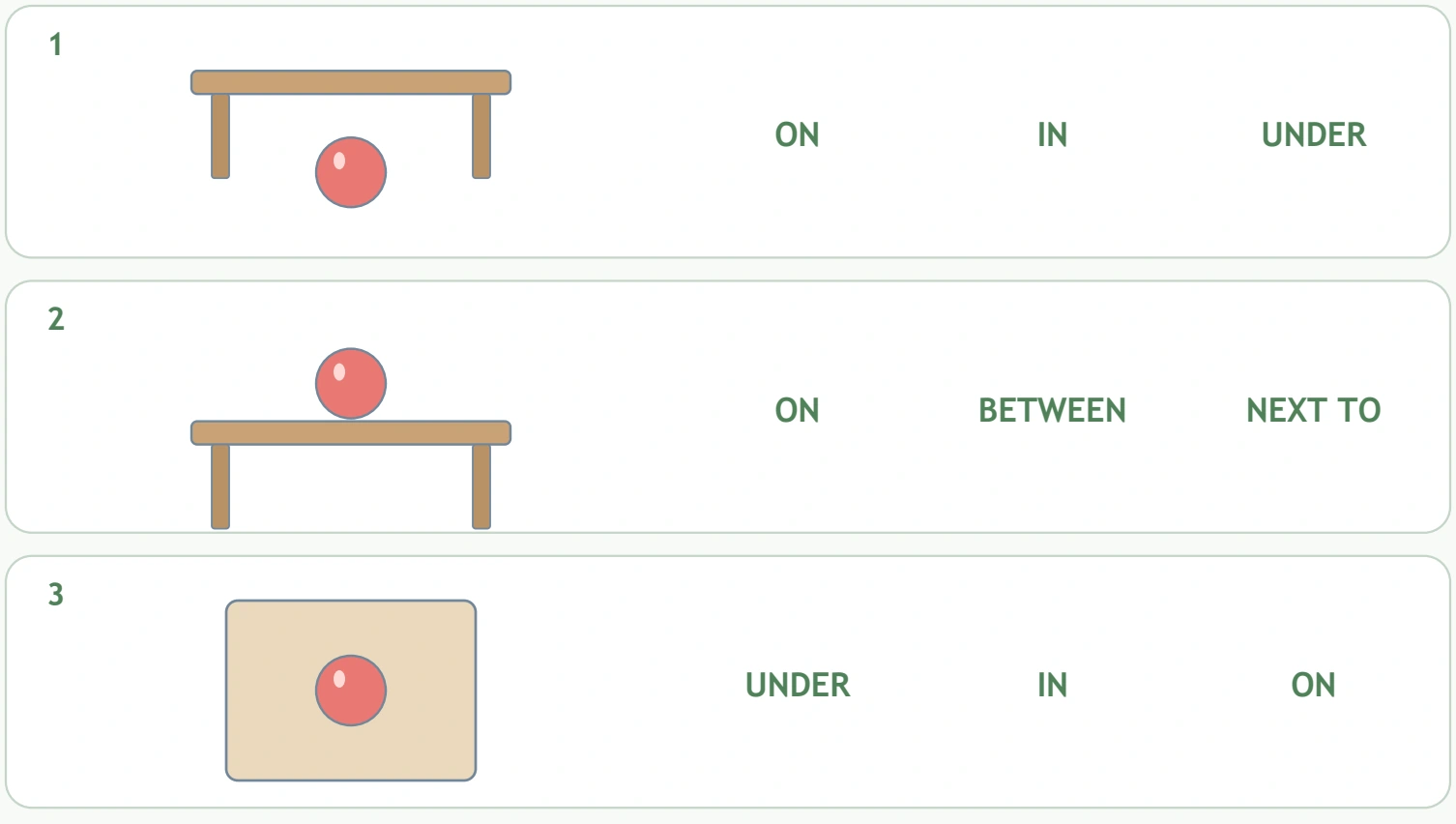
Five pictured relationships and their source answers: Ball Position Words
| Row | What to inspect | Intended choice |
|---|---|---|
| 1 | The ball below the table | UNDER |
| 2 | The ball on the table's top surface | ON |
| 3 | The ball within the drawn box boundary | IN |
| 4 | The ball beside a single box | NEXT TO |
| 5 | The ball in the space separating two trees | BETWEEN |
Use this Ball Position Words reference to prepare or check a discussion after the learner has inspected a row. The correct responses occupy different places in the choice sets. Selecting the first word every time would not describe all five pictures.
The box picture may need a shared interpretation: Ball Position Words
The third row shows the ball within the rectangular box shape. The intended description is IN. If Nico interprets the flat drawing differently, point out the boundary the source uses to represent the box and compare it with the beside-the-box picture. Clarifying the illustration can make the word question more understandable.
Describe first, then connect to the printed option: Ball Position Words
Invite Nico to point to the ball and explain its place in his own language. He might say below rather than UNDER, or beside rather than NEXT TO. Acknowledge the relationship he has described, then read the printed options and connect the intended choice to that explanation.
For Ball Position Words, choosing a word and circling it are two separate actions. The child can point to the spoken option before drawing around the capital letters. If the selected response is NEXT TO, circle the whole phrase so that the mark identifies the intended description clearly.
Read each new row again: Ball Position Words
The option sets change, as do their positions. Nico should not have to remember where UNDER appeared on an earlier row. An adult can read the choices anew while the child looks at the current picture. This supports meaning without supplying which option fits.
A home demonstration with a small ball: Ball Position Words
Imagine Nico and his aunt using a toy ball, a small table model and a box beside Ball Position Words. They first place the ball beneath the tabletop and describe the relationship. Nico then locates the source picture showing the same arrangement.
His aunt moves the ball onto the table model and asks what changed. The ball is still the same object, but the position description is different. Nico points to the corresponding printed row while the adult reads its options.
For the box pictures, they compare a ball placed inside the container with one beside it. The three-dimensional example can clarify the source's flat drawing. After that discussion, return to the printed picture and let Nico decide which offered word or phrase describes it. The real objects support the interpretation rather than becoming a different unrecorded answer set.
A classroom listener needs a clear relationship: Ball Position Words
For a hypothetical small-group session, one learner describes a Ball Position Words picture without pointing immediately. A partner uses the spoken relationship to find the row. If “near the box” could refer to more than one arrangement, the speaker can add a clearer description.
The teacher can read the capitalised choices and listen to the child's explanation. A learner may understand BETWEEN in a real arrangement but need help recognising the printed word, or may read ON accurately without checking whether the ball is actually on the pictured table. Those are different observations.
Partners can exchange roles after a row. Keep the exchange cooperative: the listener asks what the ball is being compared with, rather than judging whether the speaker used the adult's exact preferred sentence. A gesture can accompany the words when the relationship is still difficult to express verbally.
Six things the position pictures make observable
Finding the reference object: Ball Position Words
Ball Position Words asks for more than locating a red circle. Nico needs the table, box or trees to establish a relationship. Notice whether he identifies that reference before deciding which description fits.
Comparing a changed arrangement: Ball Position Words
The table pair keeps the main objects familiar while moving the ball. A child can explain what stayed the same and what changed. This makes the relationship easier to discuss than a set of entirely unrelated scenes.
Connecting everyday language to a printed term: Ball Position Words
A child may say beside and then recognise that NEXT TO describes the same intended relationship here. The adult can bridge that language without rejecting an accurate informal account. Ball Position Words offers a reason to connect words with visible arrangements.
Listening to the complete phrase: Ball Position Words
NEXT TO contains two printed words, while BETWEEN describes the relationship to two pictured trees. Invite attention to the whole response rather than choosing a familiar isolated word shape. Reading support keeps the phrase accessible.
Placing a purposeful circle
The mark should identify the selected option clearly. A child can know the relationship while finding a long phrase awkward to circle. Ask for a point or spoken choice when a mark touches neighbouring options.
Checking the description against the scene
After circling, read the selected word with the picture again. If it gives an unexpected description, Nico can reconsider. A reasoned change of response is a useful part of the discussion rather than a reason to hide the earlier attempt.
BETWEEN and NEXT TO deserve separate attention: Ball Position Words
The last two Ball Position Words pictures use different reference arrangements. One box beside a ball supports NEXT TO. Two trees with the ball in the separating space support BETWEEN. Merely counting the number of trees is not the whole reasoning; the ball's placement relative to both is important.
Ask Nico to point to each tree and then to the ball's location. Compare that arrangement with the single-box row. A child can demonstrate the difference using three loose objects before choosing between the printed descriptions.
A gap does not automatically mean the relationship is wrong: Ball Position Words
The pictured ball need not touch the box to be beside it. Focus on the relative placement rather than requiring physical contact for every position word. Likewise, examine the actual table surface when deciding ON instead of relying solely on which object appears higher on the page.
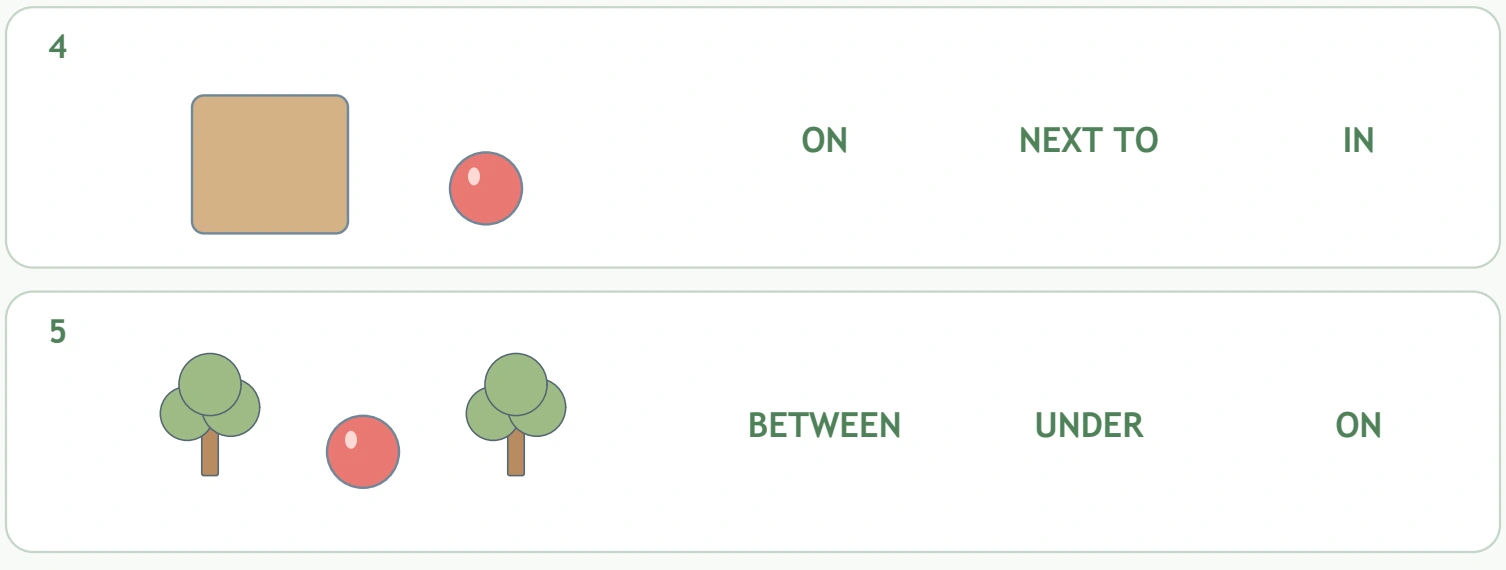
Five position games after the picture choices: Ball Position Words
Give a toy a clear instruction: Ball Position Words
Ask a toy character to place a small object next to a box, then let the child check the result. Reverse roles so that Nico gives the instruction. Keep the reference object named in the spoken request.
Contrast two arrangements
Show a ball inside a container and then beside it. Describe what changed while the objects stayed the same. A child can choose a word or demonstrate the relationship with pointing before looking at printed labels.
Make a between space: Ball Position Words
Place two toy trees or blocks with an open area separating them and position a counter between them. Ask which objects are the references. Move the counter elsewhere and invite a new description rather than insisting it must still fit the first word.
A descriptive picture postcard: Ball Position Words
Draw a simple arrangement on spare paper and dictate a sentence describing the ball's place. An adult can write the words while the child points out the relevant relationship. The extension gives a spoken description a small audience.
Check an adult's deliberate mix-up: Ball Position Words
An adult says that a ball under a small table is on it. Invite Nico to inspect the arrangement and explain which part of the description needs changing. Keep the example obvious enough that checking feels like a conversation rather than a trick.
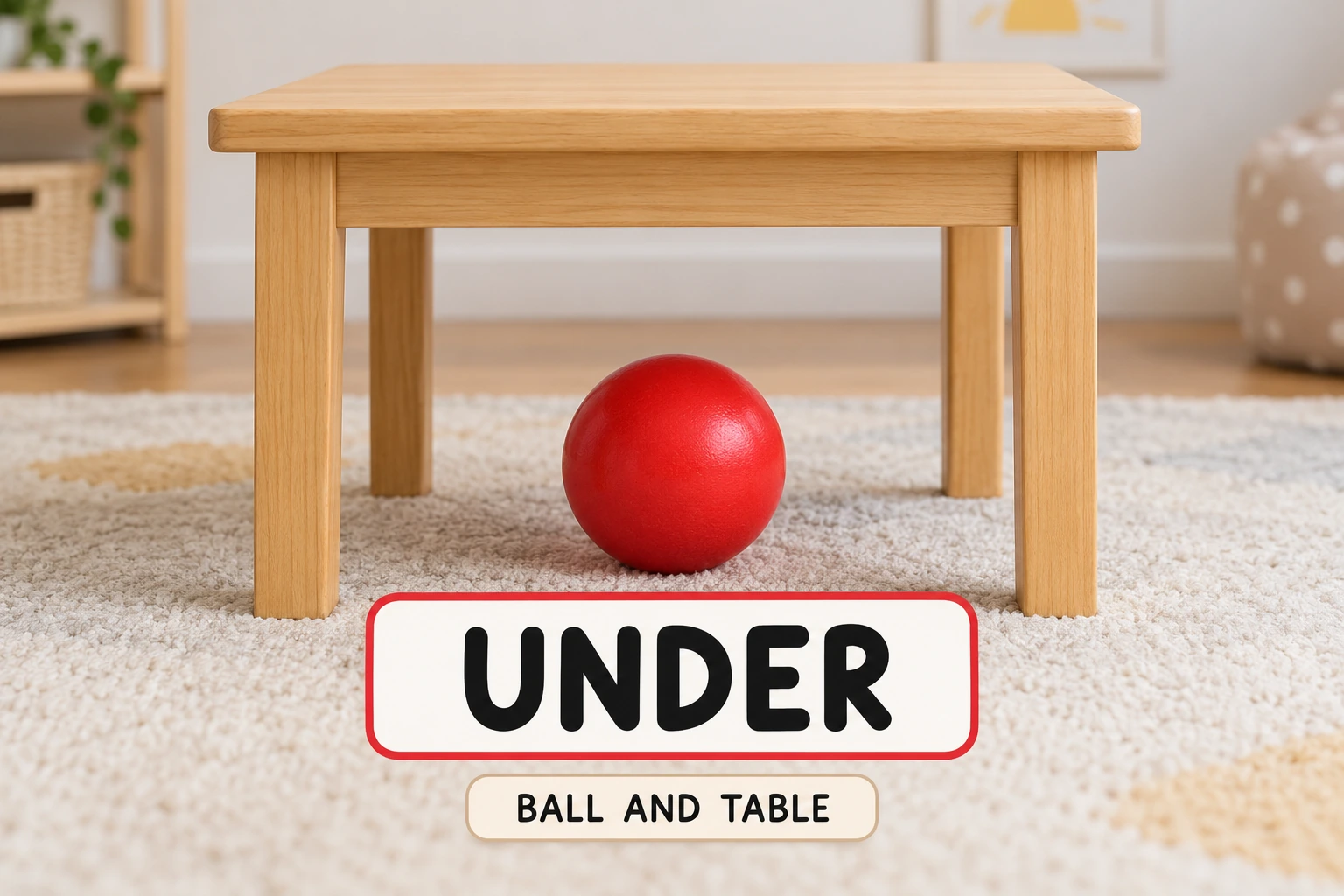
Help meaning stay clearer than the print demand: Ball Position Words
Suggested use for Ball Position Words is adult-supported play with many children around four to six. The printed options can be read aloud throughout. Position vocabulary, interpretation of a flat drawing and recognition of capitalised words may require different kinds of support.
Common difficulties include naming only the ball, overlooking the reference object, selecting the same answer position repeatedly or treating NEXT TO as two unrelated choices. Return to a single scene and read its actual options. If the illustration is unclear to the child, use a simple real-object comparison before revisiting the paper.
For another visit, let Nico describe one pictured relationship to someone who has not heard his explanation. Once the source rows are familiar, a fresh off-page arrangement can give the vocabulary a new purpose. A short, understandable instruction can be a satisfying piece of regular practice without repeating five circles automatically.
Save and print every reference picture
The premium Ball Position Words single sheet is available through an active member plan that qualifies for access. Its clean PDF removes website watermark and domain promotion and has no embedded ads. The supplied original remains separately selectable as a sample.
Check the portrait printer view for each complete reference object and the whole NEXT TO phrase. Preserve the bottom pair of trees and its choices as well as the top table row. This activity also belongs to the related $5 Little Explorers collection, purchased as a single clean twenty-page PDF.
More opportunities to describe a relationship: Ball Position Words
After Ball Position Words, explore Treasure Map Squares beside Ball Position Words, Park Grid References after Ball Position Words, Picture Pair Routes beyond Ball Position Words. Keep each new instruction separate from Ball Position Words.
For additional adult-supported language play, explore PBS Parents' ideas for talking through everyday learning or read NAEYC's resource about supporting meaningful early expression. With Ball Position Words, notice the reference object, the relationship being described and the word or phrase selected for this scene.
Popular Worksheets
Printable resources families and teachers are downloading now.
 Free
 Free
 Free
 Free