
Snail S Selector: 4 Wonderful Letter Learning Games
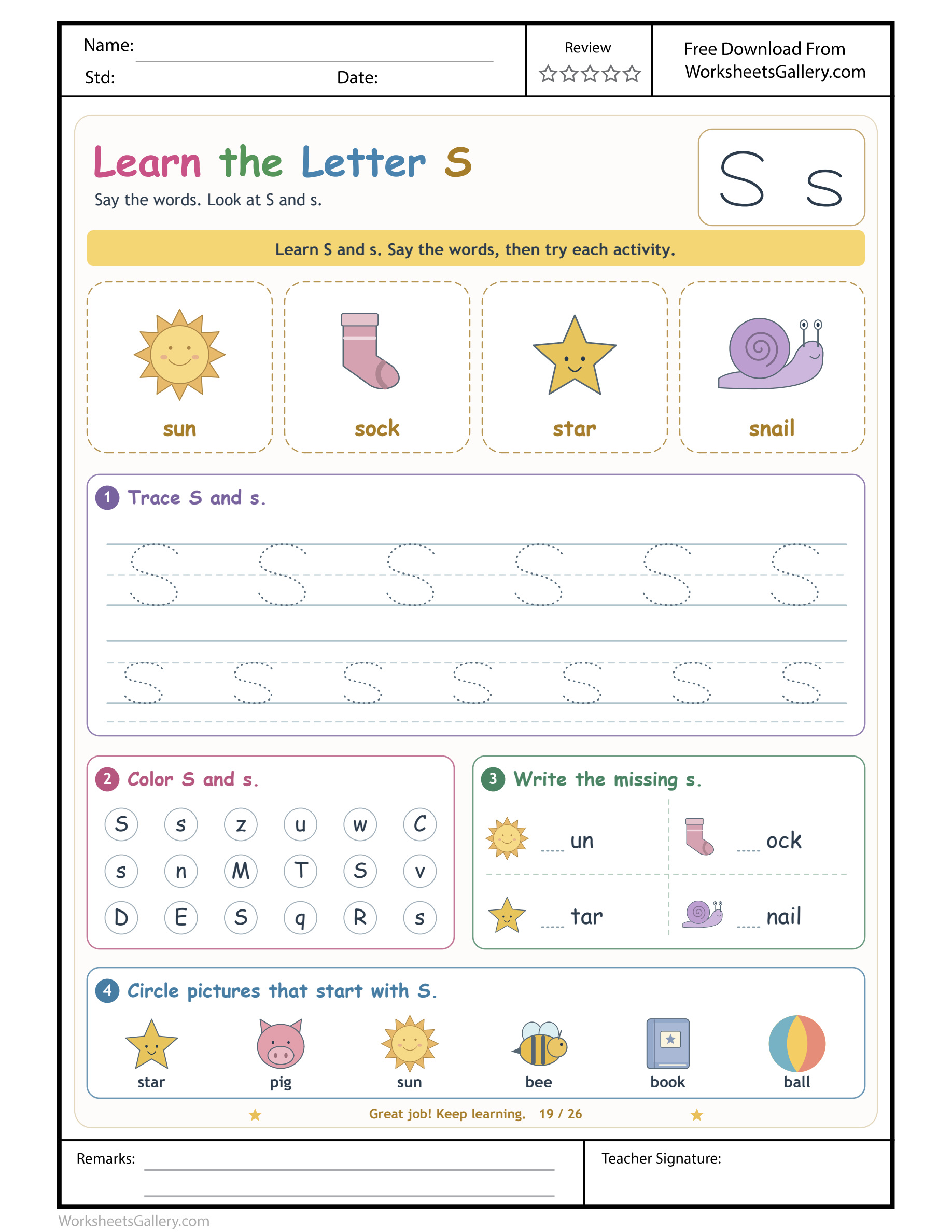
Snail S Selector: Recognise S and s by their curved shape rather than colour, and check star and sun in the picture strip.
Snails suggest a pace that suits close looking: there is time to notice the whole letter before choosing. Snail S Selector connects sun, sock, star and snail with Ss through four numbered activities. Children can inspect the cases, follow dotted guides, repair lowercase beginnings and select picture names. Adult reading keeps the labels accessible while the learner inspects the particular Ss curves. A short, thoughtful comparison can be enough to begin, with pointing or conversation available before writing. Leave the complete bank nearby so a decision can be checked instead of made from memory alone.
Meet four names at a snail's pace — Snail S Selector
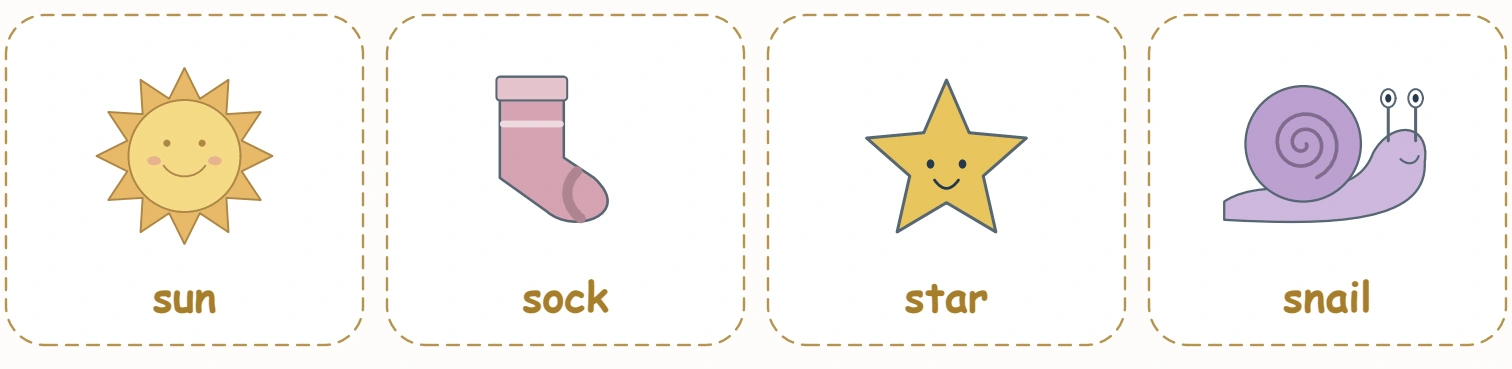
The upper Snail S Selector bank contains sun, sock, star and snail. Read each label, discuss its drawing and find the first s. A learner may know the pictures well while still needing help to connect a spoken word with its written beginning. That support belongs naturally in this activity.
Star and snail include more than a single consonant at the opening in speech. Say them naturally rather than forcing the whole word to sound like an isolated letter. The print comparison stays clear: s is the first written character. Reading every remaining spelling independently is not required.
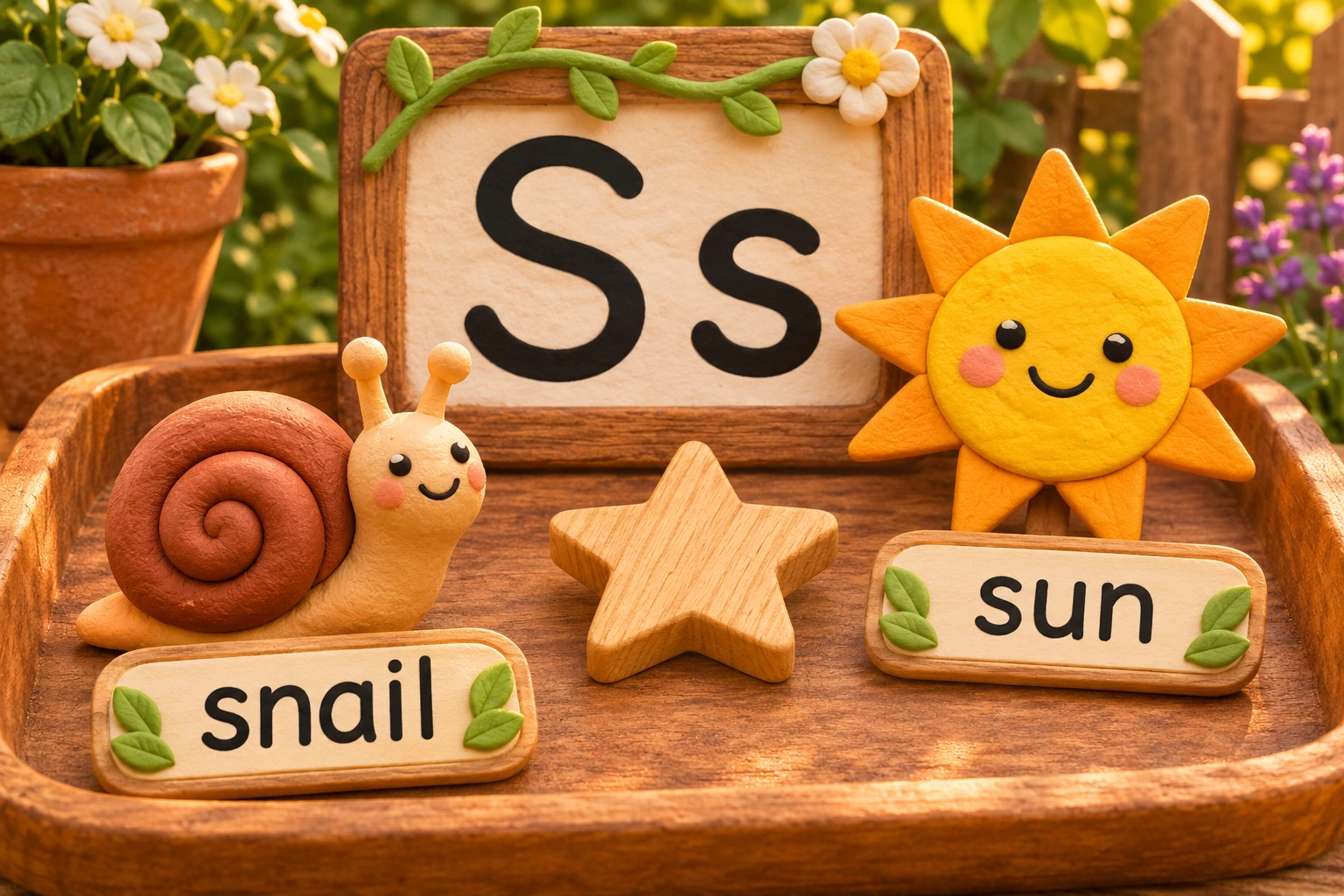
Five possibilities for noticing useful work: Snail S Selector
- Shape orientation. Comparing the supplied S and s can draw attention to the complete curves and their direction.
- Case recognition. Similar-looking large and small forms can be identified under the same letter name.
- Meaningful print. A snail label links a known creature with a visible beginning.
- A bounded movement. A short trace gives the hand a curved model without requiring a whole copied sentence.
- Evidence before a choice. The intact sock label can guide a missing character or a picture decision.
These opportunities in Snail S Selector are not a promise of progress after a fixed number of uses. Observe a particular comparison or explanation. A learner can understand an initial while finding a tiny curved pencil movement difficult, so adapt the physical response without dismissing the understood print connection.
Sana's imaginary garden visitor: Snail S Selector
At a pretend home garden, Sana makes a snail from modelling material and places a paper sun nearby. A grown-up reads both words on Snail S Selector. Sana points to their first letters and chooses one lowercase model to inspect. The slow-moving story gives the pair time to compare rather than rush.
This invented scene shows a possible introduction, not a documented outcome. The adult might write a sentence dictated by Sana about where the snail goes next. One clear letter observation can accompany the story even if the remaining worksheet panels wait for another day.
A reference for four different instructions: Snail S Selector
| Snail S Selector activity | Adult quick check | Source detail |
|---|---|---|
| Trace S/s | 6 S models;7 s models | Snail S Selector guide rows |
| Find Ss cases | 1, 2, 7, 11, 15, 18 | 6 matches in the Ss circle field |
| Complete sun through snail | s | Ss: initial s |
| Picture-name check | star, sun | 2 choices fit Ss |
The Snail S Selector search contains eighteen circles, with positions counted across rows of six. Three capital S and three lowercase s choices fit. Only two picture names match in the final strip. The table supports adult checking, while the learner can approach whichever single panel makes sense at the time.
Inspect curves before making a traced line: Snail S Selector
Six capital S guides and seven lowercase s guides appear on Snail S Selector. Look at a model's full outline, then invite a finger trace or one pencil attempt. An adult can draw a larger example on spare paper if the small curve is difficult to follow comfortably.
No numbered formation arrows appear in the source. Keep any adult demonstration distinct from instructions actually printed on the worksheet. The aim is a useful comparison, not thirteen compulsory marks. A tired hand can switch to pointing or stop, leaving the dotted examples available for a later willing attempt.
Do not let colour replace the search rule: Snail S Selector
The Snail S Selector circle task asks for matching Ss shapes. A favourite colour may make marking pleasant, but the candidate must fit the model before it is coloured. Compare the whole curve and its orientation rather than accepting a letter because one part feels familiar.
One search row can be a manageable amount, with temporary covering paper for the others if helpful. Ask the child to show what supports a choice. The adult can check six matches afterwards; the total should not encourage colouring an uncertain circle to reach an expected number.
Four waiting beginnings use lowercase s: Snail S Selector
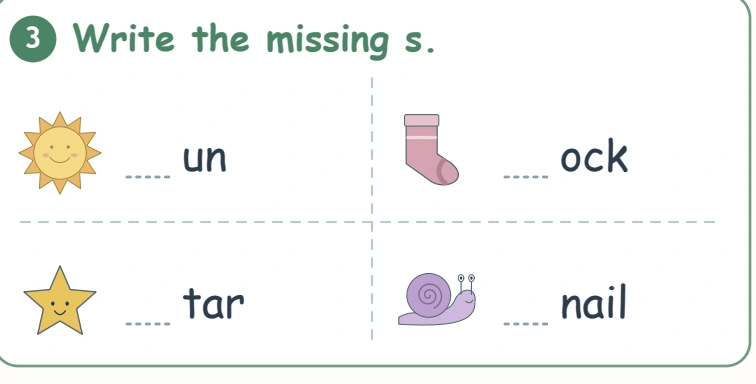
The Snail S Selector fragments un, ock, tar and nail correspond to sun, sock, star and snail. The requested addition is one small s at the start of each. Nail already names something else in ordinary language, which a child may notice. The snail drawing and full reference establish the intended word here.
Read the complete label before making a repair and keep the other letters unchanged. If capital S is proposed, acknowledge the letter name while showing the requested case. A large movable s beside the fragment can make the decision visible before the learner tries the narrower writing space.
Star and sun qualify in the last strip: Snail S Selector
The lower Snail S Selector choices are star, pig, sun, bee, book and ball. Star and sun meet the initial-S direction. Sock and snail are upper-bank examples but do not appear as additional pictures below. Read all six labels so the final decision concerns the actual available names.
A child might connect bee with sun as part of a garden scene. That is a meaningful story connection, but this panel groups by a written initial. Explain the rule before correcting a selection. The learner's other sensible ideas can still be used in play outside the exact worksheet task.

A classroom sky-and-garden discussion: Snail S Selector
For a hypothetical classroom session, a teacher places separate sun, star and snail cards beside Snail S Selector. Pupils describe them, hear their printed names and compare the first characters. The adult can then introduce both case models before children select a response on individual copies.
A pupil may point at a curve, explain a picture selection or write one missing s. Ask how the reference helped, without requiring an identical handwriting amount from the group. This suggested routine offers different participation routes and is not presented as evidence from a trial or a real class's results.
Five extensions that let Ss move beyond the page: Snail S Selector
Give a snail a story label: Snail S Selector
Make a paper snail and display a complete snail card. Invite a dictated sentence about its journey and write it elsewhere. Read the sentence back, keeping the storytelling free to use any characters or places rather than only target-letter words.
Change a sky display's instruction: Snail S Selector
Group sun and star as sky pictures, then compare them with sock under an s heading. Discuss the changed rule. A theme group and a letter group can both make sense, while Snail S Selector's final panel specifically asks for the written beginning.
Repair a large sock name: Snail S Selector
Put an ock fragment next to a complete sock reference and offer a large lowercase s. Moving it into the opening position repeats the same print decision with a broader hand action. Small pencil writing can remain a later choice.
Describe a curve with a finger: Snail S Selector
Show adult-sized S and s cards and invite the learner to trace their outlines in the air. Compare them with the supplied models afterwards. Avoid inventing a numbered route and claiming it appears on the PDF.
Let a star interview a snail: Snail S Selector
Ask what a paper star would like to know about a snail's day. An adult can write and read the question. This adds language play beside the initial-letter work without turning the sheet into a reading test for a new sentence.
Start at the learner's comfortable level: Snail S Selector
Sana’s snail story can accompany Snail S Selector at preschool or kindergarten level, generally near ages three to six with a grown-up available. Familiar picture naming can be accessible before narrow tracing is. Provide a stable surface, a tool the child can manage and larger references when necessary. Let willingness and hand comfort determine the marking amount.
Common mix-ups include reversing a curved form, searching only for capitals, adding uppercase S to a lowercase gap or choosing by a story theme. Show the specific model or instruction needed for the next decision. If frustration grows, use a spoken answer or close the sheet after one useful comparison.
Keep another encounter short enough to enjoy: Snail S Selector
A later Snail S Selector visit might begin with sock after an earlier sun story. One word repair or a single circle row gives a fresh focus without requiring the same full routine. Books, object labels and imaginative play can supply other print experiences between worksheet visits.
Try feedback such as “You checked the entire curve before colouring that choice.” Let the learner select the next interesting picture and stop before fatigue dominates. A partly completed page can preserve a clear discovery, with remaining spaces available as future invitations rather than a debt to finish.
Save the Ss edition for your account: Snail S Selector
Use the free option for the uploaded Learn the Letter Ss original. The clean Snail S Selector PDF sits in the premium member variant and requires active eligible membership. Sun, sock, star and snail activities stay intact after removing promotional advertising, website watermark and domain-name branding.
The complete clean library is offered independently for $5 on its linked page, with twenty-six sheets inside one PDF. Save Snail S Selector through your authorised option and check US Letter sizing before printing. Preserving the source dimensions keeps the curves and gaps at their intended scale. A source close-up supports explanation, while the PDF is the file to send to the printer.
Other places to find playful print ideas: Snail S Selector
Snail S Selector connections: Snail stories can continue beside Ss Letter Safari. The case work in Ss Worksheet gives Ss another setting. For an alphabet-order task after the curved-letter comparison, try Arctic Alphabet Route.
Adults extending Snail S Selector can look at NAEYC's resources for play in family life or the PBS Parents Learn and Grow articles. These independent education sites do not endorse this worksheet or change what its download contains.
Popular Worksheets
Printable resources families and teachers are downloading now.
 Free
 Free
 Free
 Free