
Ss Letter Safari: 3 Delightful Sun-to-Bus Word Finds
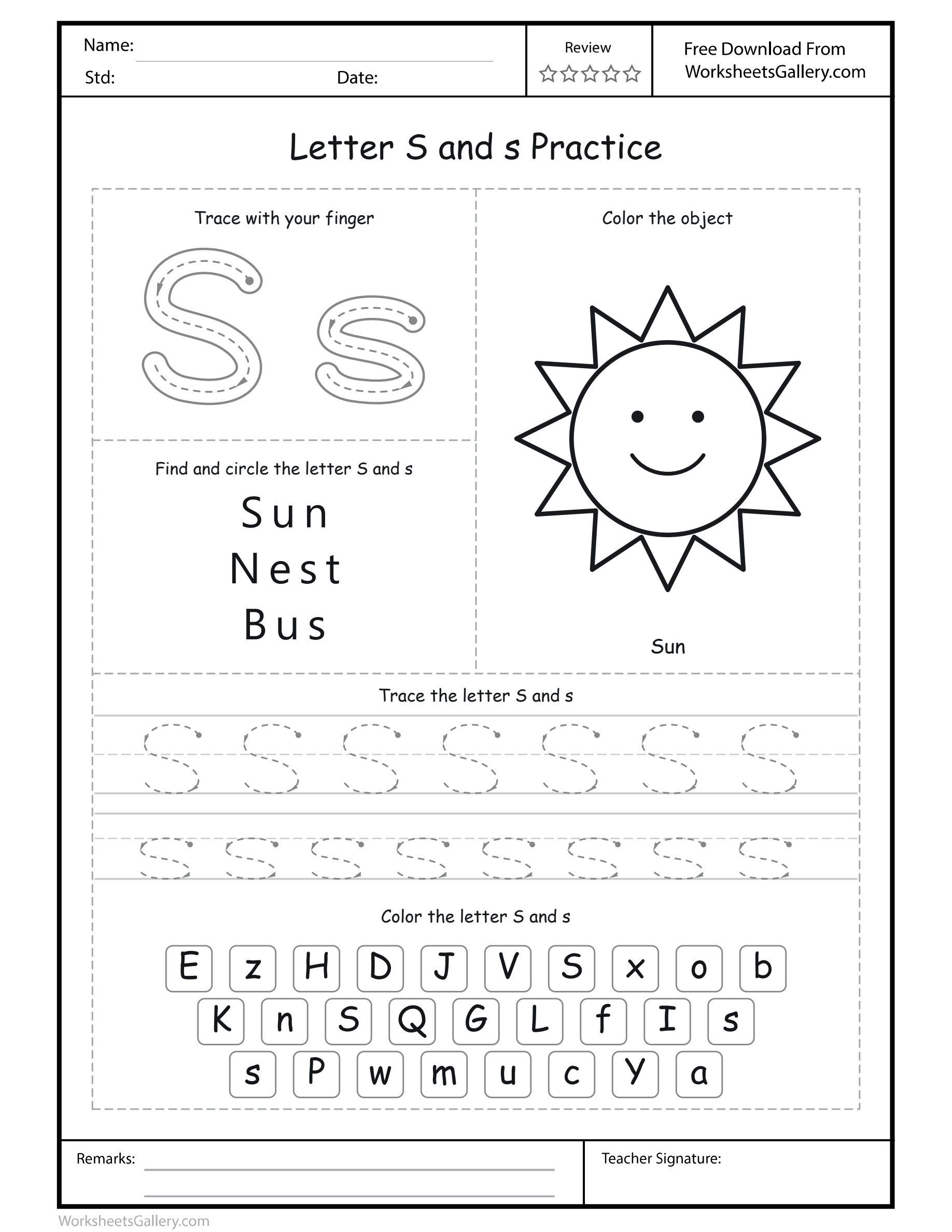
Ss Letter Safari belongs to the 26-page collection. Search for S/s in Sun, Nest and Bus while practising the supplied flowing curves.
Sun, Nest and Bus put one letter family in three different places. Ss Letter Safari begins with the capital S in Sun, then invites a child to find s inside Nest and at the end of Bus. The page also offers flowing models, a sun to colour, small handwriting guides and a field of mixed characters. An adult reads the labels while the learner inspects their print. A thoughtful route through those details can include pointing, conversation and a few chosen traces, with room to revise an answer after another look.
Follow a sunny route through the words — Ss Letter Safari
Read the three search labels on Ss Letter Safari. Sun has S as character one. Nest has s as character three. Bus has s as character three and last. There are three targets in the explicit word panel. Circle each written S or s, preserving the rest of the label so its position remains visible.
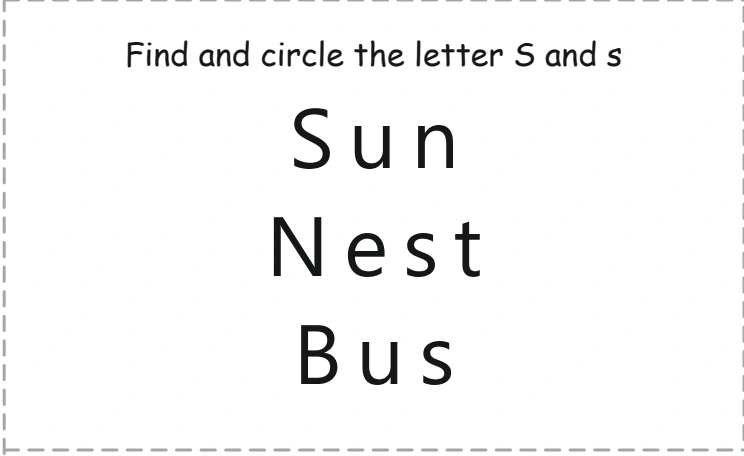
The two three-position references do different work: Nest's s has t after it, while Bus ends at s. Let a finger travel through both labels and notice that contrast. A child can point inside Nest and then to Bus's ending without being expected to read either word independently.
| Label | S/s place | What to notice |
|---|---|---|
| Sun | First | The capital opens the word. |
| Nest | Third | Another character follows s. |
| Bus | Third, at the end | The search reaches its final letter. |
Say “look at the written letter” when introducing Ss Letter Safari. This keeps the task clear if a child wants to identify an object instead. The picture names give meaning; the printed shapes supply the evidence for the circles. A whole-word loop would not show which character was inspected.
Two flowing curves with one identity: Ss Letter Safari
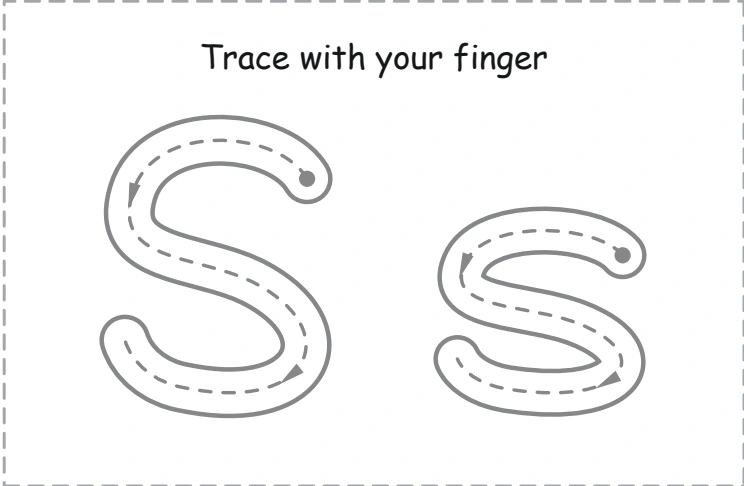
Compare the supplied S and s models. Both use a flowing double curve, with the lowercase form shown at its own proportion. Trace along the printed route with a finger, watching the start mark and arrows. A learner can describe a turn without needing formal curve vocabulary.
For Ss Letter Safari, the movement reference is the actual sheet. Avoid adding a different start direction because another handwriting style is familiar to the adult. Preview the route once, let the child try, and compare one feature. If a curve is reversed, point to the model's opening direction rather than asking for repeated copying with no explanation.
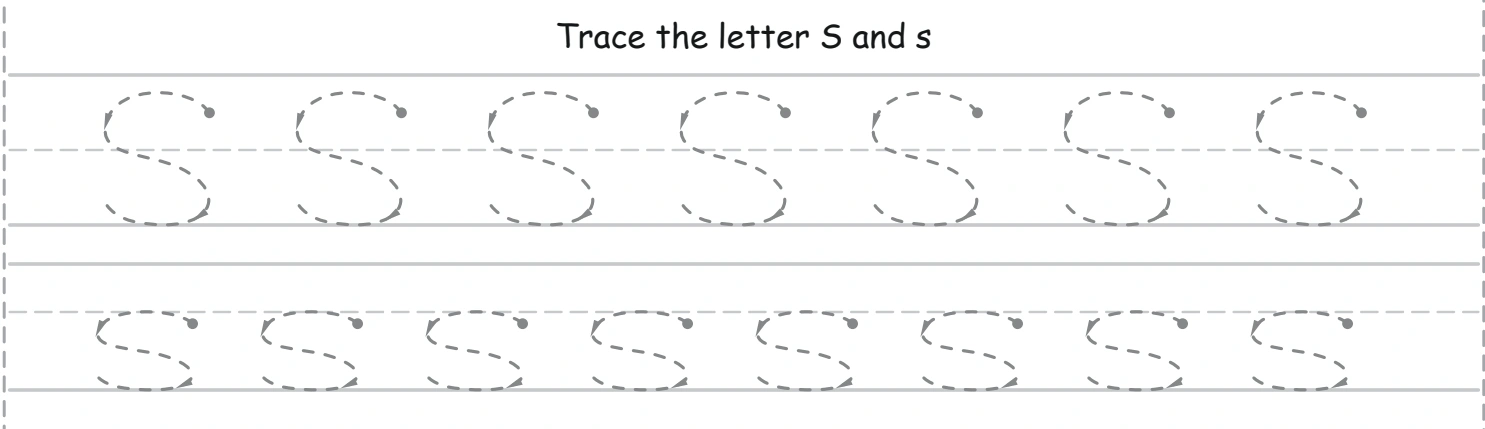
The handwriting section contains seven capital examples and eight lowercase examples. Select a few that suit the child's concentration. A comfortable hand can attend to the curve change more easily than a tired hand pressing hard to finish a row. Finger movement remains an option when small pencil work is demanding.
A bus-stop classroom safari, imagined: Ss Letter Safari
Imagine Suri helping construct a pretend bus stop. The teacher reads completed Sun, Nest and Bus cards and places them near Ss Letter Safari. Suri finds the large opening S in Sun. She then inspects Bus and points to its final s, showing that she has followed the label all the way through.
Nest takes another comparison. The teacher keeps the s model visible while Suri moves past N and e. She finds s, then notices t after it. The adult describes that contrast with Bus: one target has a neighbour after it, and one finishes the word.
This imagined safari is a route through print, not a demand to read a bus timetable. A partner may hold the model while Suri points, then exchange roles. Returning to Ss Letter Safari, the class can choose one guide or a short tile inspection and save the remaining sections for later.
Six discoveries to notice along the route: Ss Letter Safari
A family across positions. The three labels put S/s at an opening, an interior place and an ending. Ss Letter Safari shows that the target's identity does not depend on being first.
Case comparison. Naming S and s together connects the forms. The child can point to the capital and lowercase examples before attempting either with a pencil.
Curve orientation. The models offer visible evidence for the direction of the turns. Looking back at them provides a concrete response to a reversed attempt.
Movement planning. A finger trace previews the double curve. In Ss Letter Safari, this can separate learning the path from the additional control needed for a small pencil mark.
Position language. Inside, after and last describe the contrast between Nest and Bus. An adult can supply those words alongside the learner's pointing gesture.
A reasoned second look. An uncertain choice can be compared with the model and changed. The adult can value the check itself, rather than treating the first response as the only meaningful result.
The sun can have an invented palette: Ss Letter Safari
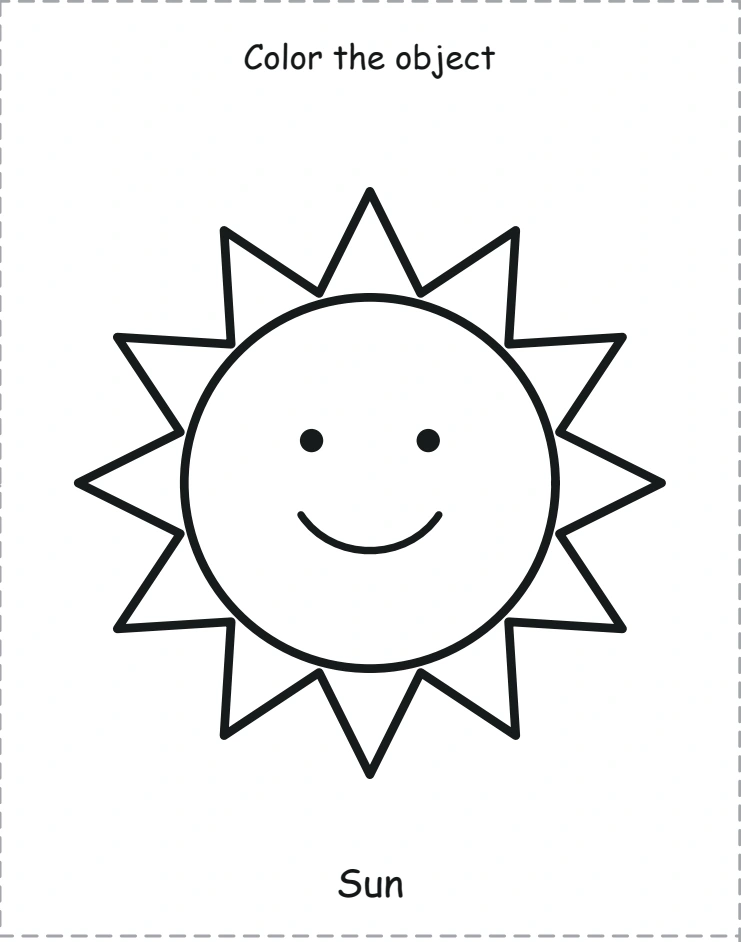
The sun drawing on Ss Letter Safari is a free-colouring opportunity. Ask the child to choose its colours and describe one part of the picture. There is no printed colour rule to solve. An unusual palette is a creative choice rather than a letter-search error.
Read Sun if the learner wants to connect the picture with its label. A brief story about a sunny bus ride can follow on separate paper, with completed adult-written words if requested. Keep that extra story away from the source word panel so the original three targets remain clear.
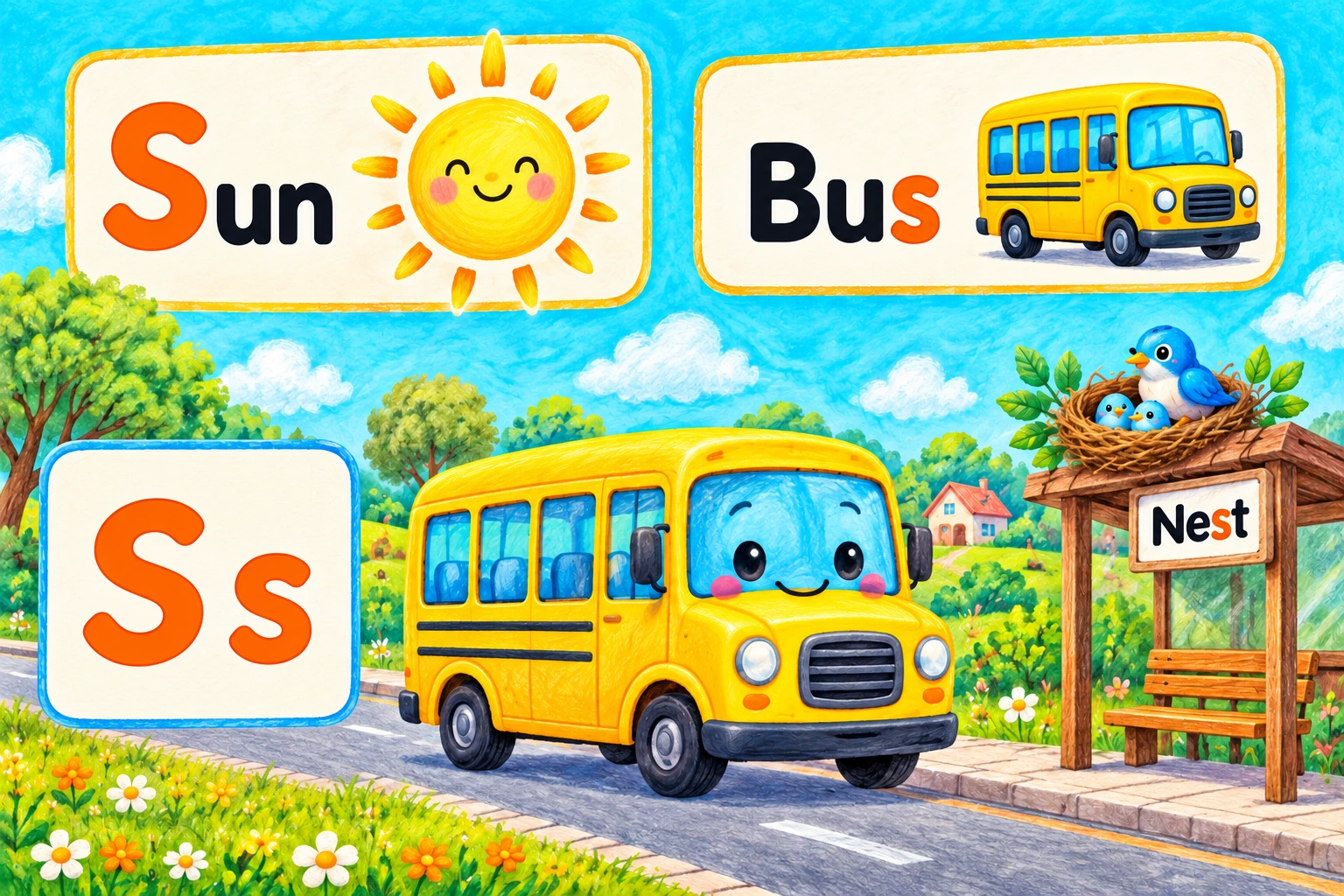
The supporting bus-stop scene presents completed Sun, Nest and Bus labels with the relevant S/s characters highlighted. It gives the changing positions a vivid setting. Compare its highlighted print with Ss Letter Safari, where the child can locate the targets in the ordinary labels without a colour cue.
Inspect four S/s tiles: Ss Letter Safari
The lower field of Ss Letter Safari holds twenty-seven mixed letters. Its top row has ten tiles, its middle row nine, and its bottom row eight. Two capital S forms and two lowercase s forms are the four matches. Adult whole-field checking positions are 7, 13, 19 and 20.
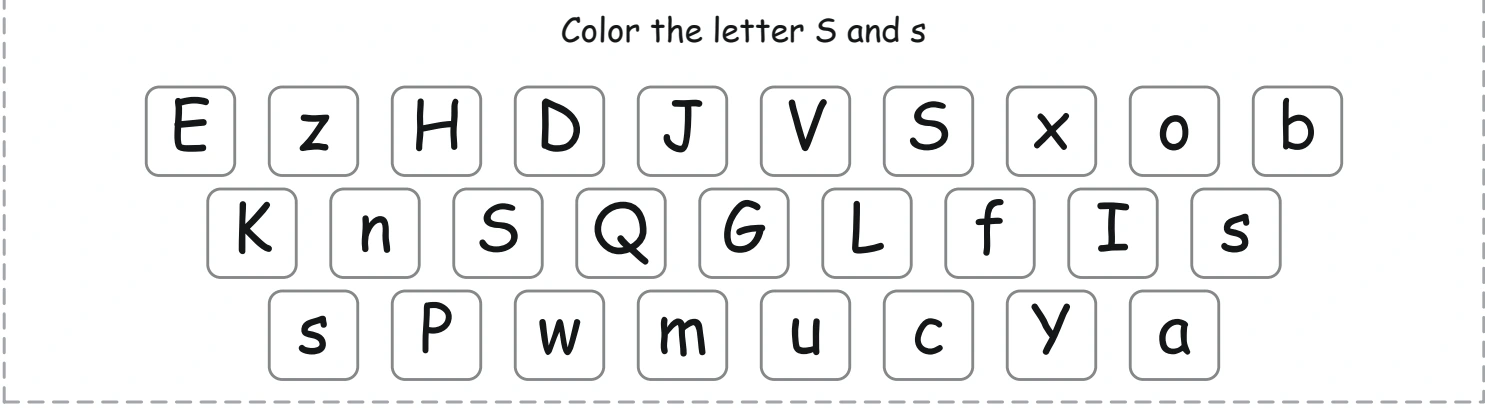
Those coordinates are for the adult checking completeness. The learner can inspect a row at a time with a pointer and the models in sight. A target at a row's edge should not interrupt the transition to the next row. Continue from the following character rather than restarting the entire search after each circle.
Compare both turns of a candidate. A single curve or an upright fragment does not establish the full letter. Ask the child to show the part that seems to fit, then compare the rest. Ss Letter Safari makes a complete outline check available whenever a quick impression leaves uncertainty.
Five safari stops for Ss: Ss Letter Safari
Sun sign arrival: Ss Letter Safari
Read a completed Sun card beside a sun picture. Invite the learner to place the capital model beside the first character, then show the same opening on Ss Letter Safari. The object supplies a familiar meaning while the model supports the print decision.
Bus terminus: Ss Letter Safari
Move a token beneath Bus from left to right and stop at its final s. Read the whole label before moving. This Ss Letter Safari route gives the ending a practical role without introducing independent word reading as a condition.
Nest neighbour: Ss Letter Safari
Read Nest and locate s, then inspect t after it. Compare that position with the end of Bus. A learner can demonstrate the contrast with two gestures, and an adult can add the words inside and last.
Curve storyteller: Ss Letter Safari
Trace the supplied S with a finger, letting a partner narrate its two turns. Exchange roles. Keep the arrows of Ss Letter Safari visible so the playful description follows the printed route.
Row-edge traveller: Ss Letter Safari
Inspect a tile row fully and then check the next row's opening before pausing. Partners can share the pointer and model. The aim in Ss Letter Safari is a continuous search route, with no timer or score for early completion.
A home picture-book bus, imagined: Ss Letter Safari
Picture Suri looking at a bus picture with a family member. The adult writes Bus on a completed card, reads it and sets it beside Ss Letter Safari. Suri points to the ending s. The family member asks whether Nest's target also finishes its word, prompting a comparison rather than a yes-or-no guess from memory.
Suri tracks Nest and notices the t after s. She shows the two positions with a finger. A small explanation can be spoken by the adult if Suri prefers pointing. This imagined exchange makes the return purposeful without requiring a new page of written answers.
They may finish by finger tracing one lowercase model. Another day can begin with the capital or the tile row near an edge. The stable worksheet remains a reference while the starting activity changes, allowing repetition to feel like continuing a familiar exploration.
Adapt the route to the learner: Ss Letter Safari
For children in the approximate three-to-six range, Ss Letter Safari can be used through shared pointing, adult-supported circles or independent inspection. A child may recognise s comfortably but need help making its changing curve. Observe those skills separately and choose a response that lets the letter decision remain visible.
If a whole label is circled, demonstrate a loop around a single character on another example. If Nest is overlooked, track past its opening. If a curve reverses, revisit the supplied model. If a row ends prematurely, place a pointer at the next unexamined tile. A narrow prompt is easier to use than a long list of corrections.
Regular short returns to Ss Letter Safari can begin with a remembered contrast, such as Nest versus Bus. Stop with an observation the child can show. Praise the specific comparison or continuation rather than speed, and leave enough willingness for the next visit to begin comfortably.
Further reading and printable choices: Ss Letter Safari
Compare Ss Letter Safari with Ss Worksheet. A listening follow-up to Ss Letter Safari is First Sound Choices. For Ss Letter Safari, explore Tt Worksheet.
For adults extending playful practice, NAEYC's play resources offer useful background. Families can also explore the literacy collection at PBS Parents for shared language activities. Choose a relevant idea when it fits the child; the printable's instructions remain complete without these optional extensions.
Use the download controls for the original Ss Letter Safari sample. A separate protected clean individual PDF can be downloaded by members with qualifying current access. Before printing, inspect the whole frame and confirm that the small S/s curves remain clear. A comfortable reading scale supports the shape comparisons better than an unnecessarily reduced copy.
A separate $5 Alphabet Wordwork Collection purchase is offered in the premium card. That separately purchased combined PDF contains all twenty-six clean letter worksheets. It provides a full-sequence option alongside membership access to this individual clean file. The collection link remains easy to find when the next plan extends beyond Ss Letter Safari.
Popular Worksheets
Printable resources families and teachers are downloading now.
 Free
 Free
 Free
 Free