
Tt Letter Trail: 4 Brilliant Tree-and-Butterfly Finds
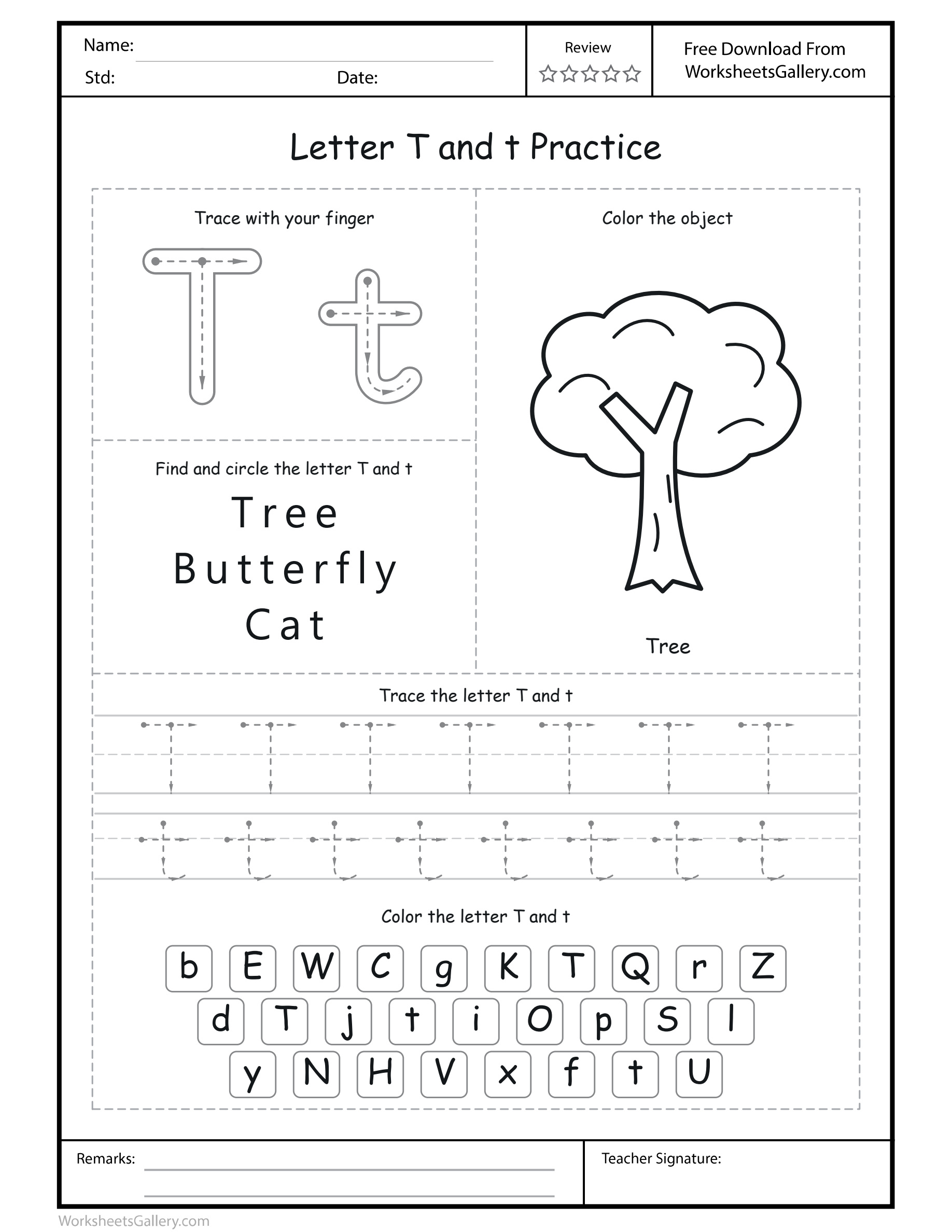
Tt Letter Trail belongs to the 26-page collection. Keep both t letters in Butterfly visible and distinguish the supplied short crossbar from a letter dot.
Butterfly hides two t letters close together near its beginning. Tt Letter Trail gives that pair a place beside Tree's opening capital and Cat's final lowercase target. Children can compare crossbars, follow movement guides, choose tree colours and inspect a mixed-letter field with an adult reading alongside them. The word search rewards checking the character next to a discovery, while the models keep a clear reference nearby. A short visit can combine conversation and selected pencil work, allowing the learner to notice details without racing through every printed opportunity today.
Butterfly's neighbours mark the trail — Tt Letter Trail
Read the explicit search labels on Tt Letter Trail: Tree, Butterfly and Cat. Tree has capital T at position one. Butterfly has lowercase t at positions three and four. Cat ends with t as its third character. These four written targets belong in separate character-sized circles, with the rest of each label left readable.
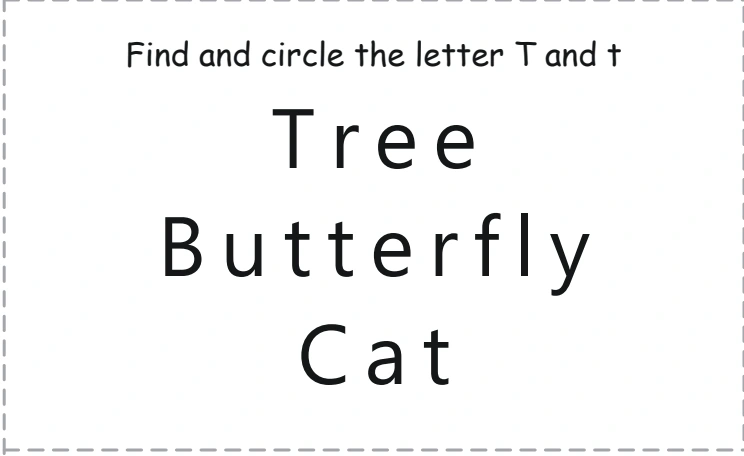
After finding the first t in Butterfly, inspect its neighbour. The second is another target, not merely part of the circle already made. A finger under the print can help the learner keep both characters distinct. Read Butterfly naturally; the doubled spelling does not create a requirement to pronounce two separate t sounds for this visual task.
| Trail label | Target evidence | Adult prompt |
|---|---|---|
| Tree | T first | Where is the broad capital bar? |
| Butterfly | t third and fourth | Does the next character also match? |
| Cat | t last | Keep travelling to the word's end. |
The learner can use Tt Letter Trail before reading these labels independently. An adult supplies the spoken words and the child supplies a print comparison. Pointing is a valid way to show a target when pencil control would make circling uncomfortable or distract from the letter decision.
A wide top bar and a smaller crossbar: Tt Letter Trail
Look closely at the large T/t models on Tt Letter Trail. Capital T has a broad bar at its top. Lowercase t has a smaller crossing stroke. Point to where the bar sits on each form, and notice that the lowercase has a crossbar rather than a separate dot above its stem.
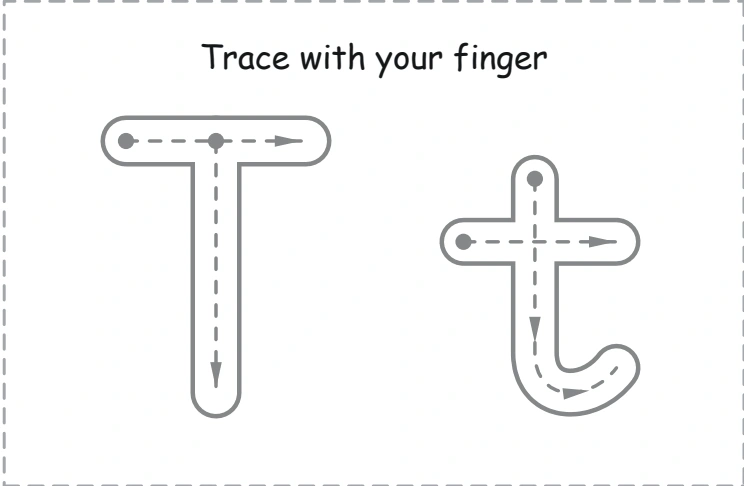
Use the printed T/t arrows to plan a finger journey. The adult may indicate a T/t movement cue and let the learner direct the trace. If t is mistaken for a dotted character, compare the marks directly: the printed crossing stroke joins the stem, while a dot is separate.
Naming both cases together helps connect the family without calling t simply a smaller T. Tt Letter Trail shows a different bar placement and proportion. Let the child describe those features in familiar language, and accept a gesture toward the crossbar as evidence of a useful observation.
An imagined classroom tree trail: Tt Letter Trail
Imagine Tavi helping lay a pretend nature trail across a classroom table. The teacher reads completed Tree and Butterfly cards beside pictures. Tavi matches Tree's initial T with Tt Letter Trail, then notices one t in Butterfly. A partner asks him to inspect the following character before the trail moves onward.
Tavi compares the neighbouring t with the lowercase model and adds it to his findings. The teacher introduces Cat as a final visitor to the trail. Tavi checks through the label to its ending, showing that the target can appear in a different position from Tree's opening.
Back at Tt Letter Trail, the group chooses one T/t tracing opportunity. This imagined setting gives Tt Letter Trail a cooperative route without asking a child to read the long Butterfly label alone. The teacher records the neighbour check and the crossbar observation, both of which can guide a later encounter.
Six useful trail observations: Tt Letter Trail
Checking adjacent print. Butterfly provides a second t beside the first. Tt Letter Trail makes continuing after a discovery a visible, meaningful action rather than an abstract reminder to be careful.
Recognising case relatives. The capital opening and lowercase targets share a name despite different proportions. The child can connect them by pointing before writing either form confidently.
Locating the crossbar. Its place and connection to the stem provide evidence when another upright character seems similar. A specific feature is easier to discuss than a general demand for neatness.
Planning a joined mark. Following the model cues helps preview where movements meet. Finger work on Tt Letter Trail can introduce that relationship before small pencil control becomes the focus.
Talking about positions. First, next and last describe the target locations. An adult can add those words to a child's gestures without requiring a written explanation.
Making a reasoned revision. A missed neighbour can be found through checking. Naming that improved strategy gives the learner ownership of the change instead of simply receiving a corrected answer.
Let the tree have chosen colours: Tt Letter Trail
The tree drawing on Tt Letter Trail has no prescribed colour code. Invite the learner to choose a palette and tell a small story about the tree. A blue trunk or multicoloured leaves can be creative choices, separately from whether the printed letter targets were located accurately.
Read Tree again if the conversation turns to its name. An adult may write a complete story label on separate paper, preserving the original search panel. The picture offers a pause from small print while keeping a familiar object available for language and imaginative talk.
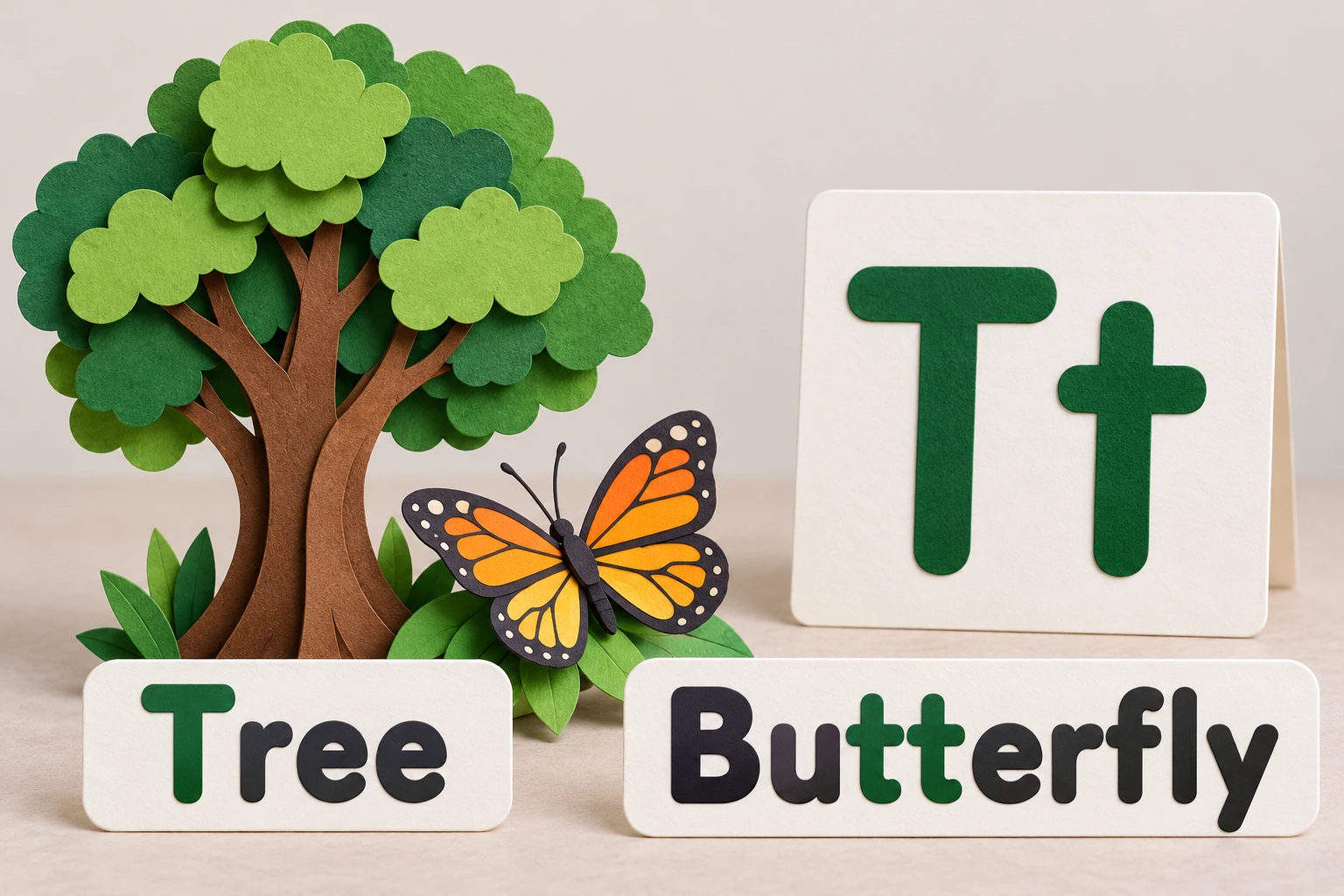
The supporting tree-and-butterfly illustration includes completed labels with both t characters in Butterfly highlighted. It can make the written pair easier to discuss before returning to the ordinary word panel. Use Tt Letter Trail for the exact exercises, while the scene supplies another setting for the same observation.
Fifteen opportunities, one manageable plan: Tt Letter Trail
The tracing area of Tt Letter Trail contains seven T guides together with eight t guides. Choose a small selection after previewing the bar positions. A learner might trace one T and one t, then show where their crossing strokes differ. All fifteen do not need to be completed during the first visit.
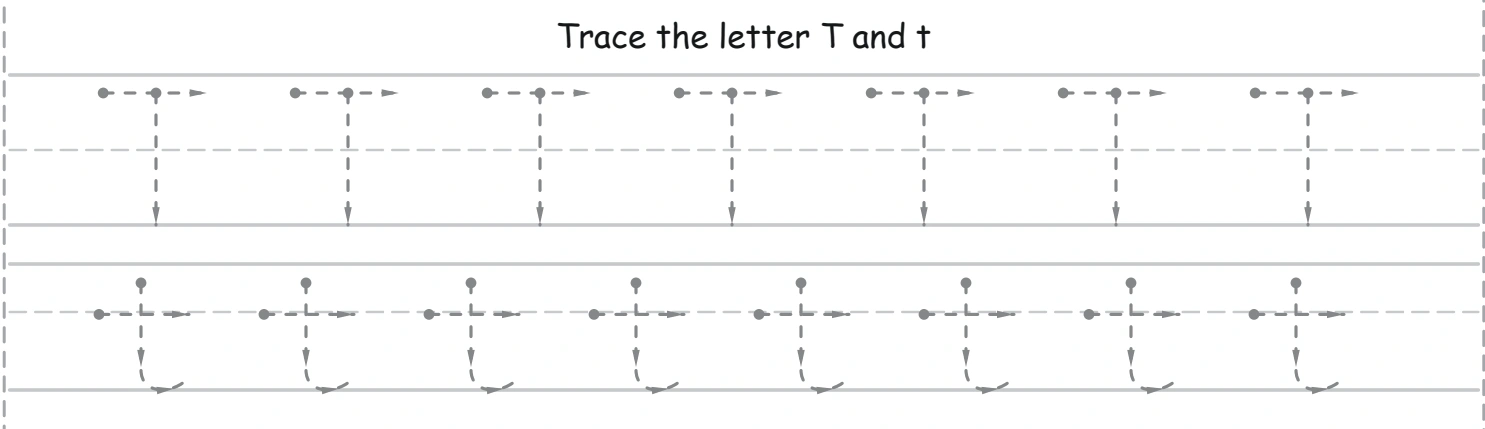
If a bar is missing, compare that attempt with the large model and choose one addition or a fresh guide. If the lowercase mark becomes a separate dot, revisit the connection between bar and stem. Keep the feedback limited to the feature being studied, with comfortable pressure and the paper held steady.
Ask the child which mark shows a useful crossbar. A pointing answer invites review without asking for a judgement about every letter. Tt Letter Trail can then move back to colour or conversation, leaving more handwriting opportunities for another short encounter when the hand is ready.
Four matches along the tile route: Tt Letter Trail
The mixed field in Tt Letter Trail uses twenty-seven characters. There are ten tiles across its first row, nine across its second, and eight across its third. Two T and two t forms are targets. Adult checking can use whole-field positions 7, 12, 14 and 26, while the child searches visually.
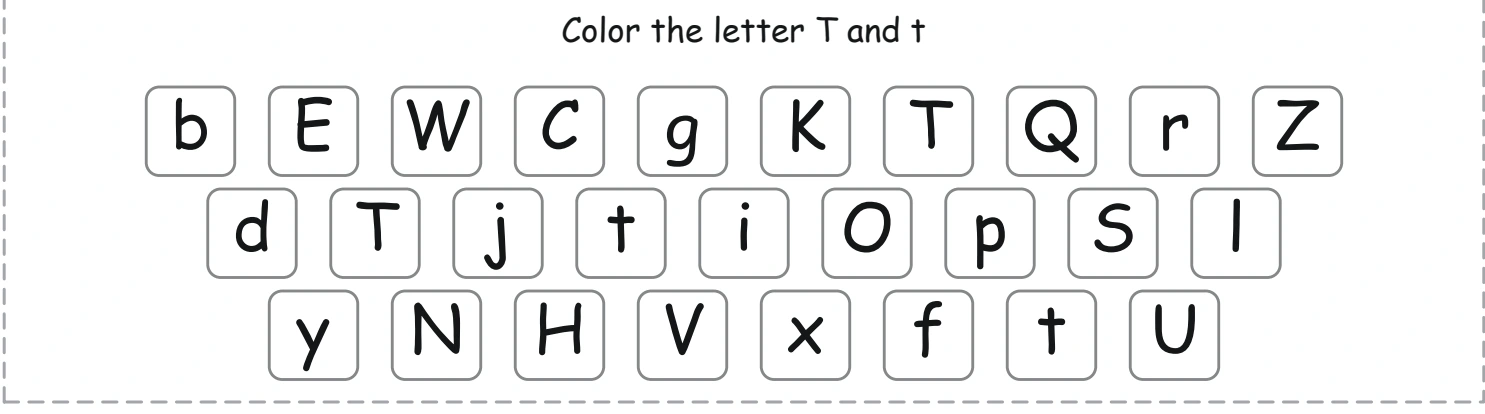
Keep the large pair in sight and inspect a candidate's complete outline. For a lowercase choice, look for the crossing stroke rather than accepting any narrow upright. For the capital, compare the broad top bar. Ask what feature supports the learner's selection and allow time to reconsider it.
The middle row contains more than one target, with a character between them. Continue through that intervening print instead of assuming a found t finishes the row. Tt Letter Trail supports checking the next unexamined tile as a practical routine. A pointer beside that tile can make resuming easier after a glance at the model.
Five ways to revisit the T/t trail: Tt Letter Trail
Butterfly double stop: Tt Letter Trail
Read a completed Butterfly card and touch both t characters separately. Remove the finger cue and locate the pair again in Tt Letter Trail. The game concerns two printed targets, without adding an extra pronunciation rule.
Crossbar workshop: Tt Letter Trail
Build T and t with strips, placing each bar according to the supplied form. Compare the finished constructions with the large models. Clear the strips before tracing so the sheet's movement cues remain the reference.
Cat's finish line: Tt Letter Trail
Track a Cat label from its opening to its final t. A token can stop beneath the ending. Read the whole word first so a learner can join the position game before independent decoding is established.
Tree label guide: Tt Letter Trail
Place a completed Tree card beside a tree picture. Invite the child to introduce its first letter to a partner using Tt Letter Trail as a reference. The explanation may be a gesture toward the broad bar.
Middle-row traveller: Tt Letter Trail
Choose the middle tile row and inspect every character, including the one between its matches. Partners can alternate pointing and comparing. The shared goal is complete coverage rather than beating a timer.
A home cat label, imagined: Tt Letter Trail
Picture Tavi looking at a cat drawing with a family member. The adult writes Cat underneath and reads the completed label. Tavi tracks it to the end and points to t. They compare the small crossbar with the lowercase model on Tt Letter Trail, then look at Tree's different capital bar.
The family member brings back Butterfly and asks what made that label interesting. Tavi touches the adjacent t pair. “You inspected both neighbours” describes his action precisely. This imagined home return may last only a few minutes and need not produce an independently written sentence.
Support the next comparison: Tt Letter Trail
For children approximately three to six, Tt Letter Trail can involve adult reading, shared pointing, assisted circles or independent checking. A learner may know where t occurs yet need help drawing its crossbar. Keep recognition and handwriting observations separate when deciding what support to offer.
If only one Butterfly target is marked, inspect beside it. If the search stops at word beginnings, follow Cat to its end. If a crossbar becomes a dot, compare the joined stroke. If the tile route is interrupted, point to the next unexamined character. Each prompt gives a visible next action.
On another day, begin Tt Letter Trail with the bar comparison or a remembered word position. Regular short visits can make the family familiar while changing the starting task. Stop with a detail the learner can show, leaving enough comfort and interest for the next return.
Print choices and further exploration: Tt Letter Trail
Compare Tt Letter Trail with Tt Worksheet. A listening follow-up to Tt Letter Trail is First Sound Choices. For Tt Letter Trail, explore Uu Worksheet.
Adults can explore play resources from NAEYC for participatory learning ideas. PBS Parents' literacy resources offer other ways for families to explore language around books. These optional links are background for an extension, with no additional tasks required by the printable.
The original Tt Letter Trail sample is available through the page controls. Eligible active members have a separate protected clean individual PDF to download. Inspect the full-page frame before printing and check the small t crossbars at the chosen scale. Keeping those joined marks clear supports the comparisons described here.
The premium collection card offers the $5 Alphabet Wordwork Collection as a separate purchase. It combines twenty-six clean A–Z worksheets into one PDF for a complete sequence of visits. That collection purchase differs from membership access to this individual clean sheet. The card provides a direct route when the next plan extends beyond Tt Letter Trail.
Popular Worksheets
Printable resources families and teachers are downloading now.
 Free
 Free
 Free
 Free