
Starter Corner Copies: 6 Wonderful First Pencil Turns
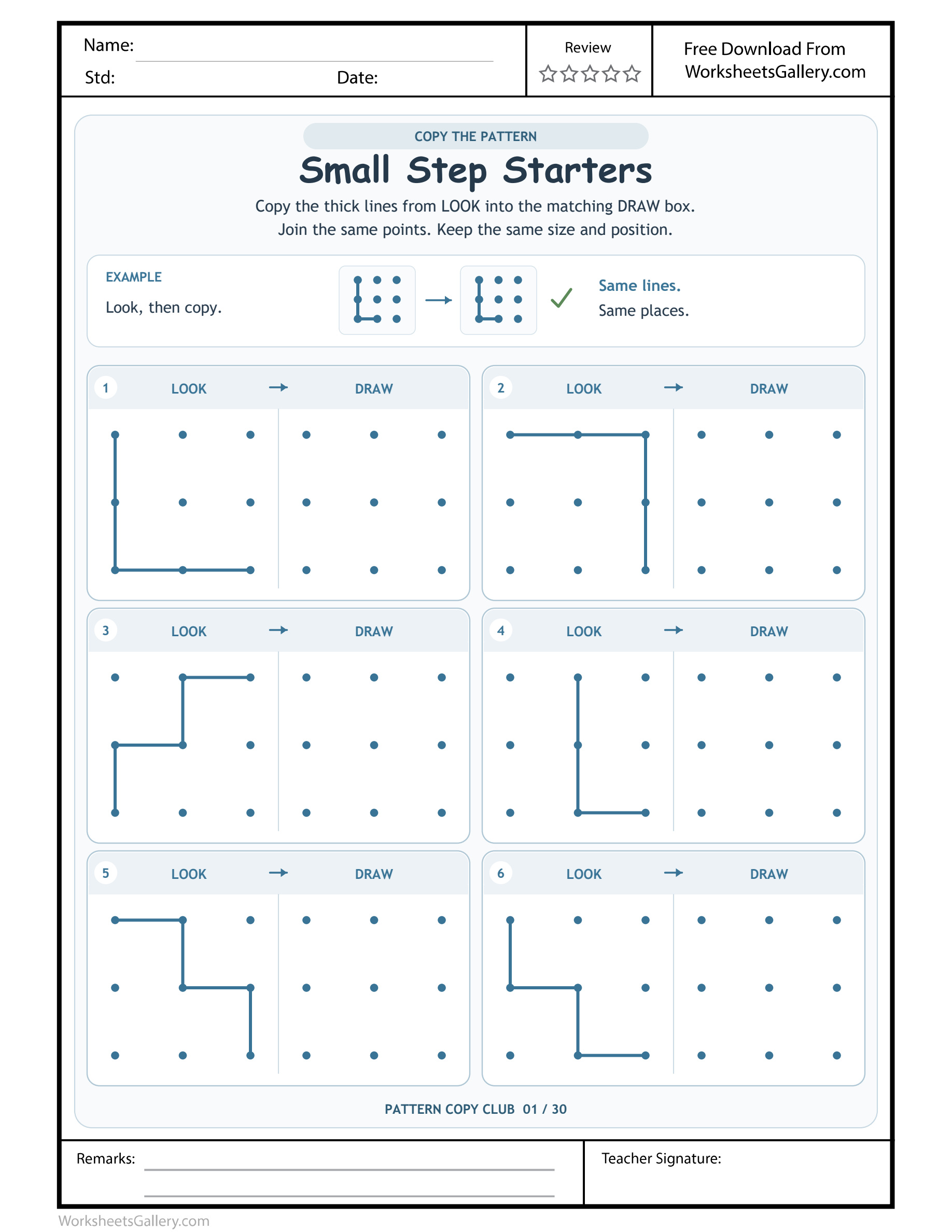
Starter Corner Copies: Transfer small right-angle paths by matching each turn to its row and column.
One small corner can tell you a great deal about a child's drawing plan. In Starter Corner Copies, children inspect short blue paths and copy them onto matching nine-point fields. The designs use horizontal and vertical lines, with an example above six independent practice pairs. Some paths travel around a large L; others change direction through smaller steps. Bring a pencil, a little conversation and permission to pause. This printable activity gives early writers a concrete way to compare where a line begins, how far it travels and exactly where it turns.
Start with a turn you can point to — Starter Corner Copies
The source sheet is titled Small Step Starters. Starter Corner Copies concentrates on transferring a path across matching grids, rather than tracing the blue model itself. LOOK contains the completed path; DRAW holds the corresponding points. A child studies one part, finds its partner position and makes the line there.
For Starter Corner Copies, the size matters as much as the general shape. A large L spans more intervals than the smaller L lower on the page. Drawing two recognisable L shapes is not enough if their corners land in different places. Point to the turn before drawing through it. That short pause makes the spatial decision visible.
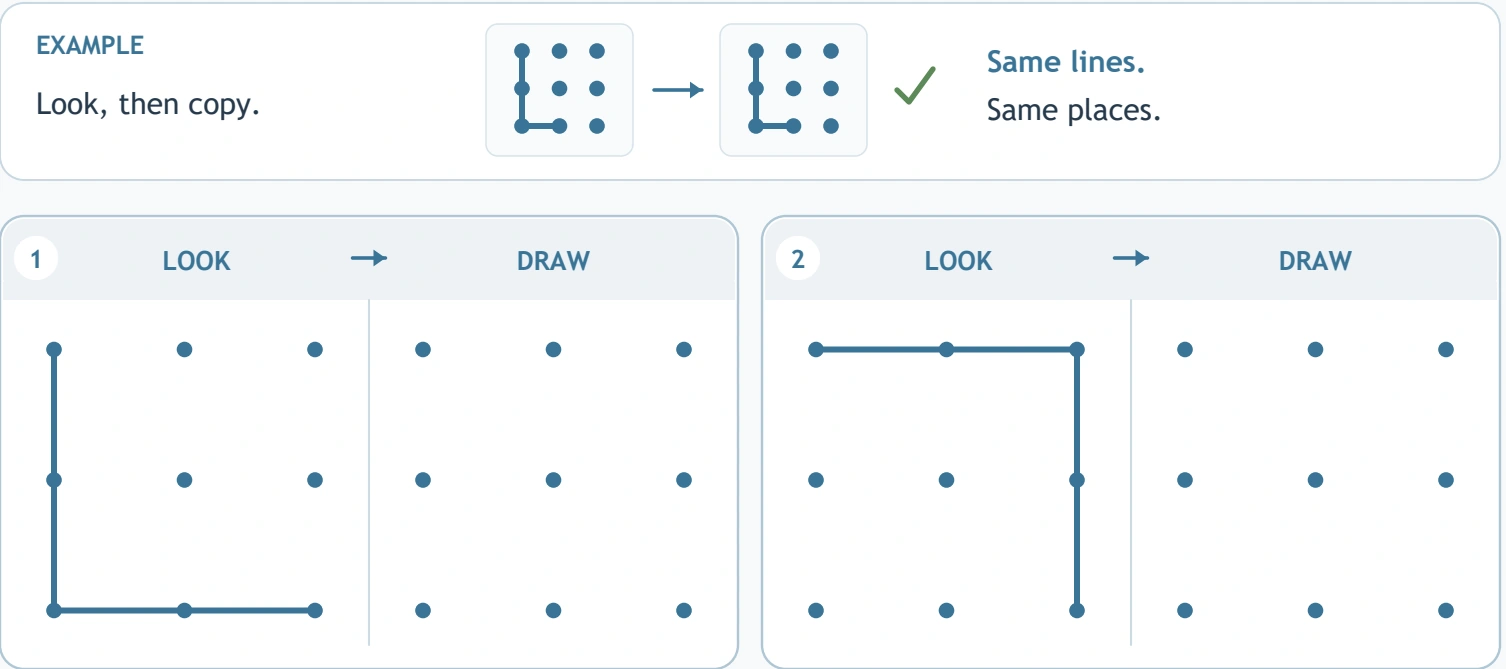
Six paths, with different stopping places: Starter Corner Copies
| Starter Corner Copies pair | Visible Small Step Starters model | Model structure |
|---|---|---|
| 1 | Large l along the left and bottom | 9 anchors / 4 bold pieces in Small Step Starters |
| 2 | Top edge turning down at the right | 9 anchors / 4 bold pieces in Small Step Starters |
| 3 | Three-turn staircase | 9 anchors / 4 bold pieces in Small Step Starters |
| 4 | Smaller l through the centre | 9 anchors / 3 bold pieces in Small Step Starters |
| 5 | Rightward step ending low on the right | 9 anchors / 4 bold pieces in Small Step Starters |
| 6 | Left-hand step returning along the bottom | 9 anchors / 4 bold pieces in Small Step Starters |
The printed segment counts describe the model's little point-to-point pieces, not a required number of pencil lifts. A long straight side may pass through an intermediate dot. On Starter Corner Copies, children can make that side smoothly or pause at the middle point, provided the copied line keeps the same course. There is no need to label the dots with invented numbers.
A comfortable starting level
Offer Starter Corner Copies to interested preschool or kindergarten pupils in the approximate four-to-six age range, with support suited to their pencil experience. Readiness is easier to judge through a short attempt than by expecting everyone of the same age to finish six boxes. Can the child spot the matching top corner? Can the pencil stop near a chosen dot?
A younger learner may build an L with blocks before using Starter Corner Copies. A more experienced child can explain the stair-step paths without adult pointing. Neither approach changes the model into a speed challenge. If the supporting hand slips or the child presses very hard, adjust the seating and reduce the amount of drawing before adding another instruction.
Six useful observations during corner copying: Starter Corner Copies
- Row awareness. The child checks whether the horizontal part belongs at the top, centre or bottom of the point field.
- Column matching. An upright on the left stays on the left when transferred; the page does not request a reflected version.
- Interval judgement. Passing one gap and passing two gaps produce different lengths, even with equally straight strokes.
- Controlled direction changes. A planned corner lets the hand stop and redirect instead of rounding the bend automatically.
- Simple working plans. Describing an upright followed by an across stroke gives the child a small sequence to carry out.
- Friendly self-checking. Comparing the two corners offers a specific repair target, rather than a vague instruction to make everything neater.
Those observations make Starter Corner Copies useful as prewriting practice, while keeping expectations modest. It offers opportunities to coordinate looking, planning and moving; it is not a diagnostic measure of handwriting readiness or a guarantee of later letter formation.
Prepare a small drawing space: Starter Corner Copies
Print Starter Corner Copies at its full page size and place it on a firm table. Supply a comfortable pencil and let the non-drawing hand hold the paper. Explain the LOOK and DRAW labels orally, since children need not read those words independently. Show how the completed example places its upright and lower arm in corresponding positions.
Ask which model the learner wants to try. Choosing the smaller L can be a sensible entry point even though it is not the first box. In Starter Corner Copies, the numbered pairs organise the sheet; they do not impose a compulsory lesson order. Keep an eraser nearby without making repeated erasing the centre of the session.
Copy an L in manageable pieces: Starter Corner Copies
Locate the first endpoint together. Let the child place the pencil there, then identify the corner that ends the upright. Draw toward it and pause. Before continuing across, glance back to see whether the model reaches one interval or two along its lower row. Compare the final point once the arm is complete.
When Starter Corner Copies changes to a stepped path, repeat this part-by-part reasoning at each bend. Looking back repeatedly is allowed. Avoid asking the child to memorise the complete path and then work with the model covered. The task is correspondence, and keeping the reference available supports that purpose.
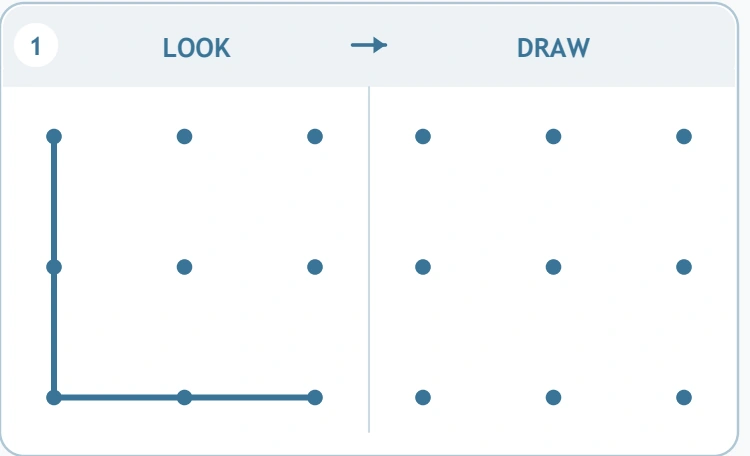
Ada's block road: an imagined home moment: Starter Corner Copies
Imagine Ada building a road from four rectangular blocks. A parent notices its L-shaped turn and offers Starter Corner Copies beside it. Ada draws downward but starts the across stroke at the middle row. Instead of taking the pencil, the parent taps the printed lower corner and asks where its partner sits.
This home scene is illustrative, not a testimonial. The parent can accept Ada's own route on the block mat while helping with the exact paper copy. That distinction keeps play open and Starter Corner Copies precise. After one repaired turn, Ada might park a toy car on the block road and leave the remaining pairs for another afternoon.
A corner station in class: Starter Corner Copies
In an imagined classroom use of Starter Corner Copies, a teacher offers two children separate copies and a tray of long blocks. One child points to a model while the other describes its vertical part; then each draws on their own sheet. Partners discuss positions without drawing answers for one another.
The teacher listens for words such as above, below, left and bottom. If a child only says “there,” the adult can model a fuller phrase while pointing. A quick note about one accurately matched corner is enough. Completing Starter Corner Copies need not become a public comparison of whose six paths look the tidiest.
Five corner games away from the worksheet: Starter Corner Copies
Make a finger-sized pavement: Starter Corner Copies
Arrange paper strips into an L on the table. Move a finger along one strip, stop at the join and change direction. Then compare that physical turn with a chosen Starter Corner Copies model. Keep the strips movable so the child can deliberately create a different route afterward.
Photograph a staircase with your eyes
Build a two-turn step using blocks. Ask the child to describe where the second turn sits before sketching it on spare paper. The blocks remain visible. This game extends the stepping idea without pretending the activity requires photographic memory.
Play the endpoint messenger: Starter Corner Copies
An adult names a location such as lower-left corner on a large homemade nine-point board. The child points to it and gives a new location back. Use Starter Corner Copies as a source of useful positions, but keep the conversation short enough that language does not overwhelm the drawing task.
Open a bend repair shop: Starter Corner Copies
Draw a simple L with its short arm one gap too long. Invite the child to compare it with a block model and suggest a repair. Reverse roles and let the adult be the puzzled customer. The humour can make noticing a difference feel safe.
Curate long and short paths
Place several stick paths side by side. Sort them by the distance between endpoints, then by the number of turns. These are two different sorting rules. A child returning to Starter Corner Copies may notice that a path can have fewer corners but still travel farther.

Keep the turn when the line wobbles: Starter Corner Copies
A shaky line reaching the intended corner can show better spatial understanding than a beautifully straight line heading to the wrong row. In Starter Corner Copies, first discuss the destination, then offer another attempt if the child wants one. Repeatedly tracing over a dark error can obscure which points were intended.
Common mix-ups include copying into the adjacent pair, stopping one dot early, moving a left-side upright to the right, or rounding a corner into a curve. Check the printed model after each small section. Corresponding positions come before decorative neatness. A different starting endpoint can still produce an accurate copy; there is no printed stroke-order arrow to enforce here.
A reason to return tomorrow: Starter Corner Copies
Save a dated Starter Corner Copies attempt and let the learner identify a turn they can explain. On a later day, offer a choice between revisiting that path and trying a staircase. Notice the explanation as well as the mark: naming the lower row can be a useful change even before the pencil becomes steadier.
A few willing minutes are enough. Keep Starter Corner Copies near building materials so it connects naturally with something the child already enjoys. “You found your turning point” is a concrete encouragement. Avoid promises of prizes for finishing every box or treating unfinished pairs as evidence that the child did not try.
Choose the file that suits your access: Starter Corner Copies
The free sample for Starter Corner Copies retains the supplied original. For the clean premium copy, check that your account has qualifying membership in active status, then request the premium file. That member PDF removes the website watermark, domain name and promotional advertising while preserving the practice designs. Guests can use the site's membership options when they want access to the clean variant.
The related thirty-sheet collection is also available as a separate $3 purchase through the package card on this page. After saving the chosen PDF, print on US Letter paper using 100% or Actual Size. Check the page preview so the complete border and lower fields fit before beginning Starter Corner Copies with a child.
Where a small corner can lead: Starter Corner Copies
Compare Starter Corner Copies with Drawing Size Choices. After Small Step Starters, try Shape Border Journeys. For Small Step Starters, consider Path Copy Thinking.
Parents extending Starter Corner Copies into hands-on play can browse NAEYC's play guidance for families. For a wider range of everyday learning invitations, visit PBS Parents Learn and Grow. Both links lead to educational organisations; their material is separate from this worksheet download.
Popular Worksheets
Printable resources families and teachers are downloading now.
 Free
 Free
 Free
 Free