
Zigzag Grid Matching: 6 Brilliant Bends to Recreate
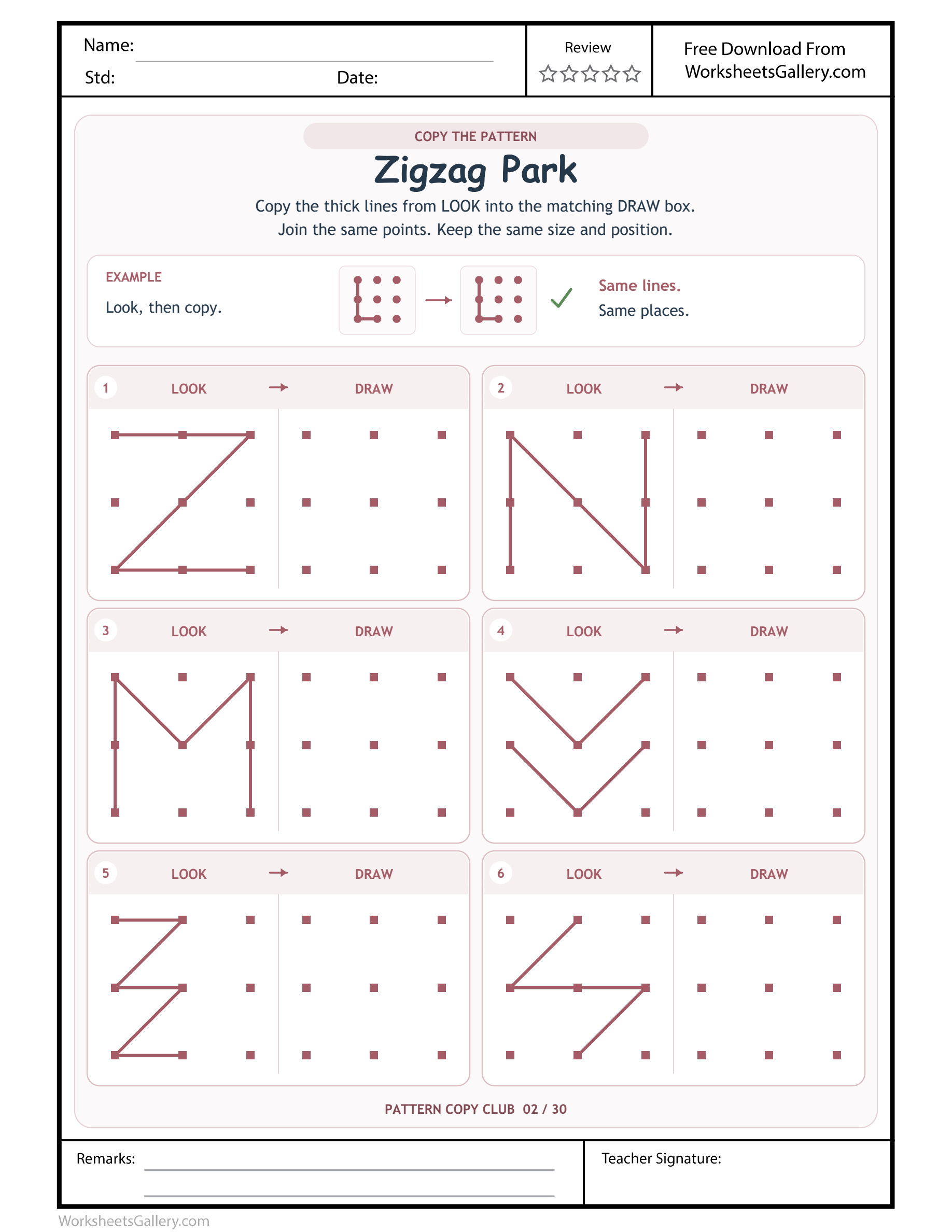
Zigzag Grid Matching: Preserve a zigzag valley and its diagonal endpoints without adding extra corners.
Slopes invite the pencil to change its mind. Zigzag Grid Matching turns that movement into a careful matching task: children examine a pink angular model and reproduce it beside the same nine square markers. Six designs include broad zigzags, a central valley, separate V shapes and shorter stepped slants. A completed demonstration sits above the practice area. Rather than making the fastest zigzag, the learner decides which points belong at each bend. Use this printable when a child is ready to combine looking across a grid with drawing a deliberate diagonal line.
Where does the valley actually sit? — Zigzag Grid Matching
On the Zigzag Park source sheet, a diagonal is a connection between chosen markers. It is not a loose wavy motion or permission to bounce between every available point. Zigzag Grid Matching invites the child to inspect a model's highest and lowest parts before copying its slopes.
The third model resembles an M, with long outer uprights and a valley at the centre. The fourth separates two V-shaped components. These differences make Zigzag Grid Matching more than six repetitions of one gesture. Ask whether the pencil must lift between components, and let the printed lines settle the answer.
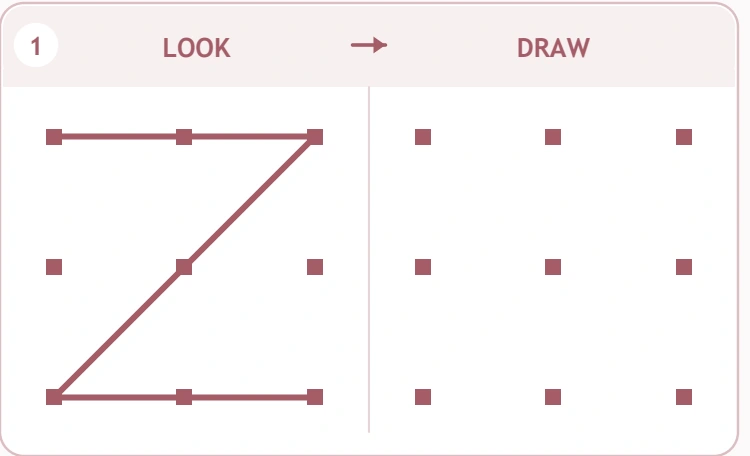
Read the park's six line arrangements
| Zigzag Grid Matching pair | Visible Zigzag Park model | Model structure |
|---|---|---|
| 1 | Wide z with a middle crossing point | 9 anchors / 6 bold pieces in Zigzag Park |
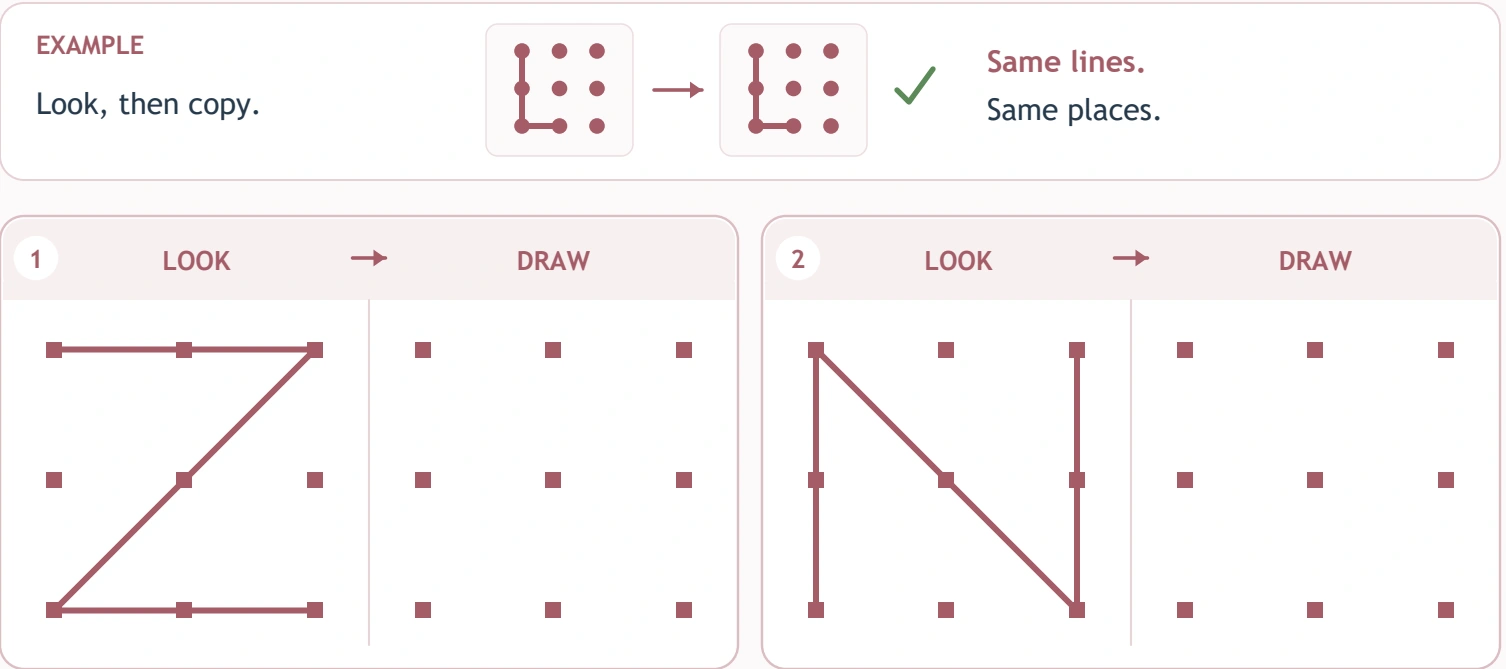
| 2 | N between two uprights | 9 anchors / 6 bold pieces in Zigzag Park |
| 3 | M with a central valley | 9 anchors / 6 bold pieces in Zigzag Park |
| 4 | Two separate v shapes | 9 anchors / 4 bold pieces in Zigzag Park |
| 5 | Compact doubled zigzag | 9 anchors / 5 bold pieces in Zigzag Park |
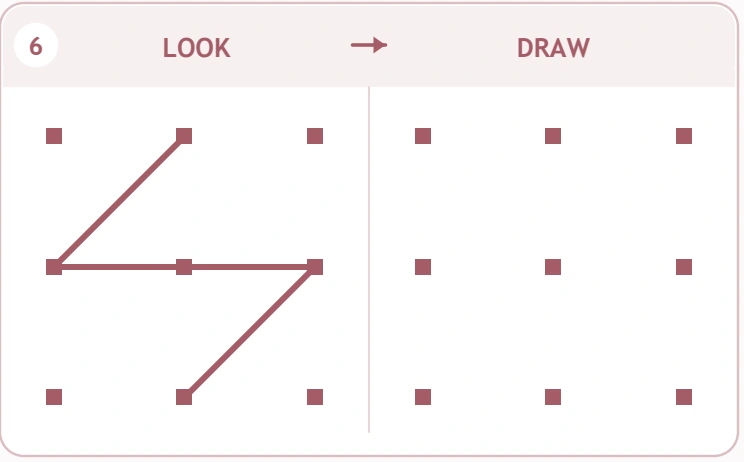
| 6 | Horizontal middle bridge between slants | 9 anchors / 4 bold pieces in Zigzag Park |
The table counts bold point-to-point segments. Children are not being asked to recite those totals while drawing. In Zigzag Grid Matching, several short segments can lie along one straight course, so the count is an adult reference rather than a rule for how often the hand must stop. Keep attention on matching the design's actual bends and open ends.
Who may enjoy this kind of slope work?: Zigzag Grid Matching
Try Zigzag Grid Matching with young learners between approximately four and seven who can attempt short slanted strokes without discomfort. A learner who enjoys building ramps may be interested before they can explain the word diagonal. Adults can supply that vocabulary naturally while the child points.
Choose just one design at first. If the child loses the starting location while looking from LOOK to DRAW, return to the completed example or use a simpler corner path. Zigzag Grid Matching should provide an attainable comparison, not expose a child to six increasingly frustrating guesses. Readiness can vary from one afternoon to another.
Let the example explain the transfer: Zigzag Grid Matching
The small worked example uses an L rather than a miniature copy of the first zigzag. Show that its two point fields agree: the upright and lower arm appear in matching locations. Then explain that the practice models on Zigzag Grid Matching ask for that same correspondence using different line shapes.
Keep the paper upright and flat. Set a pencil where it will not cover the next model, and read the instruction aloud. Let the child identify the LOOK side of one pair and its DRAW partner. The right-hand field is not a mirror: left and right positions retain their identities when the model is copied.
A three-part plan for a diagonal: Zigzag Grid Matching
First, select a starting marker on the model and locate the matching square in DRAW. Second, identify the next endpoint before moving. Third, make the slanted connection and compare its landing. This small plan is easier to use in Zigzag Grid Matching than trying to hold an entire angular picture in mind.
At a bend, ask what the next stroke does: climb, descend or travel level? If the model has a long slant through the middle point, the copied stroke should follow that same straight alignment. Do not insert an extra elbow simply because the pencil passes a marker. Zigzag Grid Matching distinguishes an intermediate point from a true change of direction.
What careful zigzags make visible
- Visual direction. Rising and falling strokes look different, and the learner must preserve that difference across the paired fields.
- Corner placement. Finding a valley at the centre requires a more precise decision than drawing a general up-and-down line.
- Boundary awareness. The outer uprights stop at specific rows; they do not extend to the panel border.
- Eye-hand timing. Looking ahead to the destination gives the hand a useful target for the next movement.
- Component separation. Two disconnected V shapes call for a pencil lift rather than an invented joining stroke.
- Spoken explanation. Describing a slope's landing lets an adult hear how the child interprets the model.
These practice opportunities in Zigzag Grid Matching can support conversations about planning and comparison. They do not require a child to know formal angle measures, and a successful attempt does not depend on ruler-straight lines. The relationship between endpoints is the central evidence.
Benji's ramp inspection, imagined at home: Zigzag Grid Matching
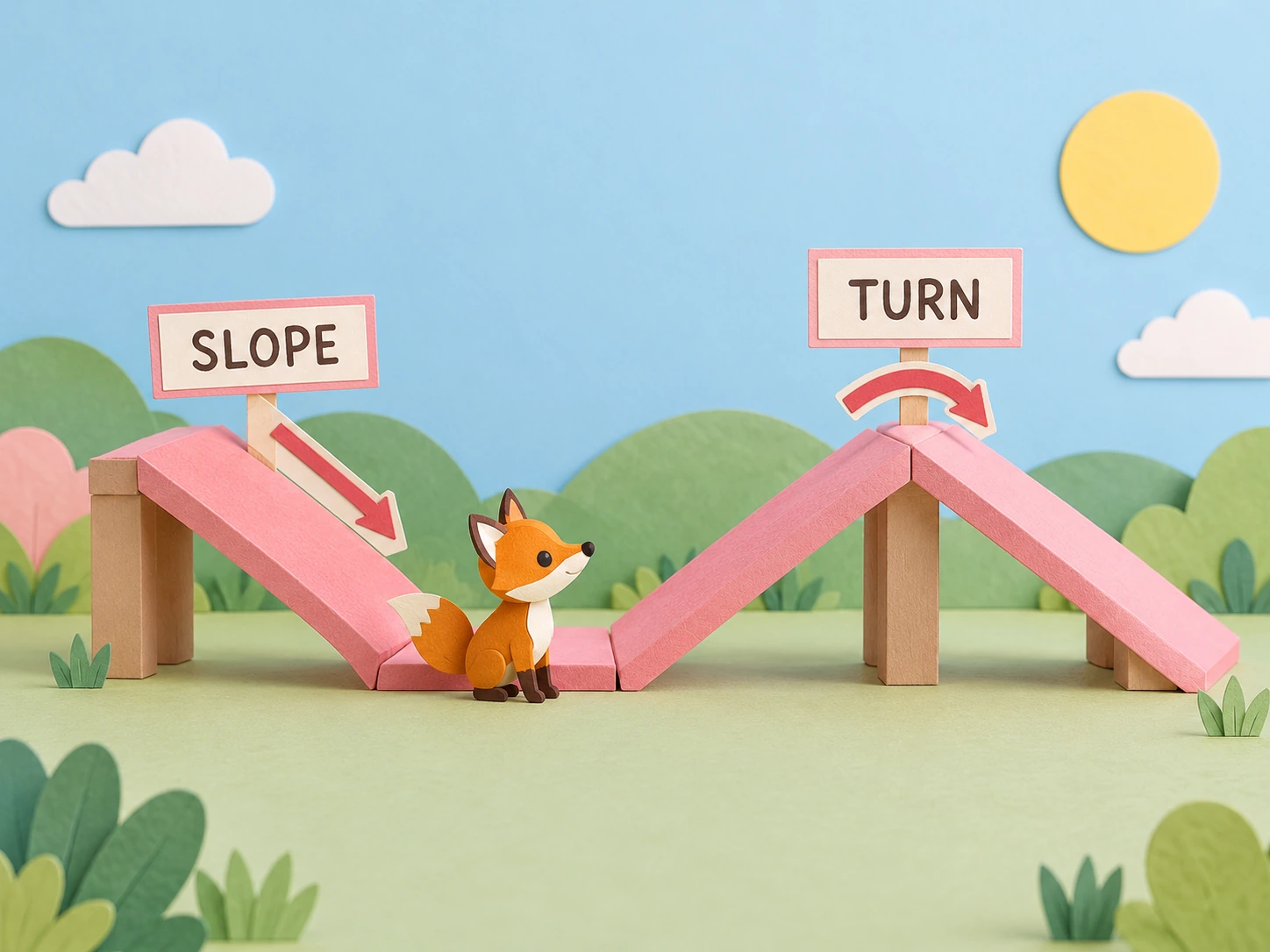
Picture Benji sending a toy fox over folded-paper ramps. An adult offers Zigzag Grid Matching and points to the M-like model. Benji calls the centre a dip. Before drawing, they locate that dip's partner square and compare it with the two high outside points.
This invented home example illustrates a possible conversation, not an observed learning result. The adult can say, “Your dip reached the middle square,” without demanding the next five designs. If Benji adds a story about the fox resting there, keep the storytelling beside the paper task rather than adding extra lines to the exact copy.
A class can compare routes without ranking children: Zigzag Grid Matching
For an imagined class session, put Zigzag Grid Matching at a small drawing table with one pencil per learner. Invite children to choose a model that contains a valley or an upright. Ask them to show a partner the matching endpoint before drawing. They can use different models while practising the same observation habit.
An adult might record whether a child distinguished two separate V shapes from a joined zigzag. That note gives a clearer next step than “needs more practice.” During Zigzag Grid Matching, one learner may finish a whole pair while another draws only its first two slants; the amount can differ without changing the lesson's purpose.
Give the pencil a rest with five park games: Zigzag Grid Matching
Build a ramp-and-valley sculpture: Zigzag Grid Matching
Fold broad paper strips into a few slopes and stand them on a table. Describe the highest join and lowest valley. Relate one feature to Zigzag Grid Matching, then let the child reshape the sculpture freely. Physical construction offers a larger version of changing direction.
Conduct a slope orchestra
Use an arm movement for rising and another for falling. A partner names a short two-movement phrase and the child performs it. Keep the motions slow. This is a movement extension; it does not add an unseen stroke order to the worksheet models.
Search for a real zigzag: Zigzag Grid Matching
Look at a folded fan, a staircase silhouette or a patterned fabric. Decide which examples have sharp corners and which are merely wavy. A quick sketch on separate paper can carry the observation back toward Zigzag Grid Matching without requiring a perfect object drawing.
Help a fox choose a resting place
Make a simple paper mountain path and place a toy at a valley. Ask the child to describe its location relative to the peaks. Move the toy and exchange roles. Position words become part of a short playful story rather than a vocabulary quiz.
Invent two disconnected tracks
Arrange two V shapes from sticks with a clear gap between them. A partner copies the arrangement using another set. Compare the gap as carefully as the shapes. The extension supports the component distinction found in Zigzag Grid Matching while leaving the source models unchanged.
Troubleshoot a flattened or stretched design: Zigzag Grid Matching
A common Zigzag Grid Matching mistake is lowering the valley too far, making a narrow V into a deep one. Another is shortening an outside upright because the child focuses only on the central diagonals. Compare one endpoint at a time, beginning with the point that most clearly differs.
Avoid rotating the sheet repeatedly until a preferred line becomes easier. A small comfortable page adjustment is fine, but first establish how the finished design should face. Preserve the model's direction and span. If a slope is curved, ask whether its endpoints match before asking for a second attempt at a straighter connection.
Encouragement that names a decision: Zigzag Grid Matching
With Zigzag Grid Matching, “You checked whether those Vs touch” recognises a useful act of inspection. “Perfect!” does not tell the child what they did. Be especially calm when a child spots their own mismatch. They have noticed something worth discussing, even if they would rather try the repair another day.
A pause at the valley can be part of the plan. Return to Zigzag Grid Matching after a brief construction game or at another quiet time. Keep the earlier attempt if the child wants to compare it, and let the next goal be one matched slope rather than a whole completed sheet.
Print and download choices for the park: Zigzag Grid Matching
Use the free control for the original Zigzag Park sample. An eligible member can sign in and choose Zigzag Grid Matching's clean premium file, whose printable pages contain no website watermark, domain lettering or promotional ads. The sample and member edition are separate file choices; an image preview is not the downloadable PDF.
For families wanting the wider series, the native package card opens the thirty-page $3 collection. Save the authorised file before printing, select US Letter and inspect the printer preview at Actual Size or 100%. Keep the square markers large enough to compare comfortably. Then choose one Zigzag Grid Matching model and begin with a spoken landing point.
Beyond today's slants: Zigzag Grid Matching
Compare Zigzag Grid Matching with Path Copy Thinking. After Zigzag Park, try Drawing Size Choices. For Zigzag Park, consider Shape Border Journeys.
For broader play-based ideas alongside Zigzag Grid Matching, explore family play articles from NAEYC. Another adult planning resource is the PBS Parents learning library, which includes everyday activities beyond worksheets. These outside resources are optional companions rather than part of the purchased set.
Popular Worksheets
Printable resources families and teachers are downloading now.
 Free
 Free
 Free
 Free